Y Combinator's New Chinese-American President: How Should Startups Find and Hire Designers?
TechFlow Selected TechFlow Selected
Y Combinator's New Chinese-American President: How Should Startups Find and Hire Designers?
Sometimes controversy isn't a bad thing; it can bring you business opportunities.
 Navigating Web3 tides with focused insights
Compiled by TechFlow
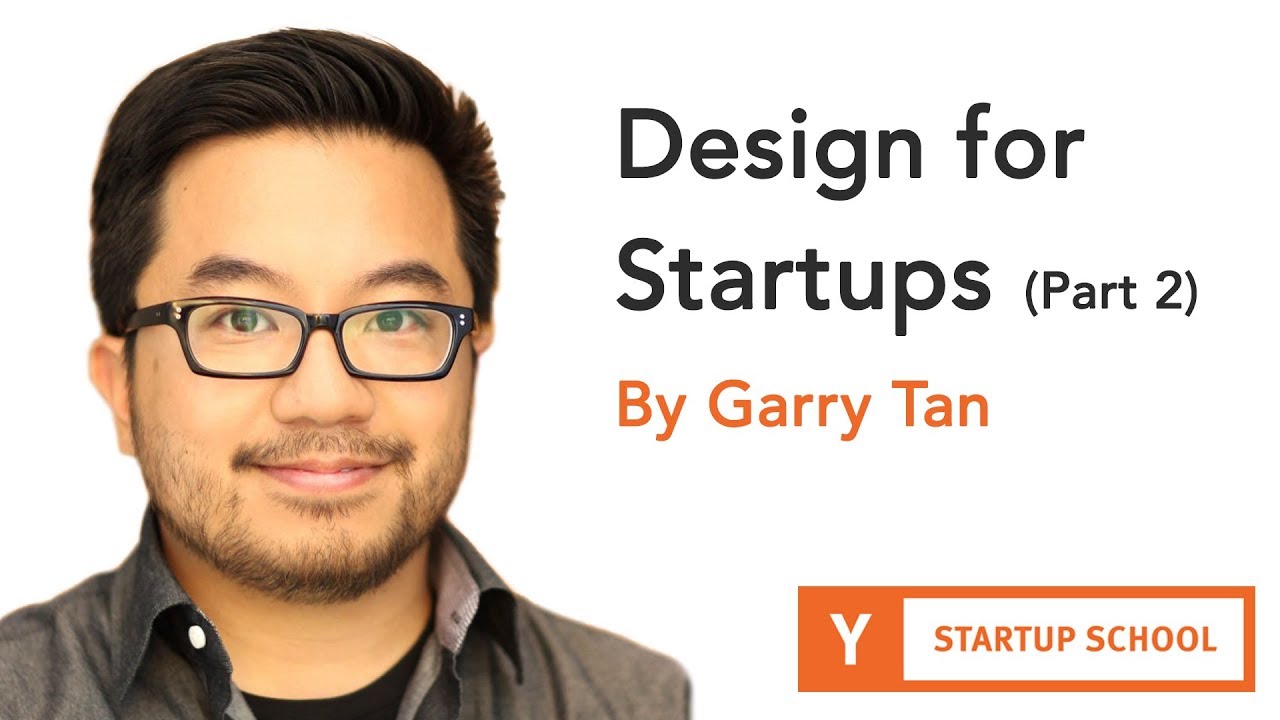
Note: This article is included in the TechFlow special series "YC Startup Course Chinese Notes" (updated daily), dedicated to collecting and organizing Chinese versions of YC courses. The ninth installment features the online course "Design for Startups Part 2" by Garry Tan, the new Chinese-American President of YC.
Garry Tan, a well-known Silicon Valley venture investor, officially became the new President and CEO of Y Combinator in January 2023, making him the first and currently only Chinese-American to hold this position.
In addition, Garry has been listed on Forbes' Midas List (the global ranking of top venture investors) for four consecutive years and previously achieved over 6,000x returns from his investment in Coinbase.
When and How to Find a Designer?
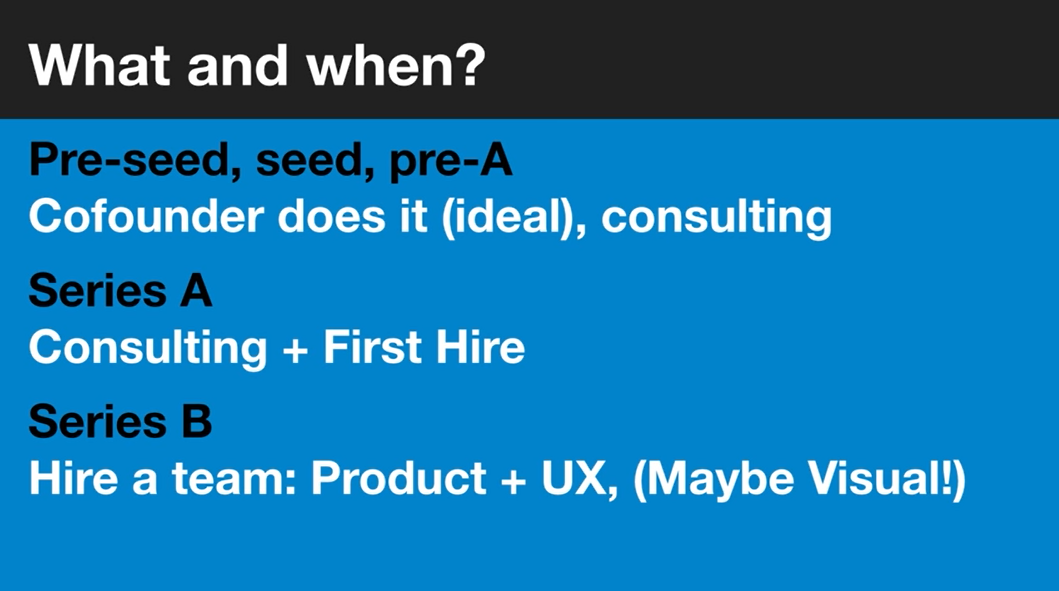
Below is a highly practical guide on how to find and select designers.
Although there are many ways to answer when and how to find and choose a designer, we are frequently asked this fundamental question.
During Series A funding, unless your company has no user-facing components at all, it’s advisable to have a co-founder who manages the company and may also take on the role of product manager. Even developer APIs require a dedicated API designer to ensure a strong developer experience—an essential factor for technical products, as it can make or break success.
By Series B, especially when building an engineering team of 10 to 15 people, you should start thinking about hiring a design team rather than just individual designers.
When searching for designers, you can explore various avenues such as online platforms listing designers, LinkedIn, or companies known for excellent design. AIGA even offers a small database of member designers. For full-time hires or contract roles, schools like CMU, HCI, NYU, MIT, Parsons, and Stanford are great sources—though note that many outstanding designers never attended formal design schools.
Finding Consultants
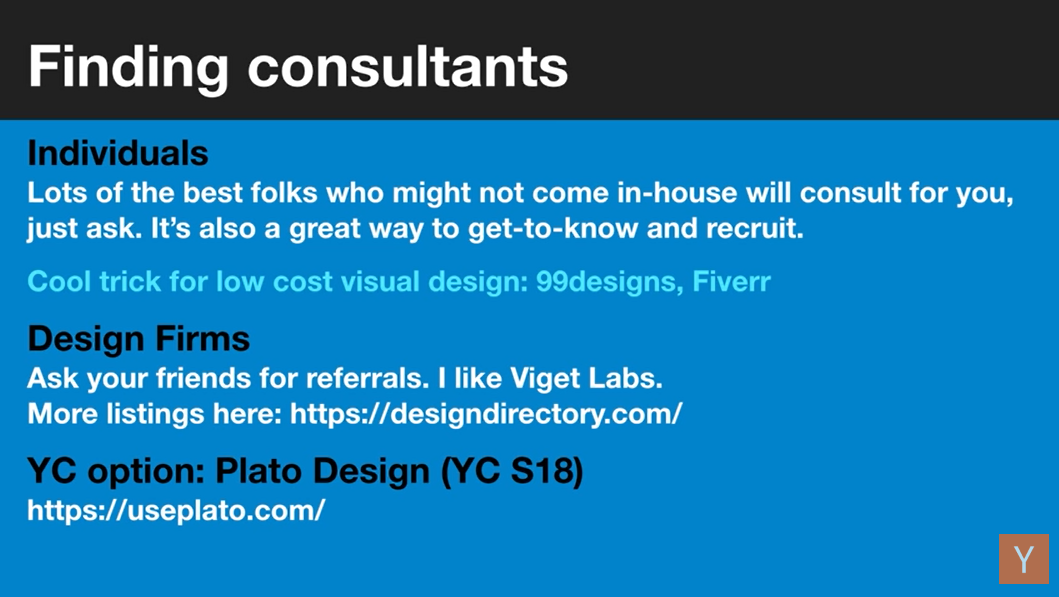
There are two main approaches to finding consultants:
- The first is reaching out to individual consultants directly. Keep in mind that top-tier consultants often work across multiple projects, so they can be hard to reach—you may need to send many emails. However, if you do connect with the right person, hiring them—even temporarily—is a good way to assess their fit.
- The second approach is using platforms like Fiverr to find affordable yet high-quality designers. You can hire several, review their outputs, and then decide who to keep.
When seeking design agencies, note that many prefer working with Fortune 500 companies and may not prioritize startups. Therefore, referrals are often the best route—for example, directories like Viable Labs or contacting Plato Design (useplato.com), whose work comes highly recommended.
Attracting Designers
How do you attract designers to join your startup?
If your company is consumer-focused, during Series A, ideally you should have a co-founder managing the business.
However, if you're a team of three or four, you might bring in an exceptional “unicorn” designer and offer them a senior-level role. This is particularly important at the Series A stage.
Yet once your team grows to 5–10 engineers, the environment can feel intimidating to designers accustomed to working in teams, at design firms, or at large tech companies like Facebook. They need space and time to think through wireframes, users, personas, and workflows.
If you’re not planning to build a diverse team, later-stage work may become extremely unappealing to these professionals.
Therefore, having clearly defined roles is a crucial part of attracting top talent.
Finding unicorns is difficult, but you can break it down into key traits—such as strong PM skills, impressive portfolios, and solid backgrounds.
An interaction designer must do more than create beautiful designs—they must possess empathy. They should deeply understand user needs and demonstrate excellent communication and writing skills. These qualities are essential for the role.
Visual design may exist as a standalone function or be integrated with other design responsibilities. It’s a distinct skill set that can play a vital role in startups, especially in content marketing and social media operations.
If you're an engineer considering hiring designers, you need to understand these terms and collaborate closely with them, because this cultural alignment is exactly what designers require.
Executives, workplace leaders, or founders must be able to understand and use the professional language of designers.
Thus, I encourage you to stay open-minded and understand these aspects—even if you’re not a designer yourself—so you can better evaluate, manage, and collaborate effectively with those skilled in this domain.
The Interview Process
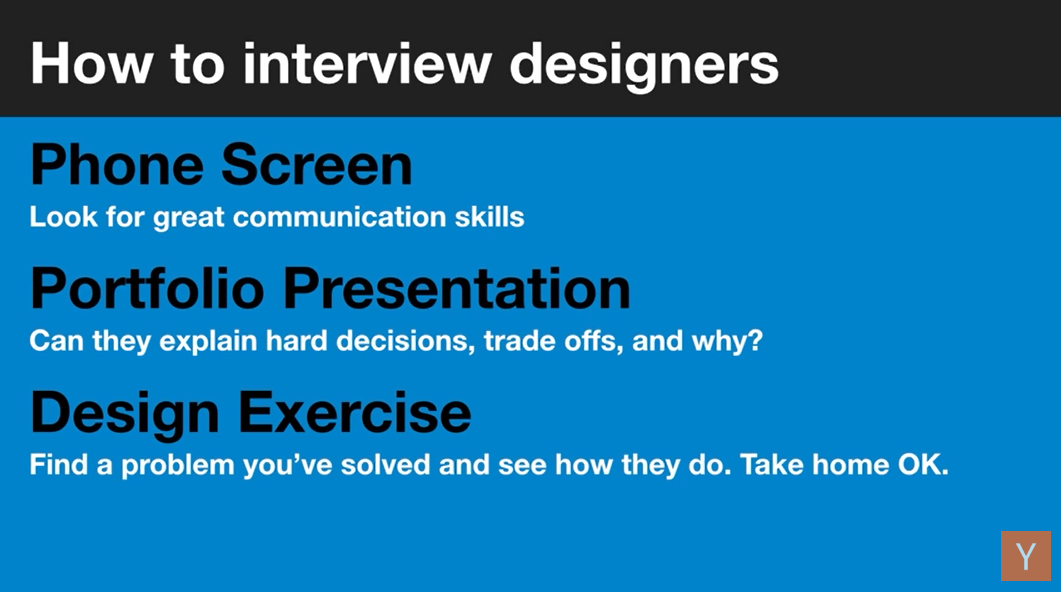
A quick phone screen isn’t enough to judge whether a portfolio looks impressive. It will be challenging to work with someone visionary but lacking in communication skills. Hence, the real value of a phone screen lies in assessing communication ability. After investing significant time in product design, you must consider role definitions and priorities. Making tough trade-offs is unavoidable in product design.
When interviewing for design roles, the most important quality is empathy—the ability to truly listen to your needs. Candidates who constantly talk about themselves are usually red flags. Returning to empathy and always keeping user needs in mind is critical. If you pose a design challenge and the candidate immediately starts sketching without asking about users, target audience, or usage scenarios, they’re likely to fail.
Hiring strong design leaders strengthens your entire team and drives product development forward. Additionally, reading practical books can help improve your own capabilities. *Taste for Makers* is one highly recommended title.
Finally, it's important to emphasize that design is just one leg of a three-legged stool—in entrepreneurship, product success depends on the intersection and interplay of multiple factors.
How Important Is the "About Us" Page?
This topic goes beyond just design.
Returning to our earlier discussion about sparse products and weak product vision—it can feel isolating. But in reality, the "About Us" page is where founders can share their story, helping build a brand that feels closer and more relatable to customers.
Many want to imitate Microsoft or become giants like Google, but that’s not necessarily the right path. Instead, embrace your uniqueness and amplify it.
Simple actions like replying personally to emails or using real names on your website can significantly strengthen customer relationships. Brian Armstrong is one of the few public figures in the Bitcoin space willing to share personal information—and this transparency has contributed to its success.
Therefore, building strong customer relationships is critically important—and this extends far beyond design.
How to Ask the Right Questions to Elicit User Stories?
The hardest part here is figuring out how to approach it. I believe this ties closely to being a good interviewer and thinker. Asking open-ended questions is an effective method.
For instance, simply ask: “Tell me about your day.” You can even start with emotions, because the best problems to solve are often deeply emotional ones.
For example, frustration or anger are powerful emotions. Looking back, Jeff might have taught me this—identifying issues that truly bother people, problems that make their hair catch fire, is incredibly valuable.
Emotions can be powerful and useful. Thus, using open-ended questions to uncover emotions is an effective way to enhance thinking and improve interview techniques.
Prototyping and the Key to Problem Solving
I must admit my shortcomings. I haven’t done much prototyping, mainly because I’m always eager to jump into coding. Once I know what to build, I start building immediately. Then I launch it and wait for feedback—that approach has kept me alive. Personally, I haven’t gained much from prototyping. Still, I recognize it’s a highly valuable tool. It feels strange to me because I tend to push things live right away.
If you face a problem but haven’t found a solution, the hardest part may be that you don’t yet know what kind of design would solve it. The issue could lie at the business or technical level.
If it’s a business problem, sometimes it’s actually a design problem—but these are tricky because they’re often vague. If it’s a business issue and you haven’t launched a product or service, people won’t realize they have a problem. So you need a way to help them recognize the problem exists.
If it’s a technical problem, then indeed a design is needed. But if there’s no viable technical solution, even the best design won’t help. So first, find a working technical solution, then identify the right design to implement it.
In short, solving problems requires both the right design and technical solution—often involving continuous experimentation until you find the optimal path.
How to Balance Secrecy vs. Openness?
Right now, I can’t think of any specific method. Perhaps there are other ways, especially in open competitions where some gain significant advantages.
But in certain cases, when you wish to keep things confidential, you may not want to publicly announce your ideas or plans.
This is especially true for easily copied ideas or enterprise-focused ventures. For many people, knowing such details isn't necessary.
Here are the main scenarios where confidentiality matters greatly:
However, most people lean toward secrecy rather than openness. In YC’s standard philosophy, whenever you create something new, you should seek competition rather than moving silently. Your real competition isn’t other startups—it’s the back button. Being as open as possible about your ideas helps more people learn about you and your work, enabling engagement and interaction—which is generally beneficial.
Should You Avoid Controversy?
It depends on the nature of the controversy.
For example, there was a company called Soylent going through YC. At the time, I gave them terrible advice—but fortunately, they didn’t follow it. They were working on something entirely different from web infrastructure, and we spent hours discussing it in the same room. Finally, they announced, “Great news—we’ve received incredible orders; people seem to love our product.” But they also said, “By the way, we’re sticking with the name ‘Soylent.’” I urged them not to use that name because I knew it referenced a movie and could spark controversy.
But that was exactly what they needed—the right kind of controversy. If you can create something 90% of people hate, the remaining 10% will be passionate about it. Such controversy can be intense, but it might also earn you billions in free publicity—as Soylent did.
Therefore, controversy isn’t always bad—it can create business opportunities. But when deciding whether to leverage controversy as a marketing tool, you must carefully weigh the potential risks and rewards.
Join TechFlow official community to stay tuned
Telegram:https://t.me/TechFlowDaily
X (Twitter):https://x.com/TechFlowPost
X (Twitter) EN:https://x.com/BlockFlow_News
 深潮TechFlow