








a16z: Decentralization Factors and Classification of Web3 Protocols
TechFlow Selected TechFlow Selected
a16z: Decentralization Factors and Classification of Web3 Protocols
Web3 participants, policymakers, and regulators must develop a more unified and nuanced understanding of decentralization in order to more accurately assess and compare the levels of decentralization across various Web3 protocols.
 Navigating Web3 tides with focused insights
Authored by: Miles Jennings, Stephen Wink, Adam Zuckerman
Translated by: TechFlow
Decentralization is a key innovation enabled by blockchain technology and one of the most important characteristics of Web3 protocols.
Therefore, participants in Web3, policymakers, and regulators must develop a more unified and nuanced understanding of decentralization to more accurately assess and compare the degree of decentralization across various Web3 protocols. This will also better position Web3 regulations and policies to understand and explain how decentralization reduces risks and ultimately incentivizes Web3 builders to pursue decentralization in ways that maximize the promise of Web3.
To this end, we define three types of decentralization and outline factors related to each type for two categories:
(1) Tokenized blockchain protocols (e.g., Layer 1 and Layer 2 blockchains such as Bitcoin, Ethereum, Polygon, Solana, Optimism, Arbitrum, zkSync);
(2) Tokenized smart contract protocols deployed on blockchains (e.g., Uniswap, Aave, Compound, Curve). This approach helps enumerate the components of decentralization and provides more specific and standardized definitions.
Any analysis of decentralization in blockchain or smart contract protocols must consider the overall circumstances surrounding such protocols. The factors listed here aim to provide a roadmap for such analyses.
Why Decentralization?
Web3 ushers in a new era of the internet—the “read, write, own” era. The technologies underpinning Web3 enable “trustless computation,” eliminating the need to rely on centralized entities to navigate networks and databases. This allows for the development of more complex and advanced protocols that deliver modern internet functionality while being owned by users.
For example, a decentralized social media protocol could allow multiple applications to be built, all leveraging the same protocol, with ownership and control distributed via token ownership to a broad group of developers and users.
Decentralization is the key feature of Web3 protocols that makes this paradigm shift possible.
Decentralization will drive the creation of a democratized internet and enable three important transformations: fostering competition, protecting freedom, and rewarding stakeholders.
First, decentralization makes Web3 systems credibly neutral—they cannot discriminate against any individual stakeholder or group of stakeholders, which is crucial for incentivizing developers to build within the ecosystem—and composable (like Lego bricks). Therefore, unlike proprietary technology platforms, Web3 systems resemble public infrastructure.
Compared to closed Web2 software, Web3 protocols offer decentralized internet infrastructure upon which anyone can build and create internet businesses.
Critically, in Web3, this can be done without requiring permission from the original protocol deployer or using a centralized control interface. For example, compared to Twitter, a Web3-based Twitter protocol would provide an underlying data architecture designed for social media, controlled by the public through token ownership rather than by a company. In such a system, anyone could build their own client or application atop the protocol and gain access to its user network.
This is an abstract concept, so consider the following diagram of a Web3 ecosystem, including decentralized blockchains, decentralized smart contract protocols managed by token-holder DAOs, and several proprietary clients operating as traditional entities atop the network and protocols. Each blockchain and smart contract protocol serves as decentralized internet infrastructure, enabling businesses to build, compete, and innovate upon them.
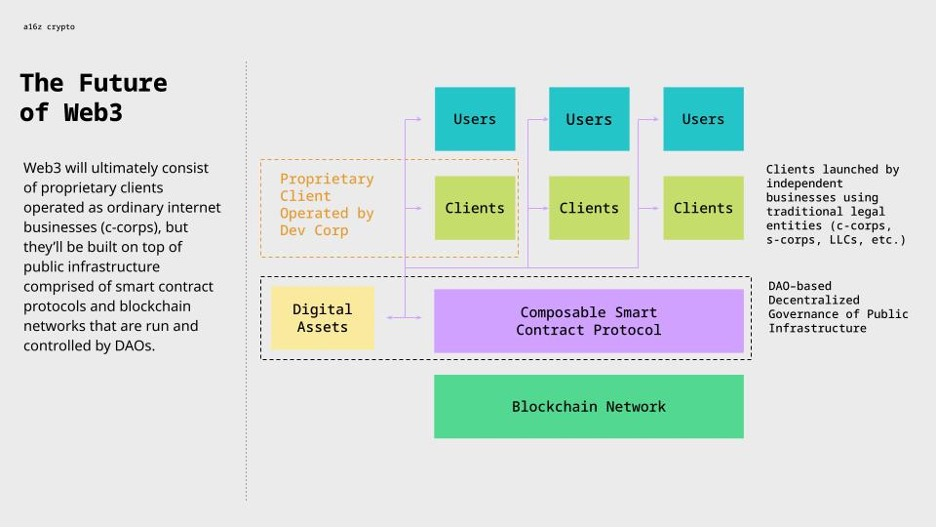
Second, decentralization requires broad distribution of control and participation rights within Web3 protocols, ensuring that the evolution and use of the network reflect the views of diverse stakeholders, not just the companies that created these protocols. Properly structured pro-decentralization protocols can limit the power attainable by a single company or small group of companies. Thus, decentralization should constrain gatekeeping power held by corporations or individuals and ensure that any protocol changes align with the interests of the broader ecosystem of users who hold tokens and ultimately govern the network.
Finally, decentralization enables the design of systems based on staker-holding capitalism—systems intended to serve the interests of all participants more fairly, rather than favoring a subset. Token-incentivized holding capitalism distributes ownership rights and control to a broader base of holders, rather than prioritizing shareholder interests over all other stakeholders, including customers and employees. As such, Web3 protocols and networks become fertile ground for designs that more equitably serve the interests of all holders. Such decentralized protocols provide more stable internet infrastructure for a wide range of stakeholders, enabling them to build with greater confidence.
Types of Decentralization
There are three distinct but interrelated perspectives through which decentralization can be viewed: technical, economic, and legal. All three perspectives are important but often involve competing interests, creating a complex design challenge when seeking to maximize overall decentralization and utility.
Technical Decentralization (T)
Technical decentralization primarily involves the security and structural mechanisms of Web3 systems. Programmable blockchains and autonomous smart contract protocols can support technical decentralization by providing autonomous, permissionless, trustless, and verifiable ecosystems for value transfer. Products and services can be deployed and operated without relying on trusted centralized intermediaries (or having commitments withdrawn at critical moments), opening up vast possibilities.
For blockchain protocols, achieving technical decentralization is a highly challenging task requiring balance among multiple competing factors. However, for smart contract protocols, this form of decentralization can be achieved relatively quickly and easily by making the smart contracts immutable (i.e., unchangeable and uncontrollable by anyone).
Economic Decentralization (E)
Blockchain and smart contract protocols leverage native tokens to unlock the potential for these open-source, decentralized systems to have their own decentralized economies (i.e., autonomous free-market economies) and enable broader participation and benefit-sharing within these decentralized ecosystems.
Builders of Web3 systems can foster the formation of decentralized economies through careful design decisions, exchanging and accumulating value from diverse sources—whether information, economic value, voting rights, or otherwise. If properly structured, decentralized ecosystems can use tokens to incentivize participants to contribute to the ecosystem and fairly distribute value according to their contributions among system stakeholders. To achieve this, Web3 systems must grant meaningful power, control, and ownership to participants through mechanisms like airdrops, other token distributions, and decentralized governance. As a result, value accumulates across a broader set of participants rather than concentrating in the hands of a central entity or a few large whales.
With sustained alignment of incentives among holders (developers, contributors, and consumers), more value can be contributed to the entire system, benefiting everyone. In other words: enjoying all the benefits of modern network effects without the drawbacks of centralized control and monopolistic economics.
Legal Decentralization (L)
Legal decentralization depends on whether the system’s decentralization eliminates the risks targeted by specific regulations.
For example, technically decentralized blockchains and smart contract protocols eliminate risks associated with trusted intermediaries. Thus, when it comes to regulations targeting trusted intermediaries, the technical decentralization of these systems also implies their legal decentralization.
Systems that are both technically and economically decentralized can eliminate additional risks, including those tied to the tokens of Web3 systems and their potential value. Such decentralization removes the necessity for U.S. securities laws to apply to token transactions, which might otherwise severely restrict their widespread distribution.
According to SEC guidance, we can define this level of legal decentralization as the extent to which a Web3 system eliminates the possibility of material information asymmetry and reliance on the efforts of others to determine the success or failure of the project. Once this threshold is met, the system may be sufficiently decentralized such that U.S. securities laws need not apply to its tokens. From this threshold perspective, it is essential to ensure that a given token does not confer any contractual rights to its holders regarding the efforts, assets, revenues, or resources of the issuer or any of its affiliates.
Factors of Decentralization
In Web3 systems using native tokens, the three types of decentralization—technical, economic, and legal—must be considered holistically. Changes in one dimension can affect the others. For instance, a decentralized economy advances legal decentralization by prioritizing decentralized ownership, value accrual from decentralized sources, and value distribution to decentralized stakeholders. All of these reduce information asymmetry and reliance on the efforts of individual managers.
Conversely, if the digital asset value of a Web3 system relies on the ongoing managerial efforts of the original development team, decentralization across all three layers may be compromised. For example, the departure of a management team could exert significant downward pressure on the digital asset's price, thereby making the system more vulnerable to 51% attacks.
Decentralization is assessed based on the totality of circumstances of any Web3 system, not on absolute grounds. The relative importance of these factors will vary depending on the Web3 system and the purpose of the evaluator. Moreover, trade-offs between different types of decentralization may differ across projects and individuals.
We hope this framework enables Web3 participants to contribute to building more decentralized projects, while empowering policymakers and regulators to design regulatory frameworks that recognize the power of decentralization to reduce and eliminate risks.
Join TechFlow official community to stay tuned
Telegram:https://t.me/TechFlowDaily
X (Twitter):https://x.com/TechFlowPost
X (Twitter) EN:https://x.com/BlockFlow_News
 a16z
a16z






