








From ERC20, 721, 1155 to 3525: Charting the Path of RWA Toward Web3 Mass Adoption
TechFlow Selected TechFlow Selected
From ERC20, 721, 1155 to 3525: Charting the Path of RWA Toward Web3 Mass Adoption
ERC-3525 demonstrates significant advantages in the future trends of Web3. Whether in real-world assets (RWA), customer loyalty programs, gaming, or other fields, ERC-3525 holds substantial potential.
 Navigating Web3 tides with focused insights
Author: Boba Boba Wanwu Research Institute
Twitter: @wzxznl
Since the inception of blockchain technology in 2008, the crypto market has experienced rapid development. However, the total market capitalization of the entire cryptocurrency market has yet to surpass that of Apple alone, and Web3 still lacks practical real-world applications. Recently, however, a new research report from Citibank titled Money, Tokens & Games could change this situation. In the report, Citibank identifies real-world asset tokenization (RWA) as the next major narrative, suggesting it may significantly impact the development of Web3 by bringing the next billion users to blockchain and potentially enabling economic activities worth tens of trillions of dollars.
Within the broader narrative of real-world asset tokenization (RWA), the author of this article, Wanwu researcher Boba, believes the ERC-3525 standard holds immense potential. ERC-3525 is a semi-fungible token (SFT) standard that combines features of ERC-20, ERC-721, and ERC-1155, allowing for more effective representation and management of complex assets such as bonds, coupons, invoices, futures, options, and ABS. In this way, ERC-3525 has significant potential to accelerate RWA adoption and drive widespread real-world applications of Web3.
This article will compare the components of ERC-20, ERC-721, ERC-1155, and ERC-3525 to illustrate their differences, explore the digital world modeling philosophy behind ERC-3525 through three layers, discuss promising application areas for ERC-3525 in the future, and extend special thanks to Teacher Samo from the Wanwu Research Institute for his meticulous editing and refinement of this article!
Table of Contents
-
Background Introduction
-
Comparison of Existing ERC Token Standards – Understanding ERC-3525
-
ERC-20
-
ERC-721
-
ERC-1155
-
ERC-3525
-
-
Understanding ERC-3525 as a Digital World Modeling Philosophy Through Three Layers
-
Super NFT with Splitting and Combinability
-
Universal Digital Container
-
Visualized Smart Contract
-
-
Promising Application Areas for ERC-3525 in the Future
-
Real-World Assets Onboarding (Real-World Assets, RWA)
-
Virtual Assets or Goods
-
Social, Identity, and Tokenized Accounts
-
-
Conclusion
Before introducing ERC-3525, let's first clarify what EIP and ERC mean:
EIP stands for Ethereum Improvement Proposals, a framework within the Ethereum community that allows anyone to suggest improvements or updates to the Ethereum network. These proposals can involve changes to the Ethereum protocol itself, related client APIs, or standards for other projects in the Ethereum ecosystem.
ERC stands for Ethereum Request for Comments. ERCs are a specific type of EIP focused primarily on application-level standards such as smart contract design patterns and interface definitions. These ERCs typically provide standardized templates for Ethereum application developers, ensuring interoperability across different projects and applications. Simply put, all ERCs are EIPs, but not all EIPs are ERCs—EIP covers a broader scope including core protocol changes.
ERC-3525 was created on December 1, 2020, designed by core members of Solv Protocol and supported by key Ethereum community developers. The process from initial proposal to final community acceptance took 20 months, involving multiple drafts before being officially adopted as an ERC token standard in September 2022. As an Ethereum standard developed by a team with strong Chinese representation, ERC-3525 has recently attracted renewed industry attention.
Comparison of Existing ERC Token Standards – Understanding ERC-3525
ERC-3525 is a semi-fungible token (SFT) standard. Many people initially perceive ERC-3525 as merely a hybrid of ERC-20 and ERC-721, but in reality, it is a foundational universal standard that offers overwhelming advantages over ERC-20, ERC-721, and even ERC-1155 in certain domains. Below, Boba will help readers understand ERC-3525 by comparing its key components (excluding attributes like name and symbol) and analyzing strengths and weaknesses relative to other token standards.
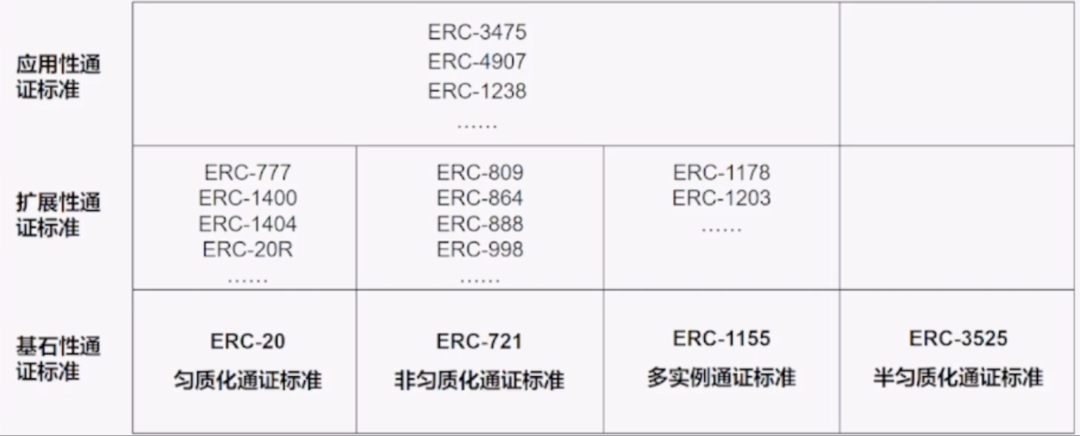
Image source: solv.finance PPT
ERC-20
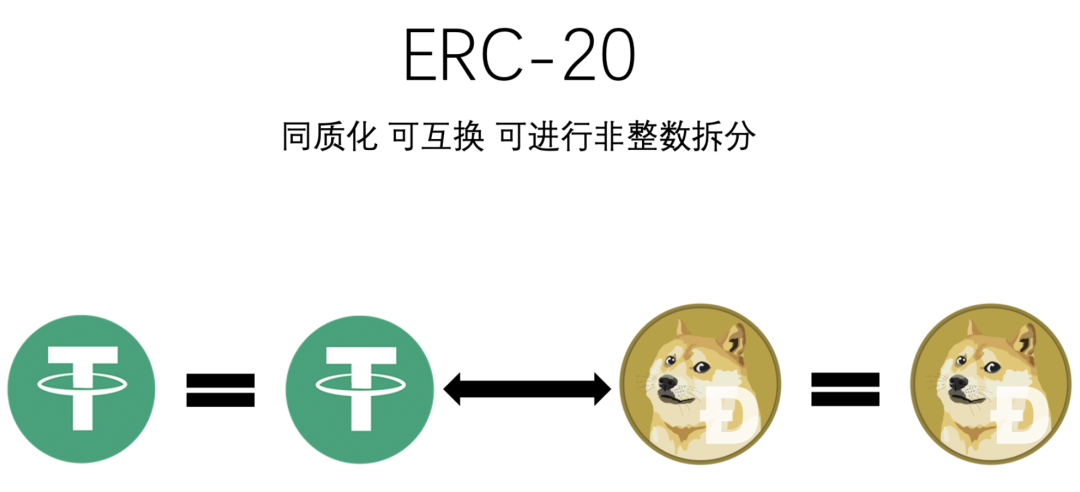
ERC-20 is one of the most widely used token standards on Ethereum—fungible tokens where each token is functionally and value-wise identical, hence the term "fungible." Stablecoins are a prime example of ERC-20 usage: every unit is interchangeable and represents equal value.
Key Components: address and value. address refers to the owner’s wallet address, while value represents the number of tokens held at that address. Under the ERC-20 standard, each address holds a single balance (value), and all balances are indistinguishable.
Advantages: ERC-20 tokens represent interchangeable assets, similar to traditional currencies or shares, making them highly useful in many applications—for instance, representing company equity or serving as trading pairs on decentralized exchanges (DEXs). ERC-20 is also extensively used in DeFi applications such as lending platforms and liquidity mining. Additionally, ERC-20 supports fractional division—you can own 0.5 of an ERC-20 token.
Limits: Because ERC-20 tokens are fully fungible, they cannot represent unique or non-fungible assets such as artworks or collectibles.
ERC-721
When discussing ERC-721, we must mention non-fungible tokens (NFTs). Well-known NFTs such as Bored Apes and Azuki follow the ERC-721 standard, which defines how non-fungible tokens should be created and managed on the Ethereum blockchain.
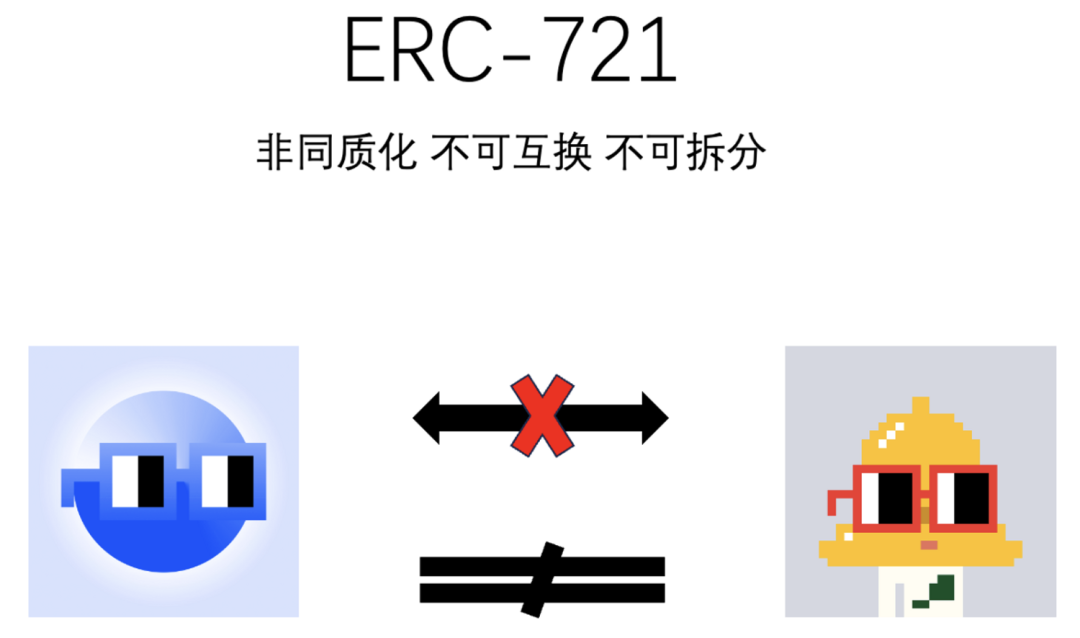
Unlike ERC-20 tokens, where each unit is equivalent, each ERC-721 token is unique and non-interchangeable. This makes them ideal for representing distinct digital or physical assets such as art, real estate, or collectibles. The earliest NFT, CryptoPunk, wasn't built on ERC-721 but rather on ERC-20. However, its emergence catalyzed the creation of the ERC-721 standard, laying the foundation for countless valuable NFT applications.
Key Components: tokenIdandowner. tokenId is a unique identifier distinguishing different ERC-721 tokens, while owner refers to the token holder’s address. Each token under ERC-721 is distinct and uniquely identified by its ID, with each ID linked to one owner.
Advantages: ERC-721 tokens are non-fungible—each is one-of-a-kind. This makes them perfect for representing unique items or assets like artwork, collectibles, or real estate. They have proven especially valuable in creating and trading digital art and other unique digital assets.
Limits: Due to their non-fungibility, ERC-721 tokens are inefficient for representing interchangeable assets like money or stock. They lack liquidity advantages and composability—they cannot be split fractionally; you cannot own 0.5 of an ERC-721 token.
ERC-1155
ERC-1155 is a multi-token standard combining features of both ERC-20 and ERC-721, aiming to manage various token types more efficiently and flexibly. Under previous standards (ERC-20 and ERC-721), each new token required deploying a separate smart contract—leading to redundant code and high gas costs. Interactions between contracts also became complex.
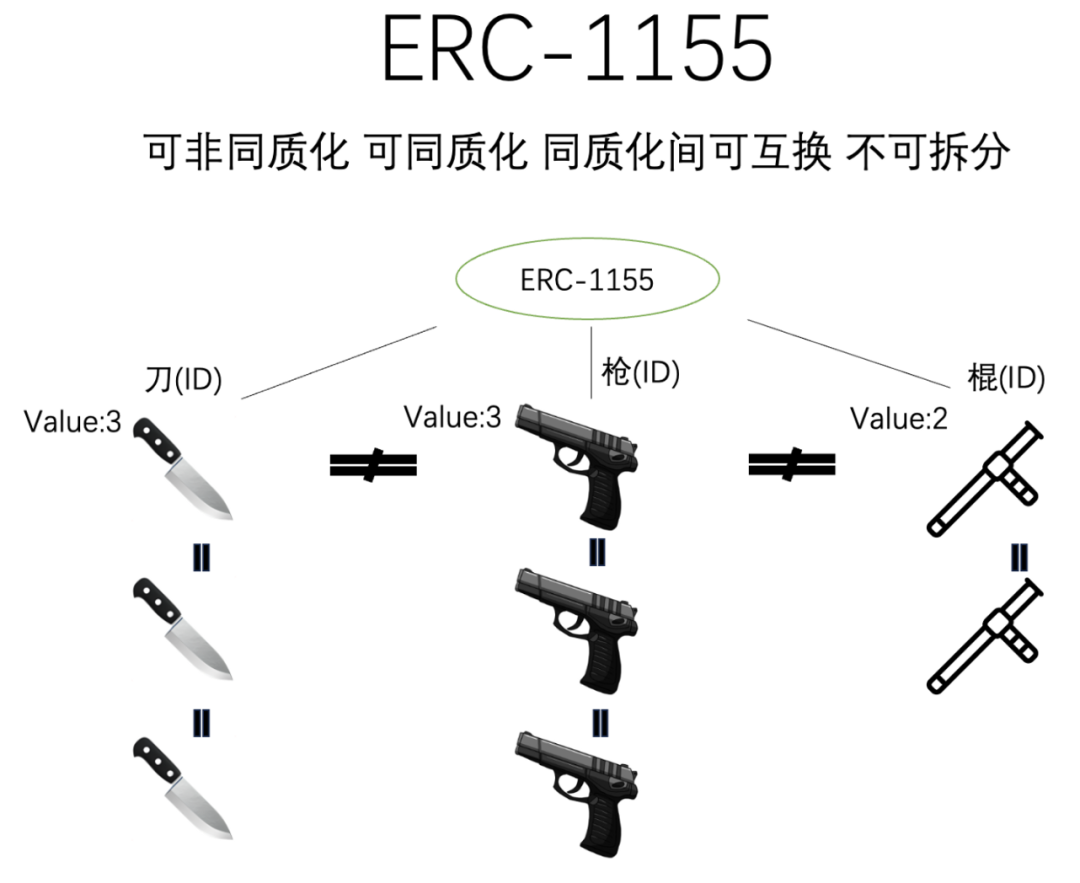
ERC-1155 enables managing multiple token types within a single smart contract. Each token can be fungible (like ERC-20) or non-fungible (like ERC-721). For example, in a game, ERC-1155 can represent different weapon types (non-fungible)—such as sticks, knives, guns—where each weapon type contains identical units (fungible): Knife #1 and Knife #10 are identical, but knives differ from guns.
Key Components: id, valueandowner. id is a unique identifier for different ERC-1155 tokens, value denotes the quantity of a given id, and owner is the token holder’s address. Using the weapon analogy: different weapon types correspond to different IDs, and the number of weapons per type (ID) is the Value—all units under a single ID are identical.
Advantages: ERC-1155 tokens can simultaneously represent both interchangeable and unique assets, making them highly versatile. For example, a game might use ERC-1155 to represent player equipment types (non-fungible) and quantities (fungible).
Limits: While flexibility makes ERC-1155 powerful, it also increases complexity in understanding and implementation compared to ERC-20 or ERC-721. Moreover, it cannot represent partially exchangeable assets such as bonds or futures, nor support fractional splitting—you cannot own 0.5 of an ERC-1155 token.
ERC-3525
ERC-3525 is a semi-fungible token (SFT) standard that integrates characteristics of ERC-20, ERC-721, and ERC-1155. More complex than ERC-1155, it is designed to express and manage sophisticated digital financial assets such as securities, bonds, options, futures, swaps, insurance policies, etc. Compared to other token standards, ERC-3525 offers superior composability and embodies a digital world modeling philosophy, interpretable through three lenses: Super NFT with Splitting and Combinability, Universal Digital Container, and Visualized Smart Contract.
Key Components: id, value, SlotandAddress. Each SFT has an id attribute analogous to ERC-721, identifying it as a globally unique entity so SFTs can be transferred and approved between addresses compatibly with ERC-721. Additionally, each token includes a value attribute indicating its quantitative nature, similar to the “balance” in ERC-20.
Address refers to the wallet owning Slot and ID. Each address can hold any number and type of IDs and Slots. What sets ERC-3525 apart is the Slot attribute: Values of different IDs within the same Slot are transferable and interchangeable; across different Slots, transfers and exchanges are impossible. A Slot can contain many IDs, but each ID belongs to only one Slot.
The key innovation lies in Slot. Essentially, Slot represents a classification. Within the same Slot, there can be many IDs—each ID is distinct and carries its own Value—but within that Slot, different IDs are treated as equivalent and can be exchanged, combined, or split. Consider membership cards: suppose two Slots exist—KFC and McDonald’s. Each KFC and McDonald’s card has a unique ID representing individual memberships (e.g., Satoshi’s card vs. Vitalik’s card), and each card has a Value representing points.
Under the same Slot (e.g., KFC membership), Satoshi’s points and Vitalik’s points are considered equivalent. Satoshi can send points to Vitalik or receive them in return. He can also split his membership card into a primary and secondary card (two different IDs with divisible point values), or merge them back together.
Across different Slots, however, since KFC and McDonald’s are separate companies, KFC points cannot be transferred to a McDonald’s card—therefore, no transferability, exchangeability, or combinability exists between Values and IDs across Slots.
Advantages: Due to its more complex structure, ERC-3525 can represent various intricate digital constructs such as securities, bonds, options, futures, swaps, insurance policies, membership cards, etc. As a semi-fungible token, each token can have custom rules and properties, making the standard extremely flexible and powerful. Thanks to the Slot mechanism, ERC-3525 supports direct ID-to-ID transfers (e.g., Satoshi transferring points to Vitalik) and enables fractional splitting and merging.
Limits: The complexity of ERC-3525 raises the learning curve. The presence of Slot introduces relatively centralized traits in technical architecture. Development difficulty is higher.

Understanding ERC-3525 as a Digital World Modeling Philosophy Through Three Layers
Due to its more complex structure compared to other token standards, ERC-3525 functions as a universal token standard whose composable data structure enables the creation of diverse complex token architectures in the digital world—akin to building elaborate models using LEGO bricks. Indeed, ERC-3525 represents a digital world modeling philosophy. To deeply understand ERC-3525, consider these three perspectives: Super NFT with Splitting and Combinability, Universal Digital Container, and Visualized Smart Contract.
Super NFT with Splitting and Combinability:
By adjusting its attributes, ERC-3525 can express all three token standards—ERC-20, ERC-721, and ERC-1155:
Representing ERC-20: Identical Slot, single ID—the Value represents fungible tokens

Representing ERC-721: Different Slots, single ID—represents non-fungible tokens
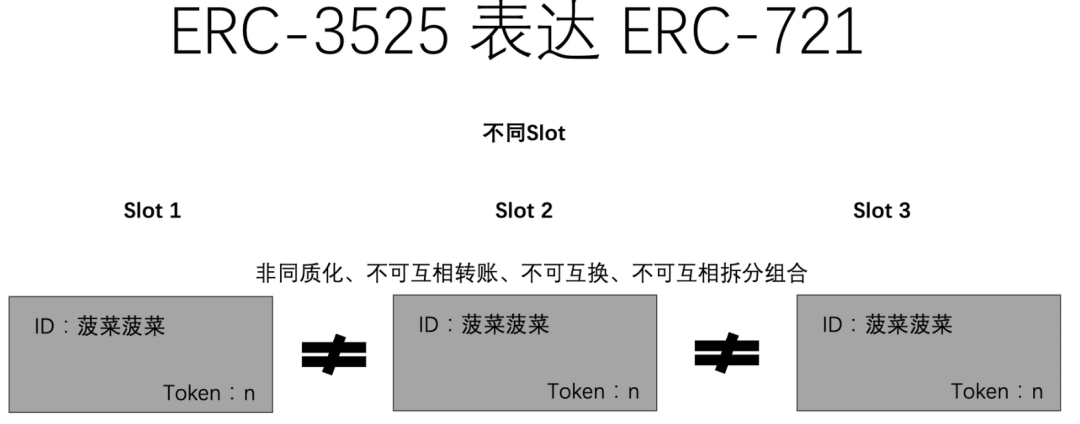
Representing ERC-1155: Different Slots, multiple IDs—represents multi-token instances
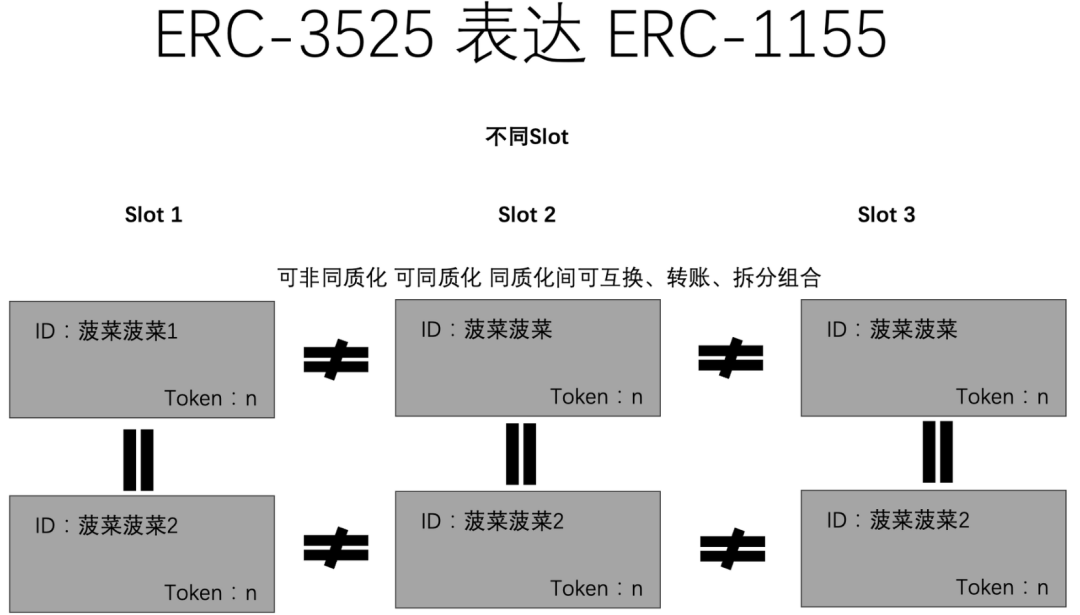
But ERC-3525 goes further—it enables actual splitting of non-fungible tokens. For example, a Bored Ape can truly be divided into parts—not via an additional fragmentation contract, but natively. To most newcomers, ERC-3525 may simply seem like a splittable, combinable super NFT. While valid, this view captures only the surface and fails to appreciate its deeper potential.

Universal Digital Container:
To grasp the idea of ERC-3525 as a universal digital container, one must understand its account abstraction feature. As shown in the membership card example earlier, ERC-3525 allows ID-to-ID transfers. Internally, each ID functions as an account—with receiving, storing, and sending capabilities—like a basket filled with various digital assets. Since an ERC-3525 ID acts as an abstracted account, its operational rights can be decoupled and granted to other wallet addresses—not limited to the owner of the ERC-3525 smart contract.
The difference between ERC-3525’s account abstraction and ERC-4337 lies in execution: ERC-4337 decouples signing rights from ownership in smart contract wallets, enabling custom sign-in methods (e.g., password-based access). ERC-3525, however, still relies on EOA wallets (private-key-controlled wallets) for operations, and each ID can only receive assets within the same Slot.
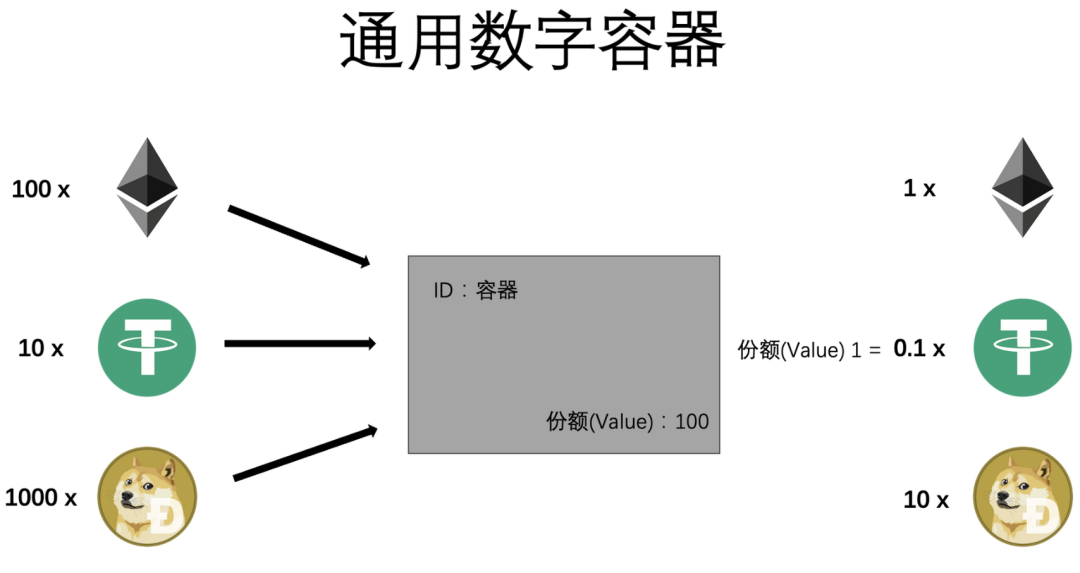
If we treat an ERC-3525 ID as an account with receive, store, and send functions, then it becomes a container for digital assets—any digital asset poured into this universal container becomes a uniform solution, and the ID’s Value becomes a share of a diversified portfolio.
For example, in one Slot, Container A (ID: A) receives 100 BTC and 10 ETH. Once these assets enter the container, they become a homogeneous mixture. If the Value of Container A is evenly split into ten parts, each resulting sub-container would hold 10 BTC and 1 ETH. If this container merges with another containing a different mix (e.g., 100 DOGE), the new container would represent 10 BTC, 1 ETH, and 100 DOGE—and this merged container can again be split or combined further, with the internal Value representing shares of this bundled asset pool.
Understanding this layer reveals the magic of ERC-3525. With its complex data structure and flexible composability, you can create infinite complex token structures in the digital world—like Russian nesting dolls embedding multiple asset layers. This makes it ideal for representing structured financial products such as ABS and MBS.
Visualized Smart Contract:
The notion of “ERC-3525 as a visualized smart contract” isn’t hard to grasp. Think of ERC-3525 as a container equipped with a real-time display showing all its contents and changes—what components are inside (which assets and their proportions). This visualization greatly enhances manageability and transparency.
Although seemingly simple, this capability carries profound implications. Had ERC-3525 existed and been widely adopted before 2008, perhaps the financial crisis could have been avoided. Let’s revisit one of the triggers of the 2008 crisis: the chaos surrounding financial derivatives.
After the dot-com bubble burst, the U.S. stimulated the economy with low interest rates and loose monetary policy, encouraging more borrowing. If you’ve seen the movie *The Big Short*, you might recall a scene where someone with no collateral—even using their dog’s name—could get a mortgage. Why did banks allow such absurdity? Weren’t they afraid of defaults? Actually, they weren’t—thanks to a financial derivative called MBS.
Mortgage-Backed Securities (MBS) are asset-backed securities whose cash flows come from a pool of mortgages—residential or commercial. Lenders (e.g., banks) package these loans and sell them to Special Purpose Entities (SPEs), which convert them into tradable securities sold to investors.
This essentially bundles mortgages into new financial products sold to investors. For banks, this shifts loan risk off their balance sheets, freeing up cash to earn spreads. Loans deemed high-risk—like those without income or collateral—are called subprime loans. That’s why the 2008 crisis is known as the “subprime crisis”: widespread subprime defaults caused the MBS market to collapse.
If home loans can be securitized, so can other loans—student loans, auto loans, credit card debt. These are generally called Asset-Backed Securities (ABS). Both MBS and ABS derive returns from borrowers’ principal and interest payments. These derivatives appeared to offer high returns, attracting massive investor participation—but problems soon emerged.
In this risk-transfer model, banks prioritized loan volume over quality. High-risk subprime loans were packaged into ABS and MBS. As these products grew popular, institutions began creating even more complex derivatives—Collateralized Debt Obligations (CDOs).
If ABS and MBS are bundles of loans, CDOs are bundles of ABS and MBS—layered financial products. By mixing asset qualities and structuring senior (lower yield, safer) and junior (higher yield, first-loss) tranches, CDOs theoretically improved portfolio stability and Sharpe ratios.
However, this complexity obscured true risks for investors. Rating agencies’ moral hazard worsened the issue—some downgraded risky assets to attract clients, inflating perceived safety. This amplified systemic risk.
With Credit Default Swaps (CDS) insuring CDO tranches, splitting, and repackaging them—including CDS into new CDOs (synthetic CDOs)—people eventually lost track of the underlying assets. Subprime loans were embedded into supposedly low-risk derivatives, misrated assets carried unrealistically low premiums, and layered packaging spread these toxic assets to brokers and investors alike. Financial leverage skyrocketed, destabilizing the entire system.
When the U.S. began raising interest rates, rising loan costs triggered widespread borrower defaults—first evident in the subprime market. But because subprime loans were embedded in ABS, MBS, and CDOs, the problem rapidly spread. Seemingly safe, high-grade derivatives suddenly revealed high default risks. Investors had no visibility into actual exposures. Market confidence collapsed, triggering massive sell-offs—one of the main sparks of the 2008 financial crisis.
This crisis stemmed directly from disordered, opaque, and overly complex financial structures. ERC-3525—as a visualized smart contract—can solve this. It enables complex derivatives like ABS, MBS, and CDOs with full visibility into nested components, playing a crucial role in risk control.
Join TechFlow official community to stay tuned Telegram:https://t.me/TechFlowDaily X (Twitter):https://x.com/TechFlowPost X (Twitter) EN:https://x.com/BlockFlow_News






