Humans.AI: Embedding AI into NFTs, enabling artificial intelligence to achieve "digital immortality" in the Web3 genome database
TechFlow Selected TechFlow Selected
Humans.AI: Embedding AI into NFTs, enabling artificial intelligence to achieve "digital immortality" in the Web3 genome database
Humans.AI's ambition is gradually evolving, with its core vision being for AI-type NFTs to ultimately serve as digital extensions of humans—or even replace humans—to achieve digital immortality.
 Navigating Web3 tides with focused insights
humans.ai is dedicated to creating an integrated platform for AI-based creation and governance. On May 19, humans.ai announced the upcoming mainnet launch of its product and rolled out a series of marketing and promotional activities around this milestone. Initially, the project focused on using artificial intelligence to generate or modify multimedia content such as images, audio, and video. Over time, however, Humans.AI's ambitions have evolved—its core vision is for AI-type NFTs to eventually become digital extensions of humans, even replacing humans to achieve digital immortality.
In 2007, the Svalbard Global Seed Vault—often referred to as the "Doomsday Vault"—was established on a remote island about 1,000 kilometers from the North Pole. Inside this vault, approximately 100 million seeds from crops around the world are preserved in underground storage at -18 degrees Celsius. Under the glow of Arctic ice, the pursuit of immortality and the sense of apocalyptic crisis converge here in a uniquely romantic way.

We all somewhat believe that precisely replicating our thoughts and memories through digital AI is a potential path toward "digital immortality." But if we go one step further and bring this into reality, beyond just memory and cognitive replication via digital AI, how we store our AI genome library also becomes a critical question—what format should it take, and where and how should it be stored?
What if we built this artificial intelligence genome library using Web3?
Introduction to the Humans.AI Project
Since John McCarthy first introduced the concept of "artificial intelligence" in 1956, AI has taken root in the public imagination, though back then it was more of an aspirational idea. After decades of development, the practical applications of AI have been repeatedly validated and it has now become one of the most popular technologies. Whether it’s AI cloud computing over the past few years or recent AIGC applications like ChatGPT and Midjourney, they all highlight the immense value of AI.
However, in this new wave of AI competition, beyond tech giants, many participants are treating small AI models and their databases as core competitive assets, further reinforcing the concept of data sovereignty. Yet we must ask ourselves: Where should AI models and data truly be placed for maximum security? It is against this backdrop that Humans.AI emerged.
Humans.AI is a blockchain-based content platform focusing on large-scale creative applications of on-chain AI, forming a multi-stakeholder ecosystem. It integrates an AI toolkit into a creative studio suite, giving users more options when bringing their ideas to life. Users have the right to create and own their digital avatars, which can be used by themselves and others to generate countless digital assets. Synthetic media, AI applications, and other digital assets can all leverage blockchain technology to create non-fungible tokens (NFTs) that cannot be forged.
Humans.ai provides users with an AI algorithm model library along with environments for training and deployment (which are tradable). Developers can share their models on the platform, and others can purchase and improve them. Additionally, each developer has access to a "digital DNA" authentication feature, requiring users of a model to obtain permission via this "digital DNA."
Put simply, Humans.AI is a blockchain content platform for AI models that enables turning AI models into NFTs for on-chain storage. Its key innovation lies in tokenizing human identity “genes” as NFTs, such as digital likeness and voice, ensuring every request forwarded to an AI NFT is verified as coming from a real person, thus keeping AI usage within the ethical standards of Humans.ai and the set of rules embedded by the creator/owner into the AI NFT.
How Do AI NFTs Work?
Imagine a researcher develops an algorithm that takes voice input and builds a program converting written text into audio resembling the original voice—the foundational logic behind Humans.AI.
To ensure the security of the AI network, Humans.ai uses blockchain combined with other technologies such as cryptography and containerization. The AI network is encapsulated within a container—a structure similar to a virtual machine—that packages the application so it can run quickly and reliably across different computing environments, along with its isolated dependencies, libraries, and algorithms. When the container receives compatible input, it generates the AI model.
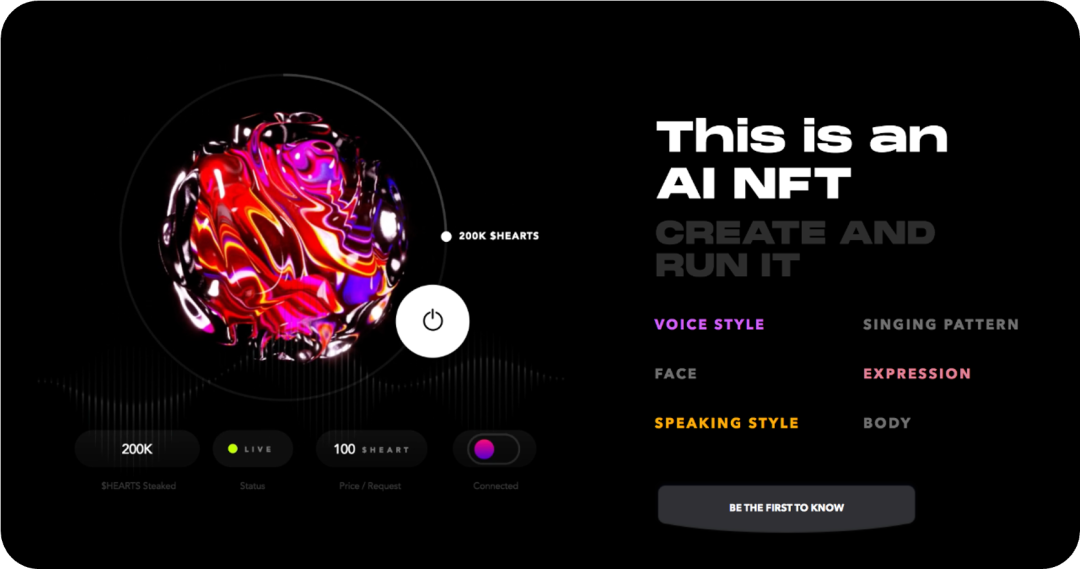
AI NFTs center around a user’s digital DNA, which may include biometric data such as voice, face, presence patterns, gestures, or any other identifiable traits. This information is encapsulated within the AI NFT and can serve as the foundation for future AI products like synthetic media. For example, multiple AI NFTs could be used to create talking avatars—a digital persona combining voice and facial features—that can be trained to speak in multiple languages.
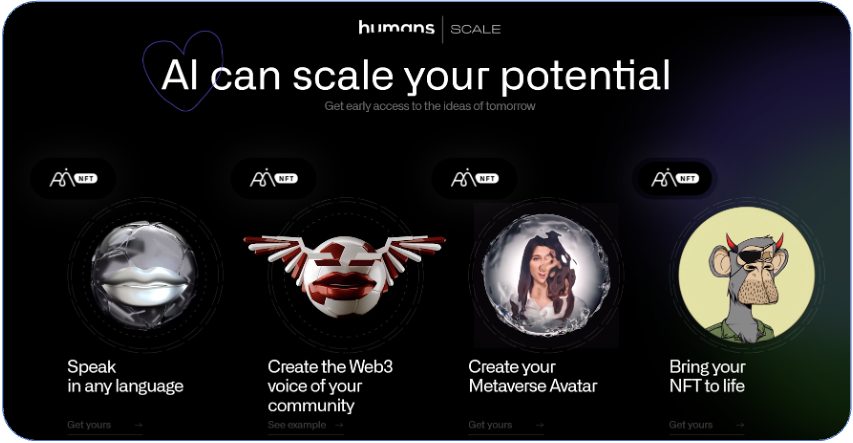
Beyond storing biometric data, AI NFTs also embed a set of rules governing how the enclosed information can be used. This ensures that users cannot generate AI products that spread harmful content, such as hate speech, politically incorrect messaging, or offensive material.
The process of creating an AI NFT within the Humans.ai ecosystem is called minting. Once an AI NFT is minted, it contains two components:
▪️A descriptive component—biometric data, a set of governance rules defined by the AI NFT’s creator/owner, and additional data confirming the NFT’s existence on the blockchain
▪️A computational component—a container structure that encapsulates the AI network. By leveraging a novel zero-knowledge cryptography method known as zk-SNARKs (zero-knowledge succinct non-interactive arguments of knowledge), we ensure that no entity can execute the AI component from the container without the digital signature of the AI NFT owner.
To make operations easier for users, Humans.AI has built rich infrastructure around marketplaces and app stores. Humans.ai plans to build an "AI Library"—a ready-to-use environment for deploying and training algorithms, where users can share their creations and collaboratively improve their models.
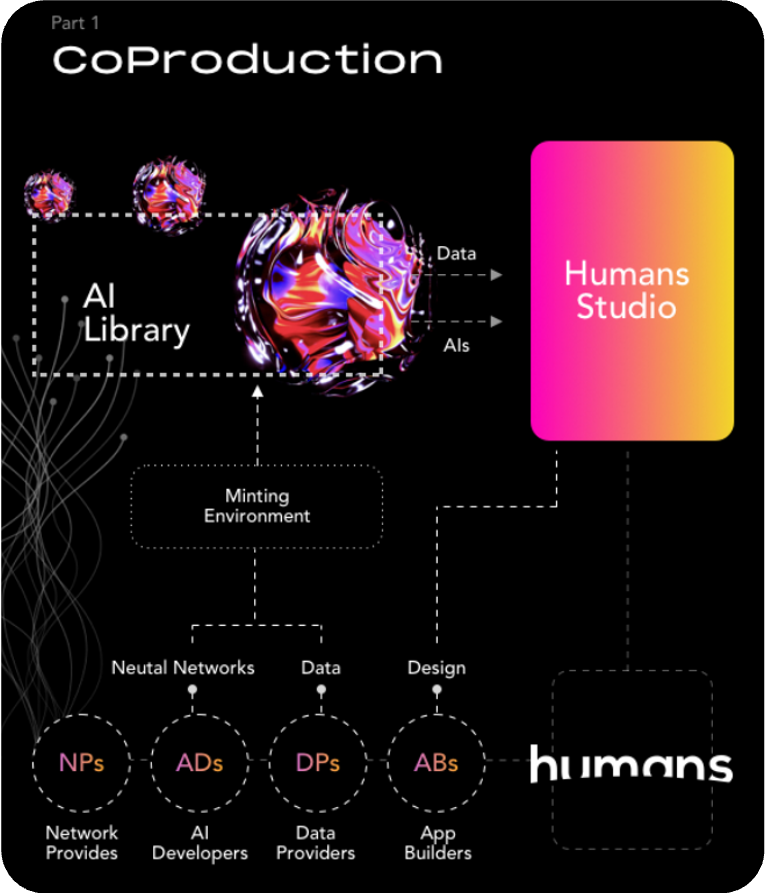
Once models are published, they are automatically uploaded to Humans Studio. Their data and algorithm models are packaged into AI entities and service products available for commercial transactions, usable by different users only after verification and authorization via the "Human Credentials." This model implies that certain expressions of human intelligence—such as language skills, vocal styles, personality traits, and other abstract elements—can be traded and encapsulated into a representational entity.
Proof-of-Human Consensus (PoH): The Core of the AI Ecosystem
When AI reaches the application layer, regulation of AI systems becomes an issue everyone must confront. While depictions of AI dangers in films like *I, Robot* and *The Matrix* may be exaggerated, allowing AI to develop unchecked will inevitably lead to a major technological crisis.
Based precisely on this ethics-driven foundation, Humans.AI introduced the Proof-of-Human consensus mechanism (PoH), emphasizing ethical oversight of AI while maintaining fairness in the ecosystem. PoH is a complex and versatile mechanism designed to ensure three critical functions related to AI NFTs: governance, consensus, and validation.
Users can directly interact with the Humans.ai blockchain and the PoH mechanism through dedicated apps and smart devices (smartphones, smartwatches, etc.). To ensure AI NFT governance aligns with human moral ethics, Humans.ai uses Proof-of-Human to verify that every request made to an AI model carries digital signatures from multiple real users—including private keys and biometric data (fingerprints, heartbeat, retina scans, facial recognition, etc.).
For instance, suppose someone named Jungle encapsulates his voice into an AI NFT. To prevent third parties from misusing his voice (including media companies or any individual/entity wanting to use the AI NFT to generate content), Jungle can encode a set of rules into his AI NFT outlining how his biometric data may be used.
For example, Jungle might specify that his AI NFT cannot be used to produce obscene content, hate speech, or anything politically incorrect. The rules encoded within the AI NFT can always be modified by its owner, should they wish to correct them or add new ones.
Rules embedded in the AI NFT can also stipulate that only validators holding a minimum threshold of staked tokens can act as verifiers for that AI NFT, or define how many validators are required to approve or reject a request. Validators are rewarded with tokens for their work, but if they consistently approve requests that violate the rules set in the AI NFT, they face penalties and lose their validator privileges.
Depending on their role, human validators fall into two categories:
▪️Workers: Agents who analyze requests sent to the AI NFT to check for deviations from the rules embedded in the NFT. Based on their analysis, workers vote whether a request should be accepted or rejected.
▪️Block Producers: After workers vote on a request and reach agreement, block producers are responsible for final validation. They are called block producers because, upon giving final confirmation, they sign off on grouped requests in blocks that are added to the blockchain, enabling transparency and traceability.
By combining artificial intelligence with blockchain technology, Human.AI empowers individuals to build and control their own AI, while ensuring that the development and use of AI products created within our ecosystem adhere to our ethical standards.
$HEART: The Core of Humans.AI’s Monetary Ecosystem
On top of the ecological model, a flowing token system is essential to keep the entire system operational. In Huam.AI, $HEART serves as the core currency.
According to the Humans.AI whitepaper, the current ecosystem includes three primary token economic models:
1.$HEART TOKENS: Used for governance and payments within the ecosystem
2.NON-FUNGIBLE TOKENS (NFTS): Represent ownership of algorithms, genomes, data, artificial intelligence, and applications
3.ERC20 TOKENS: Represent governance rights and revenue rights associated with each NFT
As the native token of Humans.AI, $HEART enables anyone to participate in platform governance and facilitates key value transfers within the platform. All fees collected by Human.AI are paid in $HEART, regardless of whether the original payment comes from fiat currency or another accepted cryptocurrency.
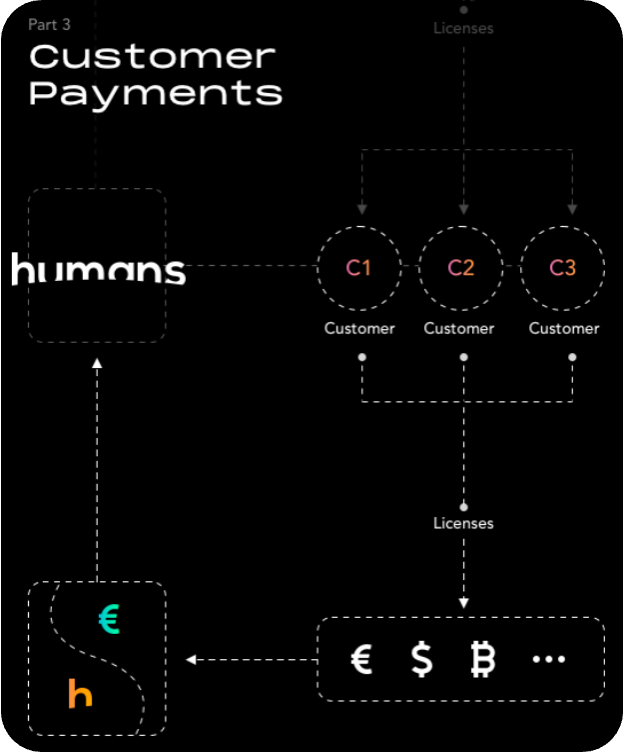
One of $HEART’s primary functions is facilitating staking. Staking $HEART is required to perform key functions within the Human Ecosystem:
▪️Minting NFTs
▪️Account verification and transaction payments
▪️Creating applications
▪️Adding AI to the artificial operating system
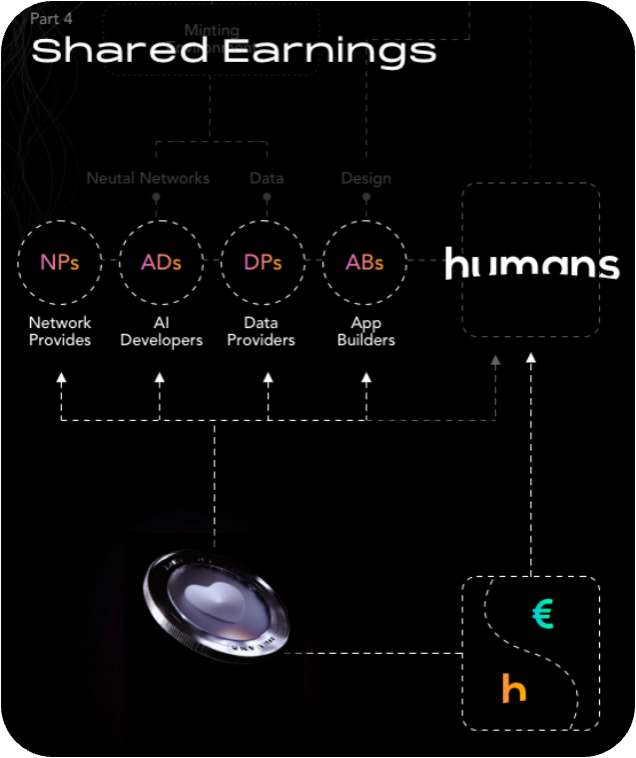
Four types of contributors to the platform automatically receive rewards based on a profit distribution algorithm. This idealized reward model aims to protect the rights of data providers, breaking away from the Web2.0 model of data and algorithm monopolies, returning data rights and developer rights back to the contributors themselves.
Governance is crucial in the ecosystem, as the community places humans at the forefront of the AI revolution, with the sole goal of aligning AI objectives with human goals. Governance underpins everything we do and will play a central role in our ecosystem.
Currently, Human.AI operates two levels of governance—protocol level and AI NFT level. Protocol-level governance is well-documented and adheres to current governance standards, collaborating with communities and major projects such as Terra, Cosmos, and Osmosis.
Given that AI NFTs will generate economic value proportional to their utility, owners of AI NFT DAO tokens will have a say in the pool of $HEART collected from incoming requests. For example, a voice data provider could set restrictions on what kind of voice-minting requests are acceptable (e.g., only for commercial videos), and human validators would check each request to ensure compliance. However, if the data provider chooses a DAO-style governance model, a decentralized rule system would present an entirely different landscape shaped by the community.
Summary
So, as a forward-thinking Web3 + AI project, has Humans.AI succeeded?
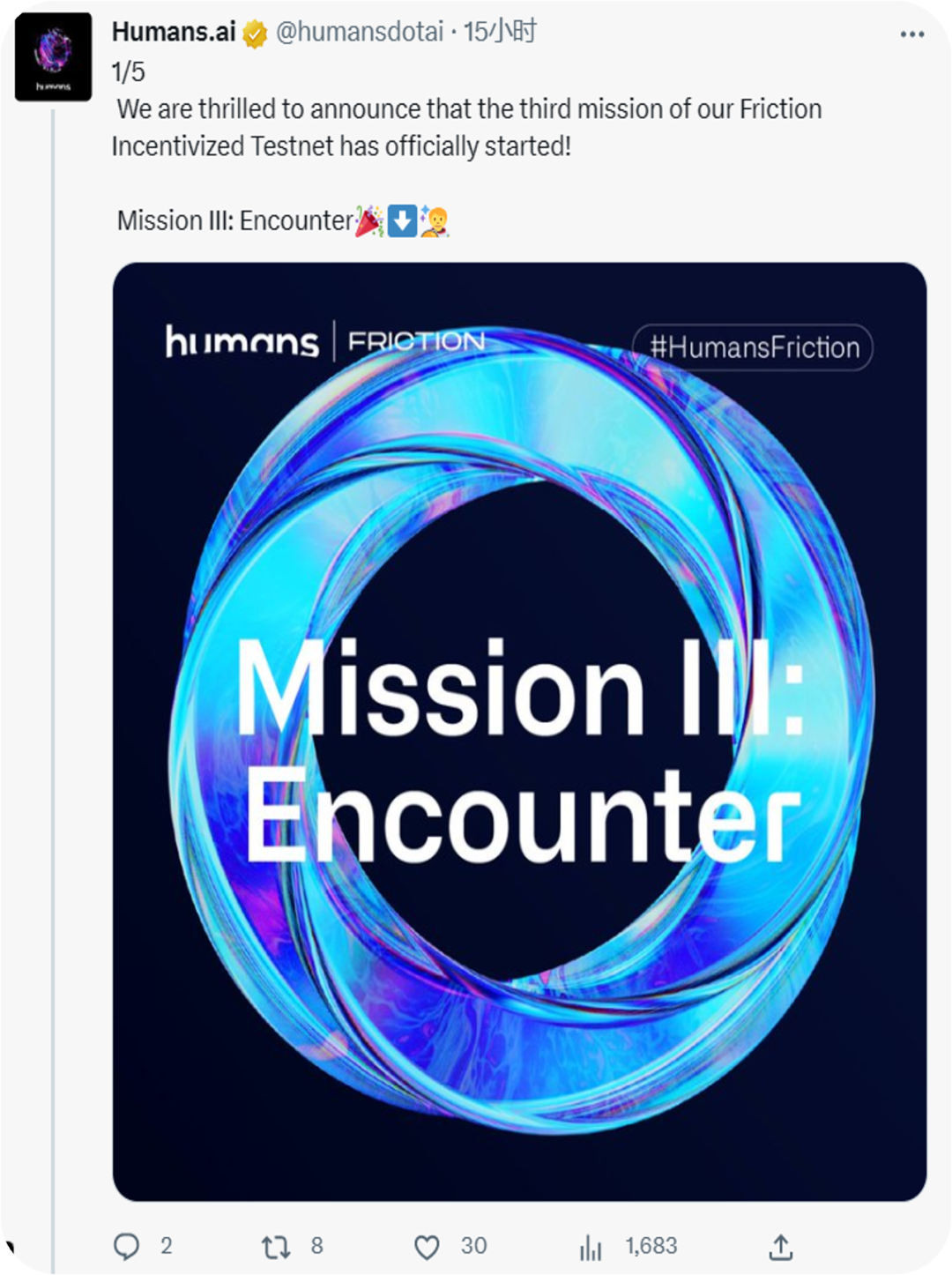
At least for now, they’re still moving forward. Although the Humans.AI project is far from perfect—the PoH mechanism’s quantification of human ethics remains overly idealistic, packaging AI into NFTs poses technical challenges, and AI itself, at its current stage of development, is still insufficient to achieve true "digital twins."
But none of that really matters. The greatest significance of Humans.AI does not lie in the project itself, but in what it tells us explorers:
When humanity seeks digital immortality, Web3 will be the key to preserving thought forever.
And that is enough.
Join TechFlow official community to stay tuned
Telegram:https://t.me/TechFlowDaily
X (Twitter):https://x.com/TechFlowPost
X (Twitter) EN:https://x.com/BlockFlow_News
 Go2Mars Capital