Interview with MyShell Founder: Building a Super Factory for Robots
TechFlow Selected TechFlow Selected
Interview with MyShell Founder: Building a Super Factory for Robots
MyShell's growth is very "organic," more evolved than meticulously designed.
 Navigating Web3 tides with focused insights
Interviewers: Afra, Zohar
Article: Afra, ChatGPT
The Starting Point of MyShell's Viral Growth
"Just three or four weeks after our initial demo bot launched, our user community surpassed 8,000 people. At that time, we saw over 30,000 total users in the backend."
"There were 8,000 people in the group chatting actively every day. Throughout March and April, it was the community’s gradual contributions—code and module development—that built us up. During this period, some users even offered to invest in us." "At the time of publication, total user count has exceeded 100,000."
MyShell’s growth has been remarkably 'organic'—less engineered, more evolutionary
"Back then, GPT and many large language models had just emerged, and we were amazed by their text capabilities. But we thought, what if we could add a truly compelling voice? That way, it wouldn’t just be a chat tool—it could help users learn new languages. Since Rick happened to need practice with spoken English at the time, we spent one day building a bot. Once it was done, we were blown away—and Rick loved it. He could now practice English with Samantha (note: MyShell’s earliest bot, voiced by Scarlett Johansson) without feeling the usual embarrassment of speaking English with real people."
"Then we posted about it on WeChat Moments. We never expected that single post would cause our Telegram group to grow from dozens to a few hundred, then suddenly jump to 1,000, then rapidly climb to 8,000 members."
"A robot that feels incredibly human, capable of direct voice conversations—you simply press the voice button, speak, send, and the bot replies with voice."
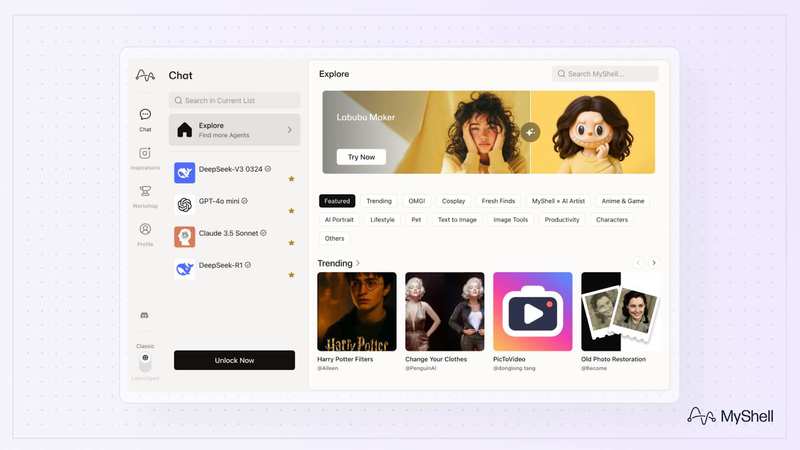
MyShell is a no-code bot creation platform
AI Vanguard: First, could you introduce your product MyShell, share your current achievements, and discuss your future plans?
Rick, Founder of MyShell: Our goal is to build a no-code platform that allows even non-programming college students to easily create their own bots. Recently, our Bot Workshop feature officially launched. Since opening up creation to users, participation has exploded—we already have nearly 60 user-created public bots, and over 100 private bots. In the previous two months, we only built five bots ourselves.
Our platform hosts various types of bots—language learning, education, pure utility tools, and more. We want users to mix and match based on their interests. Currently, we’ve integrated voice generation capabilities and plan to add image modules soon. We aim to make bots more human-like and composable, meeting diverse niche market needs.
Featured Bot Showcase
-
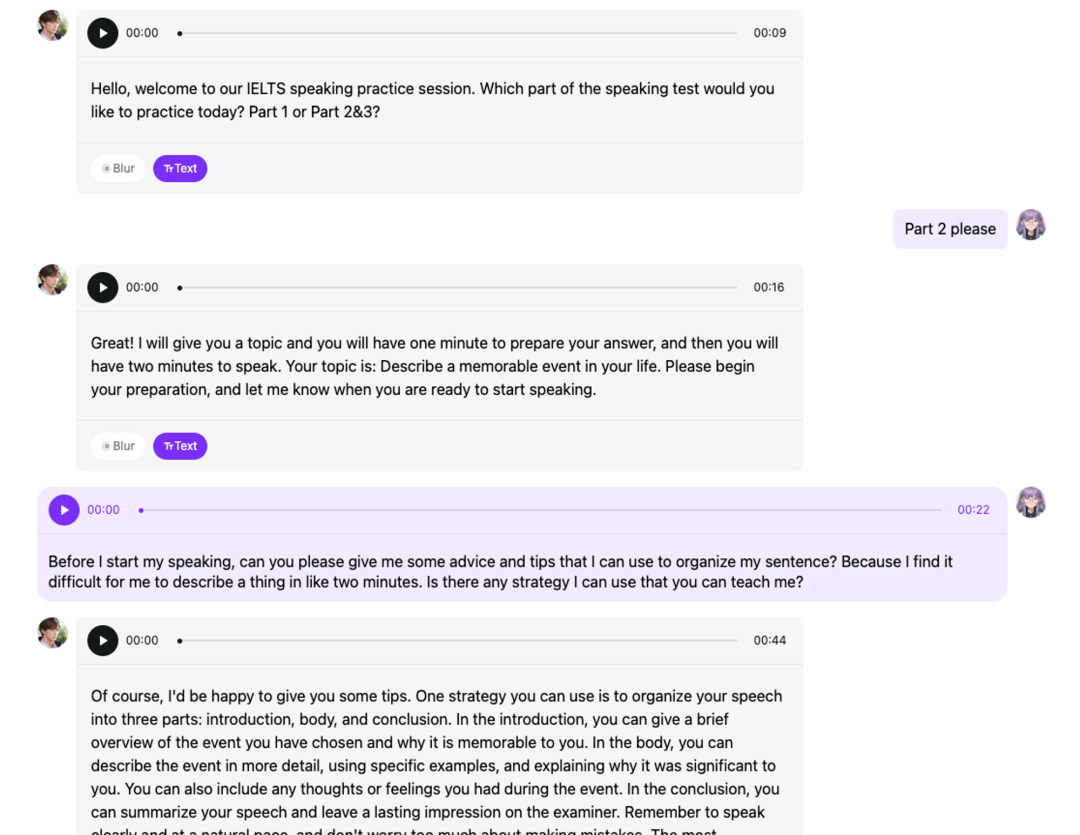
YUKI - IELTS Teacher Ben
-
[IELTS Teacher Ben] provides one-on-one mock practice and spoken English correction
-
Usage example:
-
-
Kaiserwetter - MBTI Stimulation
-
Chat with any MBTI personality as any identity
-
Usage example:
-

We divide roles on our platform into model providers, bot creators, and users. We aim to establish a healthy, sustainable economic model that enables organic collaboration among them. Users can choose their favorite bots, bot creators can select high-quality models, and model developers gain valuable use cases and high-quality data on the platform.
AI Vanguard: I understand you're using something similar to the LangChain architecture—enabling more people to participate in ecosystem building through no-code tools.
Ethan, Founder of MyShell: Yes, that's our goal. Unlike LangChain, which mainly integrates text modalities for faster text input/output development, we believe multimodality is critical. That's why we've developed and integrated voice capabilities, and plan to add image understanding and generation soon. This makes our platform simpler and more versatile—a key advantage we see in multimodal integration.
Large language models should act as super glue connecting other modalities and services
AI Vanguard: Regarding personalization, I think this deserves deeper discussion. Personality isn't just about a bot's appearance or voice—it's more about communication ability and service quality. What are your thoughts?
Rick, Founder of MyShell: We divide bots into two layers: the surface layer—the interface that interacts with users—and the capability layer—what the bot can actually do. We believe large language models should serve as super glue, connecting other modalities and services. Think of these bots as traffic coordinators, dispatching user instructions to specialized modules best suited to handle each task.
For the capability layer, we believe functionality should be highly standardized—especially basic functions like ordering food or solving math problems. But differentiation in the surface layer—the interaction interface—is crucial. The UI must feel deeply human, enabling strong emotional connection, understanding user intent well, and orchestrating different small models behind the scenes.
Ethan, Founder of MyShell: Large models can understand user intent based on usage patterns, but they should coordinate many smaller models working together in the background. A primary LLM or specialized model familiar with the user acts as the dispatcher, routing tasks to appropriate capability modules. For instance, when asking about weather, translation, or other functional queries, the bot needs strong comprehension of user habits and intentions.
Rick, Founder of MyShell: Let me give a concrete example using a familiar scenario: during a work meeting, when we encounter a technical problem, we often bring in another person to review the issue and offer suggestions. Similarly, while chatting with our bot Samantha, you might say, 'We’re having dinner tonight with 12 people—any recommendations?' Samantha could then invite a chef bot into the conversation to assist. These bots share awareness—they know each other exists and what unique capabilities each offers—and can summon one another when needed.
Secondly, regarding multimodal capabilities, bots will support various model types and services, choosing how to respond based on context. For example, if I ask Samantha for home renovation advice, communicating via text alone would be cumbersome—but invoking an image modality could resolve it in seconds. Knowing when to call which modality is perhaps a key aspect of personalized UI design.
Future large models will grow ever more powerful, but likely remain controlled by a handful of leading companies
AI Vanguard: How has the emergence of large models impacted the industry? And where do you see them heading?
Ethan, Founder of MyShell: First, models like GPT have posed massive challenges to the past decade of NLP algorithms. Previously, we used separate algorithms for distinct tasks—dedicated translation, grammar correction, etc. Now, one giant model can achieve what once required multiple specialized models. Many dedicated algorithms have become obsolete because new general models outperform them even on specific tasks.
Second, models like GPT-3 exceed 100 billion parameters, making training prohibitively expensive for startups using consumer or small-scale proprietary hardware. However, approaches like LoRA (Low-Rank Adaptation of Large Language Models) allow fine-tuning of pretrained giant models with minimal parameter adjustments, drastically reducing costs.
Meanwhile, we believe future large models will keep growing stronger but will likely be monopolized by only a few top-tier companies. The flourishing open-source community will drive widespread adoption of techniques like LoRA, leveraging state-of-the-art general models with proprietary data to spawn countless small, specialized models.
We believe large language models will increasingly resemble brains—connecting all APIs, algorithms, and tools. They’ll orchestrate external knowledge, services, and inputs to accomplish complex tasks.
AI Vanguard: Right now, we observe that other models aiming to catch up with GPT-4 either rely on unique datasets or domain-specific expertise trained on vast proprietary data. If GPT-5 launches, what challenges do you foresee for models trying to compete with OpenAI?
Ethan, Founder of MyShell: We believe GPT-5 may be extremely powerful, but also extremely costly. Thus, we expect future models to diverge—users will choose based on cost-performance and needs. Post-GPT-5, such models may primarily serve high-volume, standardized data production. Though expensive, they’d still be cheaper than human labor. There are already precedents—Stanford University uses GPT-generated data to train smaller models.
We also speculate Apple, despite seeming inactive in the LLM era, holds strong terminal and chip-making capabilities. Their mobile-specific chips might efficiently run local large language models—solving data privacy concerns while optimizing response speed. We believe Apple could play a transformative role in reshaping the current dominance of OpenAI API reliance.
AI startups seeking competitive moats should focus on algorithms and data
AI Vanguard: From an entrepreneur’s perspective, what do you see as the biggest obstacles and challenges facing AI startups today?
Ethan, Founder of MyShell: One dangerous trend is that foundational model companies like OpenAI may absorb opportunities from both traditional firms and emerging GPT-based startups. It’s hard to predict how GPT-4 and GPT-5 will evolve—many infra-layer tools closely tied to OpenAI risk being replaced by native OpenAI features.
Grammarly’s current situation exemplifies this. Entrepreneurs must carefully consider how to balance innovation against giants’ expanding capabilities—a critical strategic question.
For us, we identified multimodality as crucial early on. All our R&D effort goes into highly personalized, human-like voice synthesis algorithms. We believe this modality won’t be reached by OpenAI within the next year—giving us a technological edge. By combining cutting-edge text-based products with our own open-source algorithm fine-tuned small models, we avoid concentrating all our efforts too close to the large language model layer.
Additionally, open-source progress accelerates rapidly. From this year alone, open-source advancements in large language models have been dramatic—the best open-source models now approach GPT-3.5 performance. In just three months, from Facebook’s leaked LLaMA pretraining model, to academic projects like Alpaca and Vicuna from Stanford and CMU, to image-understanding MiniGPT—open-source momentum is vital, forming a unique and powerful counterbalance to corporate-led GPT dominance.
In this context, MyShell must build defensible advantages before open-source erodes our lead. We must establish barriers in algorithms and private data—because no matter how fast open-source evolves, we can always combine the latest open algorithms with our proprietary data to surpass even general models. Beyond technical moats, we must leverage short-term tech advantages to build multi-sided network effects, accumulating community and content barriers. Platforms like TikTok and Taobao thrive on multi-sided supply-demand networks. When a platform already hosts numerous active creators and users, newcomers face immense non-technical hurdles breaking in.
AI Vanguard: Facing these dual challenges, do you already have concrete strategies in mind?
Rick, Founder of MyShell: We believe in going with the flow. As open-source grows stronger and large models advance, startup ideas should evolve alongside. Ideally, your startup idea becomes stronger *because* open-source improves and models get better. Seek such synergistic opportunities—anything directly challenging these forces risks dying quickly this year.
Ethan, Founder of MyShell: Everyone’s fomo-ing over large language models this year, but we believe multimodality is key—so our core moat centers on voice. Past voice synthesis was either too costly or low-quality for mass application. Now, we synthesize any human voice at two orders of magnitude lower cost than existing APIs, achieving emotionally rich speech.
Second, we prioritize closed-loop data collection during user interaction to accumulate high-quality datasets. For example, I released a bot called 'voice collector'—we encourage users to contribute voice or text data while using our product, helping refine our algorithms to sound more human and empathetic. This data forms proprietary, scenario-specific datasets—a lasting moat regardless of open-source evolution. By offering creators powerful, easy-to-use tools, we attract more users, ultimately forming a content and creator ecosystem barrier. Once established, we won’t fear rapid underlying tech shifts—because if our monetization and operational efficiency lead the market, we can always integrate the best APIs or train on top open models using our proprietary data.
This is a new era of technological acceleration
AI Vanguard: Tell us about your past entrepreneurial experiences, why you chose this moment to start a company, and why you’re approaching it from a Web3 angle?
Rick, Founder of MyShell: We began AI entrepreneurship in 2013. We’ve had brief stints as employees, but mostly stayed in startup mode—so continuing to found companies feels natural.
In 2013, I founded a computer vision company focused on AR SDKs. Back then, Apple hadn’t released ARKit, so we developed a similar solution. Later, I met Ethan, who was studying at Oxford and joined my company during a return internship. Eventually, Ethan founded a VR startup tackling spatial capture and navigation in virtual environments—later acquired to become Beike Zhaofang’s VR home tour product.
Over the years, we’ve researched AI algorithms and commercialized them, gaining deep experience in large-scale deployment and consistent quality output. Later, we both joined an AI unicorn, leading the robotics division. That experience showed us robotics is fascinating—being inherently multimodal, introducing new modalities when one fails. This philosophy aligns perfectly with our current software bot approach, planting the seeds for our startup.
We chose this moment because we witnessed the extraordinary power of models like GPT-4, signaling a new era of technological acceleration. Ever since seeing ChatGPT late last year, we’ve oscillated between confusion and awe—extremely excited yet fearful. Even industry pioneers are stunned by OpenAI’s pace.
We believe natural language is profoundly important—once AI gains direct mastery over it, the boundary between humans and machines dissolves, ushering in a new acceleration phase where more modalities merge and connect. This renders much of what we did before less relevant. Faced with such acceleration, we had no choice but to reset—zero out all past assumptions about startups and technology—and rethink everything from scratch. So in March this year, we decided to launch a company and quickly released our first demo.
Ethan, Founder of MyShell: Personally, Web3’s economic models and efficiency in multi-sided networks drew us in—we want to harness these tools to fulfill our mission of building a multimodal bot creation platform. Moreover, the AI era unlocks unprecedented content creation efficiency. Whether image generation (like Stable Diffusion) or text generation (like GPT), AI empowers non-experts to solve productivity challenges in specific scenarios—boosting efficiency by 1–2 orders of magnitude. In such a world, value definition and distribution become paramount. Web3’s multi-sided platforms and cryptographic technologies greatly enhance our ability to build creator ecosystems, addressing new ownership and value allocation challenges in the AI age. Using Web3 mechanisms like smart contracts, we can decentralize economic rewards; token-holding mechanisms provide platform liquidity. While current tech isn’t mature, encryption and blockchain hold potential to resist centralized corporate control and enable community-driven, multi-role economic systems. Hence, we architect our model from this angle—traditional corporate structures don’t suit our platform.
The Pandora’s box is open—AI arms race won’t stop
AI Vanguard: Many industry leaders are now warning about AI development—Geoffrey Hinton left Google and issued cautions about AI’s future. What’s your take?
Rick, Founder of MyShell: There’s a clear issue here—much of today’s internet infrastructure and systems aren’t ready for this new wave of AI. Many things may prove defenseless against advanced large models, raising serious security concerns. Then there’s data—there’s good data, like IELTS tutoring or emotional companionship, but also bad data: misinformation, spam, troll armies. When this happens, you can only “fight magic with magic”—deploy larger defensive models to counter them. This poses major challenges for small companies or individuals lacking security awareness.
Ethan, Founder of MyShell: Indeed, since humans invented this technology, once its usefulness is proven, competing forces inevitably intensify. The AI arms race between Microsoft and Google mirrors the US-Soviet moon race—neither side will back down. Human desires will keep pushing evolution forward. We can only wait and see what unfolds.
Rick, Founder of MyShell: I deeply understand why OpenAI’s Sam Altman also launched Worldcoin—because we’re likely facing severe data pollution ahead. We must ensure data provenance. Data must be traceable to legally responsible individuals. You can lie—but we must verify the data came from a real person, so accountability follows.
Ethan, Founder of MyShell: Worldcoin aims to ensure every physical-world individual has a unique ID across the internet and blockchain worlds. Solving this could address the data ownership issues Rick mentioned. Also, I believe Worldcoin reflects Sam’s broader thinking about how future human society should be structured.
The most important thing in entrepreneurship is having a beginner’s mind—don’t cling to old habits
AI Vanguard: As seasoned entrepreneurs, what advice would you give to those looking to start AI ventures?
Rick, Founder of MyShell: First, entrepreneurship isn’t the only path. For non-founders, riding the AI wave offers abundant opportunities—many niche areas previously underserved due to lack of manpower may now flourish. Society’s productive value will leap forward. Ordinary people can better plan lives or invest wisely in high-opportunity areas.
But for founders, the most important thing is having a beginner’s mindset. Past empiricism or decades-long internet habits may mislead people into thinking this is just another mobile internet opportunity. In reality, AI may trigger a completely new technological acceleration in unprecedented ways. So shed old habits, embrace emptiness—only then can you succeed in this field.
Ethan, Founder of MyShell: In this AI era, many specialized small models will emerge, and composability between algorithms and models will grow stronger and more flexible. A single product might integrate technologies from different companies within the same modality to serve users. With rapid tech evolution, products will become increasingly adaptable. Founders must stay observant and innovative to navigate this fast-changing landscape.
Join TechFlow official community to stay tuned
Telegram:https://t.me/TechFlowDaily
X (Twitter):https://x.com/TechFlowPost
X (Twitter) EN:https://x.com/BlockFlow_News