IDO oversubscribed, listed on Binance spot—time to understand MyShell's products and token economics
TechFlow Selected TechFlow Selected
IDO oversubscribed, listed on Binance spot—time to understand MyShell's products and token economics
Will MyShell's emergence reignite the popularity of AI Agents on BSC?
 Navigating Web3 tides with focused insights
Written by: TechFlow
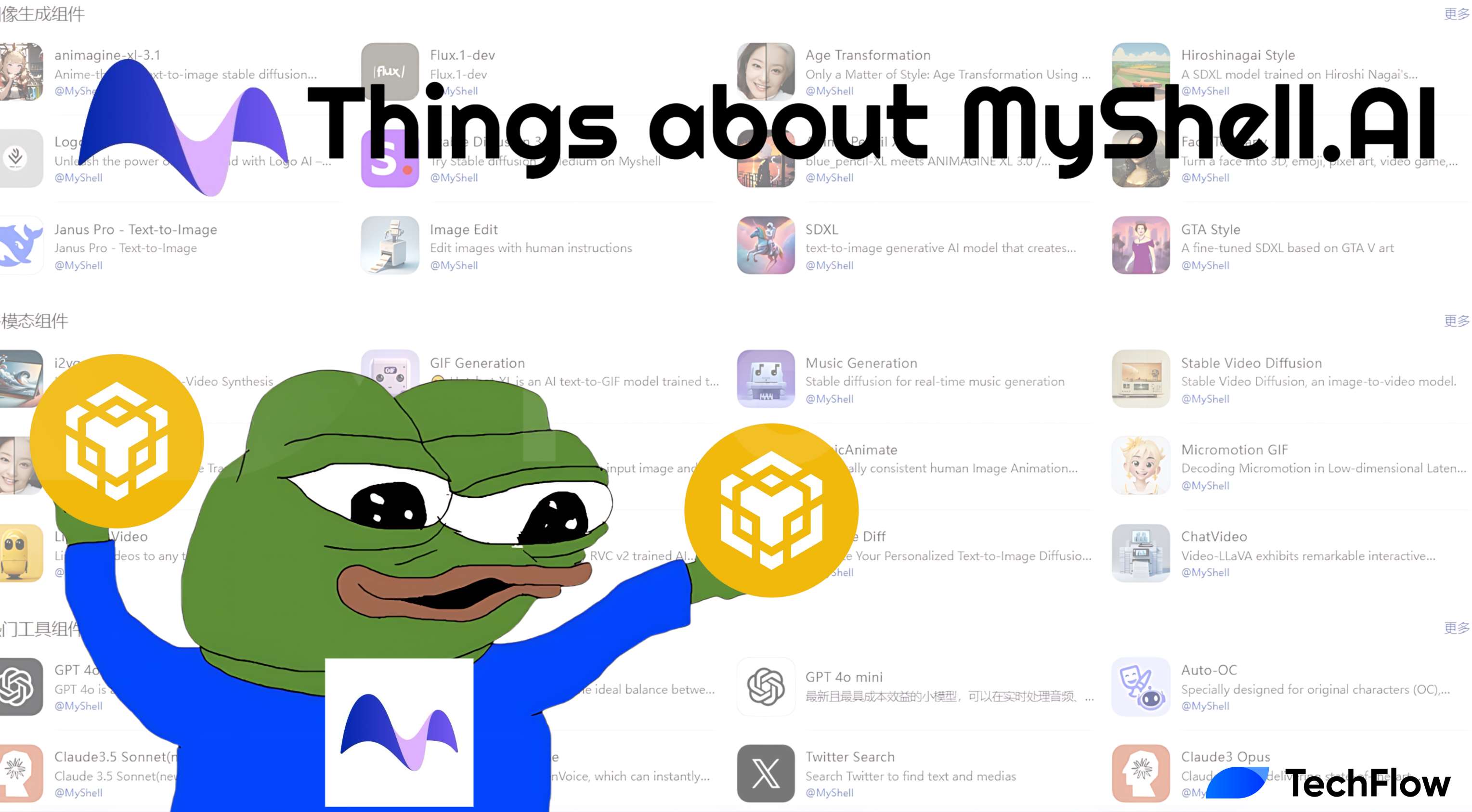
Today, Binance HODLer Airdrop Program has launched its 10th project, MyShell (SHELL), with SHELL trading officially going live at 21:00.
Impacted by this news, SHELL surged over 35% in a short period.
This article provides a detailed introduction to MyShell's products and tokenomics, with key points as follows:
The spotlight today is undoubtedly on MyShell’s token $SHELL.
Following CZ's return and the rising popularity of memes on the BSC chain, today’s $SHELL token IDO on Binance Wallet and Pancakeswap has also attracted significant attention and real capital investment.
Under the offering rule of "raising 800,000 USD worth of BNB for 40 million $SHELL tokens, representing 4% of total supply," the IDO had already been oversubscribed nearly 42 times as of press time—clearly indicating strong market participation.
Meanwhile, discussions on social media have visibly increased at a rapid pace.
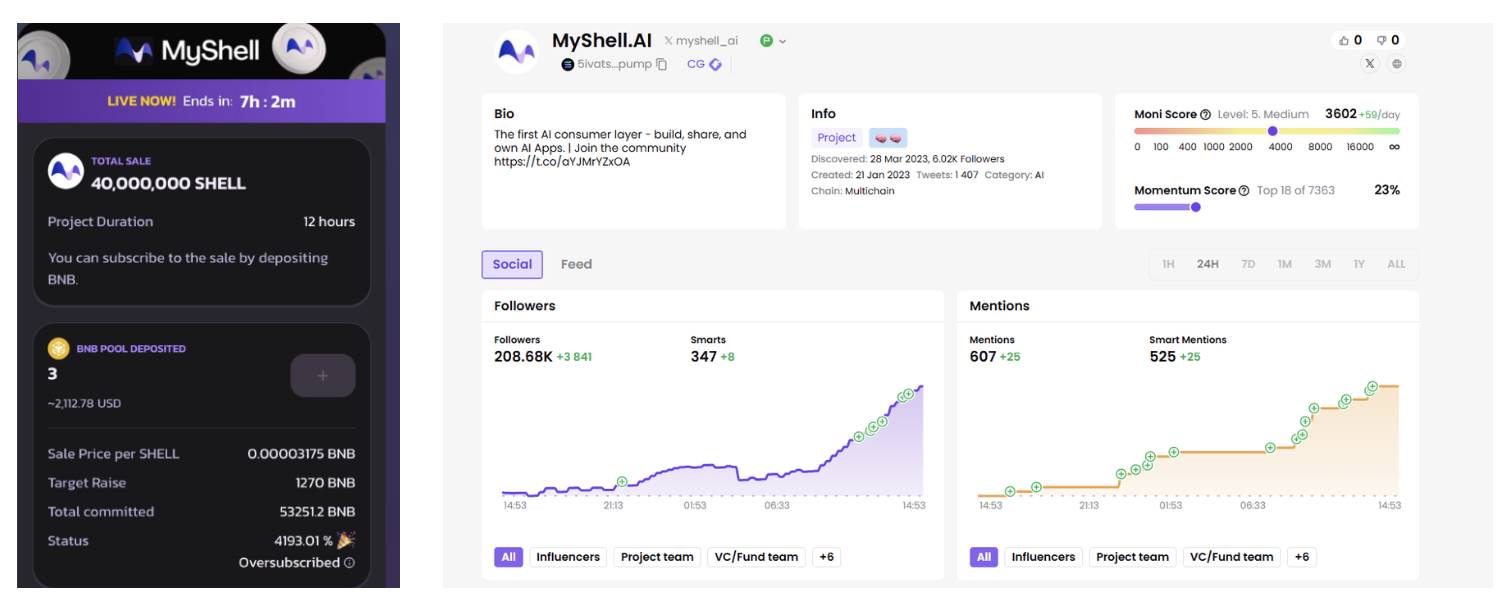
The real reason people are eager to participate lies in the foreseeable "easy profit" effect.
If 4% of the $SHELL tokens raised $800,000, then this IDO values the entire $SHELL token market cap at just $20 million. According to estimates by KOL @EnHeng456, data shows that MyShell’s three public funding rounds have already totaled $16 million, implying that the valuation after the latest round should be between $150 million and $300 million.
In other words, theoretically, getting in early means guaranteed profits.
More importantly, MyShell is not just another empty AI meme; it currently offers a usable platform where users can create new AI Agents and tokenize them.
Given Virtuals’ rapid rise in the past, and with the AI Agent sector facing reshuffling and Binance seemingly aiming to support the BSC ecosystem, will MyShell ignite another wave of AI Agent enthusiasm on BSC?
With this expectation in mind, if you're rushing in blindly without understanding what MyShell actually does, here is a comprehensive overview of MyShell’s products and features to help you make informed decisions ahead of time.
Your AI Toolset and Marketplace
There's already plenty of information available about MyShell, but most introductions focus on high-level AI technology narratives, which aren't very intuitive.
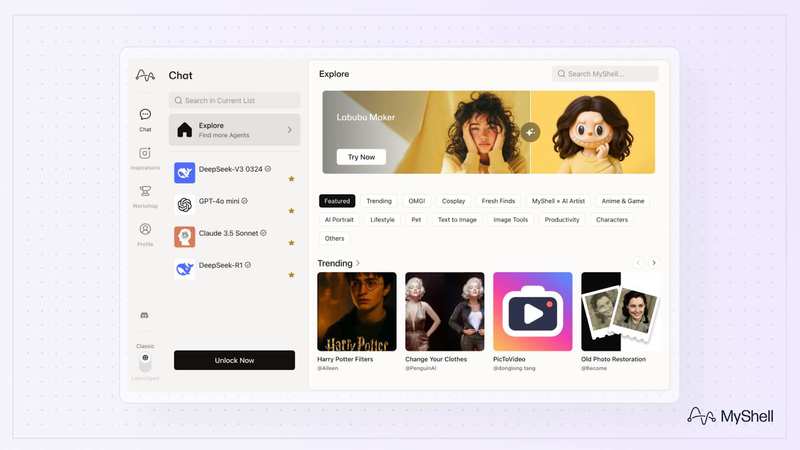
If you've recently been bombarded with DeepSeek-related news and have tried chatting with it, consider switching to an ordinary user’s perspective and take a look at what MyShell’s final interface actually looks like.
-
Chat Interface Integrated with Mainstream AI Models
Upon opening MyShell’s product page, you’ll immediately recognize one of its main functions: the familiar AI chat experience.
A notable advantage is that MyShell has already integrated multiple mainstream AI models such as GPT, Claude, and the recently popular Deepseek.
You can simply type text into the chat window to start a conversation—just like any other AI service you’ve used, requiring almost zero learning curve. You wouldn’t even realize this is a Web3 project. However, note that each conversation consumes a certain amount of credits.

-
AI Tool Marketplace
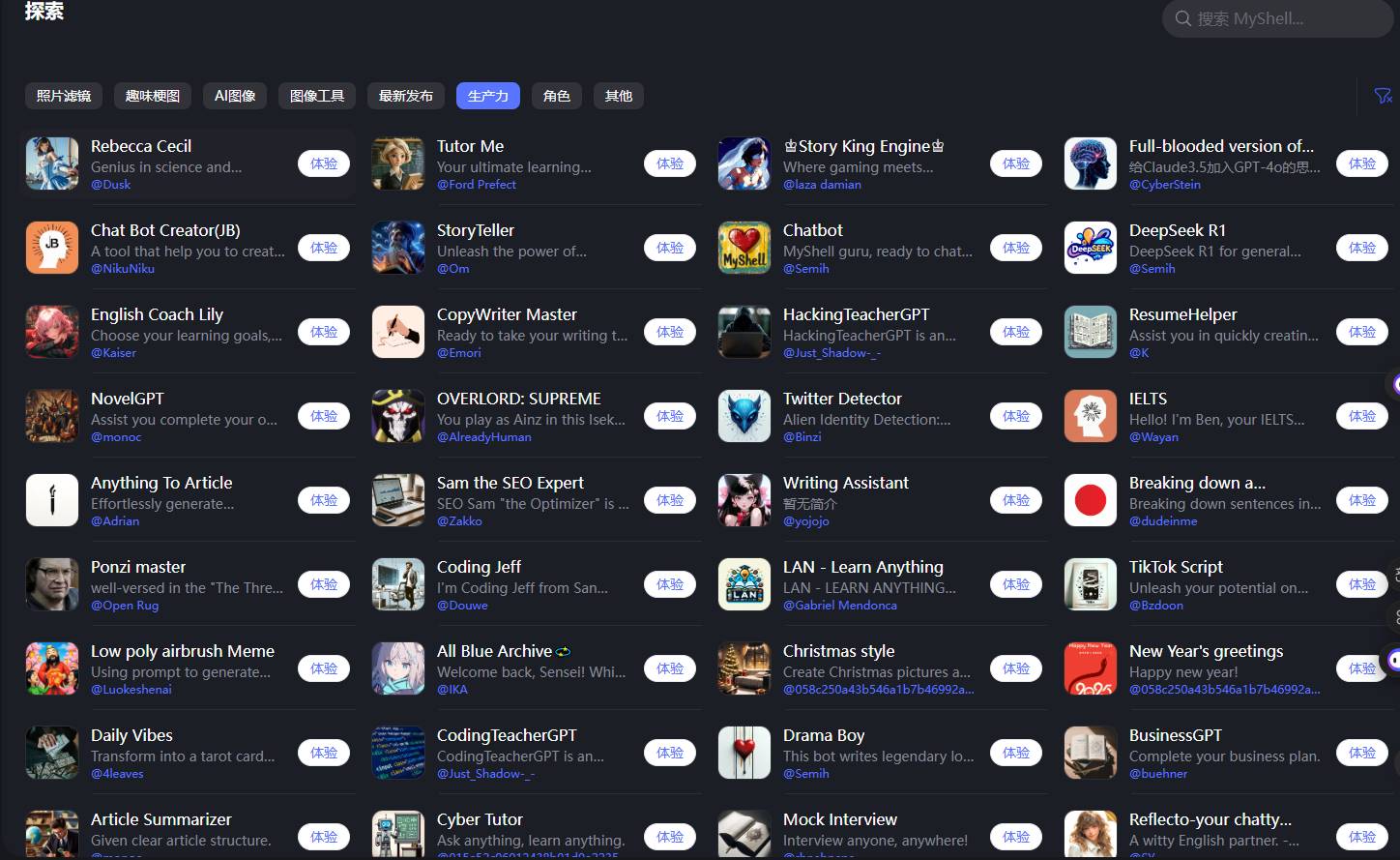
Beyond chatting with these major AI models, you can also interact with AI Agents created by other users on MyShell, each having distinct functionalities and use cases.
For example, if you want to transform a photo into the art style of GTA games, you can select a GTA Filter tool, upload an image in the chat window, and the tool will instantly convert your photo into GTA-style visuals.
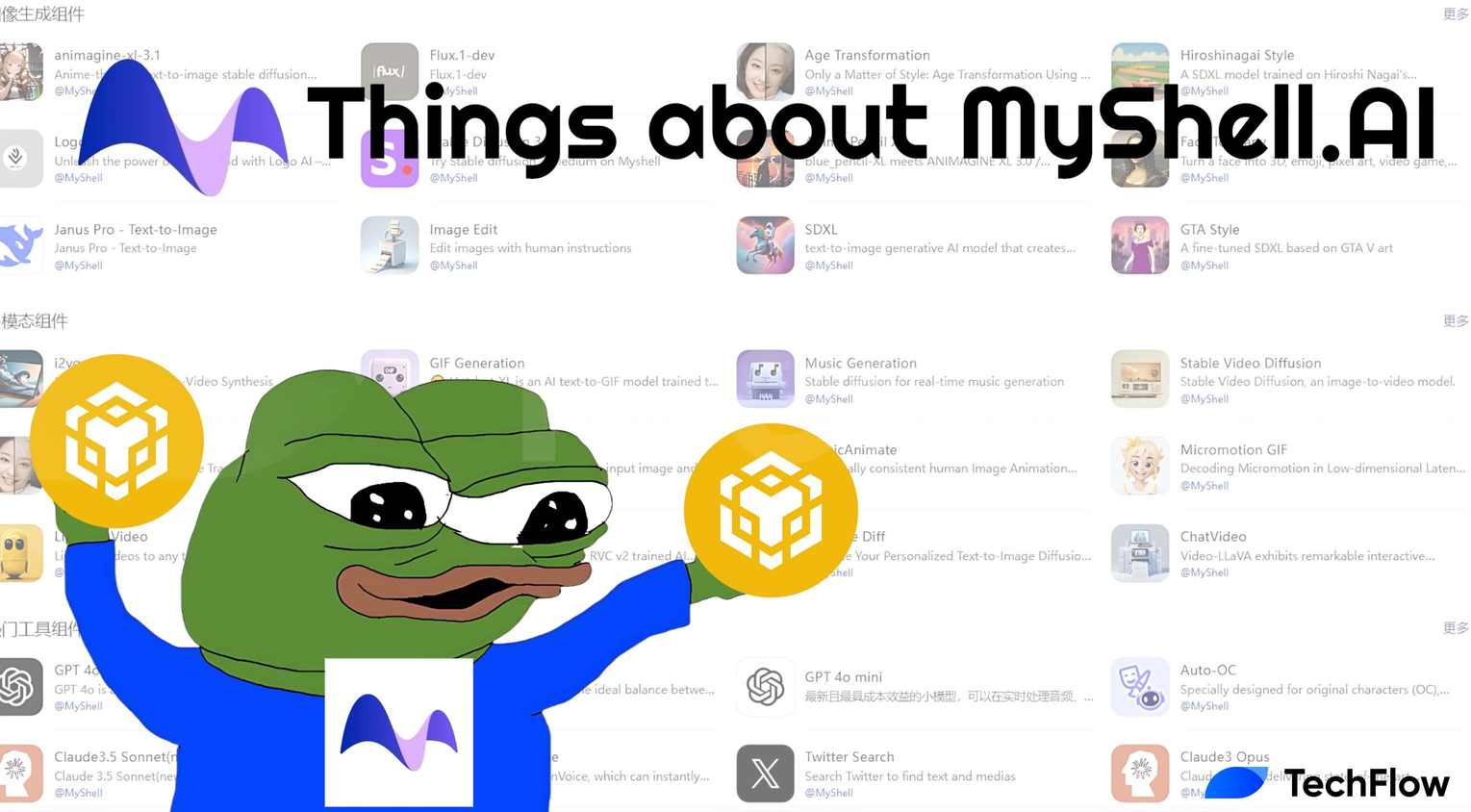
There are many similar tools across various domains designed to boost productivity, such as SEO optimization, IELTS preparation, article writing, and code editing. Think of it simply as the built-in store within GPT.
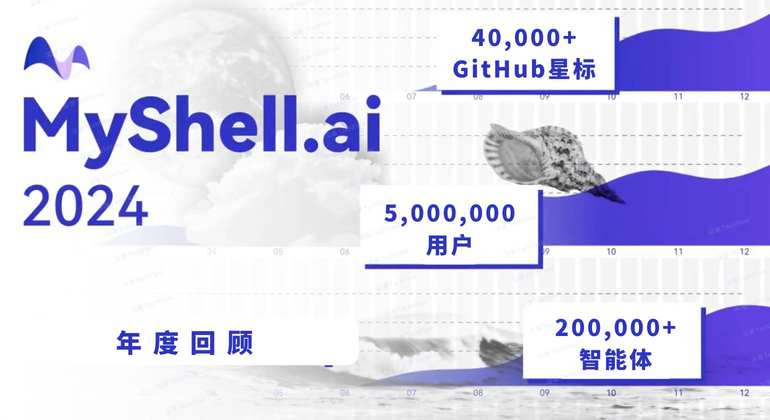
Official data shows that over 200,000 AI agents have already been deployed on the platform, with the ecosystem rapidly expanding.
-
Creation Studio: Modular Construction of Your Own AI Agent
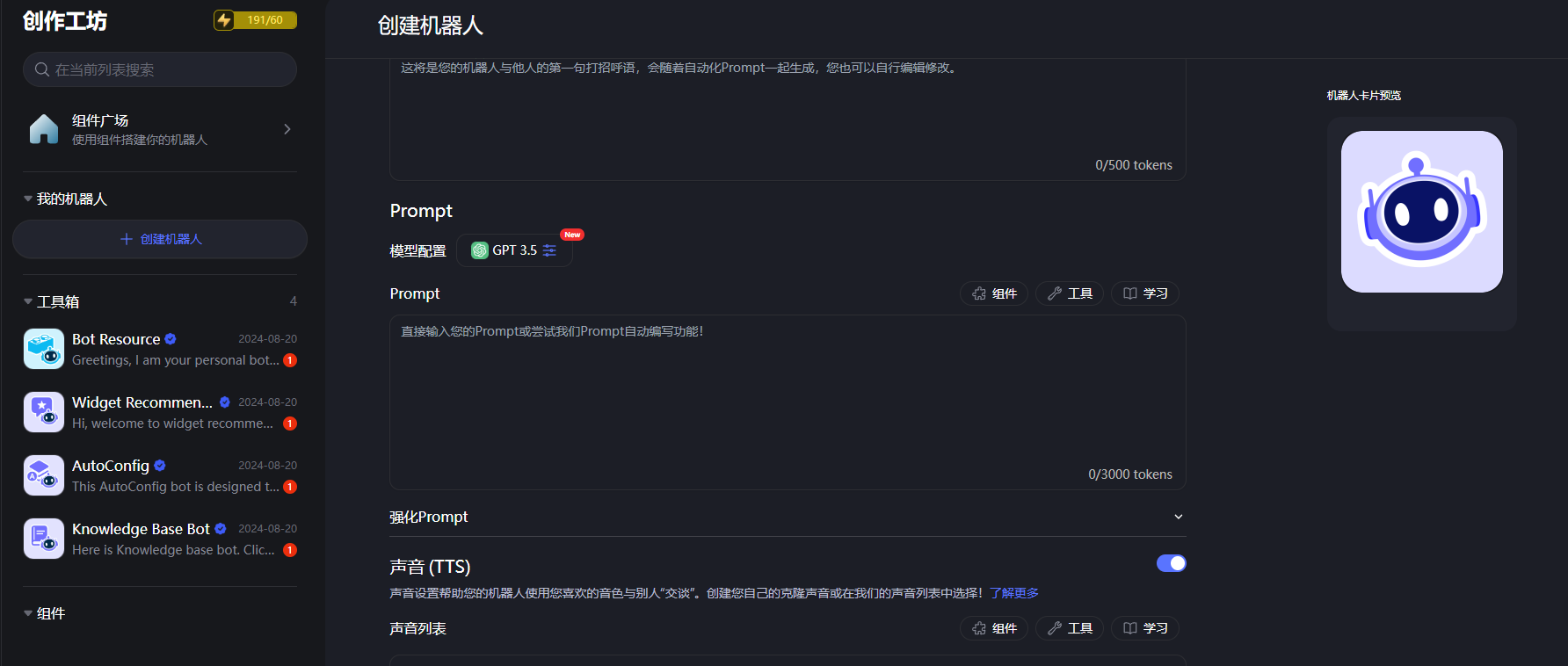
If you wish to build your own AI Agent, you can do so using MyShell’s Creation Studio feature.
Unlike casual, toy-like AI Agent builders, MyShell’s component library is significantly more powerful.
Typically, building an AI Agent requires calling upon existing large models and functions. MyShell has already integrated over 100 mainstream open/closed-source models. Additionally, it has developed several open-source AI models of its own—three of which are publicly available on the project’s Github, collectively amassing close to 20K stars.
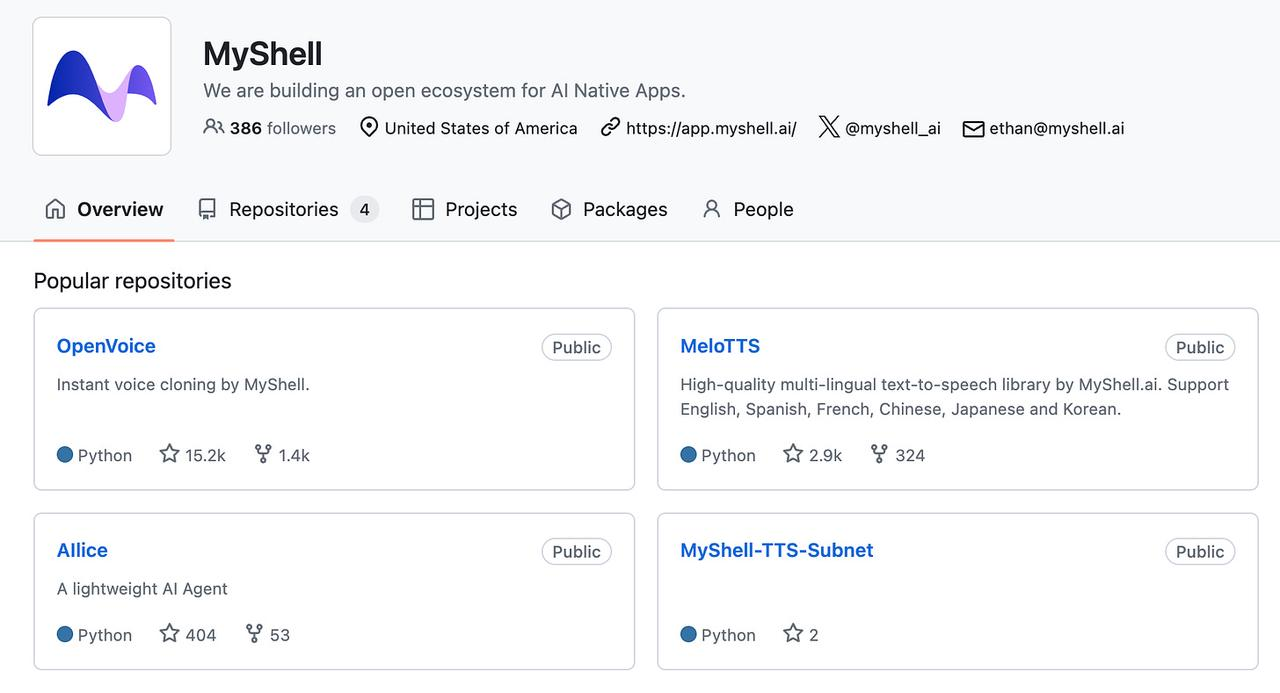
In other words, if you’re trying to build a house, this Lego set is far more advanced—enabling modular construction by leveraging best-in-class components without reinventing the wheel.
This capability may not seem immediately beneficial to casual users, but light users can still directly enter prompts and specify tasks on the Creation Studio page, while leveraging MyShell’s ready-made tool library.
For instance, if you want to create an AI Agent that chats with you, simply call upon its voice library and GPT model.
-
AIPP Store: The Great Tokenization Race for AI Apps
It's only when you reach this section that you truly feel the Crypto gameplay.
The AIPP Store is a core component of the MyShell ecosystem, allowing you to participate in the issuance and trading of AIPPs just like trading tokens—similar to how AI Agents were handled previously on Virtuals.
The AIPP Store also employs a Bonding Curve mechanism, automatically adjusting AIPP prices based on supply and demand.
When users buy AIPPs, supply increases and price moves up along the bonding curve; conversely, when users sell AIPPs, supply decreases and price drops.
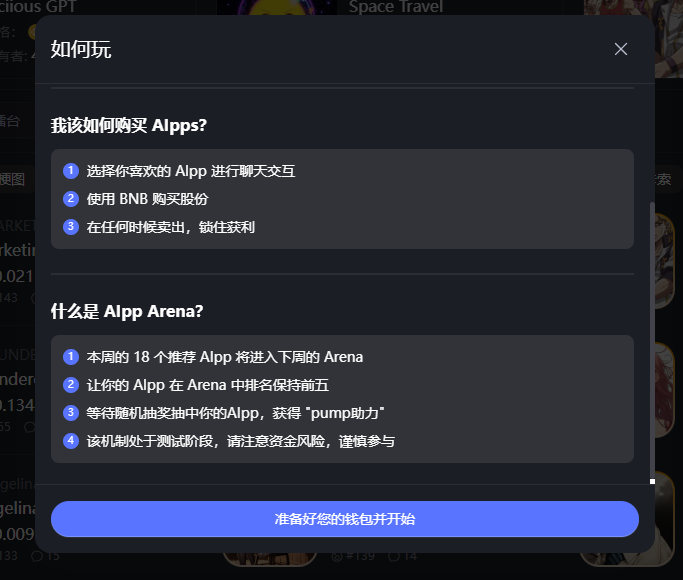
For example, if you believe in a particular AI Agent, you can purchase its token using BNB; the creator of that AI Agent then earns a portion from transaction fees.
The ultimate goal of this model remains price discovery—encouraging users to identify valuable applications early and spread the word. Early investors profit from rising prices, act as distribution nodes, and expand the application’s market influence.
So, what is the $SHELL token used for?
The total supply of $SHELL is 1,000,000,000 tokens. The tokenomics are briefly outlined as follows:
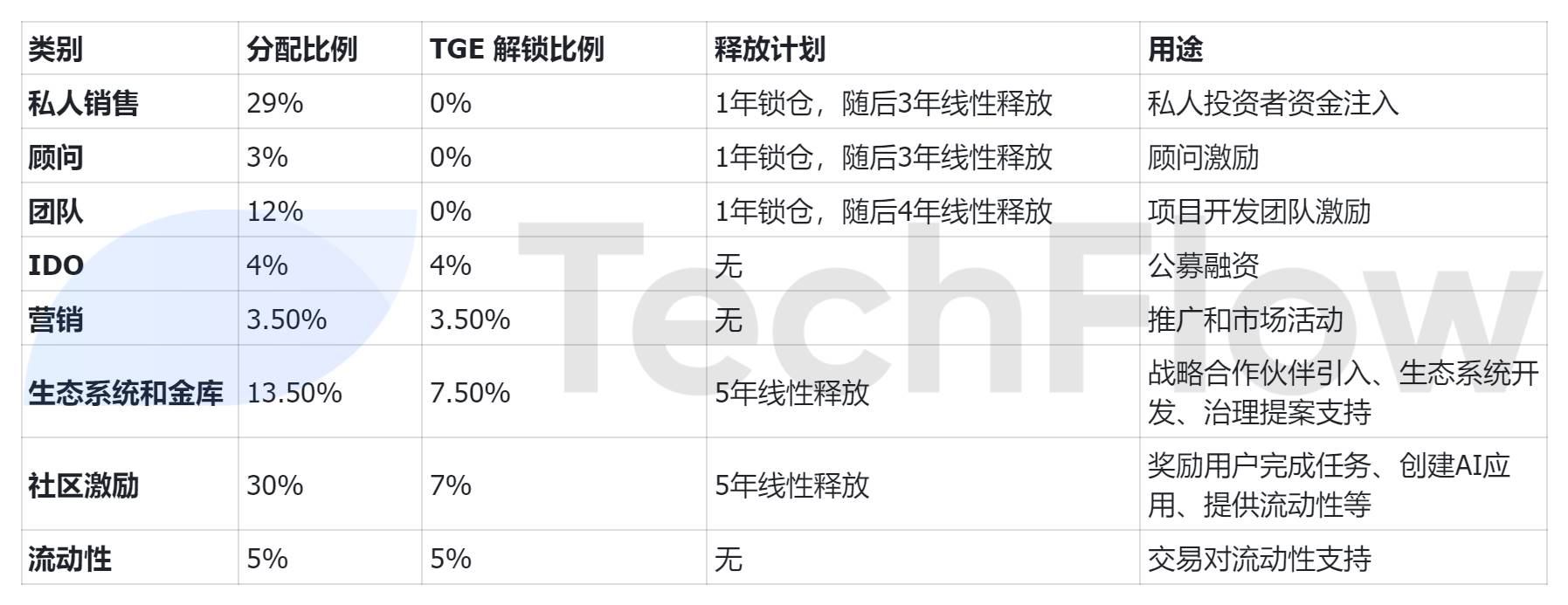
In terms of utility, the $SHELL token is closely tied to the behaviors of different participants across the MyShell platform.
-
Token Holder
Users holding $SHELL tokens can invest in or acquire tokens and participate in governance. Token holders may also receive rewards.
-
Creator
Creators earn $SHELL rewards by developing and publishing AI applications (AI Apps). Creators can use $SHELL to purchase data, advancing AI model development.
-
User
Users pay $SHELL tokens to subscribe to or use MyShell’s AI application services. Users can also earn $SHELL as rewards when authorizing data usage.
-
AI Model Contributor
Contributors who provide AI models receive $SHELL rewards. They can also earn additional tokens through data transactions.
-
API Developer
API developers earn $SHELL rewards by contributing tools or services.
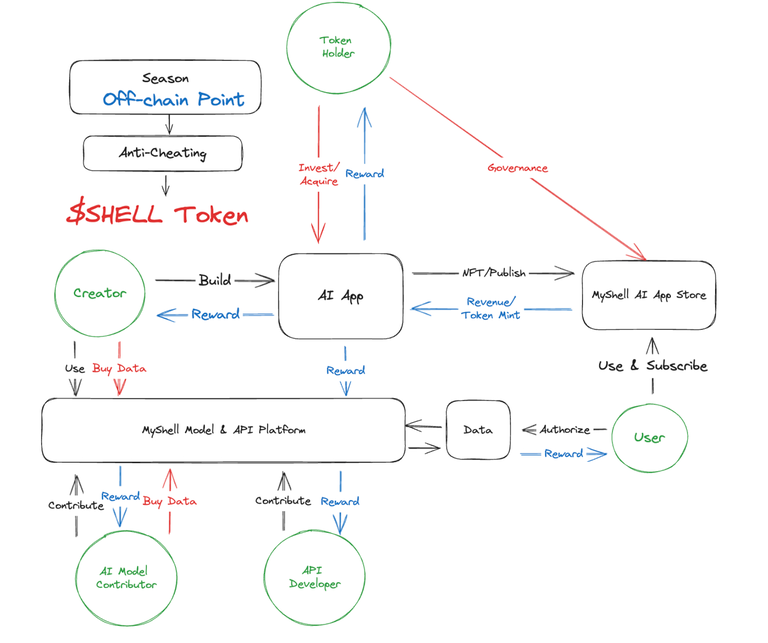
From a more commercial standpoint, MyShell can be viewed as an AI service platform. The token’s actual business role within this context includes:
-
Subscription and Membership Services (Membership Fees)
Users can pay $SHELL tokens to subscribe to high-quality AI tools or gain direct support. This membership model offers higher service value to users while generating stable token demand.
-
Advertising and Promotion (Advertising)
Creators or supporters can spend $SHELL to advertise their AI applications on the MyShell platform, increasing visibility and exposure. This provides creators with marketing tools and incentivizes the emergence of more high-quality content.
-
Application Collection and Incentives (Collection)
Users can pay $SHELL to collect other creators’ AI applications. During the collection period, users may also receive incentives via $SHELL or other reward mechanisms. This encourages exploration and support for innovative applications.
-
Product/Service Compensation (Products/Services Compensation)
-
Creator Revenue: Creators can charge consumers $SHELL tokens for access to or use of their AI applications.
-
Data Transactions: The MyShell platform may directly purchase data from users, paying $SHELL as compensation, further enriching the platform’s data resources.
-
Platform Fees (Platform Fees)
The MyShell platform charges a certain percentage of $SHELL as service fees for all the above activities. These fees are used for platform maintenance and further development.
Currently, no standout AI Agent projects have yet emerged on MyShell. After the token generation event (TGE), whether the ecosystem can foster more practical or attention-grabbing AI Agents or memes may become a key factor driving the native token’s price movement.
Join TechFlow official community to stay tuned
Telegram:https://t.me/TechFlowDaily
X (Twitter):https://x.com/TechFlowPost
X (Twitter) EN:https://x.com/BlockFlow_News
 深潮TechFlow