








MEV and Privacy Trends: Current State of MEV Technology and New Privacy Designs
TechFlow Selected TechFlow Selected
MEV and Privacy Trends: Current State of MEV Technology and New Privacy Designs
MEV is a technical topic that has become increasingly complex, especially after Ethereum's transition to PoS.
 Navigating Web3 tides with focused insights
Author: Lao Bai, Research Partner at ABCDE, Research Advisor at Amber Group
This article will cover trends in MEV and privacy.
MEV is a technical topic that has become increasingly complex—especially after Ethereum's transition to PoS. Just the non-user roles involved in MEV include Searchers, Builders, Relayers, Validators, and Proposers. It’s enough to give anyone non-technical a headache. There are already countless "10,000-character-long" online articles explaining MEV mechanics, so I won’t repeat them here. Instead, I’ll focus on the current state and emerging technical trends.
Current State of MEV
Malicious MEV bots (e.g., sandwich attacks) often earn more than legitimate MEV (arbitrage and liquidations), forming the core revenue stream for many MEV operators. However, the recent incident where a malicious validator exploited a relay vulnerability to replace a sandwich bot’s transaction—resulting in $25 million in losses—caused major waves in the community and has since made many sandwich attackers much more cautious.
Ultimately, most MEV profits go to Searchers and Builders. Those building MEV protocols or infrastructure rarely profit. Flashbots reportedly hasn't turned a profit from MEV-Boost (though it was never intended to be for-profit). Over the past few months, I’ve reviewed at least four or five dedicated MEV projects with varying technical approaches, but we didn’t invest in any—simply because I don’t believe they can achieve sustainable profitability (take Eden Network, one of the earliest, as an example).
Current Technical Trends in MEV
1. Smart Slippage Management: Mainly targeting cross-chain MEV. Some projects are working on this to eliminate manual slippage settings and prevent sandwich attacks.
2. Threshold Encryption: A strength in the Cosmos ecosystem. Projects like Penumbra and Osmosis are experimenting with it. By encrypting transactions before they enter the mempool, MEV is largely neutralized.
3. Delayed Decryption: Threshold encryption uses a multi-signature-like model requiring 2/3 validators to decrypt. If that still feels risky (due to trust assumptions around validator committees), delayed decryption offers an alternative: encrypted data automatically decrypts after a set time. This leverages VDF (Verifiable Delay Functions) and is still early-stage, with reportedly poor performance.
4. SGX-based Encryption: Similar goal as above, but using trusted hardware. This is primarily what Flashbot’s SUAVE is developing.
5. Fair Sequencing Services (FSS): Outsource transaction ordering to a trusted third party to mitigate MEV. Chainlink is pursuing this approach.
6. MEV Auction: Proposed by Optimism team members and reportedly favored by Vitalik. Could serve as a future mechanism for decentralizing Optimism’s sequencer.
7. MEV-Share: Flashbots’ latest innovation—sharing MEV profits with users. Had this existed earlier, the sandwich bot that lost $25 million could have potentially recovered around $18 million.
8. Mev-Blocker: Developed by Cowswap. Lets Searchers bid to backrun your transaction (you get 90% of the profit). Backrunning (mainly arbitrage and liquidation) is relatively benign compared to harmful front-running and sandwich attacks, thus protecting users.
9. Ethereum Protocol-Level PBS: Proposal to implement proposer-builder separation at the Ethereum protocol level. Given Ethereum Foundation’s usual pace, this likely won’t arrive until 2025 or later.
Privacy is a sector I’ve personally been bearish on from an investment standpoint, from Zcash to Tornado Cash, and now Aleo and Iron Fish. The reason is simple: while politically correct, privacy isn’t a real need for 99% of users. Outside of hackers, institutions, and large whales, who really cares if others see their Uniswap trade, Aave loan, or Lido staking?
Even for those who genuinely need privacy, solutions should resemble Aztec’s Aztec Connect—a plugin-style integration serving mainstream DeFi protocols—rather than rebuilding an entire “privacy blockchain” from scratch. With Aztec Connect now shut down (possibly due to SEC scrutiny, or simply lack of revenue), my skepticism toward the privacy space has only deepened.
Two New Privacy Designs Emerging in the Primary Market
The first type builds on Tornado Cash. While its frontend has been blocked and its design criticized for enabling money laundering, about 80% of funds in Tornado Cash are actually clean, with only 10–20% linked to illicit activity. Many whales and institutions do use such services for privacy—Vitalik himself has used it.
I’ve seen multiple projects attempting to combine Tornado Cash with KYC. If the concern is hackers laundering money, wouldn’t adding KYC and whitelisting ensure only “clean” money enters?
But this shifts regulatory risk onto the KYC provider. Moreover, KYC data can theoretically be easily faked or purchased. If hackers gain access through such a “KYC-enabled Tornado Cash,” their illicit activities could become even harder to trace.
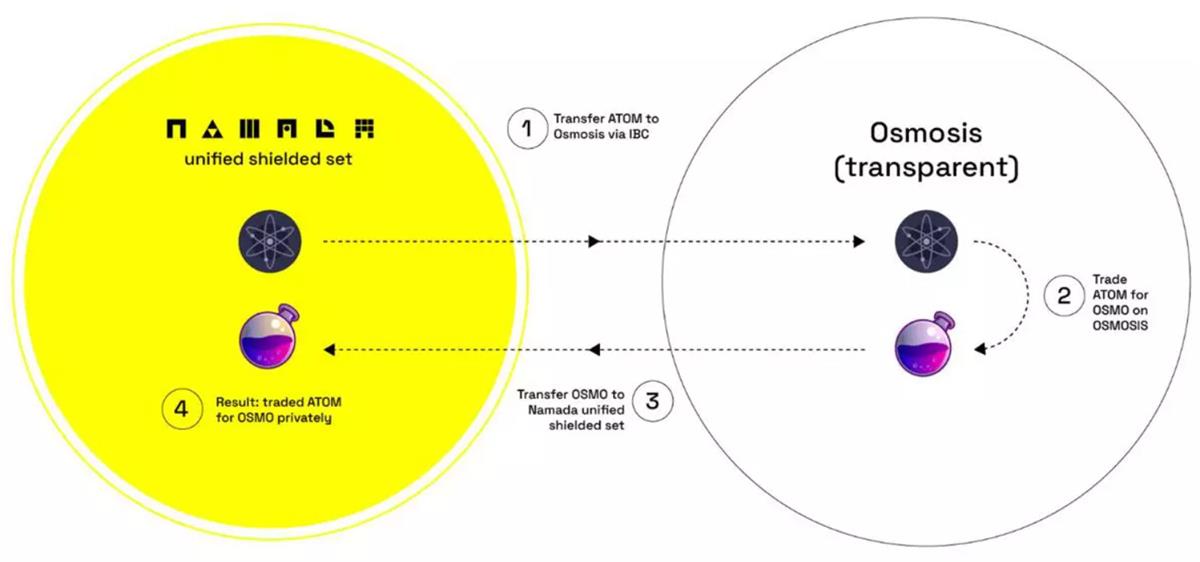
The second type resembles Namada in the Cosmos ecosystem, known as Multi-Asset Shielded Pool (MASP). Multiple private assets share a single anonymity set, combined with IBC’s powerful interoperability. Within the Cosmos ecosystem, this could theoretically enable privacy protection for all major Cosmos-native assets. For example, you could privately swap OSMO and ATOM as illustrated below:
I’ve also seen attempts using homomorphic encryption for privacy. But homomorphic encryption is still extremely early—both performance and usability are far from being “practically usable”. It feels similar to ZK technology around 2017; it will likely take another 5–10 years before it becomes viable.
That’s all for today. Next time, I’ll discuss new trends in the three pillars of DeFi: DEXs, lending, and stablecoins.
Join TechFlow official community to stay tuned
Telegram:https://t.me/TechFlowDaily
X (Twitter):https://x.com/TechFlowPost
X (Twitter) EN:https://x.com/BlockFlow_News
 Lao Bai






