OpenAI: From Startup to Leader, Focusing on Achievements and Vision in the Field of Artificial Intelligence
TechFlow Selected TechFlow Selected
OpenAI: From Startup to Leader, Focusing on Achievements and Vision in the Field of Artificial Intelligence
ChatGPT was merely a temporary project developed by OpenAI in mid-November 2022, completed in just 13 days.
 Navigating Web3 tides with focused insights
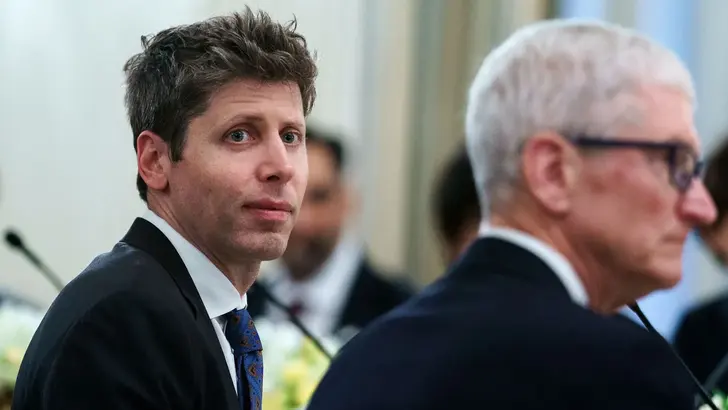
Gavel strikes! Picking up where we left off, let’s dive into the legendary journey of OpenAI—the global sensation shaking up the world today. The story begins in July 2015 at a dinner party in Menlo Park, California. Among the guests was none other than global superstar Elon Musk, but this wasn't just any dinner—its attendees formed an all-star lineup: Sam Altman, then-president of YC (the famed Silicon Valley startup incubator that has nurtured around 1,900 companies), Greg Brockman, CTO of unicorn payment giant Stripe, and Yoshua Bengio, who would go on to win the Turing Award in 2019 alongside Geoffrey Hinton and Yann LeCun for their contributions to deep learning. Together, they became the founding core of OpenAI.
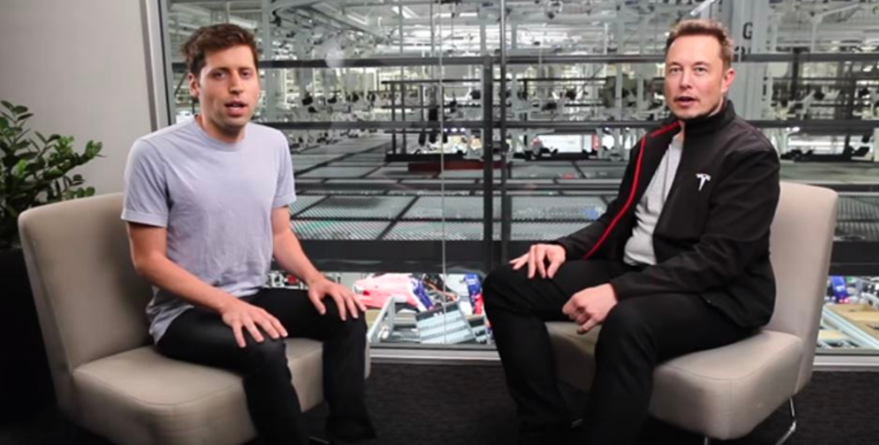
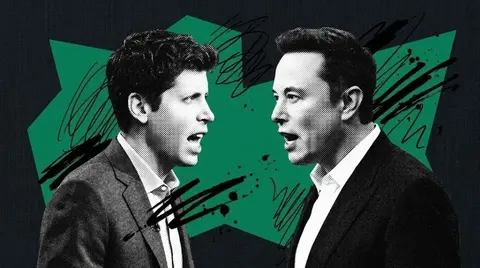
(Sam Altman and Elon Musk)
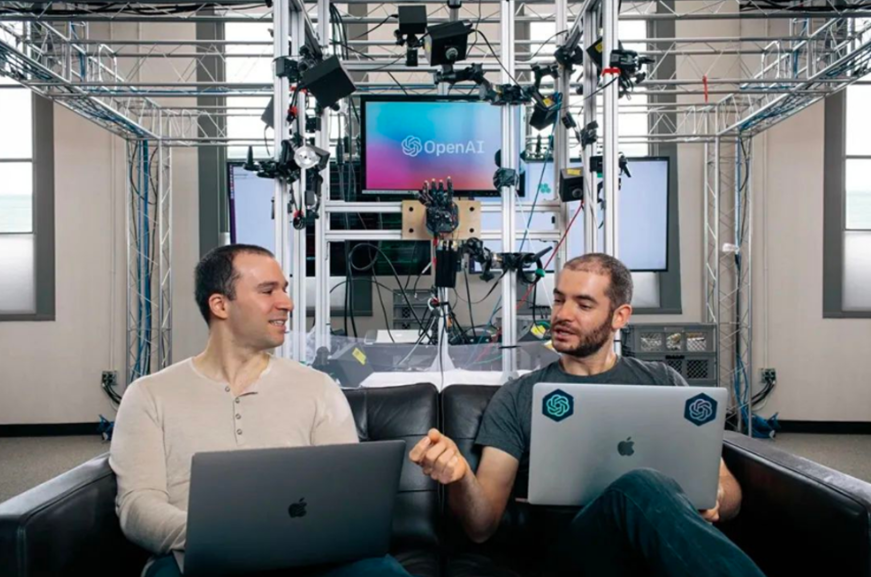
(Greg Brockman and Ilya Sutskever)
Bengio provided a list of top researchers in deep learning, and Brockman personally reached out to each one. Despite Microsoft's $1 billion investment pledge, as a startup OpenAI couldn’t match the salaries offered by tech giants like Google or Facebook. Ultimately, it was vision and idealism that convinced elite talent to join—driven by the shared belief that developing Artificial General Intelligence (AGI) could benefit all humanity, and together they could become figures etched into the annals of technological history.
Outstanding talent density alone wasn’t enough—many large companies also boast concentrated expertise in certain divisions. What truly set OpenAI apart was its top-down conviction in AGI and bottom-up innovation through experimentation. Only with alignment across both levels did success become possible.
How strong is OpenAI’s belief in AGI? Every year, employees vote to predict when AGI will arrive—a topic rife with internal disagreement. Yet as early as February 2020—during the GPT-2 era (four months before GPT-3 launched, and two years and nine months before ChatGPT debuted)—half of OpenAI staff already bet that AGI would be achieved within 15 years, i.e., by 2035. Let’s remember this date and witness history unfold together.
In its early days, OpenAI was a revolutionary force facing off against entrenched giants like Google, armed with vast resources and manpower. Still, OpenAI hoped to be the first to achieve AGI—fully aware that big corporations are driven by profit motives, constrained by stock prices, bogged down by internal politics, and prone to monopolizing breakthroughs once made. In contrast, OpenAI’s mission was to realize AGI and equitably distribute its benefits to everyone.
OpenAI never aimed to rule the world; it simply wanted to ensure safe development of technology and ultimately benefit all humankind. Years ago, I read an in-depth report based on extensive firsthand interviews inside OpenAI, revealing many previously unknown organizational secrets. It noted:
Its founding statement declared it would “create value for everyone, not shareholders.” Its charter—a document so sacred that employee compensation depends on adherence to its principles—further states that OpenAI’s “primary fiduciary duty is to humanity, prioritizing the greater good over individual self-interest.” Moreover, safely achieving AGI is so critical that if another organization comes close to realizing it first, OpenAI will cease competition and instead collaborate with them.
Reading this deeply moved me—this mindset had begun evolving into something akin to religious conviction. I once thought AI and Crypto were diametrically opposed: while Crypto seeks to return power to individuals and empower them, AI symbolizes extreme centralization and concentration of power. But reading OpenAI’s original charter felt surprisingly similar to Satoshi Nakamoto’s vision when inventing Bitcoin. An interesting timeline coincidence: deep learning emerged in 2007, Bitcoin followed in 2008—two groundbreaking inventions arriving almost simultaneously.
I truly believe this charter reflected the profound idealism held by Musk and other founding members. When they wrote those words, they meant every one of them. Indeed, Musk has always represented someone willing to share human intellectual achievements openly—he championed maximum openness and collaboration at Tesla and Twitter.
When OpenAI later succumbed to real-world pressures, compromising and partially betraying its revolutionary ideals, Musk directly resigned from the board. Perhaps having seen AI’s capabilities and potential firsthand at the frontier, he has never stopped advocating for AI safety, using his public influence to raise awareness, even proactively urging governments for regulation as an entrepreneur.
Sadly, most people—including some members of our AI GameFi research group—narrowly interpreted his warnings as “buying time to catch up with competitors.” In reality, Tesla’s early R&D focus was never AGI, and Musk’s calls for caution predated ChatGPT by years. There’s more than a hint of “humans never thank Luo Ji” here (a famous line from the sci-fi novel *The Three-Body Problem*; feel free to skip if unfamiliar).

Sam Altman, who stayed on as CEO, also maintains close ties to crypto. Beyond OpenAI, he co-founded Worldcoin, a cryptocurrency project aiming to achieve financial fairness and inclusivity via crypto—paralleling OpenAI’s pursuit of human liberation through AGI.
Back to OpenAI. Initially, the team pursued three directions: robotics (physical/hardware-based AI), game-playing AI, and language models—enabling AI to learn and understand the world through text, which eventually evolved into the GPT series. Clearly, exploration was broad at first—the team didn’t follow a divine script knowing exactly how to reach AGI, but rather converged after trying various paths.
Robotics is intuitive—aligned with common human conceptions of AI.
The gaming path was recommended by Musk. Many books liken real-world human activities to games. Indeed, the process of learning, understanding, and acting in the world bears striking resemblance to gameplay. One might say the world is a game—or that a game is a world. Earlier AI successes in chess and Go already fell under this umbrella. OpenAI chose Dota 2 and ultimately defeated world champions. In the next piece, we’ll explore how gaming drives technological progress.
The turning point came in 2019. That year, GPT-2—trained on 8 million Reddit posts totaling 40GB of text with 1.5 billion parameters—made the entire company realize it was treading an uncharted yet correct path. With direction confirmed, they doubled down. In a bold move, they disbanded two other teams that had already achieved notable results, redirecting all resources toward large models. They trained GPT-3 using hundreds of billions of words (English Wikipedia accounted for only 3% of the dataset) and tens of millions of dollars in compute power, then swiftly developed GPT-4, another order of magnitude larger.
It’s hard to imagine that ChatGPT was hastily built in mid-November 2022 in just 13 days. Sometimes history shifts unexpectedly—OpenAI rushed ChatGPT to market fearing Google might launch a similar product first, only to end up igniting a global phenomenon, posing an unprecedented threat to Google and completely reshaping the industry landscape.
Many compare OpenAI’s breakthrough in large models to Columbus discovering the New World. Afterward, new entrants could develop their own ChatGPT-like large language models at far lower cost and risk.
Today, looking back at OpenAI’s short yet epic journey, we marvel at how competitive pressure and commercial realities forced it to stray from its original oath, yet also recognize that its compromises remain within reasonable bounds—it continues striving to fulfill its grand vision of advancing AGI for the benefit of all humanity.
An era of artificial intelligence—destined to profoundly reshape human society like the advent of computers and the internet—is officially underway since the final month of 2022. People excitedly play with the latest models, debating the future of humanity and AI. Some are optimistic, seeing the strongest productivity tool ever created; others pessimistic, believing humanity is marching toward self-destruction. Regardless of stance, compared to an uncertain future, one thing is certain: being alive at this moment makes us incredibly fortunate.
To be continued. This series is collectively written by W Labs’ “AI GameFi Research Group.” Special thanks to team members Guage, Jiaran, Baobao, Brian, Xiaofei, and Huage for their contributions! This article was primarily authored by Baobao.
Join TechFlow official community to stay tuned
Telegram:https://t.me/TechFlowDaily
X (Twitter):https://x.com/TechFlowPost
X (Twitter) EN:https://x.com/BlockFlow_News
 瓜田实验室W Labs