








Trading volume sharply shrinks—when will the sluggish NFT market迎来spring?
TechFlow Selected TechFlow Selected
Trading volume sharply shrinks—when will the sluggish NFT market迎来spring?
Despite the market downturn, the NFT boom driven by the Ordinal protocol on the Bitcoin mainnet cannot be ignored.
 Navigating Web3 tides with focused insights
For the crypto industry, although the crypto market ended its strong performance from January to March and entered a correction phase in April, BTC and ETH are still up 65% and 52% year-to-date, respectively. In contrast, the NFT market has remained sluggish since the second half of 2022 amid the broader crypto bear market. It briefly rebounded at the end of 2022 due to Blur's aggressive rise and its token distribution and incentive programs. However, from the perspective of blue-chip NFT projects and the overall market, the NFT bear market appears far from bottoming out.
Since late February, NFT trading volume and number of traders have dropped by 64% and 27%, respectively. Blue-chip NFT floor prices have generally declined, new user growth has slowed, social giant Meta announced it would shut down its NFT sharing feature, and no breakout NFTFi applications have emerged—leaving the entire NFT market stagnant and unable to recapture the glory of the 2022 bull run.
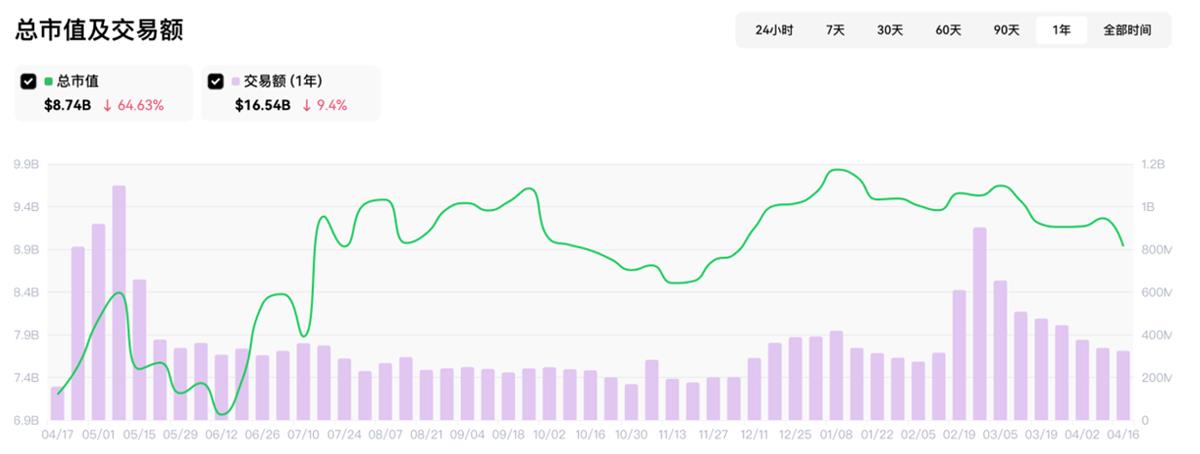
Image source: OKX NFT
Are Blue-Chips Losing Their Luster?
As the NFT market cools, even former blue-chip projects are seeing declines in both trading volume and number of traders. News reports frequently highlight celebrities suffering heavy losses from NFT investments. The blue-chip index has fallen from over 9,000 in February to 7,600.
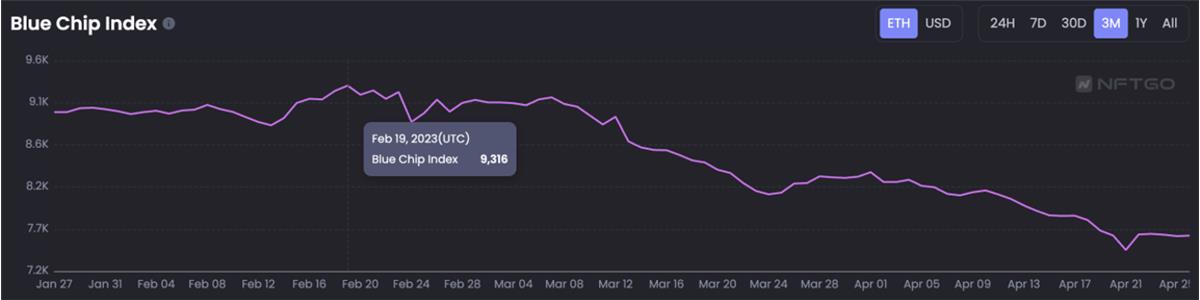
Image source: NFTGo
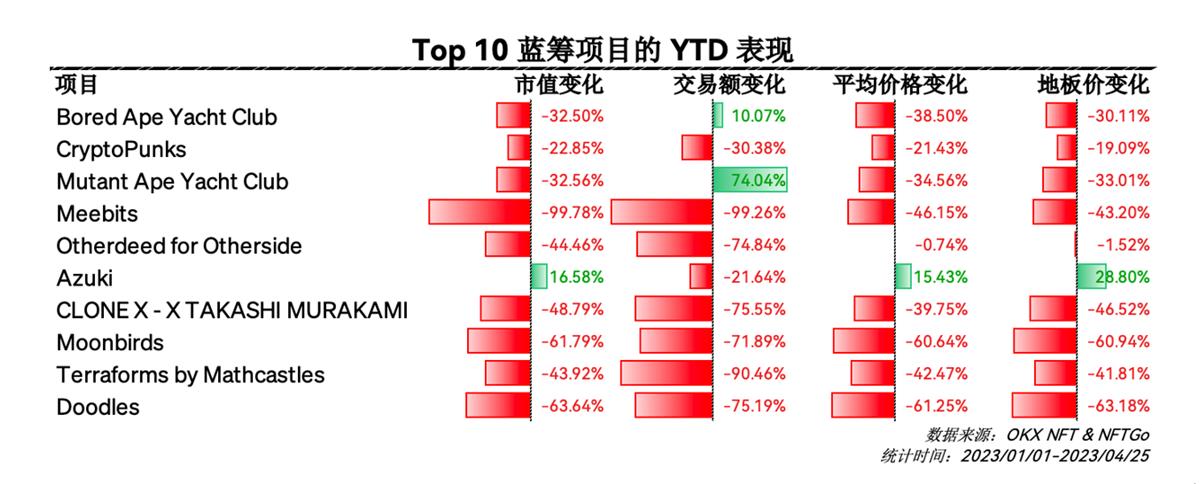
Based on the top 10 NFT projects by trading volume, OKX NFT compiled the following table. It shows that multiple blue-chip projects such as Meebits, Doodles, and Moonbirds have seen significant market cap declines. In terms of trading volume, only BAYC and MAYC among the top 10 have increased, while 60% of projects saw trading volume drop more than 70%. Regarding floor prices, seven projects saw their floor prices fall by over 30%. Even Yuga Labs, known for strong operations, has seen its flagship project BAYC reach a nearly five-month low in floor price.
The Rise of Ordinals and AI-Generated NFTs
Despite the market downturn, the surge in NFT activity driven by Bitcoin’s Ordinal protocol cannot be ignored. Data shows that cumulative minting of Bitcoin Ordinals has reached 1.873 million units, generating over 188 BTC in total fees to date.
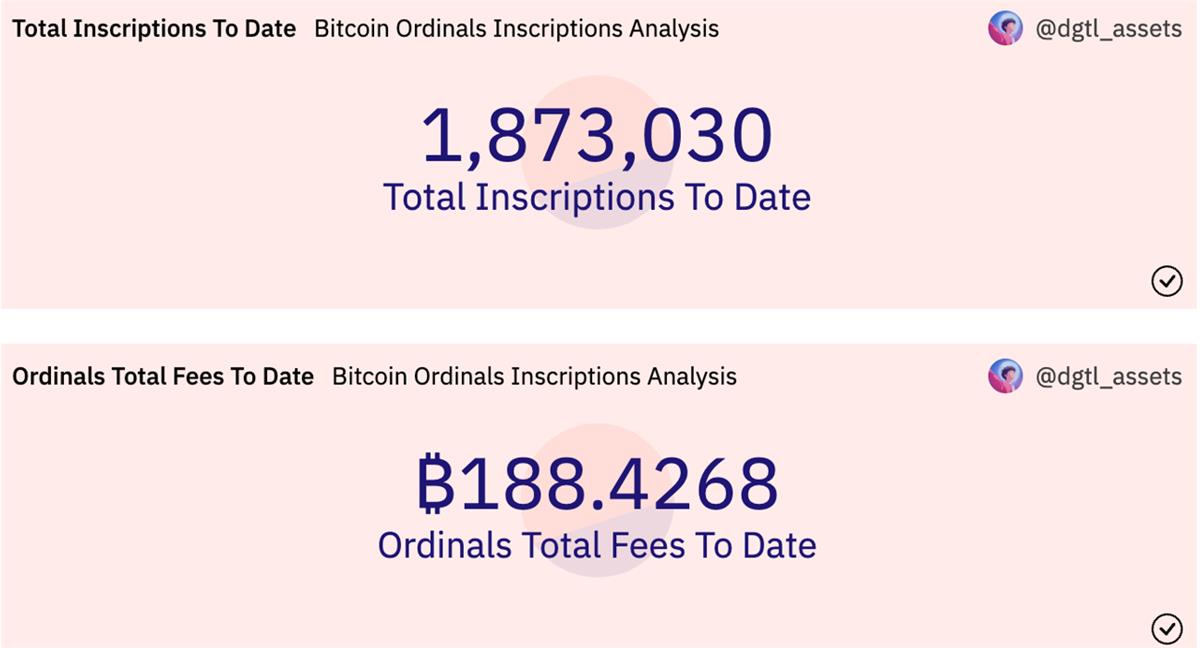
Image source: Dune Analytics
Although Bitcoin previously lacked mature trading platforms—relying solely on spreadsheets for listing and bidding—wallet apps and NFT marketplaces are rapidly emerging.
As early as March 3, OKX NFT began supporting trades of Bitcoin Punks created via Ordinals. Recently, OKX Wallet became the first multi-chain wallet to support BTC NFTs under the Ordinals protocol, enabling users to view and transfer BTC NFTs directly within the OKX Wallet browser extension. Bitcoin NFTs may bring fresh momentum to the stagnating NFT market.
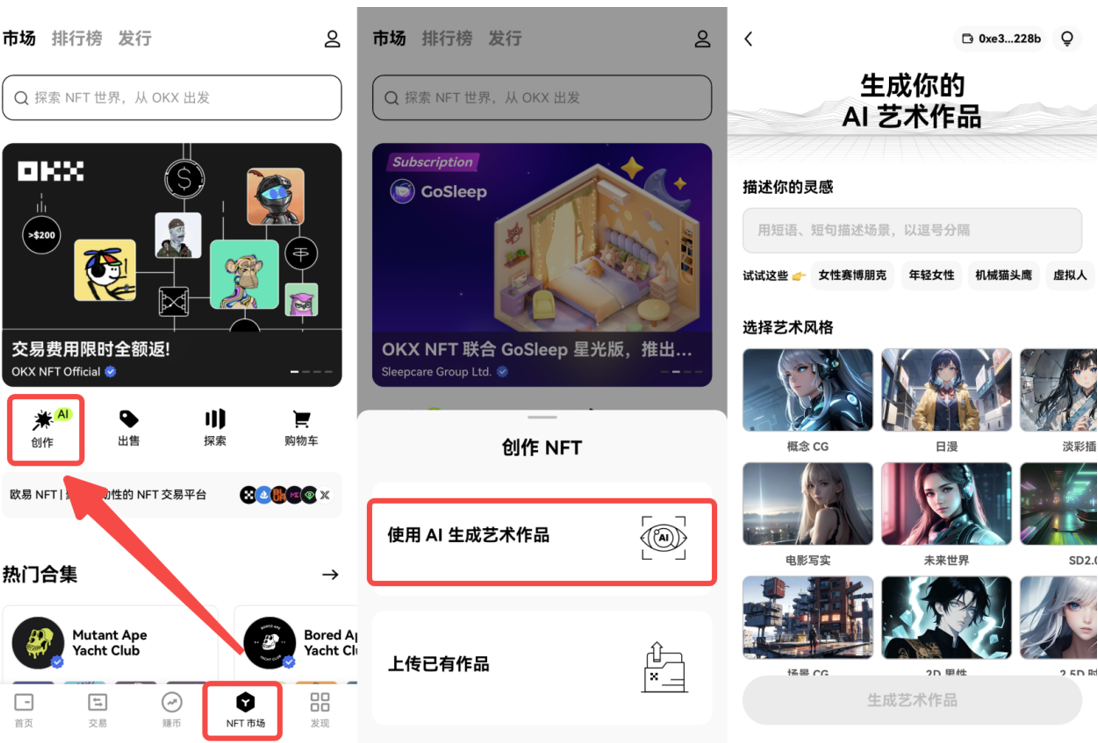
On another front, the popularity of ChatGPT has fueled growing interest in AI-generated NFT art. Generative AI technology enables faster and more diverse NFT creation. The OKX Christmas AI NFT Creation Contest, launched back during the 2022 holiday season, could signal a broader shift toward AI-driven NFT creation.
When Will the NFT Spring Come?
Undoubtedly, the one-year NFT bull market that began in the second half of 2021 has ended, and the NFT market has entered a quiet period.
First, falling crypto markets have cooled down the NFT space;
Second, speculative sentiment was rampant during that time, leading to numerous overhyped and overpriced NFT projects in a short period;
Third, compared to other crypto assets, NFTs have lower market-making costs, making them more susceptible to artificial bubbles—and thus deeper drawdowns in bear markets.
However, despite the downturn, the NFT market is not stagnant. On the exchange front, Blur quickly rose to become the top NFT marketplace by leveraging multiple rounds of token distributions and offering zero trading fees, challenging OpenSea’s dominance.
OpenSea, after acquiring GEM, rebranded it as OpenSea Pro, strengthening brand integration. It also launched its own NFT series, clearly signaling a new strategy to engage and reward its community—an effort to shed its previous aloof image.
OKX NFT stands on the shoulders of giants by aggregating listings from Blur, OpenSea, Element, LooksRare, X2Y2, Magic Eden, and others. It is also the first aggregator to allow users to list directly on Blur, OpenSea, and LooksRare.

Additionally, many projects remain active even during this bear market. Indeed, bear markets offer excellent opportunities to “buy the dip,” especially for blue-chip projects that soared during the bull run and are now significantly undervalued. Selecting promising assets and holding them patiently may prove to be a wise strategy.
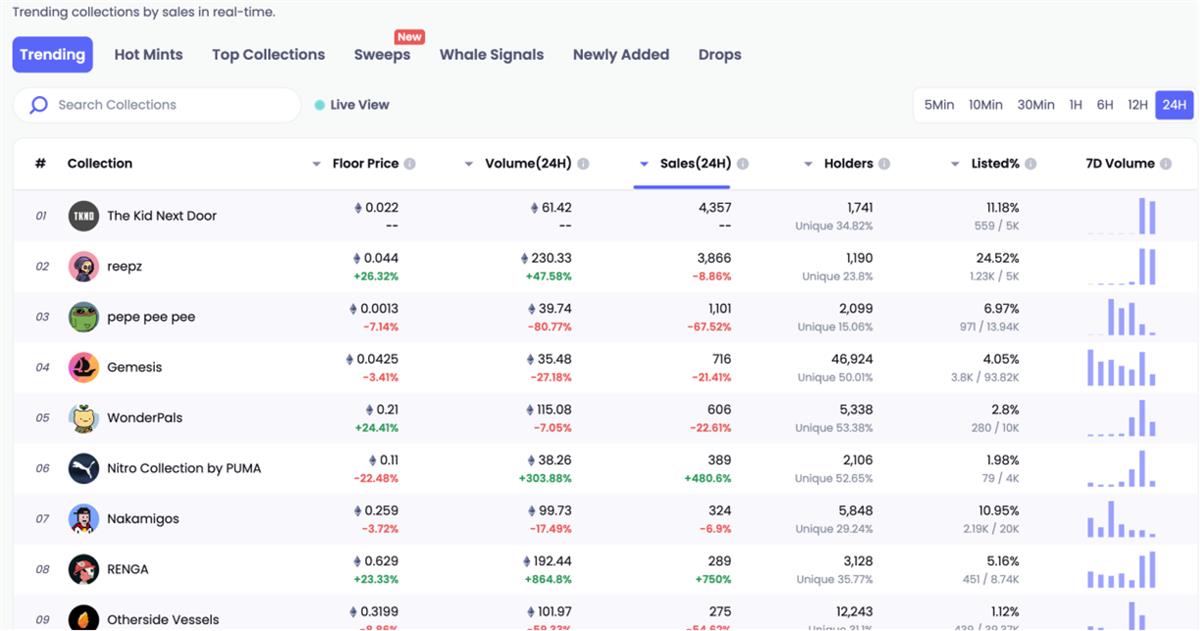
Image source: NFTGo
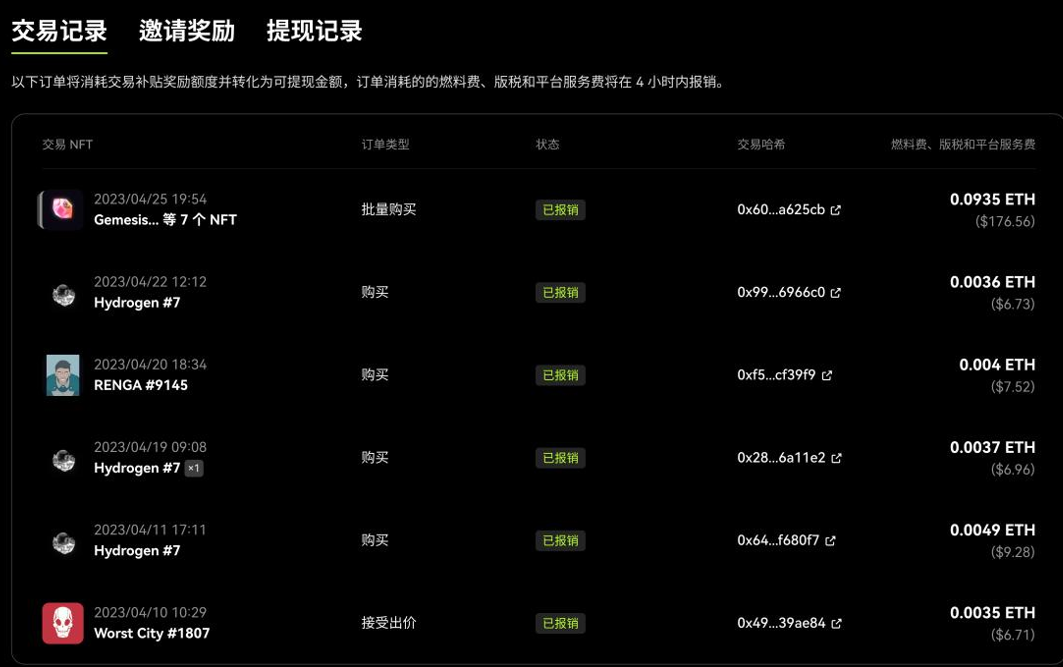
OKX NFT is currently running an NFT trading rebate campaign. Purchasing OKX NFTs, Blur NFTs (which also qualify for Blur trading incentives), or Ethereum-based NFTs on OpenSea via OKX NFT will receive waivers on gas fees, royalties, and platform service fees (OpenSea currently charges a 2.5% platform fee). Each address can receive rebates ranging from 0.1 to 0.2 ETH based on trading volume. The promotion is available on both the web platform and the OKX Wallet app.
Visit OKX NFT, click on the limited-time trading rebate offer, connect your wallet, and claim your rebate.
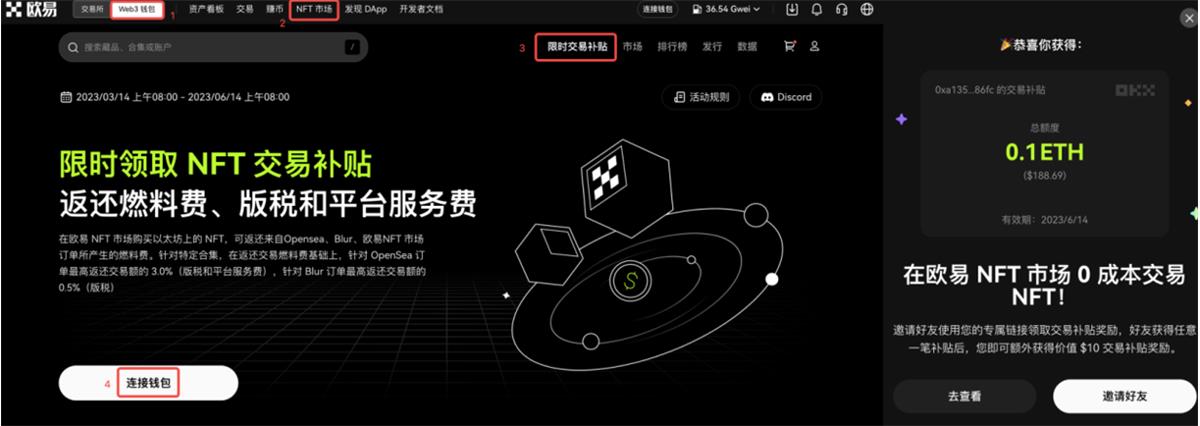
Batch trading is recommended to save more on fees. After completing your NFT transactions, don’t forget to visit the rebate program page, which updates every four hours, and click to withdraw your rebate.
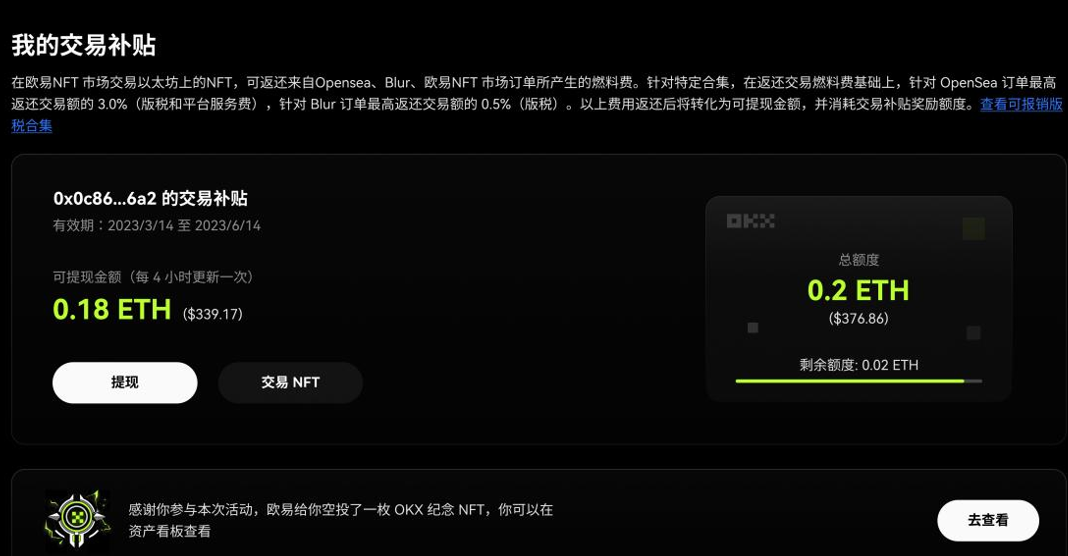
Given the various innovations mentioned above and the increasingly competitive landscape among NFT marketplaces, it’s only a matter of time before the NFT market revives. Although the NFT bull market cycle doesn’t perfectly align with broader crypto cycles, we can still identify patterns.
The crypto bull market began in March 2020 and ended in late 2021, while the NFT bull market started in June 2021 and concluded in April 2022—indicating that the NFT rally lagged behind the general crypto market by roughly 1–1.5 years. However, while Bitcoin has completed four full bull-bear cycles since 2009, the NFT market has only gone through one major cycle since gaining scale, so this timing pattern remains unproven historically. That said, trading psychologist Van K. Tharp once said: “Average traders trade with techniques; elite traders trade with conviction—and conviction comes from understanding patterns.”
NFTs are clearly not a flash in the pan.
First, NFTs continue to attract strong attention and adoption in digital art, the metaverse, and gaming. The cultural and digital content value represented by NFTs, along with the transparency and security offered by blockchain technology, continues to expand their utility and application scope.
Second, as an emerging form of digital asset, NFTs still hold immense potential and promise. The human fascination with novelty ensures enduring interest in new frontiers like NFTs.
Join TechFlow official community to stay tuned
Telegram:https://t.me/TechFlowDaily
X (Twitter):https://x.com/TechFlowPost
X (Twitter) EN:https://x.com/BlockFlow_News






