








A Preliminary Look at the LSD MEV Sector: What Will Marketization and Fairness in MEV Bring to LSD?
TechFlow Selected TechFlow Selected
A Preliminary Look at the LSD MEV Sector: What Will Marketization and Fairness in MEV Bring to LSD?
When MEV meets the booming LSD wave, what kind of synergy will emerge?
 Navigating Web3 tides with focused insights
Produced by: TechFlow Research Institute
Author: Yu Zhong Kuangshui
Editor: David
*This article is an original piece by TechFlow. Please credit the source when reposting.
MEV (Maximal Extractable Value) is one of the most important topics in the crypto world. It refers to the maximum value that validators can extract during block production—beyond standard block rewards and gas fees—by adding, removing, or reordering transactions within a block.
What happens when MEV meets the surging LSD trend? How do they intersect?
Recap: Understanding MEV
MEV is not a new phenomenon. It involves three key stakeholder groups: blockchain users, validators, and searchers.
At its core, MEV has sparked competition among all blockchain participants for control over block space usage. Thus, amid the current on-chain recovery, MEV has become a "cash machine" for many searchers. For instance, during the recent Memecoin boom, MEV profits exceeded three million dollars within just seven days as of April 19.
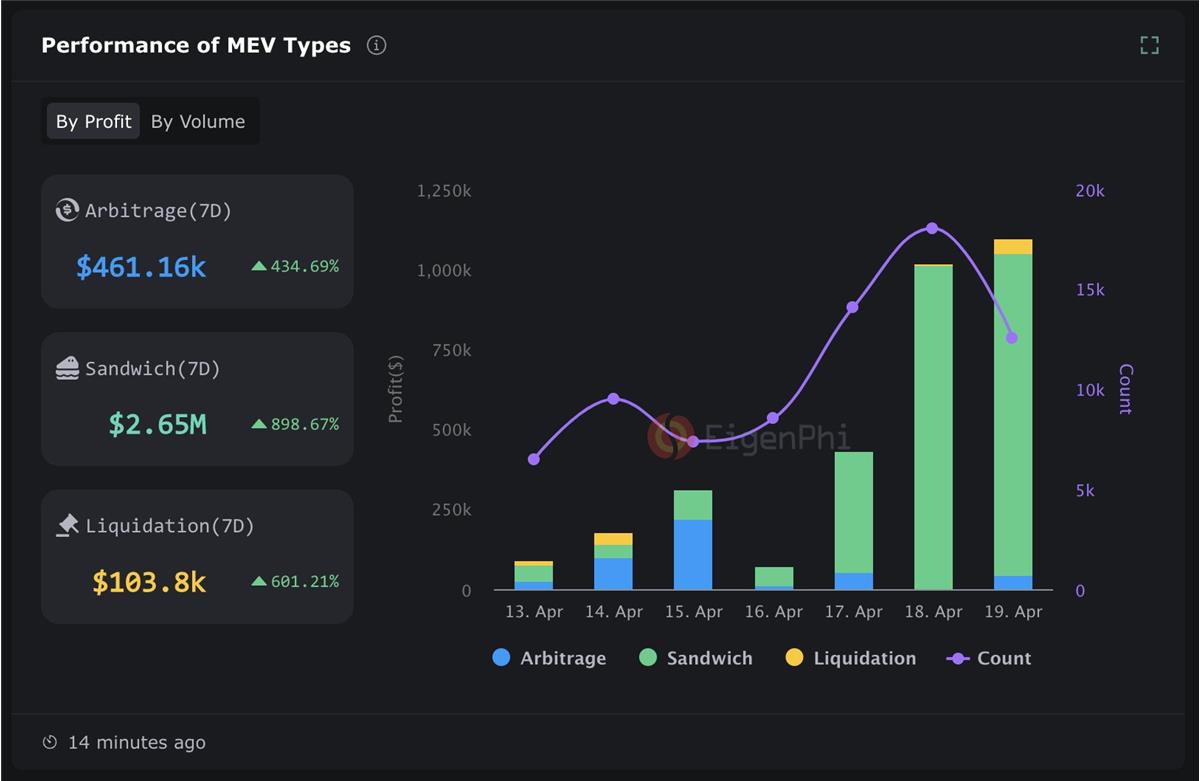
Here lies a counterintuitive reality: the value of MEV is not captured by blockchain validators but rather by searchers—often referred to as "scientists" in the Chinese crypto community.
MEV can be simply understood as on-chain arbitrage through frontrunning and similar tactics, with sandwich attacks being the most common form—commonly known as "sandwich bots."
For example, when you buy $10,000 worth of token X on Uniswap, a bot detects your transaction and quickly places its own buy order with a higher gas fee, ensuring it gets executed first before your trade is included in the block.
Due to Uniswap’s automated market maker mechanism, the price of token X rises. After your trade executes, pushing the price even higher, the bot then sells the previously purchased X at this elevated price, capturing the spread as profit.
The bot's two transactions effectively sandwich your trade—like layers of bread enclosing a filling.
MEV Protocols and Practices
To regulate the unchecked extraction caused by MEV, the crypto industry has seen the emergence of several MEV-related protocols such as Flashbots, CowSwap, Manifold Finance, and others.
CowSwap and Flashbots broadly represent two divergent directions in MEV applications.
-
CowSwap positions itself against MEV searchers by using batch auctions, where all trades within a batch are settled at a uniform clearing price. This eliminates the need for transaction ordering, ensuring every participant receives the same asset price.
-
Flashbots centralizes potential searchers under regulated infrastructure, creating a private mempool that offers regular users using Flashbots RPC a way to avoid harmful MEV. Through Flashbots Bundles, it provides searchers with non-harmful MEV opportunities. Meanwhile, Flashbots MEV-Boost establishes a communication channel enabling protocols to efficiently interact with validators—allowing validators to earn additional rewards via MEV-Boost.
Flashbots’ newer product built atop MEV-Boost, called MEV-Share, aims to deeply democratize the MEV market—enabling both block space users and searchers to pay fees and extract value fairly within defined rules, ultimately achieving fairer transaction ordering. At its heart, MEV represents a three-way博弈 between validators (builders), searchers, and block space users. Validators gain economic incentives through their power, searchers capture arbitrage profits, while block space users often appear as the unwitting victims.
The ultimate outcome of MEV-Share ensures that, while preserving user transaction privacy, validators receive their fair compensation, searchers obtain a smaller portion of MEV rewards, and block space users capture the majority of MEV value—driving MEV toward marketization, standardization, trustworthiness, privacy, and decentralization.
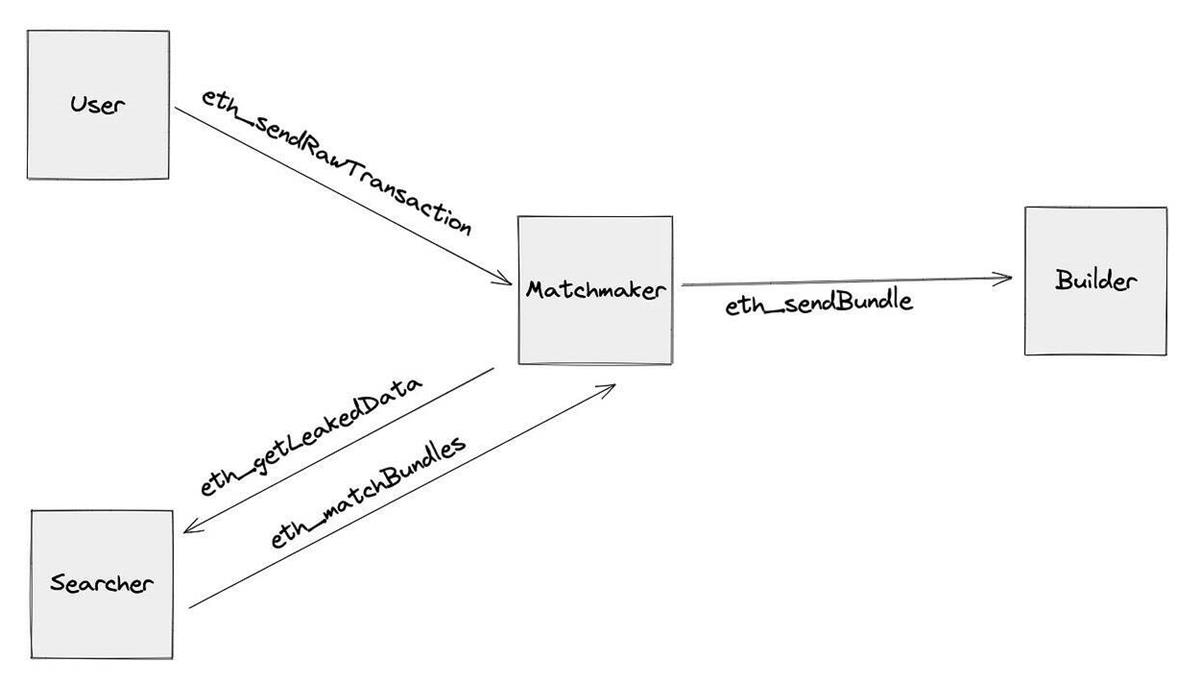
Since MEV-Share directly impacts both block space users and validators, the LSD sector—which aggregates validators—will also be directly affected. Unlike the recursive, matryoshka-like architecture of LSDFi, MEV represents another dimension of LSD expansion—one that brings more real yield to LSD protocols. In the future, the growth trajectory of the MEV sector will very likely resonate synergistically with that of LSD.
Manifold Finance, mentioned earlier, is another protocol delivering additional MEV收益 to Ethereum stakers. It introduces a novel asset called mevETH, leveraging LayerZero to extend mevETH across multiple chains. mevETH redistributes non-extractive MEV收益 back to stakers. Additionally, Manifold Finance has partnered with established DeFi OGs like SushiSwap to offer MEV protection for protocol users.
Initial Exploration: MEV’s Impact on the LSD Sector
Let us envision what kind of evolution LSD protocols might undergo under the influence of MEV-Share?
The fair and market-driven nature of MEV provides predictable returns for LSD protocols and Ethereum stakers. Higher yields will incentivize greater participation in Ethereum staking and encourage LSD protocols to adopt MEV-Boost or other MEV solutions.
In the future, LSD protocols may use native token governance to decide which MEV solution to implement in order to maximize rewards—a move that further empowers the protocol’s native tokens.
Growth in Ethereum staking will drive market share expansion in the LSDFi sector, whose rise in turn fuels further increases in Ethereum staking—creating a flywheel effect. Fair and market-oriented MEV products will act as lubricants powering this flywheel.
From another perspective, the fair and market-driven development of MEV will boost on-chain activity. By promoting rational gas pricing and maximizing block space utilization, it becomes a secret weapon for improving on-chain user experience. Increased on-chain activity drives demand for block space, which in turn accelerates adoption of MEV solutions, further fueling user demand for blockchain security—and thus, demand for Ethereum staking. This too forms a reinforcing flywheel.
Conclusion
I particularly appreciate the term "non-extractive" used by Manifold Finance. Most current MEV protocols are designed to address the problem of extractive MEV, striving to build a marketized and equitable MEV ecosystem. But ultimately, they won’t just solve the issue of predatory MEV—the balanced allocation of interests among block space users, validators, and searchers will also be significantly improved, thereby driving overall growth of the Ethereum ecosystem.
Join TechFlow official community to stay tuned
Telegram:https://t.me/TechFlowDaily
X (Twitter):https://x.com/TechFlowPost
X (Twitter) EN:https://x.com/BlockFlow_News
 深潮TechFlow


