Interview with Suji: Web3 in one word is revolution
TechFlow Selected TechFlow Selected
Interview with Suji: Web3 in one word is revolution
If entrepreneurs had to listen to investors on everything they do, capitalism would be on the verge of collapse.
 Navigating Web3 tides with focused insights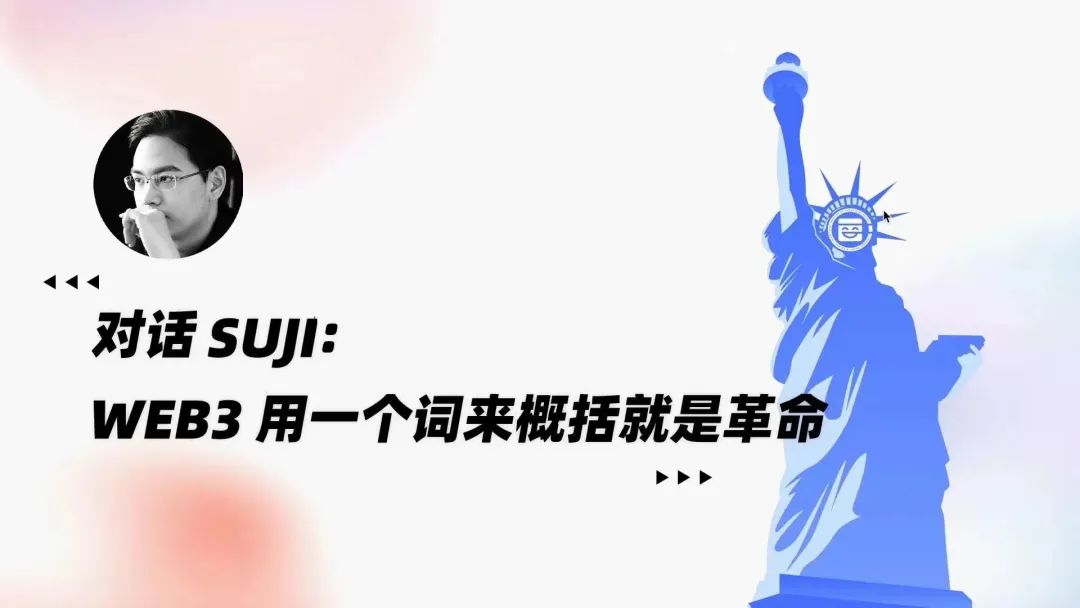
Interviewer: Claudia
Is there something that can endure cycles, transcend bull and bear markets, and become a unique mark on a project or an individual?
For many people, it might not be physical currency or value-preserving products, but rather a value impact in the spiritual world.
For Suji, founder of Mask Network, this value might be revolution and freedom.
Recently, TechFlow sat down with Suji to explore his fantastical world. From his earlier pursuit of truth and authenticity in media, to later unrewarded efforts in funds and donations, as well as his fearless attitude toward life—every step Suji has taken resembles a thrilling jungle expedition: dangerous, yet irresistibly mysterious.
TechFlow: Could you introduce yourself? When did you first enter the Web3 space?
Suji: I'm Suji, founder of Mask. Beyond that widely known title, I've done many other interesting things—I've worked extensively in media, launched numerous public goods projects, built DAOs, and now run my own investment fund.
Actually, the term "Web3" didn't exist before; it was only around 2017 that people in the crypto community started discussing it. I began buying Bitcoin around 2014–2015, when you could directly purchase it with RMB on Taobao, or join some ancient online groups where merchants would guide you—just send them money and they'd buy it for you and deliver it. I learned about Bitcoin at 17 and started buying it at 18. I bought Bitcoin in both China (using RMB) and the U.S. (using USD) during 2014 and 2015.
In 2017, at age 21, I dropped out of school to start a company and began engaging with the Ethereum community, the Ethereum Foundation, and many OGs.
TechFlow: Before entering Web3, you worked at Qdaily and Caixin. How did your media background shape you or leave its mark?
Suji: Media is all about seeking truth and factual accuracy. I’ve been involved with several media outlets. The first was Qdaily, which eventually shut down. Li Jianpeng, formerly editor-in-chief at Yicai, wasn’t someone I interacted with much. But I had strong relationships with several of their deputy editors, and we still keep in touch today.
Later, I collaborated with Caixin. I wasn't a full-time reporter at Caixin, but I consistently contributed articles and worked on various freelance projects. My biggest project was partnering with Caixin to enter the Fukushima nuclear plant and conduct firsthand research and reporting.
TechFlow: When people think of Suji, certain labels come to mind—"college dropout," "anti-996," "programmer who wears women's clothing." What values and aspirations define the real Suji?
Suji: The root of most current problems lies in intermediaries and transactions—not in people’s lack of effort. There are too many risks from middlemen. This isn’t limited to tech; even geopolitical tensions between China and the U.S. stem from this. If they could cooperate fully, neither would need to exist as rivals. Most issues arise from two causes: one, insufficient productivity; and two, even when productivity could advance, intermediaries prevent its development.
The internet, through digitization, achieved something crucial: it didn’t eliminate intermediaries, but instead centralized them. Digital systems have extremely high marginal efficiency and low marginal cost, consolidating nearly all human intermediaries into a few platforms. For example, government services once required three or four counters—now they’re streamlined into a single WeChat mini-program, even at the State Council level. Digitization has thus concentrated every form of intermediary in our society—a major advantage it brought.
The biggest problem for humanity over the past 50 years has been digitization. Over the next 50 years, decentralization will be just as significant. After digitization gathers all intermediaries into a few hands, the stage is set for a final showdown—the complete elimination of intermediaries, which is the core mission of decentralization.
TechFlow: After decentralization or disintermediation, won’t there be issues regarding efficiency or practical application?
Suji: Regarding efficiency, yes—it’s true that blockchain transfers are slower than centralized systems. In theory, transferring funds via a bank database or settling large payments on-chain takes anywhere from a few seconds to 30 seconds. But because governments like those of the U.S. and China exist, instant settlement across borders will never happen in milliseconds anyway. So decentralization doesn’t slow things down—centralized institutions were already dragging us back.
Digitization over the past 50 years has consolidated intermediaries into the hands of a few dominant digital players. Once concentrated, we see clear targets: financial over-concentration due to Wall Street, hence the rise of Web3. In China, social and entertainment sectors are dominated by Tencent alone; e-commerce by Alibaba. In the U.S., Facebook, Instagram, and Twitter dominate. When everything becomes so centralized, people naturally think: “Wait, I could do this too.” Is it really that hard? Not necessarily. Elon Musk stepped in, laid off staff, and nothing exploded—the servers didn’t crash. So why can’t we build decentralized alternatives?
In short, in decentralization, there’s no Musk-like figure yet stirring chaos, so it holds relative advantages. But in centralized systems, powerful organizations sitting at the top benefit immensely and resist disruption—they’ll actively suppress challengers.
If major governments weren’t involved in so many complications, cross-border transfers would be seamless. Imagine if Facebook donated 80% of its annual profits to open-source internet initiatives—its efficiency and legitimacy would skyrocket.
TechFlow: In your narrative, Web3 is often tied to the word "revolution." What does the Web3 revolution mean to you?
Suji: A few days ago, I co-hosted a podcast episode that explained “revolution” very clearly—I highly recommend it. I even find it miraculous that such a program could be released: https://twitter.com/dov_wo/status/1610574518342520833?s=46&t=vtJsqkybaNgCIMPwVYJVLw
To me, revolution simply means revolution. It doesn’t need justification. Revolution is something generations—our grandparents, Chinese and Americans, and most sovereign nations—have lived through: anti-imperialism, anti-feudalism, resistance against invaders, fighting Nazism. Revolutions have always happened. It’s straightforward. But because people refuse to acknowledge it as such, they invent theories about the “value” of revolution—which is meaningless! Do we need to explain the value of revolution? Don’t tell me this is just another business play, chasing value capture. In my view, one word sums up Web3: revolution.
TechFlow: After FTX collapsed, you initiated FixDAO, a legal aid community to support affected Asian users and help investors claim their rights. Why did you take on this effort, and what’s the progress so far?
Suji: Mainly because so many people were harmed. Mask has reviewed all compliance procedures and communicated with multiple parties, including U.S. exchanges, regulators, and law firms. Many victims were especially unlucky—users from Southeast Asia, Greater China, and Korea suffered heavily under FTX. Yet there’s no guarantee these users will be prioritized—we worry Americans might get paid first. I can accept each subsidiary being liquidated separately, but it’s absurd if foreigners get to leave while Chinese users are left behind. That’s precisely why decentralization matters—decentralization still holds great potential, enabling green resource players who struggle to collaborate under traditional frameworks.
We proposed initial ideas and received strong community feedback. Many volunteers are legal advisors or executives from other projects helping us out. We’re fortunate to have connections with prominent law firms. Recovering funds will take time, but as time passes, more forgotten assets may surface. Our goal is to mobilize affected Asian users to join creditor committees and maintain ongoing communication.
TechFlow: What are your predictions and hopes for 2023?
Suji: I think we should focus on big topics, not small ones. Many are obsessed with real-world applications, but deeper technological breakthroughs matter more.
TechFlow: In your opinion, has Twitter improved or worsened under Elon Musk’s leadership?
Suji: I believe Musk completed his historical mission—regardless of whether things got better or worse, he achieved full concentration of productive forces and means of production. Without centralization, you’re just a small collective village or artisan economy. The factory owner might be good or bad. But once concentration happens, the stage is set for systemic change and redistribution. Before, people couldn’t perceive how centralized things already were. Musk didn’t actually do anything new—he just accelerated what Twitter had long been doing: content moderation, layoffs, government ad partnerships, censorship. He just did it faster.
Only when this concentration is fully exposed do people react with “WTF?” At that moment, Musk’s historical mission ends. Whether he succeeded or failed, I believe once the mission is complete, others will emerge to seize the opportunity—not to replace Twitter, but to fill the gap for a unified, decentralized social protocol.
TechFlow: Some say Mask succeeded largely due to luck and narrative—launching tokens at the right time, having a name similar to Musk, early alignment with Twitter and Web3 storylines… After all, timing is everything in crypto. How do you respond to such skepticism? What did you and Mask do right?
Suji: Back in 2019, I publicly initiated reforms, inviting anyone to suggest how global social networks should evolve. But at the time, the Web3 space—and the broader startup ecosystem—was too restless. Everyone wanted to chase supply chains, launch IEOs, and pursue random schemes. Few were willing to sit down and seriously discuss building decentralized Twitter. That commitment was crucial. As for market skepticism, no response is needed. We’ve long said anyone can build decentralized Twitter, but very few are genuinely committed. The scene remains overwhelmingly superficial.
TechFlow: People often call Mask Network the 'Tencent of Web3.' Meanwhile, Mask’s ecosystem investment fund, Bonfire Union, positions itself as Web3’s version of Tencent Investment. This reminds us of the article ‘Tencent Has No Dreams,’ arguing that Tencent has lost its product innovation and entrepreneurial spirit, becoming merely an investment firm. Similarly, Mask Network now appears more as an investor. Has Mask lost its dream?
Suji: That article exists because years ago, Wan Xiaofan wrote “F***ing Tencent” in Computer World magazine. But if we must choose, we’d rather help others. When we see something valuable, we don’t want to copy it or compete head-on. Instead, we donate. Last quarter, we donated $200,000 to a project and established a startup grant for a group of dropouts. Even if there’s no return, there are no legal consequences—we can simply give money away. Historically, no company has operated this way, so we borrow Tencent’s name to draw parallels. But in reality, we differ fundamentally: through massive investments and donations, we’ve already surpassed Tencent.
*Latest update: On February 7, Mask Network announced a donation of 33,000 MASK tokens (worth approximately $140,000) to the Blockchain Initiative Fund at the Gies College of Business, University of Illinois.
TechFlow: Compared to other token funds, exchange-affiliated funds, or traditional dollar-denominated VCs, what is Bonfire Union’s core competitive edge? Any proud investment cases?
Suji: Our investment philosophy centers on supporting open planning—backing anything aligned with our values. Our key strength lies in being an open internet revolutionary fund. Our primary goal is revolution; financial returns for investors are secondary. Most importantly, we openly declare our revolutionary intent—that in itself is a rare competitive advantage. Today, probably fewer than five people would say that. This clarity gives our fund greater impact. For us, revolution matters far more than money. Successful investments include 0xScope, YGG, and others.
TechFlow: You’ve frequently mentioned 'Social Lego'—why do you believe composable, open-protocol-based social platforms have a bright future?
Suji: Software freedom means choice freedom. Without software freedom or social freedom, society becomes dystopian—that’s what deeply concerns me.
TechFlow: Prominent investor Zhu Xiaohu argues, ‘All pre-Facebook social networks failed. For a social platform to succeed, internet penetration must reach a tipping point—around 20% of the population. Until Web3 hits 1 billion monthly active users, any SocialFi app will be a pioneer destined to fail.’ What’s your take?
Suji: I think Zhu Xiaohu doesn’t understand social. Traditional venture capital has always invested in social platforms, and he hasn’t lived long-term in the U.S. during formative years. When Facebook entered foreign markets—including Europe, Japan, and South Korea—it fought intense battles, actively eliminating local competitors. Secondary market commentators exist because this industry endures. Before Facebook acquired Instagram, the broad definition of social included blog platforms. Such opinions are worth hearing but not following. If entrepreneurs had to listen to investors on everything, capitalism would’ve collapsed by now.
Join TechFlow official community to stay tuned
Telegram:https://t.me/TechFlowDaily
X (Twitter):https://x.com/TechFlowPost
X (Twitter) EN:https://x.com/BlockFlow_News
 深潮TechFlow