








A Look at Promising Liquid Staking Derivatives: EigenLayer, Obol, Alluvial, and Ion Protocol
TechFlow Selected TechFlow Selected
A Look at Promising Liquid Staking Derivatives: EigenLayer, Obol, Alluvial, and Ion Protocol
The liquid staking industry is experiencing rapid adoption.
 Navigating Web3 tides with focused insights
Author: Bridget Harris, Pantera Capital
Translation: TechFlow
Liquid staking derivatives allow users to earn rewards on their staked cryptocurrency while maintaining liquidity and improving capital efficiency.
As popular liquid staking services like Lido, Rocket Pool, and Frax continue gaining market share, understanding their underlying technology and impact on the crypto space becomes increasingly interesting. In these protocols, users’ staked tokens are delegated to a set of validators, further contributing to the overall security of the protocol. In return, users receive a liquid staking derivative token representing their staked position, which can be traded across decentralized applications (dapps) that support the token. For example, in Lido, when users deposit ETH, they receive stETH, which can be traded or collateralized on supported dapps. Additionally, users continue earning rewards from staking ETH.
The liquid staking sector is experiencing rapid adoption: as of early April 2023, ETH liquid staking deposits reached 7.3 million ETH, up from just 3.3 million ETH in early April 2022. With this rapid growth, an entirely new industry is emerging around liquid staking derivatives. Below are some exciting new primitives reshaping this space.
EigenLayer
EigenLayer is one of the most discussed recent innovations, introducing a restaking mechanism that enables shared security across projects. EigenLayer significantly improves efficiency by leveraging existing staked capital on Ethereum to restake into new security networks that require validation.
With this technology, new projects outside the EVM no longer need to launch their own validator sets to achieve security. Decentralized applications, rollups, and middleware can all leverage EigenLayer’s restaking security model for greater flexibility and scalability.
In the current landscape, there is a key limitation: modules not deployed on the Ethereum Virtual Machine (EVM) cannot leverage Ethereum’s (robust) validation capabilities. Examples include sidechains using different consensus mechanisms than Ethereum, data availability (DA) layers, virtual machines, guardians, oracles, cross-chain bridges, threshold cryptography schemes, and more (as outlined in the EigenLayer whitepaper). Each of these modules is important from an innovation standpoint, but due to security complexities, building within these categories has often been difficult.
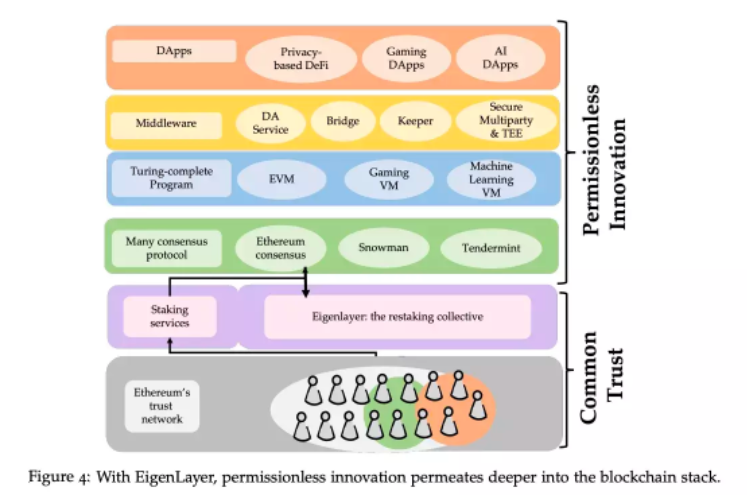
As the blockchain space evolves technically, this represents a major constraint for building beyond Ethereum. Developers are often forced to choose between innovation without access to its validator set, or building on the EVM while accepting the aforementioned constraints. As described in the whitepaper, these projects require actively validated services (“AVS”) for proper validation. However, establishing AVS comes with significant limitations.
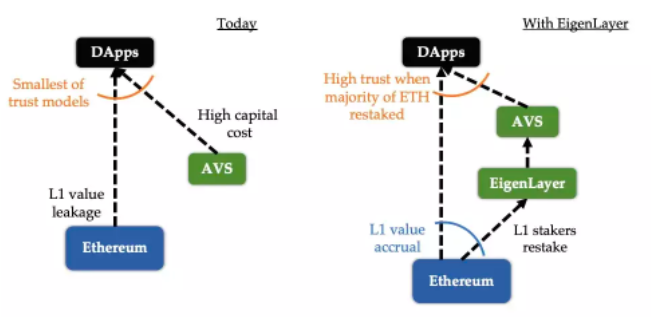
Four key problems mentioned in the EigenLayer whitepaper are:
-
Bootstrapping an entirely new trust network for each new AVS,
-
Value leakage (from Ethereum), as users must pay two fees (one to secure each network),
-
Capital cost burden (EigenLayer refers to opportunity cost / price risk),
-
Weaker trust models (because validation may not be sufficiently robust).
EigenLayer addresses these issues by applying the security provided by Ethereum’s validator set: in their words, pooled security enabled through restaking and free-market governance.
Pooled security via restaking essentially allows modules (like those discussed above) to use Ethereum’s distributed security to ensure their own reliability. Validators can opt in to protect modules and earn additional fee rewards for securing module networks.
In turn, these modules can slash validators’ staked ETH if they fail to comply with certain rules. This entire process is known as “restaking”—using existing stake to secure new networks.
The restaking mechanism fully leverages Ethereum’s strong security, distributing it across modules that previously could not benefit from the security of a large and relatively stable network.
Furthermore, liquid staking tokens such as stETH, rETH, cbETH, and LsETH can all be restaked, enabling better composability and cryptoeconomic security across Web3 platforms.
EigenLayer offers two methods of restaking:
-
Pointing already staked ETH to the EigenLayer smart contract,
-
Restaking by transferring liquid staking derivatives into the EigenLayer smart contract.
EigenLayer also implements a mechanism allowing AVSs to select which modules to participate in based on their risk preferences: free-market governance. This benefits both new modules and validators: validators profit from securing new modules, while new modules grow faster with reduced security concerns. Through this mechanism, node operators can stack yields by securing multiple projects. The risk for validators lies in potential slashing if certain conditions are not met.
In summary, EigenLayer provides a more secure and efficient validation method for non-EVM modules by offering pooled security and free-market governance. Its innovative solution helps drive progress in the blockchain and cryptocurrency space.
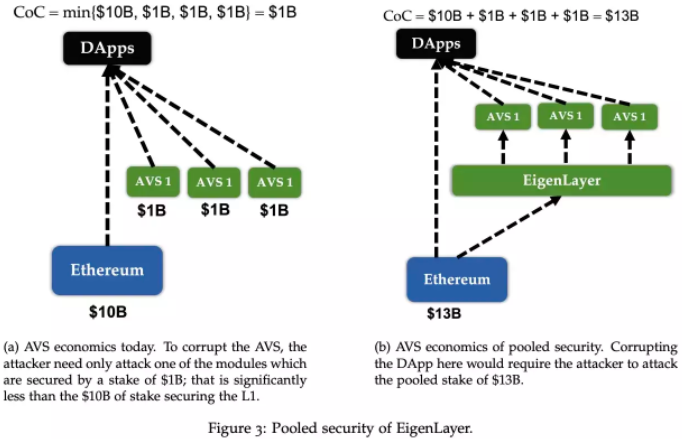
EigenLayer has developed a market model where AVSs can “rent pooled security provided by Ethereum validators.” Security is no longer solely dependent on a network’s native token but can leverage restaked ETH. This market model creates better opportunities between developers and validators, promoting broader adoption of pooled security mechanisms.
The discussions and implications arising from EigenLayer’s solution will be fascinating to observe.
Other protocols are also exploring ways to use staking incentives to drive innovation in the blockchain industry. To mitigate validator centralization risks caused by Ethereum scaling, it is crucial to create validation designs that effectively preserve decentralization. Through continued collaboration and innovation, stronger and more resilient validation mechanisms may emerge, supporting the long-term growth and development of the blockchain ecosystem.
Obol
Obol is developing new technology to build distributed validators for Ethereum. This approach enhances liveness and security by delegating computation across clusters of nodes rather than running a validator on a single node.
Obol achieves this using Distributed Validator Keys—sets of BLS private keys that collectively act as threshold keys participating in PoS consensus. This method increases validator security and decentralization, further enhancing the resilience and scalability of distributed systems.
Using this Distributed Validator Technology (DVT), Obol is also building a network that operates as a layer above the consensus layer, providing access to Distributed Validators (DVs). If successful, Obol’s plug-and-play layer could become a widely adopted foundational component, helping to secure the safety, resilience, and decentralization of blockchains that integrate it. This would further advance blockchain technology and lay a solid foundation for future innovation.
Alluvial Finance
Alluvial Finance focuses on bringing institutional participants into the staking ecosystem to better secure PoS blockchains and improve liquidity of staked tokens. The liquid staking standard Alluvial is developing, called “Liquid Collective,” is an on-chain protocol managed by industry participants including Coinbase Cloud, Kiln, Kraken, and Staked.
This solution offers enterprise-grade infrastructure designed to scale with compliance and security as top priorities. Additionally, “Liquid Collective” operates across protocols and focuses on liquidity (through industry partners), since different protocols may offer varying levels of liquidity for liquid staking tokens. The protocol also provides comprehensive slashing protection for participants, addressing issues such as network outages and node operator failures.
Ion Protocol
Ion Protocol is developing a suite of liquidity products and token standards for liquid staking tokens (LSTs). They argue that two core issues—liquidity fragmentation and complex token models—add unnecessary complexity to the staking ecosystem.
Moreover, governance friction exacerbates confusion, as discussions about liquidity token standards are scattered across different platforms. Ion also points to differing value accrual methods across various LSTs—for instance, Lido’s rebalancing mechanism versus Frax’s dual-token model—which may confuse users and make tracking difficult. By simplifying these processes and introducing a unified token standard, Ion aims to improve efficiency and liquidity within the LST ecosystem.
As the staking industry evolves, new primitives will continue to bring innovation to the space. By addressing issues such as staking centralization, lack of institutional infrastructure, and liquidity challenges, these mechanisms will drive ecosystem growth and redefine how individuals interact with staking protocols.
Join TechFlow official community to stay tuned
Telegram:https://t.me/TechFlowDaily
X (Twitter):https://x.com/TechFlowPost
X (Twitter) EN:https://x.com/BlockFlow_News
 Pantera Capital






