The Two Sessions have created new opportunities for Hong Kong's digital economy, marking a "mutual embrace" between Sun Yuchen and Hong Kong
TechFlow Selected TechFlow Selected
The Two Sessions have created new opportunities for Hong Kong's digital economy, marking a "mutual embrace" between Sun Yuchen and Hong Kong
This time around, neither Sun Yuchen nor Hong Kong will miss the historic opportunity.
 Navigating Web3 tides with focused insights
The National Two Sessions have concluded, and the "Government Work Report" released during the sessions has drawn widespread attention for its references to Hong Kong's development.
On March 14, Cailian Press published a report titled "With full central support from the Two Sessions for Hong Kong and Macao to boost their economies, can Hong Kong’s new crypto policies write another 'Hong Kong legend'?" The article offers an in-depth analysis of Hong Kong's economic trajectory and its recently debated cryptocurrency initiatives.
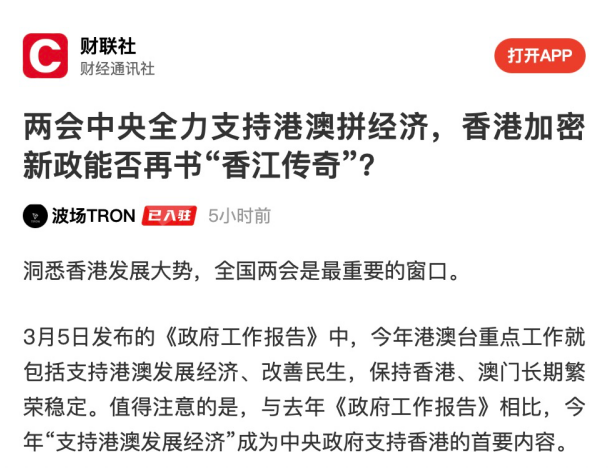
The report notes that a series of black swan events during the 2022 bear market prompted Western countries to tighten cryptocurrency regulations, leading to a geographic shift of crypto activities toward Asia—offering Hong Kong a prime opportunity to reassert its industry influence. Since last year, a string of “new crypto policies” have signaled that Hong Kong is becoming a testing ground for the crypto industry. The recent Two Sessions further provided macro-level policy guidance and momentum for Hong Kong’s crypto sector, boosting confidence in Web3 development while also enabling mainland China to later draw on Hong Kong’s experience to reclaim leadership in Web3 development for the East.
Cailian Press observes that regaining its status as a global hub for crypto finance and virtual assets has become a key driver of Hong Kong’s economic strategy in the new era. The city’s visibly accelerated opening-up has attracted significant capital and crypto investors rushing into the market.
Among them, Justin Sun, founder of TRON and member of Huobi Global Advisory Board, has already begun establishing his presence in Hong Kong. Closely monitoring policy changes in the region, Sun stated, “Over the past three years, Hong Kong’s regulatory framework has undergone many positive changes. Therefore, I am highly confident about the future of crypto compliance in Hong Kong and across Asia.”
Exploring the "Hong Kong Model" for the Crypto Industry
As highlighted in the report, Hong Kong was once the cradle of the crypto industry. As one of the earliest regions globally to explore digital economy and cryptocurrency development, Hong Kong has played a pivotal role in the global blockchain landscape, accumulating extensive experience in both foundational infrastructure and regulatory frameworks.
Around 2018, under Hong Kong’s then-relaxed policies, major crypto giants such as FTX and BitMEX were founded there. Although subsequent policy fluctuations caused Hong Kong to fall behind Singapore in blockchain development in recent years, industry leaders like Justin Sun still see immense potential in Hong Kong’s blockchain future.
Sun believes that Hong Kong’s policymakers must ensure a stable and predictable regulatory environment to attract more digital asset companies and investors. He added that if clear regulatory guidelines had been established earlier, it might have prevented the collapse of major players like FTX and allowed Hong Kong to seize global leadership in this emerging field.
He elaborated further: “I believe Hong Kong has stronger foundations for developing the crypto industry, thanks to its superior international standing and more advanced financial infrastructure. Hong Kong can serve as an experimental ground, where we can observe feedback and results after adopting crypto technologies.”
Arthur Hayes, founder of BitMEX, openly expressed his support for Sun: “Repositioning Hong Kong as a crypto-friendly region will be a powerful catalyst for the next bull market.”
A 'Mutual Embrace'
On October 31, 2021, Hong Kong’s Financial Services and the Treasury Bureau officially released the "Policy Statement on Development of Virtual Assets in Hong Kong," emphasizing support and protection for virtual assets and related industries.
Justin Sun was among the first industry leaders to publicly endorse Hong Kong’s “new crypto policies.” On December 1, 2022, at the event “Dialogue with the Government, Planning for the Future,” Sun stated he would fully embrace Hong Kong’s new crypto initiatives, closely monitor follow-up policies, actively apply for relevant compliance licenses, and look forward to collaborating with the Hong Kong government in areas such as stablecoins, NFTs, and exchange operations.
Sun said that TRON and Huobi are committed to supporting Hong Kong’s new policies, paying close attention to future developments and proactively applying for compliance licenses, aiming to become the preferred partner for clients and Web3 entrepreneurs in Hong Kong.
On the other hand, Hong Kong’s vision for developing and applying crypto technologies aligns closely with Sun’s and TRON’s own explorations. In this regard, Sun and TRON’s practical experiences carry significant reference value and point toward a viable future path.
Considering perspectives from those closely watching Hong Kong’s crypto future, there is a shared hope that Hong Kong can become a global center for crypto finance and digital assets. In this context, Sun and his TRON network offer a development model rooted in established public blockchain infrastructure. Since its mainnet launch in 2018, the TRON network has processed over 5 billion transactions involving nearly $6.9 trillion in digital assets—almost twice India’s GDP in 2022. Today, TRON has over 146 million users.
Meanwhile, according to information disclosed by Hong Kong Chief Executive John Lee, the Hong Kong Monetary Authority (HKMA) is preparing for the rollout of the “digital Hong Kong dollar.” For Sun and TRON, stablecoins are a core business area. Latest data from TRON SCAN shows that the total value of stablecoins issued on the TRON network exceeds $43 billion. Notably, the USD-pegged stablecoin USDT (TRC-20) has surpassed Ethereum in circulation volume, becoming the industry leader.
In November last year, the offshore RMB stablecoin TCNH was deployed onto the TRON network, allowing users to obtain, hold, and trade TCNH on TRON. As the world’s largest offshore RMB market and hub for offshore RMB services—and a key testing ground for virtual assets—Hong Kong presents promising prospects for both public blockchains and stablecoin-related businesses.
Beyond blockchain and crypto technologies, Hong Kong has also shown broad interest in artificial intelligence. Hong Kong Financial Secretary Paul Chan stated that the city will establish an AI supercomputing center and allocate HK$3 billion to advance research in cutting-edge technologies including AI. Sun and TRON are already prepared. Sun noted that TRON possesses natural advantages in integrating with AI. Currently, most global AI applications lack effective payment solutions. Leveraging its decentralized technological strengths, TRON aims to provide developers with secure and reliable payment pathways. At the same time, AI technology can enhance on-chain payment systems. It is reported that TRON DAO has established a $100 million AI development fund to promote the convergence of AI and blockchain technologies.
With robust public blockchain infrastructure, a mature and diverse on-chain ecosystem, leading stablecoin transaction volumes, and integration with cutting-edge AI technologies, TRON has built formidable capabilities. For Hong Kong—a city determined to advance frontier tech and fintech—Sun and TRON undoubtedly offer valuable insights.
On one side is Justin Sun, steadily expanding the depth and breadth of his “blockchain empire”; on the other, Hong Kong, determined to reclaim its position as Asia’s crypto hub. Neither will miss this historic opportunity.
Join TechFlow official community to stay tuned
Telegram:https://t.me/TechFlowDaily
X (Twitter):https://x.com/TechFlowPost
X (Twitter) EN:https://x.com/BlockFlow_News