OpenAI GPT-4 Launch Event Transcript: Code Generation, Image Captioning, and Complex Reasoning...
TechFlow Selected TechFlow Selected
OpenAI GPT-4 Launch Event Transcript: Code Generation, Image Captioning, and Complex Reasoning...
This article will describe the highlights of GPT-4 and how to truly make the most of it.
 Navigating Web3 tides with focused insights
Over the past two years, we've been focused on delivering GPT-4—first rebuilding our entire training stack, then actually training the model, and afterward exploring its capabilities and risks. We worked with partners to test it in real-world scenarios, fine-tune its behavior, and optimize the model for usability.
I. Text Summarization and Processing
Today, we’ll showcase highlights of GPT-4 and demonstrate how to truly make the most of it as a powerful tool and capable partner. Let me begin with the first task.
Something GPT-4 can do but GPT-3.5 cannot: copy part of our blog article content and paste it into the interface (as shown below). GPT-3.5 and GPT-4 share the same API and interactive interface—you simply instruct the model what to do. We’ve made these models very easy to control, so you can provide any instructions you’d like, and the model will follow them faithfully. In the future, this controllability will become even more robust, enabling the model to reliably act as an assistant and return responses accordingly.
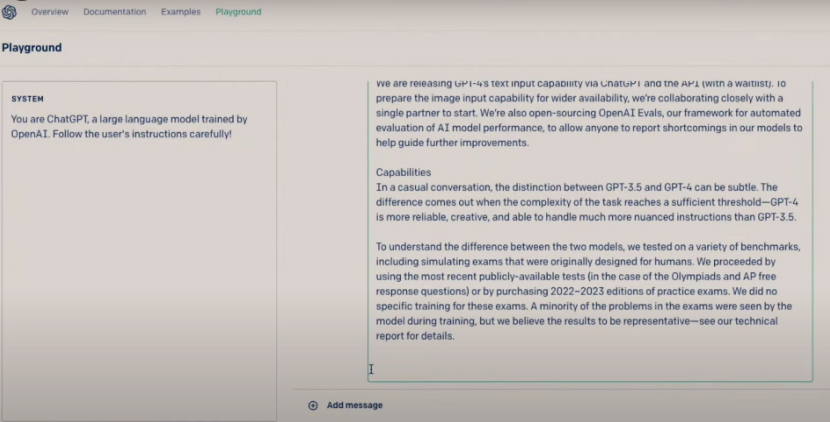
The first task is summarizing an article into a single sentence where every word starts with the letter G. GPT-3.5 didn’t even attempt it and gave up (though it might succeed with a more rigidly structured input). In contrast, GPT-4 handles this task effectively.

By GPT-3.5

By GPT-4
So I've demonstrated summarizing existing articles. GPT-4 can also flexibly summarize and identify commonalities across different articles. I copied an article from yesterday’s news into the same conversation—an article about PyneCone, a Python web application development framework. How does GPT-4 summarize it? “Both focus on making technology more accessible and user-friendly.” If this seems insufficiently deep, the model can always offer further feedback upon request.

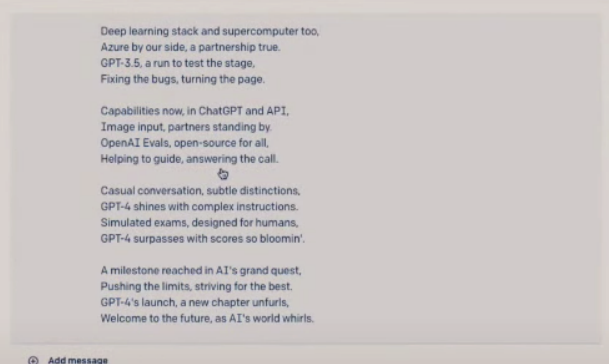
Now I asked GPT-4 to make the blog post content rhyme. Here's the result:
II. Code Generation
We have an open-source evaluation framework (Eval) that helps guide us—and allows all users to understand model capabilities and elevate them to a new level. Next, I’ll show you how to use GPT-4 for building applications (code generation). We’re going to build a Discord bot in real time, demonstrating the workflow and debugging process. The approach is to first write things out in pseudocode, then implement actual code. This method is highly effective for breaking down complex problems into smaller parts, avoiding the need to generate a highly complex solution all at once. It also makes the process much easier to understand. (One caveat: the model was trained up to 2021, so GPT-4 may not be aware of newer interfaces or modules. However, we can adjust this through explicit instructions.)
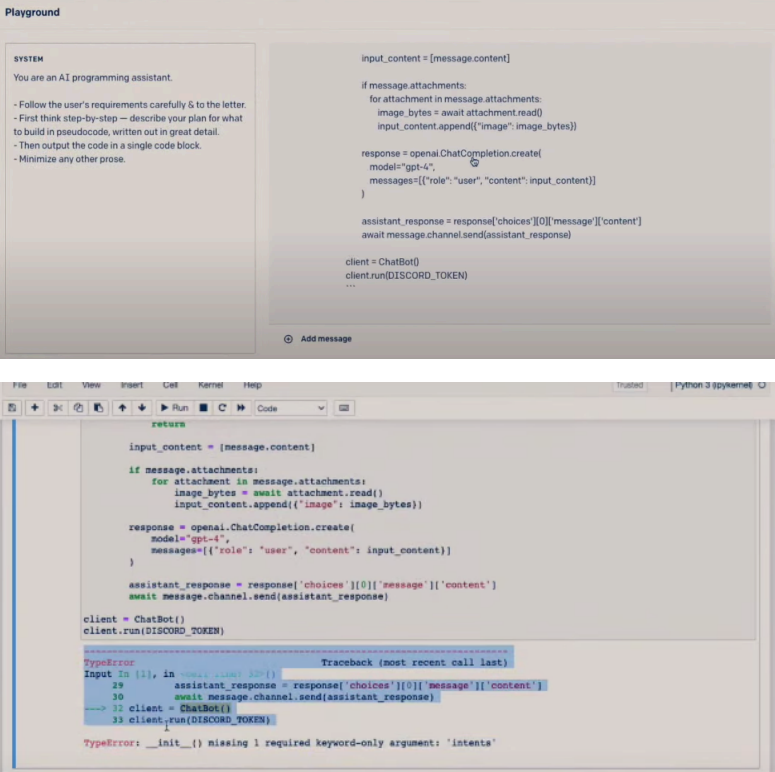
One important note: over time, the Discord API has changed significantly, especially one feature that evolved after the model’s training cutoff. GPT-4 doesn't inherently know which version of the Discord API is being used.
Let’s try again, ensuring we fully understand what the code is doing.
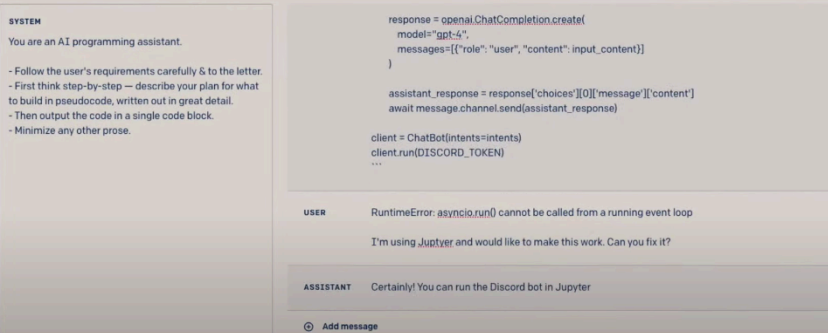
Now comes a second issue—it doesn’t know my execution environment. You can tell the model, “I’m using Jupyter; please fix it so it works,” and it handles that without a problem.
III. Image Description
GPT-4 is not just a language model—it’s also a vision model. In fact, it can flexibly accept arbitrary combinations of images and text as input, just like documents. You can ask any question you'd like: “Can you describe this image in detail?” The model captures many distinct elements of the system and provides rich descriptions. (One thing we must do is make the system faster—this is one of the optimizations we're actively working on.) Now we’ll take audience-submitted requests. Here is a screenshot of a Discord application interface. As you can see, GPT-4 describes the interface in great detail—discussing all chat contents and timestamps, the order of user messages, notification messages, and users within channels.

A new feature of GPT-4 is its extended context length—up to 32,000 tokens, which is our current maximum supported limit. The model can flexibly handle long documents, though this remains an area we're still optimizing. If you're particularly interested in long-context applications, please let us know. We’re eager to explore what kinds of new applications this capability can unlock.
IV. Image-to-Text-to-Webpage Generation
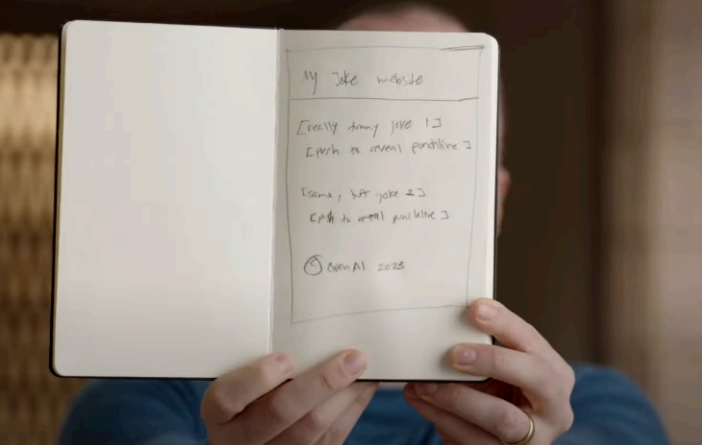
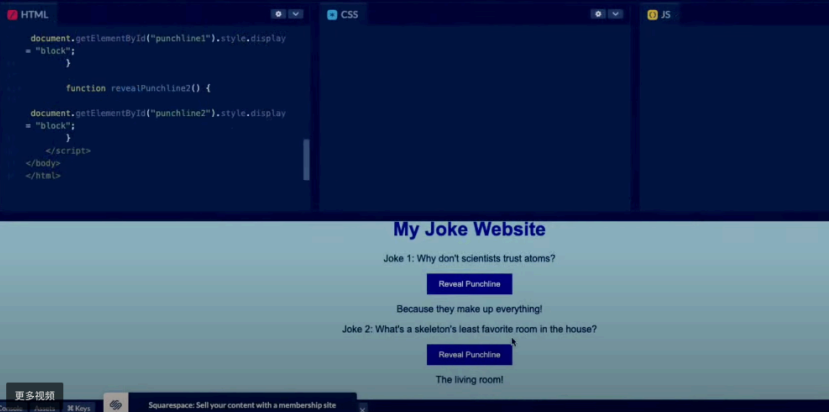
Let me show you another example. Here is a hand-drawn mockup of a humorous website. We asked GPT-4 to automatically generate a prototype website from this sketch. GPT-4 extracts textual information from the image and outputs functional HTML. We ourselves are still discovering novel ways to use this capability and will continue collaborating with partners. We'll expand from here, but please bear with us—we need some time before this becomes broadly available to everyone.
V. Complex Reasoning (Taxation)
GPT is not a tax professional, but understanding dense material can still be helpful for assisting with problem-solving and handling tasks when you're stuck. Now I instructed it to act as “Tax GPT” and provided approximately 16 pages of tax law. There's a scenario involving Alice and Bob: they were married and filed jointly. Their income details are given. The first question: what was their standard deduction in 2018?
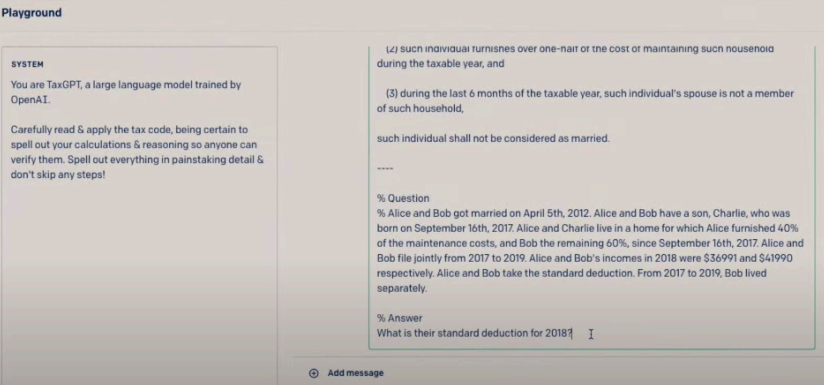
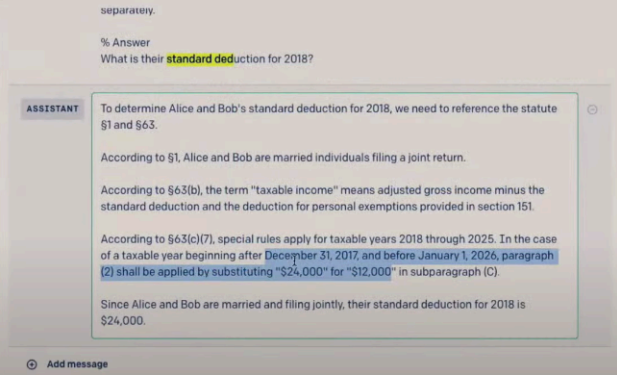
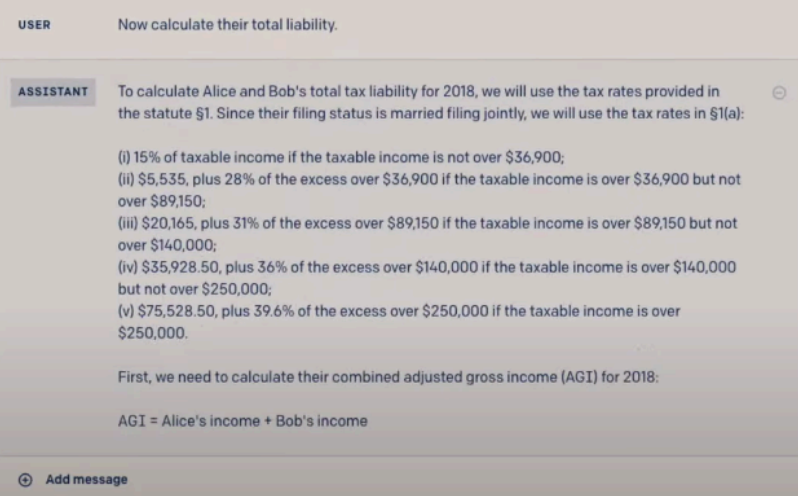
The model quickly arrived at the correct answer and provided a clear explanation. By asking the model to elaborate on its reasoning, even without having read the tax code ourselves, we now understand how the calculation works. Now calculating their total liability—the model performs mental arithmetic well. GPT-4 possesses many flexible foundational capabilities, and you can experiment with various methods to enhance these systems further.
Join TechFlow official community to stay tuned
Telegram:https://t.me/TechFlowDaily
X (Twitter):https://x.com/TechFlowPost
X (Twitter) EN:https://x.com/BlockFlow_News