Cobo Shenyu: History is your daily experience
TechFlow Selected TechFlow Selected
Cobo Shenyu: History is your daily experience
Shen Yu, from the perspective of a seasoned "old cabbage" who has lived through multiple cryptocurrency cycles, shared his insights and underlying thoughts on various topics including the current market, the impact of the FTX incident, DeFi innovation, and the future of DEX. He also explained why he continues to maintain curiosity toward the crypto industry.
 Navigating Web3 tides with focused insights
Author: Shenyu, Co-founder and CEO of Cobo
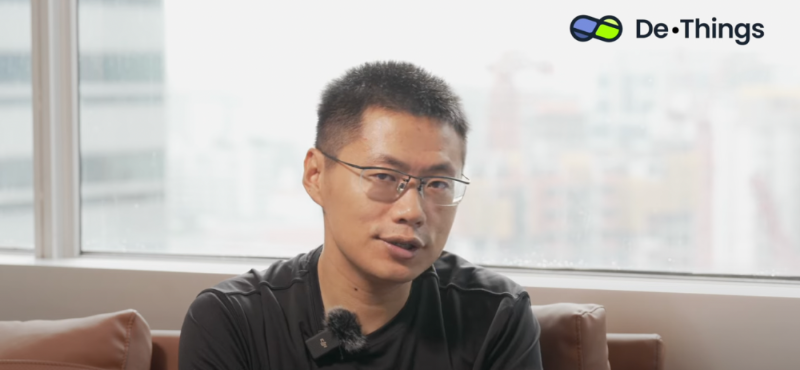
Recently, Shenyu, co-founder and CEO of Cobo, sat down for an exclusive interview with DeThings, a Singapore-based blockchain media platform. Drawing from his experience as a seasoned "old-timer" who has lived through multiple crypto market cycles, Shenyu shared his insights and deep reflections on the current market landscape, the impact of the FTX collapse, DeFi innovation, the future of DEXs, and explained why he remains deeply curious about the crypto industry.
How do you view the current bear market cycle?
-
The despair in this 2022 bear market is not as intense compared to previous downturns—it's incomparable to the depth of past despair.
-
The industry has matured over more than a decade, accumulating vast experimentation and trial-and-error. We've largely figured out what existing blockchain technology can and cannot do.
-
Early-stage scaling solutions around modular blockchains and Layer 2 networks are beginning to emerge. While full deployment may still take two or three years, we can already faintly see a glimmer of hope.
-
My confidence in the industry’s future—and clarity about its direction—is far greater than in previous cycles.
Shenyu: There were three black swan events in 2022. But personally, I feel that the level of despair during this 2022 bear market is not as severe as in previous ones—it simply doesn’t compare to earlier depths of despair.
During the 2015 bear market, prices remained extremely low for nearly half a year, with no market highlights or compelling narratives. The only narrative at the time was Bitcoin. In early 2015, Ethereum had yet to gain broad industry consensus—it was still in its infancy, perhaps just in Vitalik Buterin’s mind, with the whitepaper not even released. The entire market lacked momentum, and many questioned whether Bitcoin could survive.
Today, after more than a decade of development, the industry has accumulated significant experience and trial-and-error learning. We’ve essentially tested the limits of what current blockchain technology can achieve. Forms like tokenless blockchains and consortium chains—now familiar concepts—were already proven unviable in prior cycles. We now understand the performance boundaries of blockchains: which applications match current capabilities, which models might work (though most don't), and we've experimented across the board.
We now have a clear sense of what the industry can and cannot do. Additionally, we can begin to envision what isn’t possible today but may become feasible tomorrow—for instance, high-TPS applications we’re already demoing, despite unresolved scalability challenges. After years of debate over scaling since 2015, the technical roadmap is now largely clear.
Around modular blockchains and Layer 2 scaling solutions, early prototypes are starting to appear. Although final implementation may take another two or three years, we can already glimpse a path forward. As a result, confidence in the industry’s future hasn’t waned as drastically in this cycle compared to previous ones.
This cycle saw numerous black swans, causing many individuals—especially those unprepared for extreme volatility—to lose their entire portfolios, or suffer major losses due to entanglement with events like FTX. On a personal asset level, the damage has been substantial. Yet when it comes to confidence in the industry’s long-term vision and direction, I believe we’re far clearer than in any prior cycle.
What’s your take on the FTX collapse?
-
Sam is someone who can’t sit still—he relentlessly maximizes capital efficiency and digs deep for profits, never allowing funds to sit idle for long.
-
In the beginning, we saw Sam move exchange assets into low-risk investments. Gradually, he grew more confident and arrogant, believing in his own growing abilities, leading to increasingly risky behavior.
-
Centralized exchanges carry too many responsibilities—they handle trading matching, brokerage, and custody all at once. For founders, resisting human temptation under such conditions is extremely difficult.
-
Similar stories have repeatedly occurred over the past decade. At their core, they reflect human nature—these issues will always exist; it’s only a matter of scale and whether they eventually surface.
Shenyu: We’ve had considerable on-chain interactions with Sam. After DeFi surged in 2021, there were abundant DeFi investment opportunities on-chain, and I personally participated in many early-stage DeFi investments. When investing in DeFi projects, it’s crucial to know who else is investing alongside you, what they’re doing, their intentions, when they might exit, and how that could affect liquidity. So we conducted extensive on-chain data analysis, tracking numerous traceable whale addresses. Frequently, we found addresses linked to FTX and Sam, observing his diverse and creative on-chain maneuvers. Through his DeFi investments and trades, we gained insight into his approach.
At its core, this likely relates to personality. Sam is someone who can’t stay idle—he relentlessly seeks maximum capital efficiency and profit extraction. He applied this mindset early on in arbitrage and continued it throughout large-scale DeFi investments. He simply doesn’t allow money to sit unused in accounts for extended periods.
Exchanges accumulate massive user deposits. Initially, we observed Sam transferring exchange assets into low-risk investments. Over time, he became increasingly self-assured and overconfident, believing his skills were superior, gradually taking on higher risks. This is understandable human behavior—but once risk reaches a certain threshold, it may no longer be controllable, ultimately resulting in extreme outcomes like the FTX collapse.
The crypto industry is still nascent, with incomplete infrastructure and inadequate regulation. This causes centralized exchanges to shoulder excessive responsibilities—handling trade matching, brokerage, and asset custody simultaneously. For entrepreneurs and founders, resisting human temptation becomes extremely difficult. Managing vast user assets, it’s tempting to slightly mobilize those funds to generate strong cash flow—especially during the bull markets of the past few years. Regulatory frameworks remain unclear, so these two factors together created the perfect storm for a massive blowup like FTX.
Historically, such stories are endless—numerous similar incidents have occurred over the past decade, such as early Chinese savings platforms and the Mt. Gox incident. At their root, they all stem from human nature. These problems will always exist—it’s merely a question of scale and whether they eventually come to light.
In the future, technological solutions may help prevent such events. Blockchain fundamentally empowers individuals with freedom—enabling them to manage their assets by controlling their private keys. However, the industry hasn’t reached that stage yet. Users still make compromises between necessity, security, and usability when managing their own assets. Many believe they’ll eventually lose their private keys, so prefer leaving assets on exchanges instead. Hence, vast amounts of value remain centralized on exchanges. Nevertheless, as technology advances, infrastructure improves, and on-chain applications flourish, this issue will gradually resolve itself.
On Cobo’s Mission
-
From day one, Cobo has focused on securely managing private keys and building the necessary security and risk controls around key management.
-
We plan to productize our internal tools and the expertise we’ve accumulated in DeFi asset management and make them available to others.
-
We don’t want to become a centralized black box. Instead, we aim to provide users with convenient, secure, and easy-to-use solutions for interacting with blockchains.
Shenyu: The FTX incident served as a major wake-up call for us. From the very beginning, Cobo has focused on securely managing private keys and developing the accompanying security and risk control systems. We’ve remained disciplined, deliberately limiting our scope of activities.
Over the past five-year cycle, we’ve seen many profitable opportunities—whether in lending or derivatives—and numerous clients (such as mining groups) approached us. After conducting preliminary tests, we identified significant tail risks and uncertainties, so chose not to scale up those operations.
For a long time, we’ve stayed focused on securely storing private keys, managing contract state risks, and securing the systems involved in private key usage.
Going forward, we intend to productize the experience and internal tools we’ve developed in DeFi asset management and offer them to others. We don’t want to become a centralized black box. Our goal is to provide users with more convenient, secure, and user-friendly solutions for interacting with blockchains—whether managing on-chain assets, DeFi contract states, or potentially more complex on-chain applications in the future. Therefore, we’ll maintain a sharper focus and continue long-term iteration.
Is there still innovation in DeFi?
-
The foundational financial framework of DeFi is mature, but there remains significant room for composable financial innovation on top.
Shenyu: In roughly twenty months, DeFi has brought over 200 years’ worth of proven traditional financial products onto the blockchain. Currently, DeFi consists of four major modules.
First is stablecoins, which remain relatively immature—perhaps only 30–40% complete. The dominant model today involves USD-collateralized stablecoins, along with over-collateralized models like DAI using single or multiple assets. Despite explorations over the past two years, many attempts failed due to bubbles and Ponzi dynamics, such as Luna. We’re still searching for more robust and viable technical solutions in this space.
Second is DEXs, primarily spot exchanges. Current AMM mechanisms address most long-tail demands. Order book and derivatives trading require higher blockchain performance, which depends on future Layer 2 developments. We can already foresee the general product direction here—about 60–70% of the picture is clear.
Third is lending. Over-collateralized lending in DeFi is already quite mature, having endured numerous security breaches and attacks. Especially during recent low-liquidity periods, there have been widespread price manipulation attacks targeting lending markets. The edge cases in lending are now well-understood. We can clearly see the future trajectory—how to isolate assets, implement risk controls. Progress here is around 70–80% complete.
Fourth is on-chain derivatives and risk management. This area remains relatively early, with insurance and options markets still small in volume.
Overall, the foundational financial architecture of DeFi is mature, but there remains vast potential for composable financial innovation on top—though still in early stages, with only limited experiments so far. I believe core DeFi modules will eventually evolve into standard on-chain protocols, while other applications like NFTs and GameFi can directly integrate and build upon them.
There’s still room for innovation at the frontier—balancing new applications with risk. I don’t believe we’ve reached full maturity yet.
The Future of Centralized Exchanges
-
Crypto has been global from day one. It shouldn’t become a regional affair based on a founder’s skin color or birthplace.
-
The FTX episode essentially marks the beginning of the end for centralized exchanges.
Shenyu: Crypto has been inherently global since its inception. It shouldn’t devolve into a geographically constrained domain based on a founder’s ethnicity or nationality. Our on-chain behaviors and interactions have always been global—and will remain functional even if we reach Mars. We shouldn’t impose arbitrary geographic limitations.
Looking at today’s landscape, the FTX incident essentially signals the twilight of centralized exchanges. While public sentiment may fade quickly and market cycles cause people to forget, this event has deeply impressed institutional users—especially traditional family offices and financial institutions entering since 2017—with the industry’s structural flaws.
We’ve also witnessed massive capital flight from various centralized exchanges—large and small—into on-chain wallets following FTX’s collapse. From this perspective, most functions currently performed by centralized exchanges can now be done—or even improved upon—by decentralized exchanges. For functionalities that aren’t yet fully replicable, solutions like MPC can ensure transaction processes are no longer opaque, uncontrollable black boxes.
In the near future, hybrid models combining decentralized and centralized elements will likely emerge to mitigate such risks. For long-tail use cases, we may solve them directly in a decentralized manner—potentially with greater efficiency.
Is there still potential in mining?
-
The future of mining should not resemble its current state.
-
The ideal end-state for mining would involve numerous small and medium-sized mining operations connected to the global power grid, helping regulate grid stability.
-
We may enter another phase of re-decentralization, where home mining becomes more profitable—not only earning from mining itself, but also receiving additional compensation for helping balance grid peaks and troughs.
Shenyu: Let’s first review the history of mining. In the early days, individual miners used CPUs or GPUs at home, each contributing computing power. Starting in 2013, ASICs emerged, shifting GPU mining toward specialized hardware. But during the 2015 bear market, conditions turned harsh—miners couldn’t cover electricity costs—leading to consolidation from small-scale operators into factory-style mining farms optimized for lower energy expenses. Since 2015, mining has industrialized at scale, adopting containerized and modular designs.
Currently, most of the global hash rate is concentrated in North America. Especially after the Russia-Ukraine conflict, shifts in the global energy landscape have become evident. Energy costs in Europe have soared, leaving North America—with its abundant natural gas and hydroelectric resources—as the primary hub, alongside some regions in Southeast Asia, South America, and parts of Africa with available power supply. Thus, the industry remains in the late phase of centralization.
I believe the future of mining shouldn’t mirror its current form—where efficiency is maximized by clustering vast numbers of machines in single facilities, akin to internet-era IDCs, perhaps functioning as highly cost-efficient data centers.
The ideal end-state for mining would involve numerous small and medium-sized mining sites integrated into the global power grid, helping stabilize it. Since electricity is hard to store, much energy goes wasted—we could help flatten peaks and fill valleys. Some operations could repurpose thermal energy for industrial or residential heating and power. Others might see large financial institutions turning mining into traditional fixed-income products for investment.
Decentralization trends may gradually re-emerge, as improvements in mining chip efficiency have plateaued and power consumption is already relatively low. Under these conditions, mining hardware will have longer lifespans, enabling broader utility.
Globally, there isn’t much surplus energy left that’s both abundant and rapidly deployable—outside of China, large-scale readily usable energy sources are limited. We may therefore enter a new phase of re-decentralization, where home mining becomes more profitable—even connecting to the grid to help regulate load fluctuations, earning extra income beyond pure mining rewards.
What new things have you recently tried?
-
This industry evolves in spirals, filled with recurring or similar patterns—so maintaining curiosity, observation, and reflection is crucial.
Shenyu: I explore whatever seems interesting. For example, over the past year, I’ve dabbled in NFTs. People joke that I’m the “NFT anti-indicator”—whatever I buy immediately drops in price. I’ve also briefly experimented with GameFi.
I actively think about and anticipate the industry’s future directions, identifying key emerging trends and pivotal turning points. Early on, I experiment and make mistakes to explore. Once I detect that a niche sector or vertical has matured—marked by a clear inflection point—I invest more time studying it. I analyze why the shift occurred and where it might lead, then reinvest time and effort into further testing. Essentially, I remain in a constant state of exploring the industry’s frontiers.
If something feels fun but unsuitable for me, or intriguing yet lacking a clear path to capture rapid growth, I set it aside—marking the next milestone to watch. When that next inflection arrives, I’ll dive back in.
Every bear market offers abundant experimentation opportunities. For example, the DeFi narrative began gaining traction during the 2018 bear market on EOS, where early versions were built and tested. By 2020–2021, those ideas were refined and successfully launched.
This industry develops in spirals, repeating similar patterns—making it essential to stay curious, observant, and reflective.
When will you retire?
-
If you read history and study financial events from the past 200 years, it’s hard to truly empathize. But in this industry, history is literally what happens to you every single day.
Shenyu: The year I graduated from school, I set a goal: retire at 30. Well, I’ve already passed that age. The crypto industry is fascinating—the pace of iteration is incredibly fast. As we discussed, it’s highly cyclical, with bubbles bursting quickly, yet constantly generating innovation and exciting new developments that force you to keep learning and evolving. That’s precisely what makes this industry so compelling to me.
I continue dedicating significant time to learning at the industry’s early stages or cutting-edge frontiers because these topics are genuinely fascinating. If you read historical accounts of financial developments over the past 200 years, it’s difficult to truly relate. But in this industry, history unfolds through your daily experiences. Reflecting, learning, and growing happen rapidly—and it’s deeply engaging, with dopamine flowing abundantly. Because of this, I find it nearly impossible to leave the industry. Once you truly understand it and become immersed, retirement becomes unthinkable.
Join TechFlow official community to stay tuned
Telegram:https://t.me/TechFlowDaily
X (Twitter):https://x.com/TechFlowPost
X (Twitter) EN:https://x.com/BlockFlow_News
 Cobo
Cobo