
A Brief History of Cosmos LSD: More Research, Fewer Products
TechFlow Selected TechFlow Selected
A Brief History of Cosmos LSD: More Research, Fewer Products
LSD is only in demand where DeFi is well-developed.
 Navigating Web3 tides with focused insights
Author: ibcbull
This article assumes readers have a basic understanding of LSD — for example, what LSD is, where it's currently used, and ideally experience with an LSD product like Lido. Familiarity with Cosmos would be even better — such as having used IBC (using Osmosis means you've already used IBC).
This piece covers the history of LSD in Cosmos; the next will discuss its current state. The content can be divided into two threads: research and discussion, and practical applications.
Main Thread 1: Research
Research on LSD within the Cosmos ecosystem dates back to 2020 or earlier — roughly around one year after the launch of Cosmos Hub (ATOM).
Why has Cosmos conducted so much research on LSD?
I think this is because Tendermint, as the most standard and canonical proof-of-stake (PoS) consensus mechanism (with features like single-slot finality and long unbonding periods combined with slashing), serves as the default consensus module in Cosmos SDK. Tendermint not only powers dozens of Cosmos chains today (map of zones) but is also used by non-Cosmos-SDK-based chains such as Polygon PoS and Oasis. It has inspired many subsequent PoS consensus designs. As a result, the Cosmos community has long engaged deeply in PoS research and discussions, making the emergence of LSD ideas quite natural.
Why does Cosmos have more research than products when it comes to LSD?
So far, large-scale LSD adoption remains primarily in DeFi — especially use cases like leveraged looping. In short, LSD demand exists where DeFi is mature. For a long time, most tokens in Cosmos, including ATOM, were mainly used for voting. It wasn't until 2022 that Cosmos (excluding Terra) saw the emergence of mature DEXs like Osmosis and Crescent. Lending remained in early stages until early 2023, when protocols like Umee and Mars reached usable maturity. Thus, prior demand for LSD in Cosmos was minimal. Only in DeFi-rich environments like Terra did LSD thrive.
Despite few products, let’s review three important LSD-related events.
Topic 1 Chorus One x ICF LSD Report
In 2020, Chorus One and the Interchain Foundation jointly published an extensive LSD research report. Spanning dozens of pages, it thoroughly analyzed the history of PoW and PoS and explored how LSD concepts emerged. At that time, neither Lido nor centralized exchanges had launched real LSD products, so the report focused largely on theoretical analysis and experimental projects. Notably, it discussed potential risks of LSD — such as impacts on PoS security assumptions, or whether long unbonding periods designed to deter validator misbehavior become obsolete if everything becomes liquid staked. Worth reading if you have time.
Gauntlet also published a similar article worth reading: What PoS and DeFi can learn from mortgage-backed securities.
Note: The Interchain Foundation (ICF) plays a role in Cosmos akin to the Ethereum Foundation in Ethereum or the Web3 Foundation in Polkadot. It funds broad ecosystem growth across Cosmos, not limited to Cosmos Hub, focusing particularly on Tendermint consensus, IBC, and Cosmos SDK development.
Note: Chorus One is a professional PoS node operator. Alongside Figment, P2P, and Stakefish (the PoS arm of FTX), they represent "validator-as-a-service" providers closely tied to the Cosmos ecosystem — ideal custodians for retail stakers in my view. Chorus One’s CEO Brian is an early member of Cosmos and contributed to projects like Lido on Solana and the first Solidity-based IBC light client and Wasm-based IBC light client. Together with community validators (many lesser-known), CEX validators, and core team validators (like Informal Systems, who are both core developers and run nodes), they form the majority of validator ecosystems on most PoS chains.
Topic 2 Iqlusion Liquid Staking Module
Since Cosmos chains natively support staking — and typically require long unbonding periods (e.g., 21 days for ATOM, 14 days for OSMO) — some believe these delays hinder LSD adoption. To address this, Iqlusion developed a Cosmos SDK module enabling users to convert their staked tokens into LSD without initiating the unbonding process.
This module hasn’t yet been deployed on mainnet and remains largely at the proof-of-concept stage. However, Stride and Quicksilver may adopt it later to improve user experience (allowing users to bypass the unbonding period).
Note: Modules in Cosmos SDK can be seen as fundamental logic units of a Cosmos chain. Default modules like staking, governance, and IBC together form a functional PoS chain. Chains can also add custom modules to implement unique functionality (which is why Cosmos SDK is considered an app-chain framework), such as Terra’s stablecoin module or Osmosis’ DEX module.
Note: Iqlusion is a company led by Zaki Manian, a core contributor to the Cosmos ecosystem.
Topic 3 Cosmos Hub Proposal #69: Deploy CosmWasm on Hub to Enable Lido for ATOM
Although this proposal debated whether to deploy a permissioned cw (similar to today’s setup on Osmosis, where contract deployment requires governance approval) on Cosmos Hub, the primary goal was to enable deployment of the Lido contract — essentially porting over the existing Terra-based Lido contract to support stATOM. That contract, being a CosmWasm (cw) smart contract, had already secured substantial funds and thus was considered highly secure (bLUNA/stLUNA achieved significant issuance, reaching multi-billion dollar valuations).
The proposal ultimately failed to pass in voting. Opponents raised concerns about leverage via LSD, fearing ATOM concentration in Lido, delegation of native governance power to third parties, instability of cw itself, and the imminent arrival of shared security — which would allow Lido to deploy on other chains secured by Cosmos Hub instead. The debate was intense (see vote and forum discussion).

Note: CosmWasm (short for cw) is the most popular virtual machine in Cosmos, analogous to EVM in Ethereum. Implemented as a Cosmos SDK module, any Cosmos SDK chain can upgrade to enable cw instantly. Previously, all of Terra’s ecosystem (except stablecoin minting/burning) operated within cw — including Anchor, Mirror, Astroport, and Lido. Today, chains like Osmosis, Injective, Juno, Secret, and upcoming ones like Sei and Neutron are all cw-based (excluding rare exceptions like Gno and Agoric). Many Cosmos dApps can deploy across multiple chains or migrate from Terra to Osmosis precisely because they all use cw — similar to how Uniswap can fork onto every EVM-compatible chain. Whether to build using cw or custom Cosmos SDK modules deserves its own dedicated discussion.
Note: Shared Security (ICS) is Cosmos' solution to the challenge new chains face in bootstrapping their own validator sets while ensuring sufficient security. In short, it allows Cosmos Hub validators to also validate another chain — known as a consumer chain — effectively renting security from the Hub. ICS itself is an IBC application. Theoretically, any chain integrating the shared security Cosmos SDK module and passing governance votes can join. While less efficient than rollups (Ethereum or Celestia rollups) or Polkadot parachains, ICS addresses the critical 0-to-1 problem: getting something functional live. Optimization can come later.
Shared Security is scheduled to go live on Cosmos Hub on March 7. Neutron will also launch by end of March.
Main Thread 2: Products
Before discussing today’s Cosmos LSD landscape, it's helpful to revisit Terra’s LSD history to anticipate future trends in Cosmos LSD. This applies not just to LSD, but to the entire Cosmos DeFi ecosystem, which can draw lessons from Terra DeFi. While outcomes won’t be identical due to IBC, there remain valuable parallels.
Topic 1: Lido x Terra
bLUNA was a collaborative product between Lido and Terra, created specifically to serve as collateral for Anchor. Developed and maintained by the P2P team, Anchor functioned as a specialized lending protocol accepting only LSDs as collateral (bLUNA, and bETH — which was bridged stETH) and issuing only UST. Its 20% deposit APY was partially funded by LSD staking rewards, partially by ANC token emissions, and partially subsidized by the Terraform Labs (TFL). Ultimately, one major reason for Terra’s collapse was insufficient borrowing demand relative to excessive deposits — leading to unsustainable UST issuance, half of which remained trapped in Anchor. TFL subsidies continued until April 2022, when floating interest rates were finally introduced — too late to prevent the May 2022 crash.
Despite Anchor and UST collapsing, bLUNA itself was highly successful — widely used in both Anchor and Astroport without any security incidents. This gave P2P crucial experience in developing and maintaining cw smart contracts, laying the foundation for their work on Neutron.
Note: P2P is a core participant in the Lido ecosystem. Vasiliy Shapovalov, a key figure at P2P, was one of the original designers of Lido. Today, P2P is primarily focused on Neutron — a shared-security smart contract platform chain connected to Cosmos Hub, similar to Terra2 and Juno, but emphasizing developer tools to better support IBC-enabled cw apps. Developers can deploy on Neutron and connect seamlessly to the broader Cosmos ecosystem.
For deeper insight, see these two posts from the Lido forum discussing Terra’s aftermath: Should Lido support Terra reboot? and Sunsetting Lido on Terra.
Topic 2: Other LSD Projects
bLUNA was ultimately built for Anchor, and Lido couldn’t sustain heavy LDO incentives indefinitely — creating space for alternative LSD projects. Here are three that gained traction, all emerging in 2022, shortly before Terra’s collapse.
Prism doesn’t position itself solely as an LSD protocol — rather, it focuses on advanced DeFi structures. It offers three products:
-
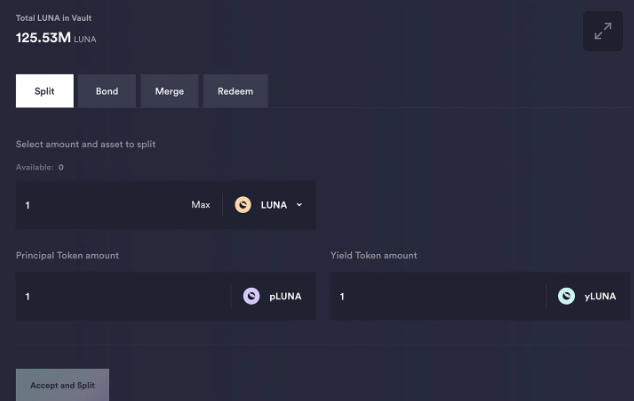
cLUNA: A standard LSD similar to bLUNA. But each cLUNA can be split into one pLUNA and one yLUNA.
-
pLUNA: Represents the principal portion of LUNA, retaining governance rights. Since Terra is a standard Cosmos chain with frequent on-chain governance requiring LUNA voting, this separation adds utility.
-
yLUNA: Represents yield generated from staking.
This design enables sophisticated financial engineering — such as time-dated p/yLUNA instruments and separate pricing or collateralization of principal and yield components. Unfortunately, Prism didn’t survive long after Terra’s collapse, though it briefly reached several billion dollars in TVL (driven by high LUNA prices at the time).
Before Terra’s downfall, Prism, like other LSD platforms, planned to expand beyond LUNA to Ethereum and other Cosmos chains. Now, Prism is preparing to launch its own Cosmos chain — covered in the next article.
This video explaining Prism is well done and worth watching.
Stader is a typical LSD project found in every ecosystem — nothing particularly innovative. It issues its own token to incentivize liquidity and partners with DEXs for joint incentives. I suspect part of its motivation was capturing ASTRO rewards from Astroport...
After Terra’s collapse, Stader expanded to other chains — Near, Hedera, Polygon (see DeFillama) — and now even Move-based chains. I generally avoid such projects and certainly wouldn’t buy their governance tokens (check the price chart — classic farm-and-dump pattern).
Steak was built by larry, an active cw developer (from Delphi Labs, whose main focus is the lending protocol Mars Protocol; v1 was on Terra, v2 runs on its own Cosmos chain, now supporting Osmosis). Steak emphasizes simplicity. Don’t underestimate that — it became the most frequently forked LSD on Terra2 and Juno. The code is exceptionally clean and readable, even for those unfamiliar with cw, making it excellent learning material for cw development. Steak has no governance token and offers no mining rewards — truly a passion-driven project.
Later, Larry shifted focus to Mars v2, leaving Steak unmaintained. Subsequent forks have seen limited success. Unless you’re studying cw development, Steak isn’t worth tracking. From a learning perspective, Steak has the best code; Prism isn’t open-source; Lido is open but complex due to feature richness; Stader is open but average in quality.
Join TechFlow official community to stay tuned
Telegram:https://t.me/TechFlowDaily
X (Twitter):https://x.com/TechFlowPost
X (Twitter) EN:https://x.com/BlockFlow_News