How AIGC Can Join Forces with Web3 Amid the ChatGPT Boom
TechFlow Selected TechFlow Selected
How AIGC Can Join Forces with Web3 Amid the ChatGPT Boom
How AIGC Can Join Forces with Web3 Amid the ChatGPT Boom
 Navigating Web3 tides with focused insights
Shortly after the new year began, a chatbot named ChatGPT went viral across the internet, amassing over 100 million active users within just two months—making it the fastest-growing consumer application in history. Launched by OpenAI, an artificial intelligence company backed by Microsoft, on November 30, 2022, ChatGPT can learn and understand human language to hold conversations, interact based on context, and even complete tasks such as writing emails, video scripts, copywriting, translation, and coding, quickly becoming a favorite tool among businesses and students. Following this surge, U.S. tech giants like Microsoft and Google have heavily invested in related fields, significantly increasing their spending on artificial intelligence; meanwhile, Chinese internet leaders including Baidu, Alibaba, and NetEase are also accelerating development of "ChatGPT-like" products.
The popularity of ChatGPT has revealed the immense potential of AI technology in the Web3 era and drawn attention to the developmental prospects of AIGC. ChatGPT represents one application direction within the AIGC domain—both leverage AI-driven automated content generation as their core technological foundation, demonstrating vast commercial value. According to 6pen, it is predicted that 10%–30% of online images will involve AI-generated content within the next five years, potentially creating a market worth over $60 billion. Considering the rapidly growing demand for content in the next-generation internet, global consulting firm Acumen Research and Consulting forecasts that the AIGC market will reach $110 billion by 2030.
In fact, AIGC first entered the public eye in August 2022 when game designer Jason M. Allen won first prize in the "Digital Art/Digitally Manipulated Photography" category at a state fair with his AI-generated artwork titled *Théâtre D'opéra Spatial*, capturing widespread attention. Now, less than a year later, ChatGPT has emerged as the "new top sensation," reigniting interest in AIGC. So how powerful is AIGC really? As a technical tool, what kind of creative vitality does it bring to content creation? Let's dive into AIGC, explore the potential of AI-generated content, and examine viable paths developers can take to effectively harness AIGC.
What Is AIGC?
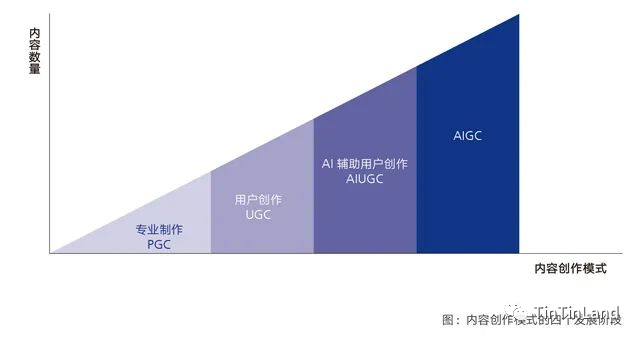
AIGC refers to the use of artificial intelligence technologies to generate content. It is regarded as a new form of content creation following PGC (Professionally Generated Content) and UGC (User Generated Content). The latest generation of AIGC models can create across various modalities, including text, speech, code, images, video, and robotic actions. In terms of creativity, expressiveness, and personalization, AIGC surpasses traditional forms of machine-generated content, offering more vivid and dynamic ways to convey creators’ ideas. Some even claim: "AIGC, NFTs, and VR are the three foundational pillars of the metaverse and Web3, representing the future direction of technological creativity." Indeed, AIGC not only holds significant utility as a tool but also harbors boundless commercial growth potential.
Tool Value
As a technical tool, AIGC primarily enhances creative efficiency. For professionals in creative industries such as art, film, advertising, gaming, and programming, AIGC can assist in daily workflows and help produce more stunning works. Its low cost and high efficiency support the construction of scalable production systems. Additionally, in terms of inspiration capture, AIGC can help experienced creators innovate interactive formats and provide space for creative expression.
Commercial Value
Gartner predicts that by 2025, generative AI will account for 10% of all produced data. According to the analysis in *Generative AI: A Creative New World*, AIGC has the potential to generate trillions of dollars in economic value. Improvements and enrichments in digital humans, virtual environments, digital content, and multimedia products can unlock further commercial returns through AIGC.
Three Key Challenges Facing AIGC Development
"The AIGC market resembles a giant carrying a bomb—appearing extremely powerful from the outside, yet harboring unresolved internal threats. If these threats aren’t addressed, industry development will ultimately be constrained."
Beneath every period of rapid growth lie hidden risks. While AIGC accelerates content creation and dissemination, it also exposes several critical vulnerabilities.
Difficulty in Attributing Ownership and Accountability
Under national copyright laws, authors must be natural persons, legal entities, or unincorporated organizations. However, the creator in AIGC is artificial intelligence itself—an entity lacking the attributes required to qualify as an "author." If platforms use AIGC to generate images, texts, or other content that leads to commercial disputes or liability claims, who should be held accountable—the platform, the open-source contributors, or the end users? As a result, most Web3 platforms remain cautious when integrating AIGC concepts, and developer exploration of AIGC often feels like a desperate struggle under real-world constraints.
Difficulty in Monetizing Business Models
Current AIGC models have limitations—much of the generated content still falls short of commercial standards. In other words, turning AI-generated content into revenue requires learning industry-specific knowledge and establishing tailored content-generation frameworks. Although OpenAI’s ChatGPT can assist with tasks like editing academic papers, coding, and writing copy, the outputs remain relatively generic. When deeper domain expertise is needed, human judgment and reasoning are still indispensable.
Lack of Trust in Technical Frameworks
Blockchain technology earns trust due to its transparency and traceability, and its high degree of decentralization enables stable trust relationships among developers, investors, and users, facilitating asset transactions and project collaborations. In contrast, AIGC stems from a "tool-oriented" mindset, relying heavily on centralized platforms, and lacks a robust framework for information privacy and responsibility attribution. Currently, most users experiment with AIGC tools—such as chatbots, voice assistants, and image generators—out of curiosity, using them for personal life, work, or decision support. But whether the data they input exists in a "regulatory vacuum" remains unknown.
Integrating AIGC into the Web3 World
New technologies often require new business ecosystems. The three major challenges facing AIGC stem largely from issues around authorship recognition and technical infrastructure. Thoughtfully leveraging Web3 and its foundational components may offer solutions to these problems.
Injecting DAO into AIGC Models
The Web3 buzzword "DAO (Decentralized Autonomous Organization)" offers a reference model for managing AIGC systems. Participants deploy a set of rules on blockchain that execute automatically and cannot be altered, enabling decentralized self-governance. The idea of "autonomy" is particularly relevant because AIGC applications in different industries require fine-tuned models—there is no one-size-fits-all solution. Questions about incentive mechanisms, fairness, and rule validation must be continuously debated, tested, and formalized into executable protocols.
Moreover, a DAO structure involving multiple stakeholder roles can suitably manage AIGC platforms. By defining four key roles—creators, original artwork owners, AIGC operators, and blockchain validators—a sustainable ecosystem can emerge. Revenue generated by creators can be distributed among the other three parties, with allocation determined through regular voting. In this model, commercial value originates from creators and flows to original rights holders, AIGC operators, and blockchain validators—all integrated via Web3 into a single DAO, making AIGC usage and coordination more seamless and efficient.
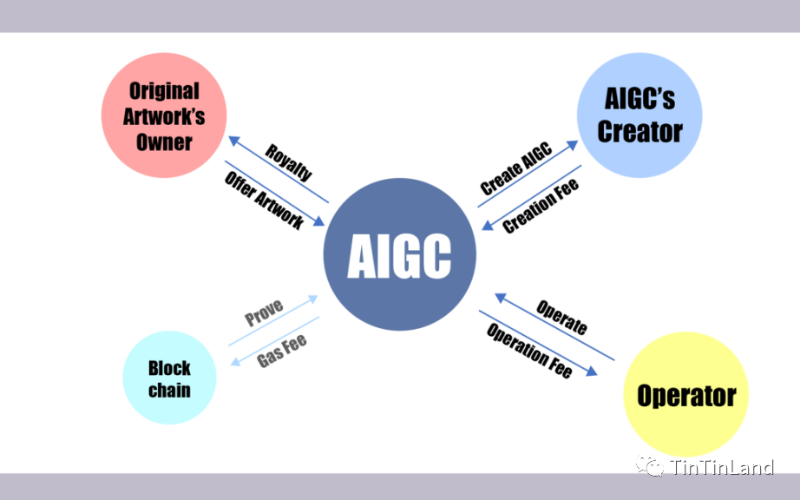
Take an advertising marketing platform as an example—the DAO + AIGC management pathway could look like this:
Dedicated marketing copy is generated via AIGC, adding value and supporting routine or campaign-specific design work;
Original ad copy creators upload their work, which then undergoes verification to become an NFT, securing copyright and enabling monetization;
AIGC operators join the DAO, participating in governance through voting and proposals, and sharing in revenue distribution;
Blockchain validators ensure system integrity by auditing key metrics such as download counts and API calls, guaranteeing fairness and transparency;
While leveraging DAOs to empower AIGC management, we must also recognize potential risks in DAO governance and seek mitigation strategies. Given the diverse and evolving nature of AIGC applications, malicious actors may exploit loopholes to steal user data. Therefore, DAOs must maintain sufficient flexibility and adaptability to respond to changing environments and demands, strengthening oversight of validators and platform operators to ensure a highly trustworthy environment with full computational traceability. Overall, DAOs represent a novel organizational form that provides AIGC with a practical, transparent, and autonomous mechanism—one worthy of continued exploration by developers aiming to build a superior technical ecosystem for AIGC.
Building the Future Paradigm of AIGC
As AIGC continues to evolve, its commercial value and market footprint expand accordingly. Currently, to meet the needs of metaverse development and deliver high-quality, high-precision content, further technological innovation is required. How can AIGC combine with metaverse concepts to create breakout content? How can AIGC accelerate the generation of NFT artworks? These directions depend on advancements in natural language processing, AIGC generation algorithms, and communication network infrastructure.
On another front, from capital investment to application exploration, the gaps in AIGC operations are gradually being filled. The "modular decomposition + personalized recommendation" model of "pan-AIGC" is already part of many platforms’ roadmaps. After all, while AIGC applications in advertising, real estate, finance, and other sectors differ in specifics, they also share commonalities. Developing a universal "ubiquitous AIGC model" would not only save time and effort in programming but also enable mainstream users to access AIGC in an integrated, user-friendly way.
Web3 demands an efficient, autonomous, and flexible technical application system—and AIGC is precisely such a tool capable of deeply integrating into our daily lives. Let us look forward to a future in the Web3 world where AIGC becomes a life assistant and a productivity booster, truly delivering on the promise of “enhanced quality and efficiency.”
Join TechFlow official community to stay tuned
Telegram:https://t.me/TechFlowDaily
X (Twitter):https://x.com/TechFlowPost
X (Twitter) EN:https://x.com/BlockFlow_News
 @OurTinTinLand