How Can Hong Kong Become a Global Web3 Hub? Exploring Hong Kong's Advantages and Current Landscape in the Cryptocurrency Industry
TechFlow Selected TechFlow Selected
How Can Hong Kong Become a Global Web3 Hub? Exploring Hong Kong's Advantages and Current Landscape in the Cryptocurrency Industry
To become a global Web3 hub, Hong Kong needs more than just regulation.
 Navigating Web3 tides with focused insights
Author: Lily Z. King, COO of Cobo
Editor's note: On February 15, the South China Morning Post published an article by Cobo COO Lily Z. King, exploring Hong Kong’s strengths and current landscape in the cryptocurrency industry, and how it can become a global Web3 hub.
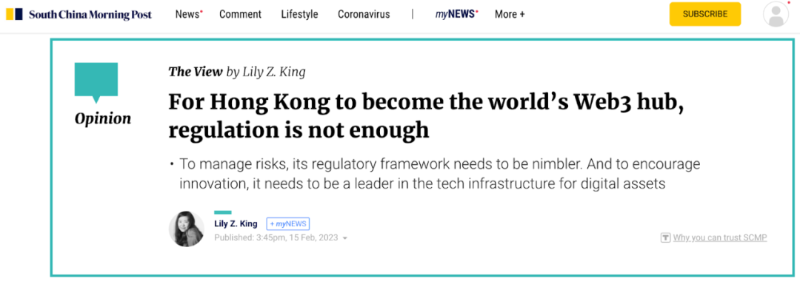
- Hong Kong’s regulatory framework needs greater flexibility to manage risks, and to foster innovation, it must lead in technological infrastructure for digital assets.
The Hong Kong Monetary Authority recently released a discussion paper on regulating activities related to stablecoins. This aligns with Hong Kong’s strategy of connecting next-generation digital assets with its well-established traditional financial ecosystem—the core advantage behind its ambition to become a Web3 hub. Hong Kong has made steady progress in building a clear and comprehensive framework, and regulation around stablecoins is therefore no surprise.
However, being a globally recognized financial center with robust regulation is not enough for Hong Kong to gain a sustainable edge over other potential hubs like Silicon Valley, Dubai, and Singapore. To attract the industry’s top builders, Hong Kong must also become a leader in the digital infrastructure that supports the creation and trading of digital assets.
Hong Kong was once home to several prominent cryptocurrency exchanges and still hosts more Bitcoin ATMs than any other Asian city. However, since 2019, due to the pandemic and cautious policymaking, its position in the global crypto industry has declined.
Missed out on the wild boom-and-bust cycles of the crypto industry—perhaps that’s not a bad thing. FTX, founded in Hong Kong before relocating to the Bahamas, eventually triggered a multibillion-dollar financial disaster that shook the entire crypto sector. Cryptocurrency mining firms that chose to list on Nasdaq rather than the Hong Kong Stock Exchange are now mostly struggling financially and facing harsh criticism for their environmental impact.
The crypto industry has entered a reset phase, giving Hong Kong a valuable opportunity to redefine how a Web3 hub should operate.
This year, we see growing signs that the Chinese government views blockchain and digital assets as potential drivers of economic growth. Hong Kong has been empowered to explore a path of innovation and global integration unconstrained by mainland policies. Meanwhile, after the collapses of FTX and Genesis, the U.S. and Europe are tightening their crypto regulations. This could shift more digital asset activity toward Asia—offering Hong Kong a timely chance to regain influence.
As one of the world’s strongest capital markets, Hong Kong’s well-developed financial regulatory system and top-tier talent in finance and technology are significant advantages. With its mature capital market, Hong Kong’s digital asset sector uniquely combines technology and finance, making it an ideal place to build real-world blockchain applications, especially in asset tokenization.
The Hong Kong government aims to create a favorable environment for public-private collaboration. When government agencies, financial institutions, tech giants, and crypto-native builders work together, digital assets can be better integrated into the real economy and generate impact beyond virtual spaces.
Hong Kong can also leverage mainland China’s tech entrepreneurs. Chinese internet companies that created Web2 products rivaling Western leaders still possess substantial expertise relevant to digital assets and Web3. Mainland Web2 giants listed in Hong Kong—such as Tencent, Alibaba, Bilibili, and Baidu—are already experimenting with digital assets. Hong Kong may just be the incubator they need.
Yet, Hong Kong faces challenges in becoming a Web3 hub. One is that existing regulatory frameworks, designed for traditional assets, may not suit fast-evolving digital assets and cutting-edge technologies.
Hong Kong’s principle of “same business, same risk, same rules” for digital asset regulation means traditional financial rules apply equally to digital assets. The high barriers to obtaining licenses alone have turned the field into one favoring established institutions. Yet innovation often arises unpredictably from grassroots levels, so creating space for bottom-up innovation remains an urgent challenge.
Moreover, at its core, Web3 is a technological movement—but Hong Kong is not a tech hub with the same resources as Shenzhen or Silicon Valley. Therefore, it must develop differentiated technical infrastructure tailored to digital assets.
The security of digital assets differs fundamentally from that of traditional assets. Their on-chain nature means digital assets cannot rely on closed security systems like traditional finance. Licenses or periodic audits cannot guarantee the safety of customer funds on centralized platforms. Advanced technologies such as multi-party computation (MPC) are needed to ensure asset owners have full control or co-management over their holdings.
What kind of Web3 infrastructure does Hong Kong need to build?
Given the heavy losses suffered by retail investors last year, 2023 holds greater promise for institutional businesses. Digital assets are primarily held by exchanges, mining pools, investment funds, and other institutions. To reduce risks on centralized platforms, much of these assets will eventually migrate to custody platforms employing the latest technological solutions.
More importantly, to comply with new regulations, institutions also require solutions enabling distributed private key management and fund segregation. Custody services, institutional wallets, and digital security are just a few examples of the infrastructure needed in the digital asset ecosystem.
The dramatic boom-and-bust cycles of the past three years in the crypto industry have shown us what can go wrong. Hong Kong is well-positioned to learn from all these lessons and build a Web3 hub equipped with appropriate regulation and technological infrastructure—one that fosters innovation while effectively managing risks.
Join TechFlow official community to stay tuned
Telegram:https://t.me/TechFlowDaily
X (Twitter):https://x.com/TechFlowPost
X (Twitter) EN:https://x.com/BlockFlow_News
 Cobo
Cobo