








Keep BUIDLing—Justin Sun's TRON is closely collaborating with exchanges to explore solutions for reducing fees.
TechFlow Selected TechFlow Selected
Keep BUIDLing—Justin Sun's TRON is closely collaborating with exchanges to explore solutions for reducing fees.
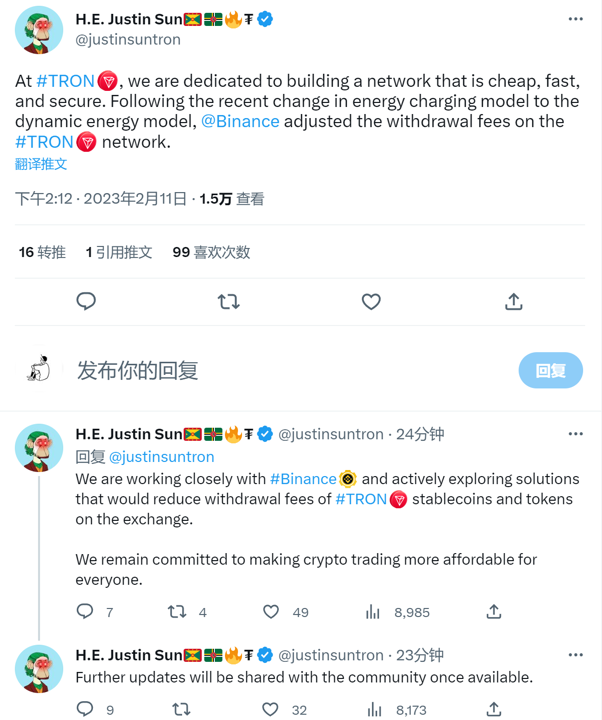
Currently, TRON is closely collaborating with Binance and actively exploring solutions to reduce withdrawal fees for TRON's stablecoins and exchange tokens.
 Navigating Web3 tides with focused insights
On February 11, Justin Sun, founder of TRON and member of Huobi Global Advisory Board, tweeted that TRON is committed to building an affordable, fast, and secure network. With TRON's recent shift from a fixed energy fee model to a dynamic energy model, Binance has adjusted withdrawal fees on the TRON network. TRON is now working closely with Binance to actively explore solutions that could reduce withdrawal fees for TRON-based stablecoins and exchange tokens.
"We remain committed to making cryptocurrency transactions affordable for everyone and will share further updates with the community once available," emphasized Justin Sun.
It was reported yesterday that Binance announced adjustments to withdrawal fees on the TRON (TRX) network, specifically increasing fees for withdrawing USDT, USDC, TUSD, BUSD, and other TRON-based tokens on the TRON blockchain.
Although this move by Binance followed TRON's adoption of Proposal 83, which transitioned its energy fee mechanism to a dynamic model—thus being a standard adjustment—it unexpectedly sparked widespread discussion within the industry. In response, Justin Sun publicly stated via Twitter that TRON would collaborate with exchanges to find better solutions.
As one of the most important infrastructures in the crypto industry, the TRON blockchain supports massive assets and transactions. Currently, TRON has processed over 4.8 billion transactions, with a total value locked (TVL) exceeding $11.3 billion, and a total market capitalization of over $33 billion for stablecoins on its chain—second only to Ethereum. It has become the fastest-growing public blockchain globally and evolved into a decentralized autonomous organization (DAO) governed by the community. Its consistent focus on security, speed, and low costs has drawn significant attention from the industry and earned repeated recognition from mainstream research institutions.
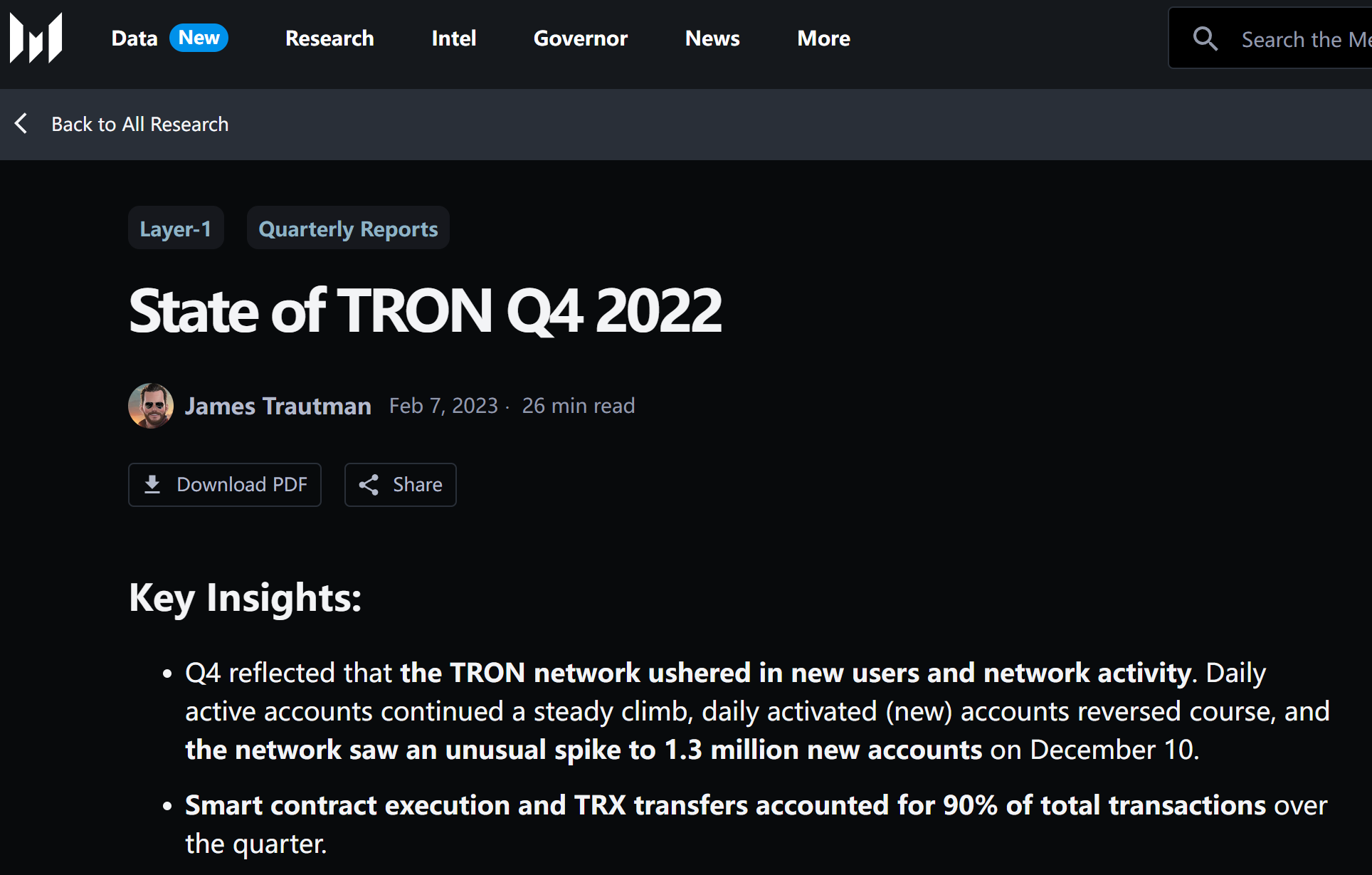
Recently, Messari, a leading global crypto research firm, released its Q4 2022 report on TRON, directly affirming TRON's past achievements. Messari pointed out that user activity on TRON saw comprehensive growth in Q4 compared to the previous quarter, with double-digit percentage increases in key metrics such as daily active accounts, newly activated accounts, and transaction volume—achieving meaningful momentum even in a challenging market environment.
Notably, rapid growth inevitably brings challenges that TRON must address. At present, the majority of energy consumption on the TRON network is concentrated in just a few contracts, some of which involve low-value transactions or even fraudulent activities.
If left unchecked, this situation could harm user experience and hinder the rapid development of the dApp ecosystem. Network capacity is limited; when it becomes clogged with numerous low-value transactions waiting in queue, other legitimate transactions are forced to wait longer—creating a poor experience for both users and dApp developers.
Therefore, implementing a dynamic energy model is essential—not only for TRON’s self-improvement and evolution but also as proof of Justin Sun’s continued commitment to BUIDL and building superior infrastructure for the industry. This effort ultimately aims to fulfill Sun’s vision: “Making cryptocurrency transactions affordable for everyone!”
Today, under Justin Sun’s leadership, TRON is rapidly advancing toward compliance and mainstream adoption. In 2022, TRON became the national public blockchain of Dominica, with seven TRON-based tokens designated as the country’s digital legal tender. This year, Rolando Brison, a legislator from Sint Maarten, submitted a proposal to recognize TRON as the nation’s official blockchain infrastructure and grant TRON-based tokens legal tender status. After securing partnerships with two nations, this "spark" from the Caribbean region is poised to spread to many more countries.
On one hand, TRON continues improving itself to become the industry’s premier infrastructure; on the other, its regulatory expansion progresses steadily forward. Through these efforts, Justin Sun is consistently demonstrating his determination and vision for building the Web3 world.
Join TechFlow official community to stay tuned
Telegram:https://t.me/TechFlowDaily
X (Twitter):https://x.com/TechFlowPost
X (Twitter) EN:https://x.com/BlockFlow_News
 TRON DAO






