








Understanding GMD Protocol: The YFI on Arbitrum Based on GMX
TechFlow Selected TechFlow Selected
Understanding GMD Protocol: The YFI on Arbitrum Based on GMX
GMD Protocol is a yield optimization and aggregation platform built on Arbitrum, similar to YFI.
 Navigating Web3 tides with focused insights
By Morty
GMD Protocol is a yield optimization and aggregation platform built on Arbitrum, similar to YFI. Its products are designed around GLP from the derivatives trading platform GMX, allowing users to deposit WBTC, WETH, and USDC into delta-neutral vaults while using these assets to purchase GLP. The protocol then distributes earnings generated from professionally managed GLP strategies to stakers.
A core aspect of its design helps investors hedge against impermanent loss; the protocol itself uses hedging strategies to generate real returns and distribute profits to investors. After depositing assets into the vaults, investors receive gmdToken as a receipt. This design also lays the groundwork for future support of gmdToken across additional DeFi protocols.
Additionally, in mid-January, GMD partnered with Buffer Finance to launch a new product: the GMD BFR USDC Vault.
Buffer Finance is a decentralized binary options trading platform. GMD users can stake USDC to earn fees from Buffer’s binary options trades and share in profits derived from trader losses. The capacity of the GMD BFR USDC Vault depends on Buffer's deposit limits.
$GMD is the native token of GMD Protocol. $GMD stakers take on the risk of GLP impermanent loss but benefit from losses incurred by GMX traders. Additionally, $GMD stakers receive a portion of vault earnings.
GMD Protocol's ecosystem also includes another token called $esGMD. $esGMD will be used for OTC swaps when GMD Protocol collaborates with other protocols; tokens acquired through such exchanges will be returned to $GMD stakers.
$esGMD stakers will receive protocol revenue distributions at a higher rate. In future plans, $esGMD may be distributed as rewards to vault depositors or used for vote bribing in governance. Converting $esGMD into $GMD requires a one-year waiting period. Furthermore, the GMD protocol will buy back $GMD and lock it into $esGMD.
Basic Data
Next, let’s look at some basic data for GMD Protocol:
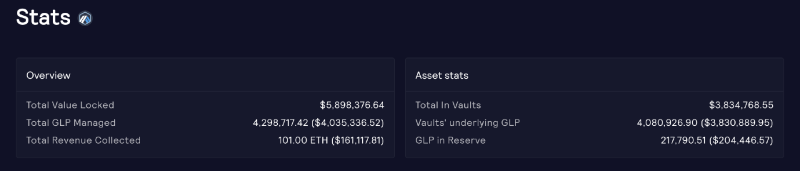
After two months of development, GMD Protocol has reached a TVL of approximately $5.89 million, managing $4.03 million worth of GLP. Notably, both the BTC and ETH vaults are at full capacity, while the total staked amount in the USDC vault accounts for 92% of vault capacity—nearly full.
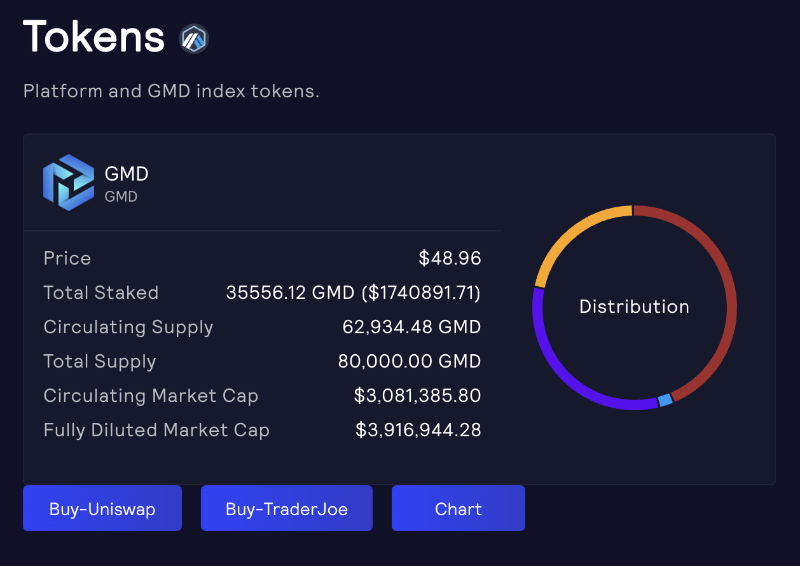
Regarding $GMD token distribution, 44.45% of $GMD is staked, 1.88% is used for liquidity provision, 21.33% remains undistributed, and 32.35% is held unstaked.
Future Development
On January 29, GMD Protocol announced it will soon launch on Avalanche.
Delta-neutral vaults built on Avalanche’s GLP will offer four vaults: USDC, AVAX, WETH, and BTC.b, with a 0.5% deposit fee and an initial vault cap of $500,000.
To fund deployment on Avalanche, GMD sold 2,500 $esGMD tokens at $40 each. Of this $100,000, 70% will serve as GLP reserves for the protocol on Avalanche, and 30% will be deposited into Trader Joe to provide liquidity. Additional incentives will be introduced by the GMD team later.
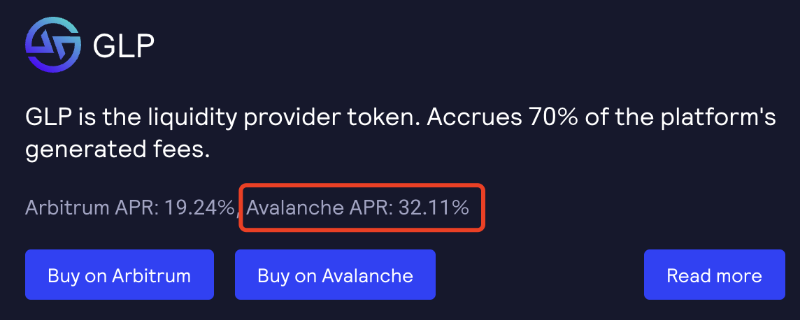
As is well known, GMX operates on both Avalanche and Arbitrum, so GMD Protocol’s expansion to multiple chains—being purpose-built for GLP—is highly logical and opens deeper business opportunities. Although GMX is highly popular on Arbitrum, GLP yields on Avalanche are also significant. Therefore, we can reasonably infer that GMD Protocol holds even greater growth potential.
Prior to this, on January 19, GMD announced a partnership with Trader Joe—the largest DEX on Avalanche—to migrate part of its liquidity there. This is just one part of their collaboration. The GMD team is actively developing the aGMD token and aims to establish liquidity on Trader Joe. Additionally, the team plans to explore building wrapper contracts for Trader Joe’s Liquidity Book feature in the future.
In my view, launching the aGMD token represents GMD Protocol’s effort to further improve capital efficiency. As mentioned above, aGMD will likely function as a receipt token for users who deposit into vaults—similar in logic to Lido’s stETH, which can be reused across various DeFi applications. This is precisely why GMD needs support from platforms like Trader Joe—just as stETH relies on liquidity from Curve.
Beyond deep integration with Avalanche, GMD has also mentioned upcoming collaboration with another leveraged trading platform, Gains Network, which is equally promising. Additionally, GMD plans to launch an NFT project, though specific details remain unknown.
Final Thoughts
From the points discussed above, GMD Protocol’s future growth potential stems from four key aspects:
1. Deployment on Avalanche;
2. Deepening cooperation with Trader Joe;
3. Partnership with Buffer Finance and upcoming collaborations with other DeFi protocols such as Gains Network;
4. Strong product delivery capability demonstrated by the GMD team, with plans to launch an NFT project.
However, we cannot overlook the inherent smart contract risks associated with on-chain DeFi protocols—especially dual-layered risks given GMD’s heavy reliance on GMX.
According to public information, GMD Protocol completed its second smart contract audit in January. The first audit was conducted by Solidity Finance, and the second by independent auditor pashov.
Join TechFlow official community to stay tuned
Telegram:https://t.me/TechFlowDaily
X (Twitter):https://x.com/TechFlowPost
X (Twitter) EN:https://x.com/BlockFlow_News
 雨中狂睡Sleeping in the Rain






