








How does Telegram use TON to provide encryption services to users?
TechFlow Selected TechFlow Selected
How does Telegram use TON to provide encryption services to users?
Telegram users can now buy and sell cryptocurrency without leaving the app.
 Navigating Web3 tides with focused insights
Author: Kadeem Clarke
Compiled by: TechFlow
Telegram users can now buy and sell cryptocurrencies without leaving the app. The Open Network (TON) is a fully decentralized Layer 1 blockchain designed by Telegram to attract billions of users.
The Open Network is a scalable, sharded Layer 1 blockchain enabling fast, low-cost, and energy-efficient transactions. Every feature is designed with everyday users in mind.
Despite market volatility, TON has drawn significant attention and continues to grow. After the FTX incident, this open-source protocol remained one of the few ecosystems still thriving.
History of TON
Telegram Open Network was a blockchain developed by Telegram. After the project was abandoned, it was handed over to the community and renamed The Open Network.
Telegram vs. SEC
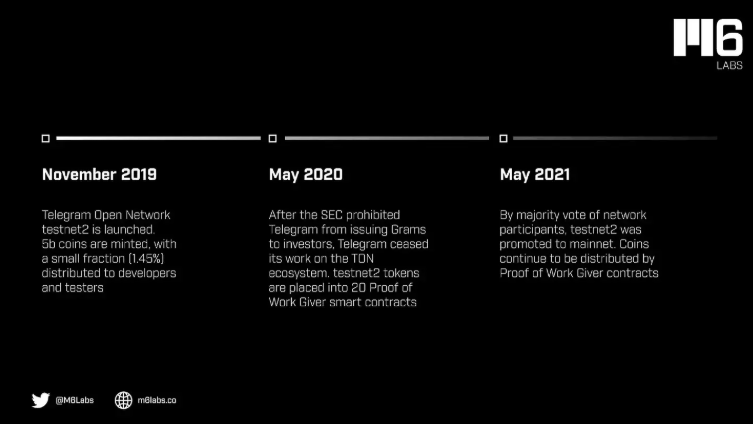
In 2020, after litigation, the Telegram team agreed to settle with the SEC and was forced to halt work on The Open Network.
Telegram CEO Pavel Durov and his brother Nikolai created Telegram Open Network in 2018. After failing to register its $1.7 billion ICO token sale, the SEC ordered Telegram to stop selling $GRAM, the token previously associated with the TON blockchain.
In May 2020, founder Pavel Durov announced the end of Telegram’s involvement in blockchain development and began issuing refunds to early investors.
Revival Through Community Efforts
After Telegram abandoned the TON project, community developers kept it alive, renaming it The Open Network and rebranding $GRAM (which never officially launched) as TON.
Durov expressed support for the project in December 2021, stating: "I'm proud that the technology we created is still alive and evolving... TON leads all others in the blockchain space."
Goals of TON
In an interview, a representative from the TON Foundation said: "TON is built for millions of users, and one of our goals is to make using blockchain no more complex than using familiar apps."
While Bitcoin and Ethereum pioneered blockchain technology, these networks face challenges. High fees, slow transaction speeds, and steep learning curves make it difficult to use cryptocurrencies for daily purchases.
Within just one year, a full ecosystem with all necessary products and services was built, including tokens, non-fungible tokens (NFTs), staking, domains, marketplaces, multi-functional wallets, decentralized exchanges, and other DeFi services.
TON has three bridges—one on Ethereum, another on BSC, and Orbit Bridge. TON is the native cryptocurrency of the network, used to pay for smart contract execution, dApp usage, and governance participation. The Open Network is currently live, with 240 validators (as of December 1, 2022) and 1.4 million addresses.
In April 2022, the TON Foundation received a donation of 500 million TON tokens from early miners into its reserve (Telegram distributed testnet tokens through PoW mining completed in summer 2022).
TON can verify and process millions of transactions per second thanks to dynamic sharding and workchains. In other words, TON’s adaptive architecture allows infinite scalability without sacrificing performance.
Telegram's Cryptocurrency - $TON
Although Telegram is no longer actively involved with The Open Network or its independent team, TON remains connected to the app. Wallet allows users to purchase TON and send cryptocurrency to contacts via chat at zero cost. Through wallet bots, users can also buy crypto with credit cards and conduct peer-to-peer transactions.
TON is designed to support billions of concurrent users—unlike most other blockchain ecosystems. It achieves this through blockchain sharding, which uses multiple sub-networks or shards on the same chain to efficiently distribute tasks. Each shard serves a specific purpose, helping prevent backlogs of unconfirmed blocks.
The TON network operates on Proof-of-Stake (PoS), where $TON is used to validate transactions and reward validators. Nominators earn rewards by lending their tokens to validators. Nominators must join a pool and stake their assets to lend tokens. Smart contracts then manage relationships between nominators and validators. TON is accepted as payment for services and applications on the TON blockchain.
The TON Ecosystem
TON is known for its utility and emphasis on efficiency. Its goal is to make finding practical uses for the token as simple as possible for end users. The TON developer community has also integrated many advanced features that distinguish the token from competitors.
TON introduced radical new concepts for smart contract development. Designed after Ethereum’s launch, it benefited from understanding what worked well in the EVM model and where improvements could be made. Most importantly, TON was created to put blockchain technology into the hands of everyone on Earth.
TON Storage
The idea of decentralized data storage isn’t new, but TON takes it further. Functioning similarly to Dropbox, it uses private keys for encrypted private and public online storage, adding an extra layer of security.
TON Proxy
Privacy is always paramount for users. With TON Proxy, users can connect to the TON network through privacy-focused networks like TOR or I2P, avoiding censorship and easily accessing dApps.
Smart Contracts
Like many other blockchain ecosystems, TON relies on smart contracts to accelerate on-chain transactions. All smart contracts run on the TON Virtual Machine (TVM), capable of deploying highly complex contracts.
TON Domains
TON DNS (Domain Name Service) aims to improve usability for cryptocurrency wallets, accounts, smart contracts, and other functions and websites (such as TON Validators, TON Apps, TON Bridge, etc.). TON DNS gives users easy-to-remember names instead of strings of random numbers and letters.
TON DNS works similarly to social media usernames. Users can register domain names and usernames on the blockchain. Some simple applications, including cryptocurrency wallets, support TON DNS.
Applications and Services on TON
The TON blockchain hosts numerous dApps and services powered by smart contracts:
TON services enable developers to create new blockchain applications. These third-party apps are accessible through a user-friendly interface. TON also provides a searchable registry of all dApps and services on the blockchain.
StickerFace
StickerFace allows users to create NFT avatars on the network. These avatars can be used across various TON games and applications. StickerFace continuously adds animation and 3D effects and offers various wearable accessories for avatars.
TON Diamonds
TON Diamonds is a blockchain-based decentralized marketplace where users can easily purchase digital art from artists as NFTs.
TON CATS and TON Hamsters
There are many NFT art projects such as TON CATS and TON Hamsters.
Wallets
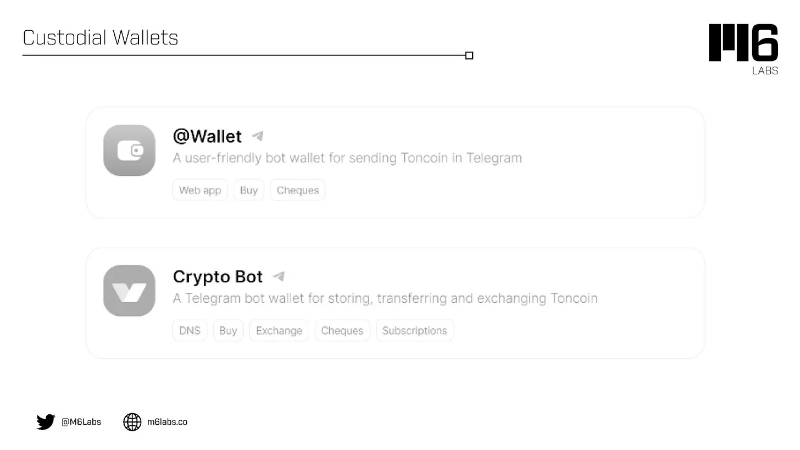
There are two types of custodial wallets on TON. Wallet is recommended for completing transactions within Telegram. Ton can also be stored, transferred, and exchanged easily via Cryptobot.
TON offers custodial wallet services and partners with several third-party non-custodial wallets. Currently, there are 377,017 unique TON wallets completing thousands of daily transactions. Custodial wallets are ideal for users seeking a straightforward solution. Users wanting greater control over their assets should consider non-custodial wallets like Tonkeeper, which Telegram also chose for its Fragment.com utility.
Utility of TON
The token is primarily used to pay transaction fees on the blockchain. Due to sharding, users may also use the token to pay cross-chain fees or create new workchains.
Additional use cases include:
- Paying for decentralized data storage;
- Paying for TON Proxy usage;
- Paying for TON DNS;
- Payments within dApps on the blockchain;
- Rewards for validators maintaining the blockchain;
Key Milestones in the TON Ecosystem
As part of a collaboration with the TON Foundation, DWF Labs has committed $10 million to support the TON ecosystem. All 50 seed investments are planned within the next 12 months, each aimed at accelerating TON’s growth and projects.
Efforts also focus on increasing participant numbers by expanding the number of platforms supporting Ton. So far, Ton trading volume has approached $20 million. In the first three months of collaboration, DWF Labs will develop a reliable OTC market while doubling the number of buyers and sellers.
What’s Next for TON and Telegram?
With over 700 million active users globally, if the wallet bot reaches widespread adoption, it could catalyze broader cryptocurrency adoption.
When asked about the future of Telegram and The Open Network, a TON Foundation representative said: "Telegram is a platform friendly to everyone in the Web3 world—for both communication and building products using disruptive technologies. Moreover, The Open Network enables developers to build functional products with real-world use cases deployable within the app."
Developers remain central, so continued improvements in tools, documentation, competitions, hackathons, and grant programs will persist. TON is the only modern blockchain adopting novel—and sometimes unexpected—approaches to attract users.
Regarding new network components such as payment networks, cross-chain solutions, TON Proxy, and TON Storage updates, these represent strategic directions to pursue. However, existing TON ecosystem components must first be streamlined to become as functional and user-friendly as possible.
Some statistics from early 2022 to November 2022:
- Network accounts: 128K → 1.4M;
- Media subscribers (in 9 languages): 600K → 2M;
- Number of validators: 155 → 240;
- CoinMarketCap ranking: 206 → 26;
What to Expect in 2023
Over the past month, TON has been one of the hottest projects in the cryptocurrency market, and next year looks promising for TON. In terms of transaction speed and versatility, TON continues to outperform other Layer 1 blockchains. Beyond fast block validation times, the blockchain offers advanced scalability features such as sharding support.
Ton is younger than other major Layer 1 blockchains. It is still growing and evolving, and it will be fascinating to see what innovations TON brings in the coming years. As developers add new features, the token will become increasingly practical and appealing to more people.
Join TechFlow official community to stay tuned
Telegram:https://t.me/TechFlowDaily
X (Twitter):https://x.com/TechFlowPost
X (Twitter) EN:https://x.com/BlockFlow_News
 M6 Labs






