









How does Flashbots manage the MEV market across all blockchains through SUAVE?
TechFlow Selected TechFlow Selected
How does Flashbots manage the MEV market across all blockchains through SUAVE?
As financial activity on Ethereum accelerated over the past few years, those securing the network have also gained profit opportunities.
 Navigating Web3 tides with focused insights
Author: Chris Powers
Translation: TechFlow
As financial activity on Ethereum has accelerated over the past few years, those securing the network have also gained profit opportunities. When we explored this topic last July, the MEV arms race was underway—and intensified as Ethereum transitioned to PoS in September. This behavior reshaped market structure, redefining it from Miner Extractable Value to Maximal Extractable Value (MEV) for Ethereum validators.
Flashbots, a central player in MEV, has continued its remarkable success; nearly 90% of Ethereum validators now run its MEV-boost client. This means they receive additional payments—beyond protocol rewards—for reordering or including transactions in their proposed blocks.
However, this raises two issues:
1. It centralizes block production;
2. It requires complete trust in Flashbots to enforce economic rules.
Flashbots takes decentralization seriously, and its current mission is to decentralize and minimize MEV. This is reflected in the unveiling of its grand plan SUAVE: a new blockchain to manage the MEV market across Ethereum (and any blockchain).
This vision is ambitious. Most strikingly, it assumes MEV is a persistent issue embedded into market structure—one that can only be minimized and redistributed.
On the other hand, opposition to the normalization of MEV is growing. Leading this camp is CoW Protocol, which uses batch auctions and an independent network of solvers to protect users from MEV.
As early as May 2021, we called MEV “the greatest threat to Ethereum’s decentralization.” Now, with a wave of new projects emerging, it's becoming increasingly clear that the best solution to the MEV crisis—whether CoW, SUAVE, or something else—will be a standalone, decentralized network fully dedicated to transaction ordering.
Flashbots: A Fallen Hero?
Initially, Flashbots was seen as the hero of the MEV story. Before Flashbots, the Ethereum network was clogged by bots competing for profitable opportunities like arbitrage, liquidations, and frontrunning user orders. To ensure profitable trades were included in a block, these bots (now called searchers) set increasingly high gas prices in what are known as Priority Gas Auctions (PGAs), driving up gas costs for all Ethereum users. Flashbots created a forked version of Geth (MEV-Geth) for miners, allowing them to auction block space to searchers—off-chain—so they could include profitable transactions. Moving this off-chain saved significant costs for all Ethereum users.
Over the 20+ months since MEV-Geth launched, Flashbots’ image has dramatically shifted. No longer a warrior charging through the dark forest, it is now viewed as a centralizing force that arguably has achieved censorship over Ethereum. While Flashbots previously focused on delivering immediate solutions (flaws and all), SUAVE aims to build a comprehensive, decentralized solution to resolve the MEV crisis once and for all.
The Legacy of SUAVE
SUAVE is a new blockchain designed to become “the memory and block builder for all blockchains.” Rather than connecting MEV activities via the Flashbots network, a brand-new EVM-compatible blockchain will serve as the economic foundation for this market.
With the shift to PoS and MEV-boost, the Flashbots network expanded. While it still connects searchers to validators (replacing miners) via relays, a new role—block builders—is now required. This role specializes in constructing Ethereum execution payloads and optimizing transaction ordering (or sequencing). SUAVE’s goal is to decentralize this role.
After MEV-boost launched in September, the Flashbots team quickly became the top relay and block producer, soon relaying and bundling over 50% of Ethereum blocks.
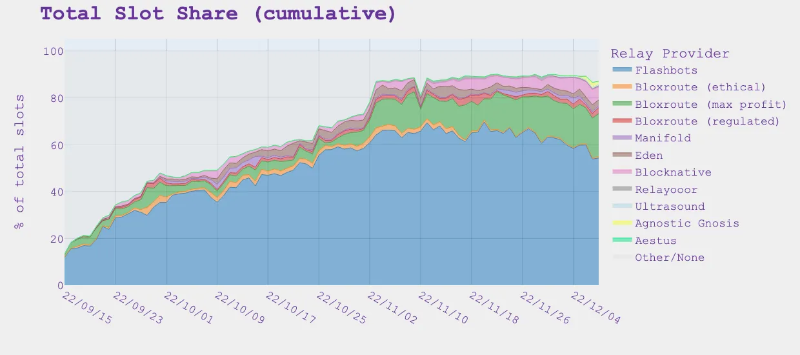
Flashbots rapidly open-sourced its MEV-boost relay software, followed by its MEV-boost builder package, in an effort to encourage competition and avoid monopolization. This helped to some extent (see recent decline in chart above), but block building is naturally centralizing. Without Flashbots, some other entity would likely rise to build most Ethereum blocks, creating opportunities for censorship and rent-seeking.
Ethereum's View: Proposer-Builder Separation (PBS)
Of course, the Ethereum research community hasn’t ignored the threat of MEV. The network’s security model is at risk whenever actions within the protocol are dictated by external economic forces. MEV is complex and computationally intensive; despite its high returns, it isn’t an effective reward mechanism for the protocol because it raises the entry barrier for validators. In PoS, block proposers are in a privileged position to extract MEV, but doing so involves complexity that translates into inherent centralization of the validator set.
To address this, Vitalik proposed a design framework called “Proposer-Builder Separation” (PBS), where instead of block proposers themselves creating "revenue-maximizing" blocks, they outsource this task to a market of external actors (builders). MEV-boost is a “native PBS”—existing outside the protocol. It relies on Flashbots’ goodwill. If a more threatening actor occupied Flashbots’ role, Ethereum would face serious trouble.
Integrating PBS into the Ethereum protocol will take considerable time, engineering, and research. Projects like Eigenlayer—a programmable slashing layer for staking ETH—might help align incentives. Regardless, it’s clear that the process of block building (or transaction ordering) won’t happen on Ethereum itself.
A New Market Structure
Flashbots aims to move block building off Ethereum via SUAVE—and do so for every blockchain.
SUAVE has three core components:
- Universal Preference Environment;
- Optimal Execution Market;
- Decentralized Block Building.
These are independent components that work together to achieve optimal outcomes for all parties.
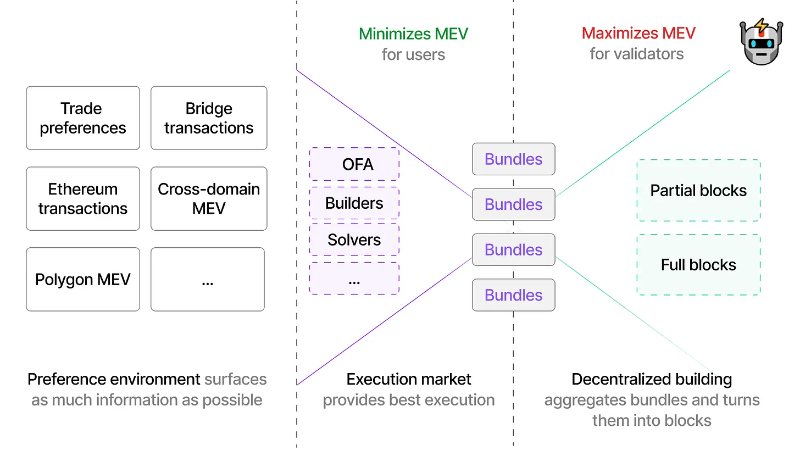
Once again, Flashbots expands the cast of roles in the MEV ecosystem. They ultimately incorporate ordinary users through the Universal Preference Environment. Combined with the execution market, this ensures users can efficiently reclaim extracted MEV.
Is MEV Inevitable?
SUAVE is Flashbots’ ultimate goal. If successful, it will fulfill its vision of staying ahead of the MEV crisis, democratizing MEV extraction. Yet many still reject MEV. Must users, as the price of using public blockchains, submit to frontrunning?
CoW Protocol says no. Its core idea is simple: each token should have only one price per block. Instead of reordering transactions for maximum-profit bundles, all trades are settled at the same price through batch auctions every 30–90 seconds. In CoW, users sign orders and submit them to a network of solvers. These solvers first attempt to match peer-to-peer trades entirely independent of MEV, then fill remaining orders using on-chain liquidity pools.
Batch auctions differ sharply from today’s trading methods. In both TradFi and DeFi, there is a race to trade based on dynamic market information. It’s estimated that 60–80% of all DEX activity consists of MEV bots rushing to DEXs to arbitrage after new price movements appear on centralized exchanges. Large market makers want to execute their orders first (in TradFi) or optimize order placement (in DeFi). In batch auctions, there is no race—because all trades settle at the same price. Meanwhile, solvers are paid fees for finding solutions that generate the maximum surplus for all users—not for themselves.
There are potential downsides. For starters, running solvers requires substantial resources—computational power and capital—and it’s unclear whether sufficient privacy protections exist to prevent solvers from frontrunning user orders.
SUAVE Comes Full Circle
Surprisingly, CoW Protocol and Flashbots’ SUAVE share many similarities. CoW focuses on “transaction intent expression,” while SUAVE aims to capture “generalized intent expression”—a fancy way of saying, “what do you want to buy or sell, and at what price?” The protocol then auctions this intent to solvers (CoW) or builders (SUAVE).
The key difference is: SUAVE is designed to extract most value from transaction ordering, whereas in CoW, transaction order doesn’t matter because all tokens have the same price within a block. Another key distinction is that SUAVE aims to be a single place to submit orders across multiple blockchains, though CoW may evolve in that direction too.
Digging deeper, SUAVE also touches on themes similar to Chainlink’s Fair Sequencing Service (FSS). FSS is designed for L2 sequencers, not block builders, but both SUAVE and FSS aim to create a decentralized network for activity that gains massive scale advantages. Of course, another major difference is that SUAVE’s block builders seek to maximize MEV, while Chainlink node operators aim to achieve correct ordering based on submission time.
In any case, this marks a new chapter for MEV—the arms race between profits and decentralization has moved beyond Ethereum. This doesn’t mean the fundamental problems are solved. But it does suggest that the ultimate solution (SUAVE, CoW, etc.) will be a dedicated, standalone network balancing the needs of decentralization and profit incentives.
Join TechFlow official community to stay tuned
Telegram:https://t.me/TechFlowDaily
X (Twitter):https://x.com/TechFlowPost
X (Twitter) EN:https://x.com/BlockFlow_News






