After the FTX collapse, will Solana continue to languish?
TechFlow Selected TechFlow Selected
After the FTX collapse, will Solana continue to languish?
As we've seen, Solana is struggling but not out.
 Navigating Web3 tides with focused insights
Written by Ben Giove
Translated by TechFlow
The collapse of FTX and Alameda Research has been catastrophic for the entire cryptocurrency ecosystem, bankrupting lenders, exchanges, and funds. The fallout has also rocked markets, with total crypto market capitalization falling from $1 trillion on November 6 to around $86 billion today—a 14% decline.
Many individual tokens have fallen even further, with those held by Alameda Research—including Solana—hit particularly hard. According to CoinDesk’s reporting on the firm’s balance sheet, Alameda held approximately $1.2 billion worth of SOL tokens as of June 30.
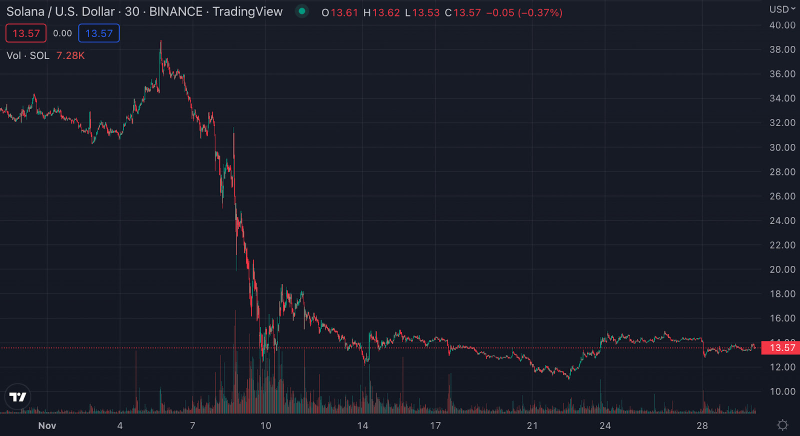
While it remains unclear how much of the recent price drop was driven directly by Alameda itself versus trader fear, in the weeks following the FTX/Alameda collapse, SOL plummeted from $35 to a low of $11 (a 68.5% drop).
After being one of the top-performing tokens during the 2021 bull run, SOL is now nearly 95% below its all-time high. A crash of this magnitude not only shakes supporter confidence but also poses significant risks to its DeFi ecosystem and the overall network security.
This raises the question… Is Solana dead? Can it rise from the ashes?
Let’s review the aftermath of the crash and look ahead at Solana’s future to see if we can answer that question.
Crisis: Network Security and Stability
A 60% drop in an L1’s native token within 72 hours is a massive stress test.
Such a collapse not only risks the on-chain DeFi ecosystem through mass liquidations and bad debt in lending protocols, but also introduces stability and security risks by increasing the likelihood of outages (a recurring issue for Solana) and lowering the cost of network attacks.
Security Concerns
Following the FTX collapse, Solana experienced a massive outflow of staked assets.
Since November 6, across nine epochs (each typically lasting 2–3 days), 54.6 million SOL have been unstaked, reducing the total staked SOL supply from 411.2 million to 356.6 million—a 13.2% drop, representing about 15% of circulating SOL supply.
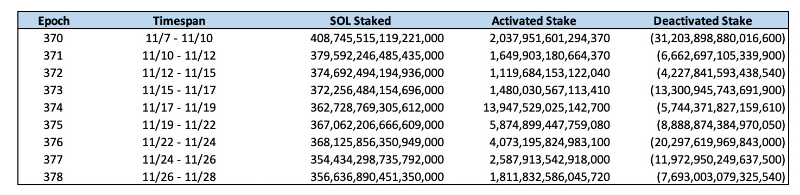
During the peak danger period between November 7 and 10, up to 29.1 million SOL (53% of the net total) were unstaked.
The dollar value of staked assets securing the network dropped even more sharply. Factoring in the price of SOL at the start of Epoch 370 and end of Epoch 378, the value of staked SOL protecting the network crashed 65.3%, from $14.7B to $5.1B.
The outflow could have been worse had the Solana Foundation not decided to postpone its plan to unstake 28.5 million SOL at the end of Epoch 370.
Despite these outflows—and possibly due to the 3–4 day delay before unstaked balances become liquid—Solana did not suffer any security breaches or major attacks. Even after this asset exodus, Solana still ranks fourth in dollar-denominated staking among PoS networks tracked by Staking Rewards, and 19th in staking ratio.
Stability
Extreme market conditions can impact network security and stability. This is because during turbulent periods, demand for blockspace surges on-chain, putting pressure on validators as users and bots rush to top up collateral, execute liquidations, and capture arbitrage opportunities created by market chaos.
These issues have long plagued Solana, which has experienced multiple performance degradations and outages.
Since September 2021, the network has suffered four full outages totaling 37 hours and 11 minutes.
The Solana community has been working on remedies to improve uptime, including upgrades like stake-weighted Quality of Service (QoS) and QUIC rollout on mainnet. Other improvements such as fee markets and transaction size increases are planned for release over the coming months.
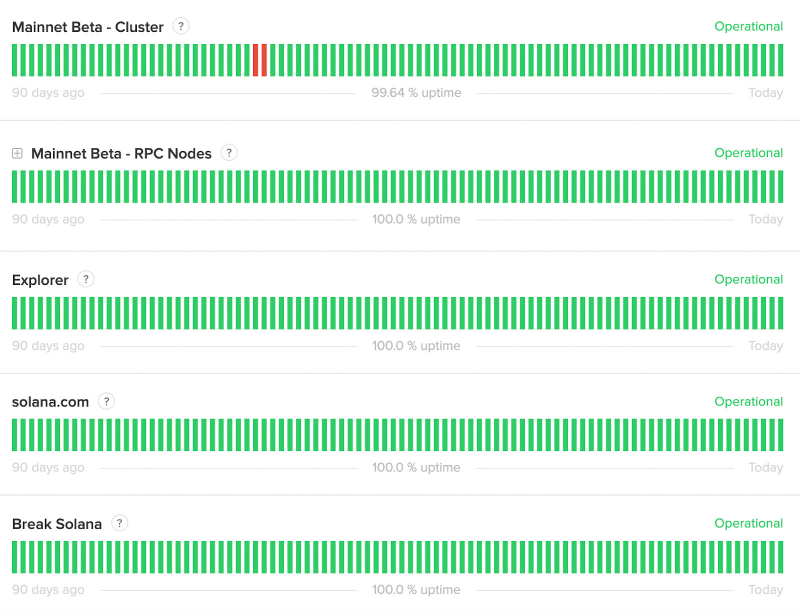
These upgrades appear to be making a difference, as Solana experienced no downtime or performance degradation throughout the crisis.
100% uptime is expected of a blockchain regardless—but given its history and the severity of this crisis, Solana’s performance during this period is notable and an encouraging sign that the network is becoming more resilient.
Crisis: Solana DeFi
Liquidity Crunch
Solana experienced a significant liquidity crunch following the FTX collapse.
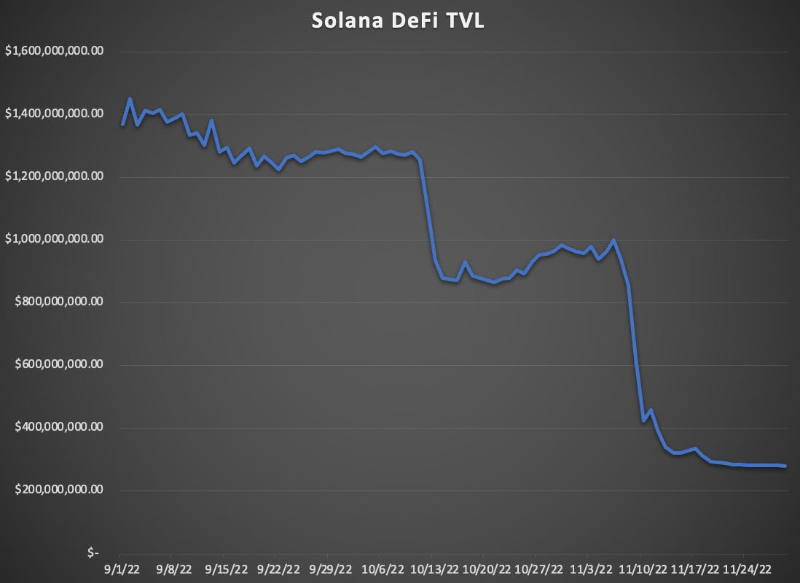
The network’s dollar-denominated DeFi TVL dropped 72.1% from $1 billion on November 6 to $278.3 million.
This was somewhat expected, as many assets deposited into DeFi protocols—such as SOL, ETH, and BTC—are volatile. As such, the drop in USD-denominated TVL does not necessarily indicate that users are pulling funds out of SOLFi.
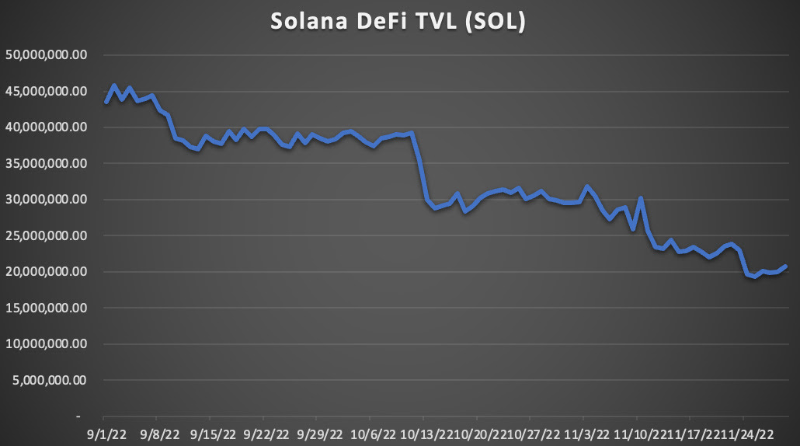
However, SOL-denominated TVL tells a different story, declining 27.5% from 27.2 million to 19.7 million since November 6.
This suggests that the decline in USD-denominated TVL may not be solely due to price drops, but also reflects users withdrawing assets from DeFi.
In recent weeks, stablecoin supply on Solana has also contracted significantly.
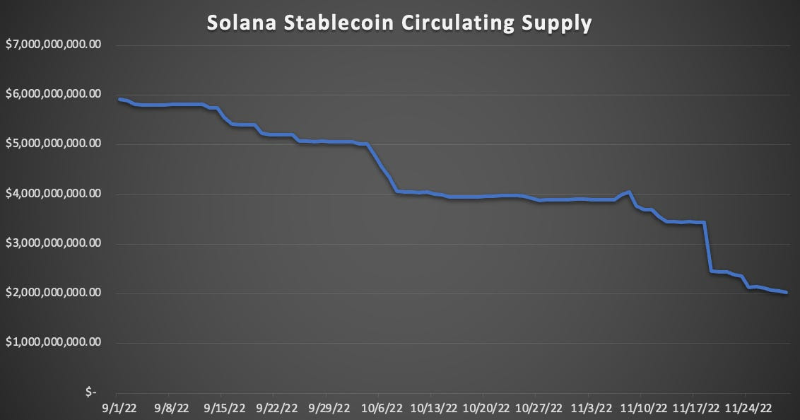
Since November 6, the network’s stablecoin market cap has shrunk from $3.9 billion to $2.1 billion—a 46.1% reduction.
This decline was largely driven by Tether’s “chain-swap,” where the USDT issuer migrated $1 billion in supply from Solana to Ethereum on November 18.
That single move accounted for 55.5% of total stablecoin outflows since the crisis began.
Serum Hits New Lows
Many DeFi protocols suffered heavy blows after FTX, with projects closely tied to Alameda hit hardest.
Most notably, Serum—an orderbook-based DEX whose governance token SRM became emblematic of the “low-circulating-supply, high-FDV” token design, allowing the project to borrow heavily against inflated valuations.
Even after a 69.2% price drop over the past three and a half weeks, SRM still carries a $2.4B FDV.
Serum is also a foundational primitive in Solana DeFi, with projects like Raydium, Zeta Markets, PsyOptions, and others built atop its protocol.
If Serum’s contracts were immutable, this wouldn’t necessarily be an issue—the protocol could continue functioning normally despite its crashing governance token.
But Serum’s contract keys are held by FTX, placing both Serum and the broader Solana ecosystem at risk, as a potential rug pull could trigger catastrophic ripple effects.
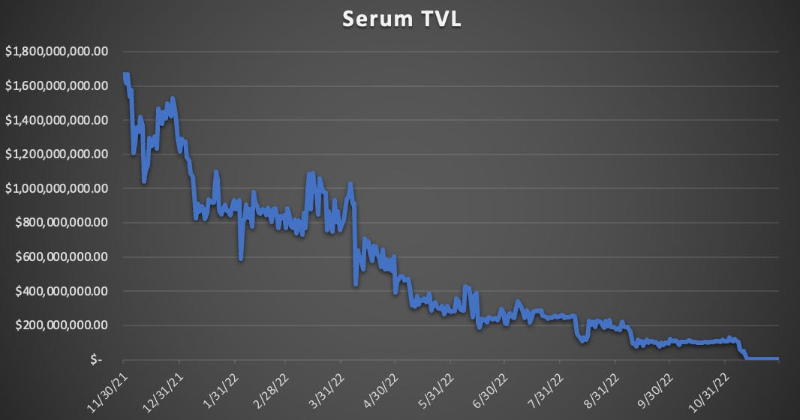
To date, Serum’s TVL has collapsed 99.6% from its pre-crisis level of $121.7 million to just $434,000. Raydium has paused market-making on its DEX, and Zeta Options has halted deposits—all in an effort to mitigate disaster.
The Solana DeFi community has deployed a Serum fork called OpenBook, which has already attracted $1.5 million in TVL.
Whether this fork survives remains to be seen, but it may provide a temporary solution during this period—a lower-risk liquidity venue for Serum-dependent projects compared to the original protocol.
Knocked Down, But Not Out
As we’ve seen, Solana is struggling—but not out.
While SOL’s price may now be closer to the "$3" figure mentioned in SBF’s tweet, Solana the network has demonstrated resilience, operating without downtime or performance degradation during extreme volatility. So far, the chain has also weathered a significant outflow of staked assets.
This may represent little more than meeting basic blockchain expectations rather than a major achievement, but given Solana’s history of instability and outages, it deserves recognition. Smooth operation during this turmoil should help build deeper trust as the network moves forward.
That said, Solana’s path ahead is far from clear.
Solana DeFi has taken a major hit, with significant liquidity outflows—projects closely tied to FTX and Alameda, like Serum, suffering especially severe damage.
The blockchain will also need time to recover from the perception of FTX as a key ally.
Moreover, it remains unclear how much SOL Alameda—which has filed for bankruptcy restructuring—still holds; they will likely liquidate whatever remains on their balance sheet during legal proceedings.
Concerns about Solana’s long-term technical competitiveness persist, as it may eventually have to embrace modularity rather than sticking with monolithic architecture. It’s also uncertain whether developers and community members—who may never have experienced a 95%+ drawdown before—will remain committed over the coming months and years.
That said, crypto natives know that Solana is more than just SBF’s pet project—it continues to see strong usage, even during bear markets.
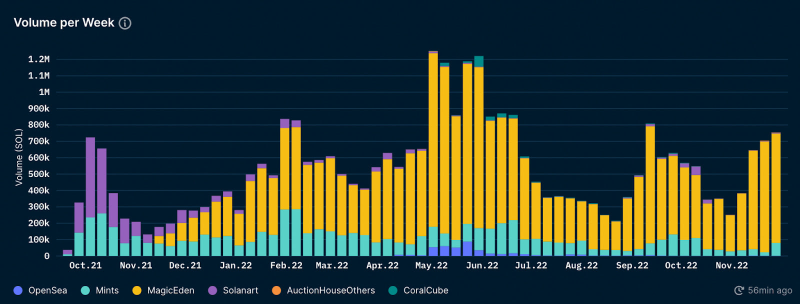
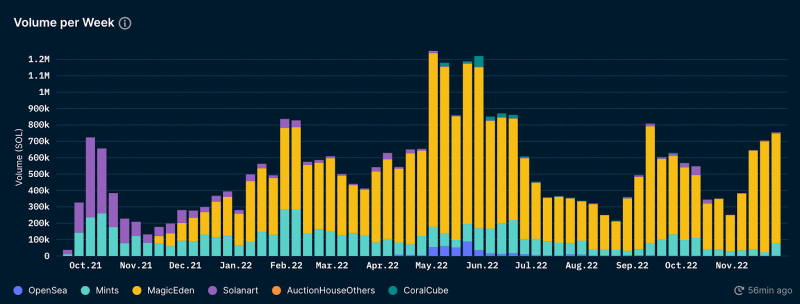
The blockchain’s recent hackathon saw 750 project submissions, and NFT trading volume denominated in SOL grew 102% month-over-month.
In the long run, losing FTX and Alameda might even be beneficial, as the ecosystem will no longer be influenced by their business practices and token designs.
Solana may thus emerge as a more decentralized and fairer place.
So yes, Solana is hurting—there’s no denying that. But so far, it’s far from truly being knocked out.
Join TechFlow official community to stay tuned
Telegram:https://t.me/TechFlowDaily
X (Twitter):https://x.com/TechFlowPost
X (Twitter) EN:https://x.com/BlockFlow_News