Could writing NFTs become a new source language for content discovery and distribution?
TechFlow Selected TechFlow Selected
Could writing NFTs become a new source language for content discovery and distribution?
Believe the same on-chain curation mechanism will be applied to every industry.
 Navigating Web3 tides with focused insights
Author: ELIOT COUVAT
Compiled by: TechFlow
The more I search for fresh perspectives on specific topics for my writing, the more I realize how difficult it is to uncover hidden gems and high-quality content online.
From Twitter to Google, recommendation has become the dominant mode of information exploration on the web. When I search “Web3” on Google, I mostly find marketing spam about NFTs.
This is the harsh reality: discovery/search is optimized for products, not for people.
All social networks are built around one fundamental design: the feed.
This is no accident.
It’s a deliberate choice that maximizes the platform’s ability to display ads—and thus maximize revenue.
We rely on these centralized platforms to publish content. While their feeds act like highways, they make it extremely hard to discover content beyond the mainstream.
In recent years, media oversaturation has led to increasingly fragmented audiences, while centralized platforms fail to deliver what we want quickly enough.
In short, discovery/search on today’s Web2 media networks is broken.
Over the past few months, I’ve grown increasingly interested in a new class of flexible, boundary-crossing primitives: writing NFTs.
They promise a world where people no longer depend on platforms designed to maximize time spent on their feeds, but instead connect directly with others who can surface great content.
Individuals won’t need to stay confined within a single platform. Instead, they’ll be able to move seamlessly across media and platforms within a set of protocols, owning and transferring their content to create their ideal NFT-powered media experience.
David Phelps clearly articulated this paradigm shift:
"When people own their content—including its data and metadata—they also own its distribution rights. They become the new intermediaries. People become the new platforms."
Writing NFTs will allow anyone to become their own search and discovery engine, helping more writers get discovered and offering a chance to eliminate inequalities in Web2 media—not just between the rich and poor, but also between "rich" platforms and all creators.
So How Would This Work?
By minting their articles as NFTs for fans to collect, writers enable readers to own, transfer, and combine their content—allowing creation and distribution to happen simultaneously.
Instead of letting fans simply “like” content on a centralized platform, readers can collect it into their wallets, creating a new space accessible to anyone—a space that’s uncensorable, interoperable, and easy to build upon.
Through their on-chain collections, these new curators amplify the voices of those they support. As Kairon explained in a recent article:
By fully trusting her (the collector) taste and expertise, I use her as my starting point; she gains reputation, visibility, and growth—the very things every creator needs. She becomes a node in my discovery chain and thus reaches a wider audience.
With this new behavior, fans automatically become curators. Though their engagement with individual posts may be lighter, their act of organizing and curating content around themes serves a greater purpose—drawing attention and consumption from niche social audiences.
For writers, having collectors means gaining wallet addresses and direct access to their audience—without relying on intermediaries.
In this new model, the line between fans and creators blurs, completely reshaping the “fan-creator” relationship.
Mirror, a Web3 application, is already building infrastructure to support this future for writers. It allows readers to collect favorite articles as NFTs, embedding the experience directly within the article.
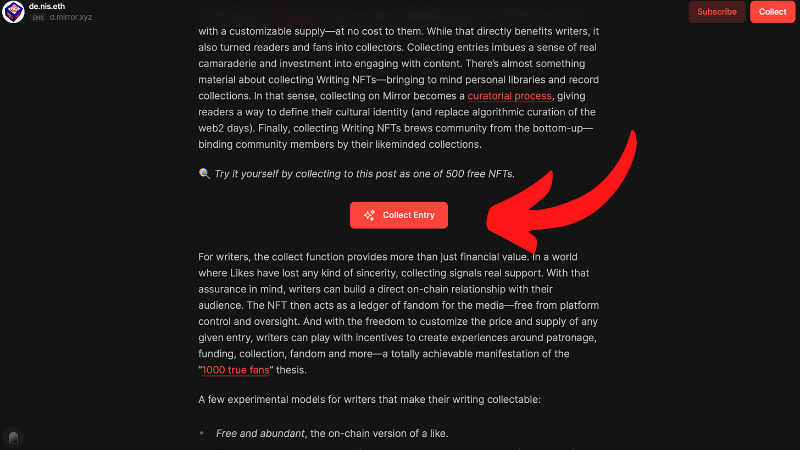
As more people begin collecting writing NFTs, Web3 wallets could one day become primary profiles for writers. We might even envision a new form of curation—readers creating wallets dedicated to curating articles in specific domains—each wallet becoming a new media outlet.
We may also witness the rise of experiments using collectors as creative catalysts. Top fans (i.e., collectors) could vote to choose the topic of the next article.
But while this is incredibly exciting (at least to me), we’re not there yet.
For NFTs to become a new curation mechanism, future wallets must go beyond transactions and be built natively around personalization, navigation, interoperability, and strong social components.
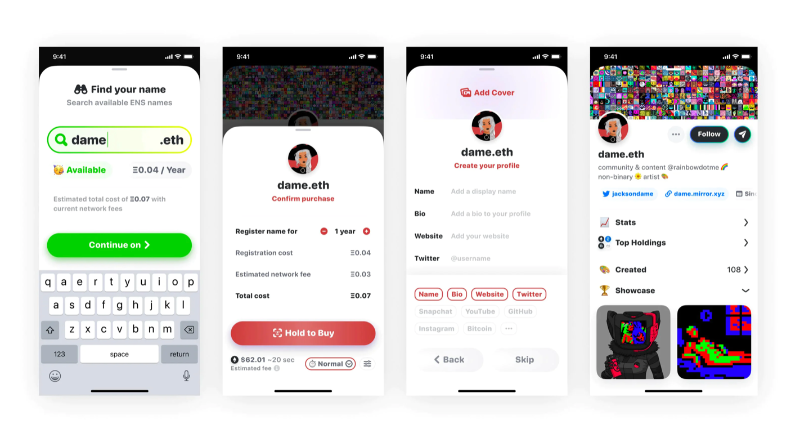
These new Web3 wallets—like Rainbow—will resemble LinkedIn, Twitter, or Substack more than traditional bank accounts such as MetaMask. You’ll freely share your wallet with friends and platforms, controlling what you reveal and emphasize through granular permissions for authorization, revocation, and sharing.
You might evensoon be able to read articles directly from your wallet.
Conclusion
I’ve focused mainly on writing NFTs and writers in this article,but I believe this same on-chain curation mechanism can apply to every industry.
Solving today’s discovery problem ultimately requires a fundamental shift in how we view the internet and content creation: moving from a top-down model controlled by centralized institutions to a bottom-up model where everyone has a voice and can be rewarded for their work.
In this new model, as a writer, cultivating trusted sources and building your curation network will become critical—and this upfront effort will be the price of independence from centralized platforms.
Ownership and distribution rights have always been central to Web3, and writing NFTs represent an opportunity for creators and fans alike to both own and distribute content.
Clearly, we still have a long way to go before this future becomes reality—but I’ve already seen the habit of collecting writing NFTs emerge among my writer friends, and in the coming months, I expect to see many more adopt this practice.
Join TechFlow official community to stay tuned
Telegram:https://t.me/TechFlowDaily
X (Twitter):https://x.com/TechFlowPost
X (Twitter) EN:https://x.com/BlockFlow_News
 @Globalcoinrsrch