Web3 Privacy Solutions Overview: How Can Developers Protect Themselves?
TechFlow Selected TechFlow Selected
Web3 Privacy Solutions Overview: How Can Developers Protect Themselves?
In the privacy sector, homogenized competition drives innovation, fostering the emergence of new projects and the iteration of existing ones in the privacy chain space.
 Navigating Web3 tides with focused insights
• The Tornado Cash incident raises questions: Should developers be held accountable for users who abuse protocols they contribute to?
• As guidance for developers and their open-source code remains unclear, on-chain privacy becomes increasingly critical
• This guide outlines some existing and upcoming privacy-focused chains as secure deployment options for privacy-conscious developers
No developer wants to face prison time over a few lines of code—but this is exactly what happened to Alexey Pertsev. As a key contributor to Tornado Cash, Pertsev was accused by the U.S. government of aiding money laundering through the Ethereum-based dApp. This dramatic case sparked global backlash, with critics emphasizing that developers cannot control how users may misuse their code.
While the story may be more complex than it appears, it has ignited debate around on-chain privacy. Arresting someone for writing code sets a dangerous precedent and threatens future contributions to open-source software. After all, who would willingly take responsibility for how others use their code when they have no control over its application?
The blockchain community champions openness, but this ethos does not always extend to data security and privacy. In certain cases, full transparency is unnecessary (see @GeneralRinaker’s article for reference).
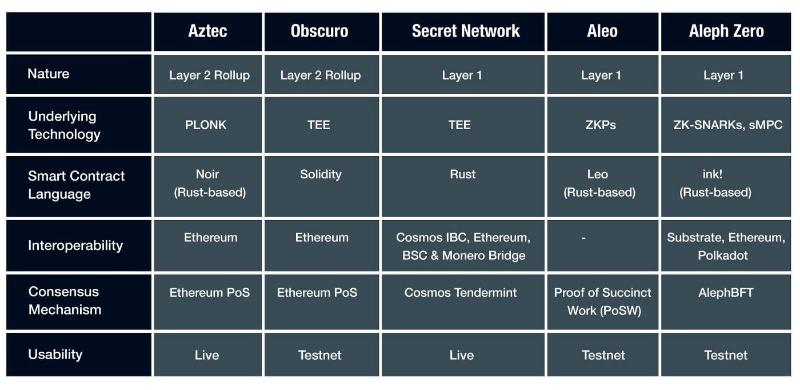
This article evaluates several existing and upcoming privacy solutions designed to preserve a degree of anonymity for Web3 developers.
#1 Aztec Network
Aztec is the first Layer 2 privacy chain (privacy layer) on Ethereum utilizing zero-knowledge proofs. Smart contracts running on Aztec ensure asset privacy, allowing users to transact, stake, and earn rewards while preserving the confidentiality of their on-chain activities—all at lower transaction fees.
-
Chain: Ethereum
-
Status: Mainnet live
-
Underlying Technology: PLONK, a system built on zk-SNARK standards for Layer 2 transaction processing
-
Architecture: Dual SNARKs. The first layer is a privacy circuit that verifies each transaction while keeping sender, receiver, and asset details confidential. The second layer is a rollup circuit that batches encrypted transaction data and submits it to Layer 1.
-
Github: https://github.com/AztecProtocol
Primary Use Cases
Through the Aztec Connect privacy bridge, users can directly interact between Layer 2 privacy chain and Layer 1 DeFi applications.
DeFi protocols on Layer 1 can integrate the Aztec Connect SDK into their systems to enable private transactions, as seen in zk.Money.
Aztec Connect, the flagship product of Aztec, enables private transactions using ETH and DAI. At the time of writing, Aztec Connect has processed approximately 255,000 transactions.
Progress
The team is currently working on adding custom smart contract functionality to its network. These contracts will be written in Noir—a Rust-based language specifically designed for the Aztec network. The project is now in testnet phase, aiming for completion by the end of 2022.
Assessment
Aztec enables the privatization of all ERC-20 assets, making it a significant use case for Ethereum.
Given Ethereum's high activity level, enabling privacy for existing assets is far more accessible to users than launching a separate privacy chain. On this foundation, Aztec has the potential to become an indispensable privacy layer for Ethereum.
#2 Obscuro
Obscuro is another Layer 2 privacy solution for Ethereum, designed to optimize MEV mitigation while ensuring transaction and contract state privacy. By combining Optimistic Rollups with zero-knowledge proofs, Obscuro claims to offer “the best of both worlds.”
-
Chain: Ethereum
-
Status: Testnet
-
Underlying Technology: Intel SGX technology runs EVM within TEE hardware—essentially a black box inside the CPU where fully private computations can be executed.
-
Architecture: The Obscuro network features two types of nodes. Aggregators validate all encrypted transactions, bundle them, and send them back to Ethereum. Verifiers perform similar functions but operate independently using hardware-based validation. Having both node types enhances decentralization and security.
-
Github: https://github.com/obscuronet
Primary Use Cases
As Obscuro is still on testnet, there are no live products yet. However, the platform outlines various potential applications, including private DeFi and Web3 strategy games.
Notably, Obscuro is one of the few privacy solutions that allow developers to write smart contracts using Solidity.
Solidity enjoys higher adoption among Web3 developers compared to Rust.
In contrast, most other solutions mentioned here are primarily Rust-based.
Progress
Mainnet launch is expected in 2023.
Assessment
Obscuro’s use of Solidity gives it significant potential and growth prospects.
Developers can easily deploy their mainnet-ready smart contracts on Obscuro.
Additionally, its EVM compatibility offers a clear advantage over Rust-based projects in terms of ecosystem integration. However, the extent of modifications required for existing contracts remains to be seen.
#3 Secret Network
An industry OG, Secret Network launched in September 2020 as the first network with privacy-preserving smart contracts at Layer 1. Built using the Cosmos Tendermint SDK, its smart contracts are written in Rust via the CosmWasm toolkit.
-
Chain: Cosmos IBC, Ethereum, Binance Chain, and Monero bridge
-
Status: Mainnet live
-
Underlying Technology: Similar to Obscuro, Secret Network uses Intel SGX on TEE for computation. Protocol code is split into two parts: trusted (sensitive information) and untrusted (the rest).
-
Architecture: Currently, a group of 50 validators secures the network using the Tendermint consensus engine (a BFT-based Proof-of-Stake mechanism). Validators verify transactions and propose blocks by staking SCRT tokens, earning rewards in return. Delegation comes from non-validators.
-
Github: https://github.com/scrtlabs
Primary Use Cases
Secret Network currently hosts a rich ecosystem with over 20 dApps and more than 100 developers.
As a Cosmos Tendermint SDK project, the chain is interoperable with other components of the Cosmos ecosystem—especially after enabling IBC.
Essentially, Secret Network brings privacy capabilities to the entire Cosmos IBC ecosystem.
With ample documentation and tools available around the Cosmos development framework, Secret Network is relatively developer-friendly for Web3 builders.
Progress
Development on Secret 2.0 is underway. Key improvements include integrating FHE (Fully Homomorphic Encryption) and strengthening the existing network.
Assessment
The team has clearly invested heavily in network development. Functional products within the ecosystem continue to grow, and community engagement is increasing. More importantly, full privacy isn't suitable for every scenario under regulatory scrutiny.
Secret Network appears to strike a balance—preserving user privacy while meeting regulatory requirements.
The SCRT token is fully transparent, yet transaction activity involving platforms and contracts remains entirely hidden. This value proposition is increasingly important in a tightening regulatory environment.
#4 Aleo
Leveraging recent advances in ZK cryptography, Aleo is dubbed the first decentralized, open-source protocol enabling private and programmable applications. Users can allow third parties—including smart contracts—to verify data without revealing transaction details, while selectively disclosing partial information at different transaction levels. This feature is highly useful for interactions between composable dApps, helping build broader ecosystems.
-
Chain: Aleo
-
Status: Testnet
-
Underlying Technology: The platform uses PoSW (Proof of Secure Computation), where each block generates ZK proofs derived from Bitcoin’s SHA algorithm. Unlike arbitrary hash functions, underlying computations rely on PoW. Essentially, it allows users to verify state with minimal computational power.
-
Architecture: Aleo combines Ethereum’s programmability and account model with Zcash’s privacy transaction design to achieve full on-chain privacy.
-
Github: https://github.com/AleoHQ
Primary Use Cases
Aleo provides Leo, a domain-specific language (DSL) for private contracts. Inspired by Rust, Leo is used to develop privacy-focused applications and integrate ZK circuits. Though a specialized language, its developer documentation is comprehensive, concise, and clear.
Additional developer tools include Aleo Studio, Aleo Package Manager, and Aleo Explorer.
Progress
Aleo’s third testnet is being rolled out in three phases. This month, validators (users with 10 million Aleo credits) can begin producing blocks and earning rewards. The project plans to transition its consensus mechanism to AleoBFT to prevent centralized block production.
Assessment
The project has achieved阶段性 progress. The testnet already supports a full programming language and includes tooling to support ecosystem growth.
The Aleo team promises to launch additional products and services to help developers build decentralized networks within the ecosystem, offering a superior developer experience.
#5 Aleph Zero
The final—and newest—project on our list is Aleph Zero. Built on Polkadot’s Substrate technology and leveraging a peer-reviewed consensus protocol, Aleph Zero claims to deliver instant settlement, speed, scalability, and security. Once fully operational, its privacy framework could eventually be deployed across all major blockchains.
-
Chain: Substrate, Ethereum, Polkadot
-
Status: Testnet
-
Underlying Technology: Aleph Zero employs a unique approach to private contracts by combining zero-knowledge proofs and sMPC (secure Multi-Party Computation). ZK-SNARKs securely and privately exchange user keys, while sMPC protects data across multiple computers, which only gain access upon reaching consensus and receiving permission.
-
Architecture: Aleph Zero’s custom algorithm blends a variant of PoS with DAG technology. The PoS consensus rotates validators to verify block states. The DAG serves as an intermediate data layer, enabling faster transaction speeds and higher throughput, thereby significantly reducing fees.
Primary Use Cases
The first product on Aleph Zero is Common, a decentralized exchange with an integrated wallet and a decentralized dark pool designed to prevent front-running. Front-running occurs when traders exploit insider knowledge of pending transactions to place profitable trades ahead of price movements.
Progress
Aleph Zero is developing Liminal, a cross-chain privacy solution.
Liminal will introduce innovative security measures based on a combination of ZK-SNARKs and sMPC.
Additionally, through bridges, Liminal will support transactions between Aleph Zero and other chains such as Ethereum, Near, Cosmos, and BSC. Developers can write smart contracts on these chains while maintaining privacy via Aleph Zero.
Assessment
The growing developer community and interoperability of Substrate itself are major enablers of Aleph Zero’s success.
The experience of the core team and its partnerships also bode well for future growth.
Beyond that, the protocol’s ease of use will likely attract more businesses and users into its ecosystem.
Outlook
Regardless of methodology or design, privacy chains fundamentally revolve around giving developers the choice to conduct private transactions.
Within the privacy space, competitive innovation drives the emergence of new projects and continuous iteration of existing ones.
Web3 developers should have the right to retain a certain level of privacy—empowering them to write code freely, push boundaries, and advance blockchain innovation.
Author
Special thanks to Xarl (Rajapandian), technical researcher at Arcane Group, for his research contributions in privacy protection and code security. Other team members including Frank, OxCryptolee, Don, Sue, and Charles provided translation and proofreading support for the Chinese version.
About Us
Arcane Labs is an emerging Web3.0 research, investment, and incubation platform dedicated to exploring cutting-edge infrastructure and native applications. We provide incubation and ecosystem collaboration platforms for Web3.0 entrepreneurs worldwide. Insightful globally, empowering Asia.
📬 Contact: [email protected]
🔗 Read more:
-
Mirror: mirror.xyz/arcanelabs.eth
-
Twitter: twitter.com/Arcane_Labs_
-
Medium: medium.com/@Arcane_Labs
Join TechFlow official community to stay tuned
Telegram:https://t.me/TechFlowDaily
X (Twitter):https://x.com/TechFlowPost
X (Twitter) EN:https://x.com/BlockFlow_News