








Decoding Aptos Token Economics: Who Received the Community Token Allocations?
TechFlow Selected TechFlow Selected
Decoding Aptos Token Economics: Who Received the Community Token Allocations?
As Aptos announced its mainnet launch, related public discussion gradually intensified.
 Navigating Web3 tides with focused insights
By Morty, TechFlow
With Aptos announcing its mainnet launch, major centralized exchanges have also released announcements stating they will soon list the native token APT.
Criticism quickly followed—TPS of only 4, Discord shutdown, over 82% of tokens staked...
What's particularly puzzling is that as the token prepares to go live, investors still cannot access a complete tokenomics model.
As public discussion intensified, Aptos responded on Twitter and later released a preliminary version of its APT tokenomics in the afternoon.
Here’s our analysis and interpretation.
Tokenomics
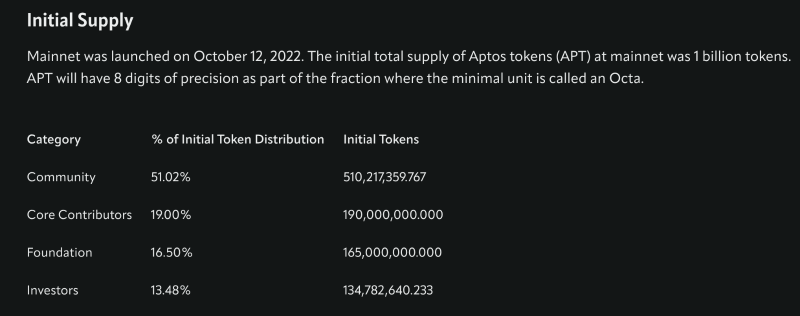
According to official disclosures, Aptos token allocation is as follows:
-
51.02% allocated to the community
-
16.5% allocated to the foundation
-
19% allocated to core contributors
-
13.48% allocated to investors
Among these, investors’ shares will be locked for one year, with unlocking beginning in the 13th month—3/48 of tokens unlocked monthly until the 18th month, and from the 19th month onward, 1/48 unlocked each month.
Regarding this initial version of APT tokenomics, we highlight four key points:
1. Where exactly is the 51.02% community allocation?
The tokenomics document states that out of the 51.02% community share, 410,217,359.767 APT are held by the Aptos Foundation and 100,000,000 APT by Aptos Labs. These tokens will be distributed at a rate of 1/120 per month, fully unlocked over ten years.
In other words, the 51.02% “community” allocation does not truly belong to the community—it remains under control of the Aptos team. The official explanation is that these tokens will be used to support ecosystem growth. Thus, calling it "community allocation" may be misleading; “ecosystem fund” would be more accurate.
2. Where are the rewards for testnet node operators?
Aptos previously mentioned rewarding contributions from testnet node operators. However, this latest tokenomics document makes no mention of such rewards. This omission may be clarified in a comprehensive explanation of APT tokenomics promised by the team for future release.
3. Investors can earn immediate rewards through staking, even with locked tokens
Both unlocked (distributable) and locked (non-distributable) tokens can be staked to earn staking rewards, and reward payouts themselves are not locked—they can circulate immediately.
Undoubtedly, this benefits project insiders and VCs, especially given that over 82% of tokens are currently staked.
Currently, the base staking reward for APT is 7%. This base percentage decreases annually by 1.5%, eventually settling at 3.25%.
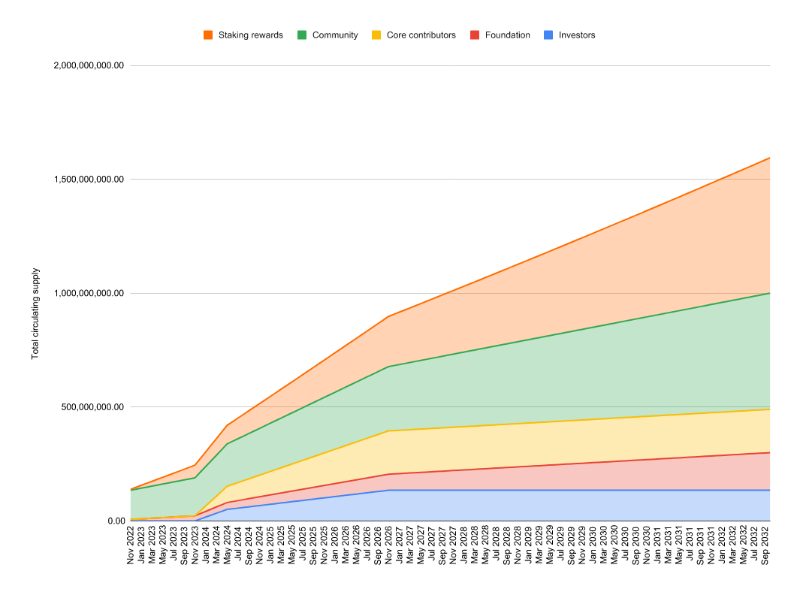
4. Initial circulating supply is 13%
According to the team, 130 million tokens—13% of the total supply—will enter circulation at launch.
Of this, 125 million come from the community allocation and 5 million from the foundation.
Two additional factors that could significantly impact APT are Aptos’ staking mechanism and ecosystem development.
Staking
On August 2, Raft Labs (@Raft_Move) tweeted that based on Layer1 and the Move language, Aptos designed a unique staking mechanism for APT that differs from other Layer1s and could deliver high compound yields to stakers. Raft Labs likened this system to OlympusDAO.
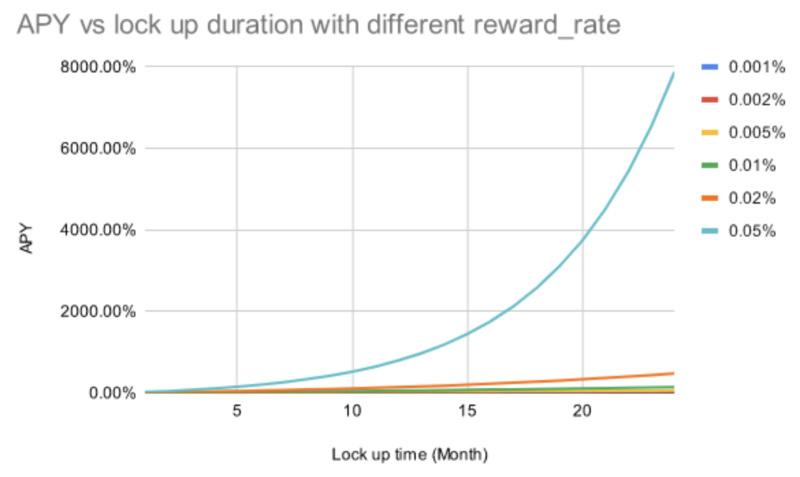
Aptos' staking model draws inspiration from OlympusDAO. Rewards are distributed every epoch (one hour), and block rewards are variable—proportional to the length of time tokens are locked. The longer the lock-up period, the higher the reward.
As noted above, a large number of locked tokens can participate in network staking, potentially forming a massive Ponzi-like structure, while also increasing the total token supply over time.
However, during the early stages of the token launch, most circulating tokens remain concentrated in the hands of the Aptos team, meaning insufficient tokens are available for staking participation.
Therefore, APT token value may grow as demand outpaces supply.
Ecosystem
The growth potential of a Layer1 token ultimately depends on its ecosystem development.
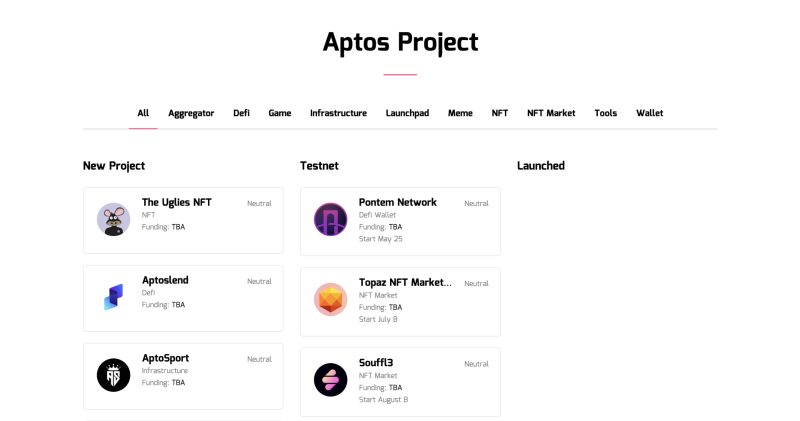
Reviewing the Aptos ecosystem, we see 215 projects preparing to deploy on Aptos.
For developers using the Move language, deployment is relatively straightforward—the path has already been charted by early adopters.
As such, upcoming projects on Aptos span DeFi, infrastructure, aggregators, gaming, launch platforms, NFTs, NFT marketplaces, tools, wallets, and even meme projects.
Developers
Notably, developers building protocols on Aptos resemble opportunists in a nascent ecosystem. Historically, a significant portion of Move developers come from Polkadot and Solana. Even Austin Virts, former marketing director at Solana, joined Aptos in August as Head of Ecosystem Development.
This raises a critical concern: low developer loyalty among Aptos builders. This group largely consists of developers migrating from other blockchains—akin to mercenary liquidity providers—who are loyal to incentives and yield rather than the chain itself.
Rather than relying on such “opportunistic” external entrants, Aptos may need a core group of MOVE-native developers to build lasting competitive advantages.
Final Thoughts
For any Layer1, we can summarize the value proposition of Aptos’ token as: "Short-term driven by hype, mid-term by narrative and expectations, long-term by ecosystem and adoption."
As the first Move-based Layer1 to launch its mainnet, Aptos deserves ongoing attention. Yet, as a "capital-controlled, centralized blockchain", its ultimate success or failure remains to be seen.
The above content is not investment advice.
Join TechFlow official community to stay tuned
Telegram:https://t.me/TechFlowDaily
X (Twitter):https://x.com/TechFlowPost
X (Twitter) EN:https://x.com/BlockFlow_News






