








Sentiment: A lending protocol that unlocks greater capital efficiency through uncollateralized leverage
TechFlow Selected TechFlow Selected
Sentiment: A lending protocol that unlocks greater capital efficiency through uncollateralized leverage
Sentiment is a new lending primitive on Arbitrum that enables composable, permissionless, and undercollateralized on-chain credit.
 Navigating Web3 tides with focused insights
Author: 0x_d24.eth
Compiled by: TechFlow
Sentiment is a new lending primitive on Arbitrum that enables composable, permissionless, and undercollateralized on-chain credit.
The dominant DeFi lending protocols mitigate counterparty risk through over-collateralization (e.g., AAVE/COMP loans), but this comes at the cost of extremely low capital efficiency: you must deposit 1.2x or more collateral for every dollar borrowed.
While several projects are building undercollateralized lending solutions for large institutional borrowers, options remain limited for degens or small on-chain funds seeking exposure to long-tail assets.
Enter Sentiment — built to address this market gap.
Sentiment is a composable liquidity protocol launched on Arbitrum. Lenders provide capital to borrowers who can leverage up to 5x, with borrowed funds deployable permissionlessly across DeFi.
With amplified leverage, borrowers achieve significantly higher capital efficiency, enabling them to use leveraged positions to go long/short tokens or participate in staking.
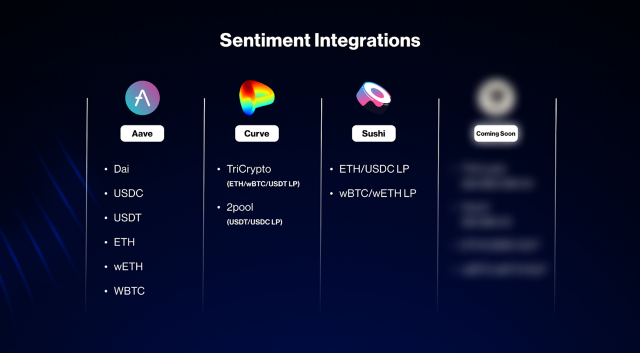
Sentiment has currently integrated the following protocols:
- AAVE;
- Curve;
- SushiSwap;
Integrations with GMX/$GLP, Balancer, and others are also expected soon.
Let’s illustrate how this works in practice: Chad and Thad each have $100,000 and want to short ETH/USDC. Thad can deposit $100,000 USDC into his margin account on any perpetuals protocol of choice and short ETH with 5x leverage. Chad, using Sentiment, deposits $100,000 and borrows ETH worth five times his collateral — $500,000 — then swaps the ETH for USDC on a DEX, effectively establishing a 5x leveraged short on ETH.
Beyond this 5x leveraged short, Chad still holds $500,000 in USDC within his Sentiment account. He can deposit these funds into BAL and CRV liquidity pools to earn yield, offsetting his borrowing costs.
You’re clearly not limited to leveraged longs and shorts—you can deploy your debt across various DeFi protocols, from LP positions to staking.
Of course, this raises a key question: How does the protocol manage risk, and how do lenders and the protocol mitigate insolvency?
Sentiment addresses this through a dedicated on-chain account system. The Sentiment account is a foundational component of the protocol—holding both borrower collateral and loaned assets. Each account functions similarly to a compound cross-margin debt position. Borrowers do not custody the borrowed assets directly; instead, they can only deploy them into whitelisted DeFi protocols.
An “account” acts like a wallet holding your assets, subject to restrictions such as no asset withdrawals and usage limited to approved protocols.
Margin risk is managed via a proprietary risk engine that calculates a liquidation risk factor. It divides your account value (deposited assets + debt) by your total debt, then subtracts 1 — resulting in the liquidation risk factor.
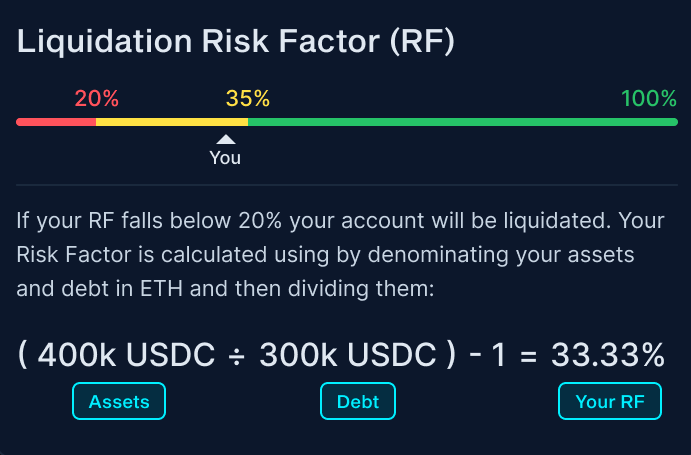
In the future, an insurance fund may also be introduced to cover liquidations of positions below the RF threshold. It is precisely because this protocol unlocks exceptionally high capital efficiency and seamless composability with other DeFi protocols that I am so bullish on Sentiment. The protocol is set to launch on October 21 — looking forward to the surprises it will bring.
Join TechFlow official community to stay tuned
Telegram:https://t.me/TechFlowDaily
X (Twitter):https://x.com/TechFlowPost
X (Twitter) EN:https://x.com/BlockFlow_News






