








Why has Avalanche become developers' top choice for deploying protocols in the future?
TechFlow Selected TechFlow Selected
Why has Avalanche become developers' top choice for deploying protocols in the future?
This article presents thoughts and trends on the Avalanche ecosystem from a VC + BD perspective.
 Navigating Web3 tides with focused insights
Written by: based lord
Compiled by: TechFlow
Builders remain active even during bear markets. However, gaining clear visibility into developer activity can be challenging, as many projects operate quietly.
Below are insights and trends on the Avalanche ecosystem from a VC + BD perspective.
TLDR:
The combination of cutting-edge technology, a culture of continuous innovation, and top-tier BD makes Avalanche one of the most exciting blockchains for Builders to flock to.
As a result, an increasing number of innovative dApps are choosing to deploy on Avalanche.
Avalanche's Vision
AVAX’s vision is very clear. The goal has always been to digitize all assets, and the path forward is enabled by Avalanche’s novel consensus protocol (efficient vertical scaling) and application-specific subnets (horizontal scaling).
Despite the fiercely competitive L1 landscape, there are strong reasons why developers choose to build on Avalanche:
- A vibrant community and dApp ecosystem;
- Subnets enable high-TPS protocols with lower transaction costs, using native tokens as currency;
- Top-tier BD and support from Avalabs;
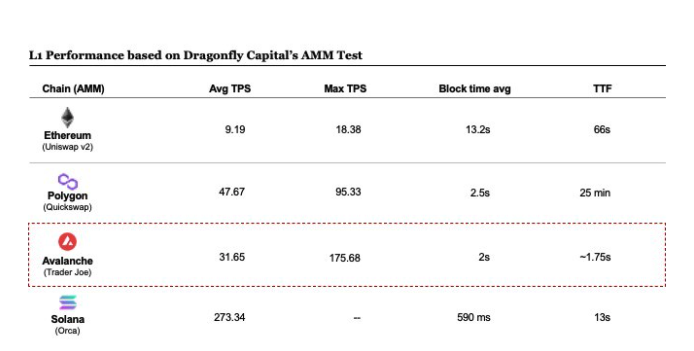
Although having a fast chain and high TPS may seem commonplace in today’s L1 space, technical nuances still matter greatly to Builders when choosing where to build: protocols managing millions in TVL require large-scale, high-performance, and reliable networks.
On this front, Avalanche remains the fastest chain in terms of time-to-finality and has reported no downtime. Subnets are also explicitly enabling technologies that allow new use cases in crypto.
Applications that are too slow or too expensive to run on other chains can now be built here.
Although subnets are still in their early stages, I expect a Cambrian explosion within the next 6 months to 3 years. Currently, over 60 subnets are in development, with more developers joining daily.
Beyond existing technologies, I anticipate new innovations emerging.
The Avalanche tech team consistently leverages the best of science and academia and applies it to crypto’s biggest challenges. I’m particularly excited about Avalanche’s leading breakthroughs in custom VMs (which can run as subnets!)
In the coming years, I expect the L1 environment to gradually move away from its current siloed state, where consumers won’t need to think about which chain they’re on. Avalanche will be a game-changer, as enterprises will need a fast chain with zero downtime to ensure top-tier user experiences.
DeFi
Moving into specific verticals and developments, let’s start with DeFi — which has long been Avalanche’s main focus.
Digitizing all assets has always been their goal, and I believe Avalanche is focused on cultivating a rich, DeFi-native ecosystem while also building multi-billion-dollar bridges for institutions, trading firms, and corporate capital.
Vance Spencer has an interesting take on L1s: the most critical factor for a new L1’s success is the quality of its BD. While I agree that certain technical factors matter—and top-tier Builders do carefully consider a chain’s technical environment when deciding where to build—I do concur that BD is crucial.
While previous cycles saw DeFi innovation emerge primarily on ETH, the combination of strong BD, an existing ecosystem, and Avalanche’s technical advantages means that new DeFi innovations may now come from AVAX.
We’ve already seen projects like Platypus, and we’re now poised for exciting new AMMs, perpetual contracts, and various types of options protocols. Likewise, many of these protocol products will run their own subnets.
Additionally, real-world asset (RWA) tokenization has become a key area where crypto can add tangible value and expand financial possibilities.
RWA assets create a win-win scenario:
- In the real world: increased liquidity, greater accessibility, and lower cost of capital across many asset classes;
- In DeFi: sustainable, real yields and opportunities in alternative asset classes for investors.
Some of these new RWA use cases are now emerging, including KKR fund tokenization and reinsurance tokenization. More cases are underway involving infrastructure, SME microloans, real estate, and more.
Gaming
Subnets and gaming are a perfect match. Games constantly update states and involve massive transaction volumes. These transactions must be fast and cheap to be viable for any type of crypto game.
Moreover, the new wave of game studios and developers now building are more mature than ever before. Many have experience working at top-tier studios, and several high-fidelity projects have chosen Avalanche due to subnet capabilities and BD support.
I expect that within the next year, we’ll see the first wave of higher-quality casual games that can help onboard more non-crypto-native players, followed by the emergence of AAA-grade game projects.
These developers understand that many gamers dislike crypto, so they prioritize creating a fun game first. Crypto will be placed in the backend, so players don’t need to interact on-chain until they want to withdraw their assets.
Teams are exploring new business models so that not only does gaming advance crypto, but crypto also advances gaming.
Crypto enables increased consumer spending and secondary sales royalties. It also enables Play-to-Own models, where gamers truly own their in-game assets.
Mindset analogy: Early 2000s–2010s crypto gaming = free-to-play + casual mobile games.
Initially low fidelity, but eventually the right teams and products powered new business models and significantly expanded the player base and experience.
The Avalab gaming BD team has extensive experience helping games design their tokenomics, introduce internal partnerships, and fine-tune what might or might not work.
NFT
Avalanche is also poised to become an art chain. Culture drives adoption, and this holds true in crypto as well. Since Joepegs launched just months ago, the ecosystem has welcomed new trends.
Many other L1s have experienced significant growth or revival due to NFTs—such as Solana, Near, Tezos, and Algorand—and different chains adopt varying approaches to the types of NFTs they aim to curate.
Avalanche appears well-positioned to attract artists and curators like GabrielJWeis (ConsciousLines), while strong enterprise BD will further develop NFTs as a business tool: ticketing, rewards/loyalty programs, customer acquisition, and more.
As startups begin using the C-Chain for settlements, NFTs with real-world utility look set to become strong players on Avalanche. Similarly, the more crypto moves into the backend, the more important it becomes for traditional enterprises to partner with a chain offering seamless UX and flawless technology.
Join TechFlow official community to stay tuned
Telegram:https://t.me/TechFlowDaily
X (Twitter):https://x.com/TechFlowPost
X (Twitter) EN:https://x.com/BlockFlow_News






