








SocialFi in Web 3: There Is No Endgame in Social
TechFlow Selected TechFlow Selected
SocialFi in Web 3: There Is No Endgame in Social
As the legendary figure of Web2 social media and father of WeChat, Zhang小龙 believes the essence of social interaction is finding kindred spirits.
 Navigating Web3 tides with focused insights
Written by: Jayde Zhang, [email protected]
Socializing, short for social interaction, is formally defined as "a social activity involving mutual exchange of material and spiritual communication between individuals." In social interactions, people share opinions, emotions, and experiences.
Humans are social animals. As the legendary figure behind WeChat—the king of Web2 social apps—Zhang Xiaolong believes that the essence of socializing is finding your tribe. Zhihu founder Zhou Yuan, on the other hand, suggests that the core of socializing may lie in answering two questions: Who am I, and who are others?
"The self" is a complex philosophical concept, yet social connection remains a universal human need. The fundamental reasons people seek social connections boil down to three drivers: exchange of value (economic and social); fulfillment of emotional needs; and access to sexual resources. Through these interactions, behaviors generate information exchange and build relational networks.
As a business centered on human relationships, social networking has always represented a multibillion-dollar battleground fiercely contested by entrepreneurs. In the Web2 era, socializing often equates to one or more social apps. But it's evident that the Matthew effect among super-apps is intensifying—WeChat appears to be becoming a black hole swallowing all other social products.
On the other hand, with mobile internet红利 peaking and big tech firms running out of growth headroom, Web2 social products have generally underperformed and lacked innovation. Since Clubhouse’s brief global splash in 2021, no new mainstream phenomenon-level product has captured the world’s attention.
Opportunity emerges from crisis. Issues such as meager creator earnings, cutthroat competition, and platform authoritarianism in Web2 are fueling the rise of the SocialFi sector. Amid the paradigm shift from Web2 to Web3, a vibrant cohort of founders is now flourishing on the fertile ground of blockchain infrastructure.
“Conversations with SocialFi Founders” brings you three outstanding practitioners from this space, sharing their personal journeys, industry insights, and visions for the future. May their stories serve as nodes, sparks, and torches—illuminating each other through the enchanting primordial forest of Web3.
01/ Louis Lu: Building a Web3 digital identity platform, witnessing the paradigm shift toward user-centric socialization.
——BOOM CTO | Twitter @boomapporg
After six years in Web2, I decided to go all-in on Web3.
During my student days, I had the chance to get involved in Bitcoin mining and trading, and even launched a basketball community app. After graduation, I worked at Baidu and ByteDance focusing on data mining, particularly in user behavior analysis, news feed recommendations, and ad optimization. My extensive experience in Web2 search, recommendation systems, and advertising gave me deep insight into its flaws—especially how highly centralized social platforms handle user data.
-
Data ownership issues: In Web2, centralized platforms treat users’ data and creators’ content as proprietary “data assets” and “data moats.” Users, however, have little control or management rights over their own data. For example, if Facebook or Twitter bans your account, you not only lose your content and followers but often have no way to appeal. This creates significant insecurity for users.
-
Data privacy concerns: All data is stored in centralized databases managed solely by the platform, creating risks of leaks. Worse, most platforms collect user data without clear consent.
-
Data monetization rights: Advertising is a primary revenue model online, where platforms profit from creator-generated traffic and user data. Yet only a tiny fraction of this income reaches creators and users.
I joined Web3 partly because after nearly two decades of development, Web2 has become extremely centralized, with diminishing returns, saturated markets, and exhausted policy advantages—making it imperative to explore the next frontier. Also, friends from my university crypto days who stuck with Web3 have achieved notable success amid its rapid growth. More and more of my Web2 peers are also transitioning into Web3. When an emerging industry attracts increasing venture capital and talent, you sense massive opportunities ahead—so I chose to leave Web2 and dive into Web3.
Doing hard but right things—witnessing the shift from platform-centric to user-centric paradigms.
With the growth of DeFi, GameFi, and NFTs, Web3’s user base and influence continue expanding—socialization is becoming inevitable. However, existing Web2 social platforms are too centralized to meet Web3 users’ demands for data ownership, privacy, and fair monetization. A new paradigm for social networks is needed.
Boom aims to build the next-generation social network based on blockchain technology. At Boom, I lead technical architecture and product development. Currently, we’re focused on building a Web3 digital identity tagging protocol. Identity is the core of any social product. With the emergence of concepts like social graphs and soulbound tokens (SBTs), there’s growing consensus that Web3 needs a better decentralized identifier (DID) system.
Web3 leverages blockchain-based decentralized technologies to make user-generated content, social relationships, identities, and reputations truly decentralized and composable—no longer dependent on any single centralized platform. These changes offer new solutions to long-standing problems around data ownership, monetization, and privacy, paving the way for a more user-centric social ecosystem.
Users come for tools,stay for the network.
Looking at the evolution of current social products, successful Web2 platforms deliver tangible utility and entertainment that users can clearly perceive. Facebook, Twitter, and TikTok let you connect with many people and follow their lives. WhatsApp and WeChat enable free global messaging and video calls—real utilities.
Social networks also follow Metcalfe’s Law: the value of a network is proportional to the square of its number of users. The more users join, the greater the network value becomes—eventually triggering explosive growth at a critical point.
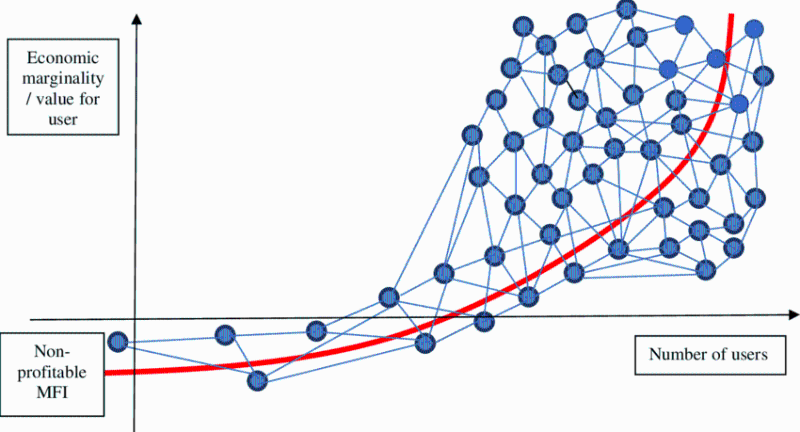
But why do large social networks sometimes lose perceived value during rapid user growth? Why do once-dominant platforms decline while newer small ones rise? Why do some niche tools attract early adopters but fail to retain them, while seemingly useless ones succeed?
For instance, after Facebook came Instagram and Snapchat. Even TikTok has challenged Facebook’s dominance. Many young people now “play dead” on WeChat Moments but “party” on Douyin.
To explain this, a new social product model extends beyond utility and entertainment by adding a third dimension: social capital.
How can one acquire and accumulate social capital quickly?
This process resembles how capital is earned in blockchain networks:
1. Each social network issues a new form of social capital (e.g., followers, likes), akin to tokens in blockchain networks.
2. You must show proof of work (PoW) to earn tokens—just like mining in blockchain.

On Facebook or WeChat Moments, you post fun updates; on Instagram, you share interesting photos; on TikTok/Douyin, you upload engaging short videos. Only by doing so can you prove your effort and gain attention, likes, and other forms of social capital. Early adopters gain a natural advantage in accumulating social capital.
Celebrities and influencers—who already possess inherent social capital—also enjoy built-in advantages when joining new platforms, similar to pre-mined tokens in blockchains. Like cryptocurrencies, social capital derives value from scarcity, which stems from proof of work (PoW).
However, we must recognize that social networks, much like blockchain networks, have distinct life cycles. Over time, earning tokens on any given network becomes harder—deflation sets in. Eventually, users feel they can no longer derive value from older platforms and begin to leave.
Long-term commitment: building a user-centric social network powered by youth.
Web3 social networks are still in early stages. The 2021 wave of fan communities tokenized via SocialFi was fleeting. Yet decentralization in social networking is gradually gaining traction. Decentralized social DAOs and foundational protocols continue evolving. I believe the next cycle will bring forth more user-centric social platforms.
Currently, Web3 social activity mostly exists within Web2 networks. In the future, Web3 and Web2 social ecosystems won’t be entirely separate—they’ll intersect and converge, though the exact form remains unpredictable.
History shows that young people will drive the next generation of social networks. They enter late, struggle to compete with established users on old platforms, but have the time and curiosity to explore new networks and chase novel forms of social capital.
I’ve been working in Web3 social for quite some time and have lived through a full SocialFi cycle—from early experiments with fan-owned communities and Social Tokens to today’s efforts in decentralized social graphs and Web3 digital identity. We’ve tried many approaches and accumulated valuable experience integrating Web3 tech with social products and driving user growth.
Going forward, I’ll focus on ZK technology, especially how it can improve identity management and privacy—a crucial area where Web3 complements Web2. Privacy is vital for Web3 social apps, yet unfortunately, no breakthrough applications have fully realized this potential yet.
Given current trends, the entire crypto industry is in a bear market. BOOM will prioritize iterating infrastructure—starting with a Web3 digital identity platform—to empower the next wave of social products.
02/ Ryan Li: Laying the groundwork for a unified system of social relationships
——CyberConnect CTO | Twitter @ryanli_me

Third time entering social—shifting from simply connecting friends to empowering creators.
I did my undergrad at UC Berkeley. Right after starting college, I attempted my first social startup, securing funding from Tencent and targeting friend-to-friend socializing. But even back then—seven or eight years ago—I realized that no matter how good your product is, if everyone’s already on Snapchat or WeChat, it doesn’t matter. Now, years later, I can clearly see how much the product ecosystem has changed.
After graduating in 2017, I launched Lino, a decentralized autonomous video community built on blockchain. My goal was to help creators monetize better and regain ownership of their data. It became Cosmos’ first major project. By tying content value directly to rewards, we created positive feedback loops, allowing creators to become true owners of the platform.
Building on Lino, our team then created DLive, a gaming livestreaming platform. In 2019, PewDiePie, the world’s biggest gaming influencer, streamed exclusively on DLive. The platform reached about 1 million daily active users and 10 million monthly actives—an impressive entrepreneurial milestone. In 2020, BitTorrent acquired DLive, and I served as CTO there for a year and a half. Then in March last year, I started CyberConnect.
Web3 offers many exciting areas—DeFi, NFTs, etc.—and I experimented with several before deciding to focus on social infrastructure.
My past ventures gave me deep insights into creators—especially the importance of giving them real ownership over their data. I want both creators and regular users to truly own their relationship data, social identities, and content through a universal identity system that enables seamless social logins. Then provide this full-stack infrastructure to developers, enabling them to rapidly build native social platforms—like laying foundations before building the next Twitter or Facebook.
My passion for social stems from seeing social as the process of content transmission and community formation. There are different types—between close friends, strangers, niche groups. Channels facilitate content flow, and there’s a subtle balance between content value and relational proximity. Initially, I wanted to strengthen bonds between friends.
Later, especially as monetization models evolved, I saw creators increasingly interested in cross-platform presence. I want to help them earn what they deserve and maximize their value.
Breaking walled gardens—returning social assets from platforms back to people.
In Web3, creators don’t need millions of followers. Serving a loyal niche audience well can be enough for a sustainable livelihood. This wasn’t viable before, but now real opportunities exist—that’s the space I’m exploring.
My collaboration with the team is long-term—we keep pushing together. Wilson (my co-founder) and I initially explored ways to help influencers monetize. Later, we realized the gap between influencers and their communities was too wide. So we pivoted to infrastructure, aiming to better represent social relationships—building personal social channels feels more valuable long-term than just helping KOLs sell NFTs.
Building around user relationships isn’t a quick path to profitability. If I want to bring my friends to a new app, I need to bring all their friends too.
Relationships are complex. In the physical world, when two people meet, they can hang out offline. The relationship exists between people. If I meet someone at a bar and become friends, I don’t need to return to that same bar every time we meet. But online, relationships live on platforms. We’re WeChat friends, Snapchat friends—the bond stays tied to those apps. If I follow someone on Twitter, I must return to Twitter to track their updates. This stifles innovation: no matter how great your product is, high migration costs render it meaningless.
Early internet lacked native concepts of user identity or data ownership—leading to fragmented, siloed platforms. I aim to improve this by building around specific applications where users truly own their data and relationships.
From one angle, social use cases vary. Different relationship networks carry different values depending on context. On TikTok, users mainly consume centrally distributed PGC. What we see on Instagram or WeChat differs significantly.
I envision a future where social relationships form a unified system. If relationships could be fully public and personally owned, my role would be to provide developers with direct configuration tools at the individual level.
Future goal:Make unique technical contributions and create lasting value for the industry.
For products, I hope to serve millions of users. We aim to provide powerful tools for social-enabled apps, enabling richer experiences, better monetization for creators, and stronger relationship maintenance. I take a long-term view—hoping to define the technical foundation of next-gen social apps.
Currently, I’m building Link3—a Web3 version of LinkedIn. I define it as a verified identity network, designed for Web3 practitioners and those genuinely invested in Web3’s long-term success. It serves as a Web3 business card for individuals wanting to establish project connections and participate in development—offering a trustworthy personal homepage. That’s my immediate focus.
Long term, I hope to make a unique contribution to Web3—one that creates enduring value for the entire industry. Provide better tools for developers, better products for users. The industry is still early—most apps follow market trends, and current offerings determine what becomes mainstream.
Truly innovative products haven’t emerged yet, and new needs remain uncreated. Current apps mostly satisfy basic human desires. But as more users enter Web3, diverse new products will emerge. Only with a richer ecosystem can users enjoy fresher, better experiences.
03/ Luke Wang: Rethinking social permission models—creating social in newer, more exciting ways
——SwapChat CEO | Twitter @Web3MQ
Tech background from MIT Media Lab—I want to ensure technology helps create something different.
I'm kind of a Web3 veteran newcomer—entered the space in 2015, right when Ethereum released its first EVM-enabled version. Back then, the decentralized company everyone admired was XRP, though it's largely forgotten now.
Still, my main focus was academics. Professors emphasized data science, machine learning, and natural language processing. While I found these topics less compelling, I craved to make tangible impact. I dabbled in consumer tech, health tech—basically a Web2 startup veteran.
By then, I sensed the bubble was bursting—the cycle’s peak had passed. I began planning for the next wave, aiming to secure an early-mover advantage and build influence across the emerging ecosystem.
Back then, mainstream perception of Bitcoin was shallow—it was seen merely as digital pocket change. Everyone focused on using crypto for payments. True mainstream awareness of Web3 arguably began with ERC-20, when people realized Bitcoin-like assets could be programmable—and capable of spawning vast ecosystems.
Early computers were just machines. Web1 enabled file sharing over networks. Web2 and mobile took sharing further. The key innovation of Web3 is making permissioned building faster and easier.
When permissions require corporate approval, big companies naturally dominate. They can easily block competitors. Projects favored by giants thrive; those against their interests rarely survive.
Because incumbents protect their status quo, they stifle ecosystem vitality.
I envision an ecosystem where building apps becomes dramatically easier. But today’s infrastructure still falls short—frequent crashes, fragmented ownership models. In Web2, big companies own entire stacks. In Web3, it’s scattered individuals and small nodes running infrastructure—like Ethereum public nodes or other Web3 services operated by independent parties.
Collective ownership—placing important things under collective oversight.
There’s a political concept called “capture”—when a group takes over an organization or agency. Poorly designed organizations risk endless corruption once captured.
For example, if a central bank lacks safeguards, employees might print money freely. But real central banks have multiple checks to prevent abuse. Some Web2 giants, however, operate without sufficient public oversight. Initially user-focused for growth, they eventually evolve into platforms optimized only for themselves—driven solely by stock prices, not user satisfaction.
One thing people often miss about Web3 is that its technology fundamentally alters game dynamics. It uses mathematical mechanisms to ensure certain outcomes promote fairness. Note: not all game dynamics can be engineered.
For example, suppose “I” need permission to perform an action. A group votes on whether to grant it, using cryptographic functions or consensus rules to ensure voting integrity. Superficially, this could be implemented in Web2—since Web2 is Turing-complete.
The difference is, big platforms can arbitrarily change rules. Today they say, “Come to us—we’re the friendliest!” Tomorrow: “Now that you’re here, we’ll change the rules to make more money.”
It’s an inevitable trend. No matter how benevolent a company starts, once it grows large, it must restructure the ecosystem in its favor to keep growing.
YouTube is a classic case. Initially very creator-friendly, it’s now dominated by advertiser interests—the real paymasters. New creators face steep cold-start challenges. A channel with tens of thousands of subscribers today requires immense effort, unlike in the past. Web3’s core improvement lies in using foundational tech and mathematical designs to enforce fair game dynamics.
Betting on Web3 infrastructure,but social content layer remains challenging.
Personally, I’m bullish on the creator economy as Web3’s breakout opportunity. Future tools will reshape how creators earn and split revenue with platforms—but the nature of what creators produce may not change much.
For the SocialFi space, we need long-term vision. Short term, no Web3 infrastructure matches Web2 in usability. Web2 stacks are far more mature, faster, and scalable.
Facebook and WeChat serve hundreds of millions daily. Current Web3 products can’t handle that scale. To illustrate Web3 innovation, consider the semiconductor industry.
For years, Intel dominated chips with little competition. Initially, many chip companies existed. One by one, they exited—leaving Intel as a giant. AMD survived only due to U.S. antitrust laws preventing monopoly breakup.
Like how Microsoft invested in Apple—not out of kindness, but to avoid being the sole OS provider and facing forced division.
Objectively, Intel chips were top-performing. Users chose them for good reason—they led in key performance metrics, albeit at higher prices.
AMD existed for years unnoticed. Initially, it only designed chips—outsourcing production. Intel controlled the full chain. Gradually, AMD gained traction in mobile because it offered an open ecosystem—any manufacturer could build smartphone chips using AMD cores. Servers adopted AMD chips; custom CPU designs flourished. Even Apple’s A16 uses AMD architecture, outperforming Intel equivalents. As AMD eats into Intel’s server market, its monopoly fades.
Right now, entrepreneurs may not be able to innovate socially. Competing with Facebook or WeChat is near impossible. We’re likely in a low point of Web innovation history—similar to Intel’s reign. Incumbents face no real challenge, and innovation stagnates. Web3 opens an alternative path. Though new things rarely look impressive at birth, adhering to long-term principles can profoundly reshape network effects—for the better.
Web3 progress requires sustained accumulation. Fundamentally, Web3 promises greater long-term value and broader vision.
SwapChat & Web3MQ:If Web3MQ is Android, SwapChat is Google Phone.
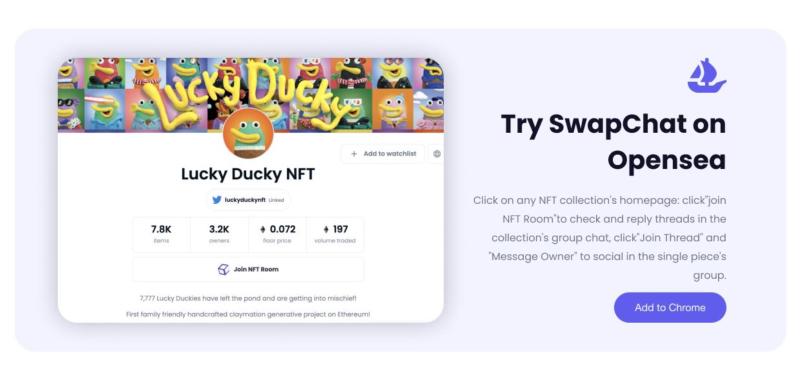
When Google first built Android, it also made a phone—to show how the OS should be used. SwapChat is a demo DApp for MQ (Message Queue); Web3MQ is the underlying communication protocol powering SwapChat.
Web3MQ is like Android; SwapChat is like Google’s phone—an app atop the platform. I want users to enter Web3 by installing the SwapChat Chrome extension.
In the future, more Web3 intelligence will materialize in concrete scenarios and deepen further. Right now, Web3 is in a collective-building phase. Having tens of thousands of users is considered strong in Web3, whereas in Web2, even apps with hundreds of thousands barely make waves—given six billion people globally. I want to co-build this space early with fellow builders. Be a pragmatic idealist—see what I believe in, and make it real.
For me, the first key milestone is ensuring 99% of message-sending activities happen within SwapChat. I dislike rankings like “first” or “second”—because comparison breeds homogenization and pushes founders toward copycatting. Horizontally speaking, SwapChat’s beta performance is currently the fastest in the industry. But I care more about empowering the industry than winning races.
Social also ties into the future metaverse. As the metaverse evolves, communication media itself may transform. We surely don’t want clunky, localized social experiences. Is there a newer, more exciting way to interact? I want to contribute to reimagining human connection in social communications. Of course, this requires collective effort—to accelerate the dynamic shift toward next-gen Web3 social paradigms. Being first would be nice, but it’s not the point. What matters most is creating the most meaningful value for everyone.
Closing Thoughts
There is no final destination in social. No single product can fulfill all needs.
Ma Huateng once said: “Whatever defeats WeChat won’t be another WeChat—it’ll be something more fun.” Imagination is the sky; tools are the foundation; between them lies human evolution. Innovations at the tool level push forward human connectivity. Humanity invented writing—unlocking new modes of interaction. Perhaps in the future, we won’t need language to understand each other perfectly.
The future fascinates because of imagination, thrives because of creation. The future is already here…
Join TechFlow official community to stay tuned
Telegram:https://t.me/TechFlowDaily
X (Twitter):https://x.com/TechFlowPost
X (Twitter) EN:https://x.com/BlockFlow_News






