








China's Dynastic Oddities and the Future Path of GameFi Economic Models
TechFlow Selected TechFlow Selected
China's Dynastic Oddities and the Future Path of GameFi Economic Models
The Future Path of GameFi's In-Game Economy Model – The Future is Bright, but the Road Ahead is Full of Challenges.
 Navigating Web3 tides with focused insights
By: Guatian from W Labs
This article is approximately 20,000 characters long and takes about 25 minutes to read.
(I) A Wild Researcher's View on Blockchain Gaming
Today I finally have the urge to start this new series. My teammates at W Labs kindly advised me: "Brother Guan, players rarely take seriously theoretical articles that forecast the future of the industry. Right now, everyone only wants to know which blockchain game is good, which one earns fast, when to jump in, and how to do it. At the very least, you could spend that time creating more 'one-page briefs' on trending blockchain game projects—those will always reach more players."
That advice makes sense. But as a stubborn, self-taught researcher in the blockchain gaming space, I've always ambitiously wanted to write about this topic. Recently, apart from conducting internal testing for a few games, I haven't played any blockchain games for over a month. It's bear market season—without the financial incentive to earn (Earn), I simply have no motivation to play any current blockchain game. They're just not fun. Honestly, they're not fun at all. I'd rather go back to Web2.0 and continue playing Romance of the Three Kingdoms Strategy Edition or PUBG.
So right off the bat, let me state my view clearly: The economic models of most current blockchain games are heading in the wrong direction—or perhaps they’re still in their infancy—leading inevitably to death spirals.
But I can’t just be an armchair critic forever, criticizing everything as bad or flawed, right? I actually have great confidence in the future prospects of blockchain gaming. Eventually, better economic models will emerge to support its continued evolution. In my previous long-form article, “Uncovering Blockchain Game Economic Models” (original link),
I proposed three possible ways blockchain games could escape the death spiral:
- Make blockchain games genuinely fun—so fun that crypto players are motivated to spend money just for the experience;
- Shift the current model, dominated by tokenomics, toward NFT-centric economics with stronger asset lock-in and lower liquidity;
- Expand the scope—for example, into metaverse scenarios—where blockchain games become just one component supported by other interconnected experiences within the broader metaverse ecosystem.
Over the past month, I’ve had many insightful conversations with brilliant peers, greatly enriching my understanding. Now, I’d like to expand upon those three points with additional ideas and share them with you—all while warmly welcoming fellow enthusiasts to join the discussion.
(II) Why GameFi 1.0’s Economic Model Inevitably Leads to Death Spirals
GameFi 1.0 blockchain games are built on the “play-to-earn” economic model—in other words, Axie Infinity clones and various modified versions, whether single-token or dual-token systems. As I stated in my previous article, such games will inevitably have shorter lifespans than similar mobile games, and death spirals are unavoidable.
When I first voiced this opinion months ago, many criticized me: “You don’t understand, stop spreading nonsense.”
I generally don’t argue:
- First, I still believe my view is likely correct;
- Second, people’s positions dictate their perspectives. If someone has invested their life savings, hearing that your model is doomed won’t make them happy. Their emotional reactions are understandable;
- Third, even if I explain it clearly, they won’t give me half a USDT. So why should I stress?
However, if you follow recent articles or media coverage, you’ll notice more authors are adopting this viewpoint. I’ve asked community members who share this opinion: Why do death spirals happen?
Most responses cite Ponzi schemes and fewer buyers during bear markets—valid points, but surface-level.
Instead, I want to use behavioral finance and build a simple model to dissect this phenomenon step by step.
2.1 Behavioral Finance
In GameFi 1.0 blockchain games, participants fall into four categories: investment institutions, project teams, veteran players, and new players. All four aim solely to profit—their food chain looks like this:
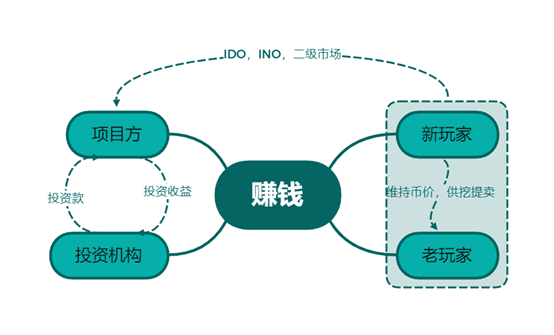
Project teams have the highest chance of profiting, extracting value from investors, veterans, and newcomers alike due to minimal information asymmetry.
Their biggest threat is the market—like today’s bear market, which wipes out everyone.
Investment institutions also stand a good chance of profit. As long as the project team gets rich, investors get scraps. After all, we operate in the same industry—if one project burns me, I won’t invest in your next one.
Win-win is ideal. If forced to compete, the project team usually cuts the investor—that’s the power of controlling the narrative and moving faster. There are cases where investors reverse-cut the project: “We agreed not to sell,” then dump everything anyway. What can you do? Sue me? I’ll countersue for defamation. That’s why some investors realize they should both invest and launch projects themselves—Animoca Brands being the prime example, eating the whole pie.
Players sit at the bottom of the food chain. Yet due to sheer numbers, survivorship bias ensures some achieve hundredfold returns—like last year’s Raca or this year’s StepN. These success stories keep crypto warriors charging forward.
Veteran players enter early, ambush promising projects, quickly recoup their investment through farming-and-dumping or trading, then reinvest the profits. The risk? Entering too late or exiting too slowly—or going all-in emotionally.
New players suffer most. They typically arrive post-launch hype, mainly boosting pool liquidity and propping up token prices so veterans can farm-and-dump. So if you joined after the initial surge, proceed with extreme caution.
From a behavioral finance perspective, if all four parties seek profit, who loses? Someone must lose—or at least, which group is most likely to? Clearly, it’s new players! All three others profit at their expense. This is why I constantly tell readers: Assess a project’s health using two metrics: new player growth rate and veteran retention. Veteran retention is harder to measure (Footprint, a blockchain analytics platform, offers a veteran retention table—feel free to explore). New player inflow data, however, is easier to obtain and forms the basis of our analysis below.
2.2 The Dialectic Between New and Veteran Players
Let me illustrate the challenges faced by new players joining after launch using a simplified model:
Assumptions:
A. Ah Qiang joins on Day 1; cumulative players before Day 0 total 100, increasing by 10 daily thereafter;
B. Per Section 2.1, assume all players seek short-term profit—farm, withdraw, sell—and veterans don’t reinvest;
C. Each player produces 5 TokenAs daily;
We derive the following table:
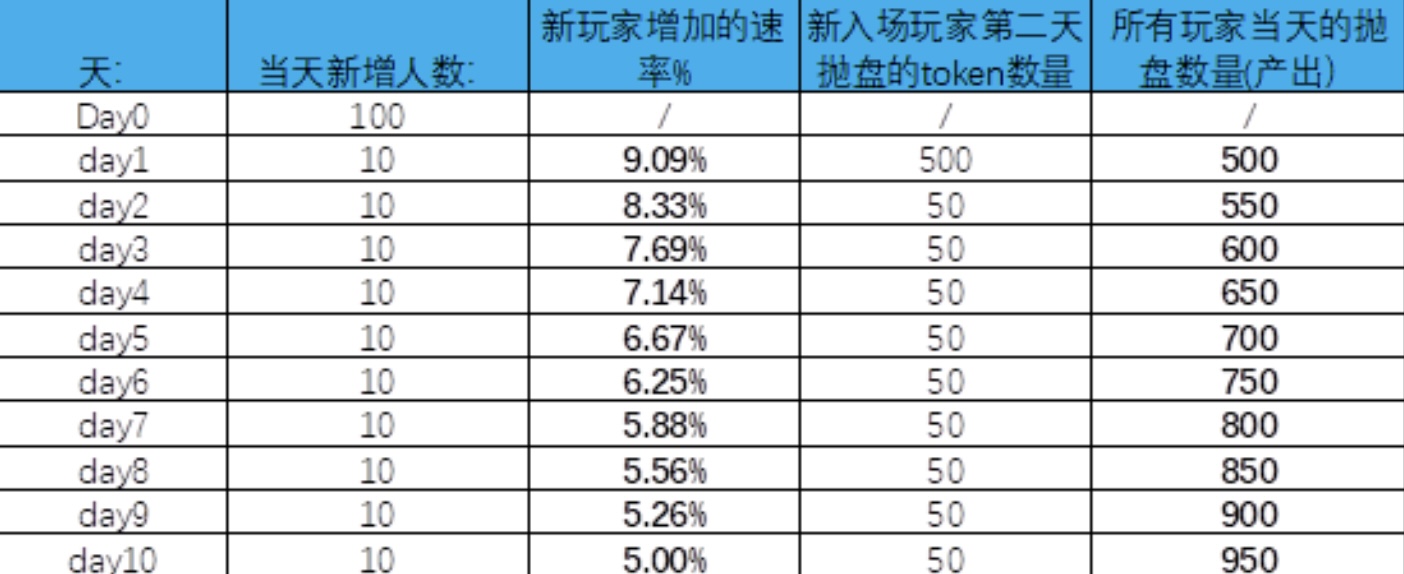
Careful analysis reveals several insights:
- Even with constant daily new-player growth, the growth rate declines;
- Daily consumption of TokenA by new players must balance daily farming-and-selling output. Only when consumption equals production does the TokenA price stabilize. However, the table shows output accumulates daily—yesterday’s newcomers join today’s farmers-and-sellers. This is the fundamental reason GameFi 1.0 models inevitably spiral downward: Yesterday’s comrades become today’s enemies. This enemy count grows daily, while new players don’t accumulate—they change roles overnight. Thus, cumulative output growth inherently exceeds new-player growth. Conclusion: Over time, output surpasses consumption, triggering the death spiral.
2.3 The Model: New Players vs. Net Output
Adding a consumption column to Table 2.1 yields a critical metric: Net Output = Output – Consumption. When net output exceeds zero, token price begins falling; when below zero, price may still rise. I’ve hand-drawn three rough graphs for analysis—ugly, I know, but please bear with me…
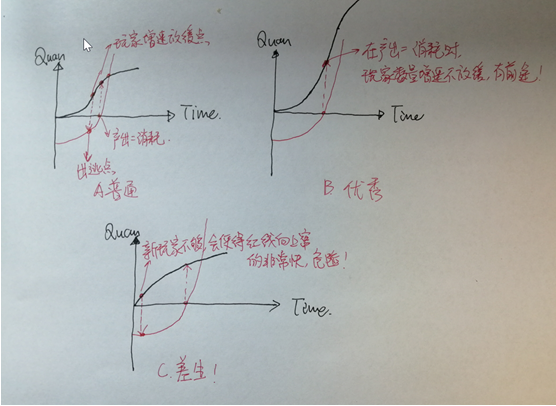
Can anyone help improve these ugly charts?
The horizontal axis represents time, vertical axis quantity. Curve slope indicates growth rate. The black line shows new player count; red line shows net output.
These charts intuitively show when new-player growth slows enough to signal exit timing.
- Chart A reflects most blockchain projects. When the red line crosses above the horizontal axis, net output hits zero, and price starts falling. By then, new-player growth has already slowed. Is this the ideal exit point? Probably too late. I suggest exiting earlier—when the black curve’s growth rate begins flattening.
- Chart B represents strong projects like StepN—new players grow rapidly, offsetting veterans’ farming-and-selling through fresh consumption. When net output reaches zero, if growth continues, it’s a solid performer—consider holding or slightly reducing position.
- Chart C depicts weak projects—new-player growth stalls even while net output remains negative (veterans still consuming tokens). Avoid these entirely—if already in, flee quickly.
Of course, this is just a simplified model. The full version has helped internal-test projects adjust output and consumption values—with promising results. Still, it’s largely my own tinkering—feel free to refine it.
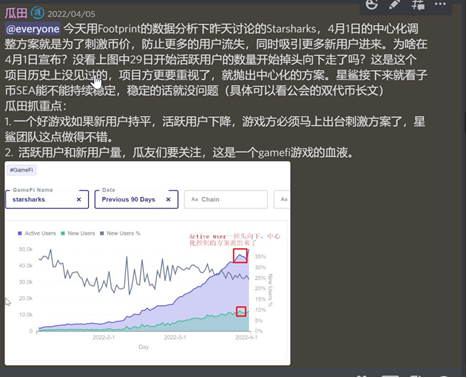
To summarize: Two metrics matter—new users and net output—especially crucial in bear markets. Monitoring them helps identify short-term opportunities, anticipate project actions, and profit accordingly. For instance, StarSharks and StepN saw 30%-100% short-term price swings last month when indicators shifted, prompting centralized adjustments.
(III) Why Did You Play Games Before Blockchain Gaming?
I’m a lifelong gamer—nearly thirty years. From early handheld Tetris, Windows Minesweeper and Spider Solitaire, PC RPGs like Sword Immortal Legend 1 and Romance of the Three Kingdoms: Heroes, to RTS titles like Red Alert, StarCraft, Heroes of Might and Magic III, then online games like World of Warcraft, PUBG, and Romance of the Three Kingdoms Strategy Edition. Games are truly enjoyable—they deliver intense satisfaction. Here are the key thrills:
-
Escape Reality: Experience a second life with greater control—just like everyone loves transmigration fantasy novels;
-
Massive Achievement: Through grinding or spending, become a top-tier leader whose every command rallies followers, earning reverence from fans and tears from rivals;
-
Gambling Appeals to Human Nature: When luck strikes on a gacha pull or underdog victory, dopamine floods the brain, delivering pure euphoria;
-
Social Features: Long-time gaming allies often become real-life friends—sharing chats and emotions beyond the game.
With so many thrills, what’s wrong with spending money? Do current blockchain games offer these? Mostly no. While gambling mechanics can be designed, the core focus remains earning. When you play solely to earn, you inevitably end up in the death spiral described earlier.
Therefore, to extend a blockchain game’s lifespan, the first breakthrough must be delivering non-monetary thrills—more the merrier! Foresight Research’s Alex recently wrote (“Thoughts on Healthy and Incentivized GameFi Economic Models”) advocating for non-monetary rewards in games—a kindred spirit. In my plain terms: non-monetary rewards mean all the fun aspects besides making money.
Future blockchain games incorporating more of these thrills stand a better chance of escaping death spirals.
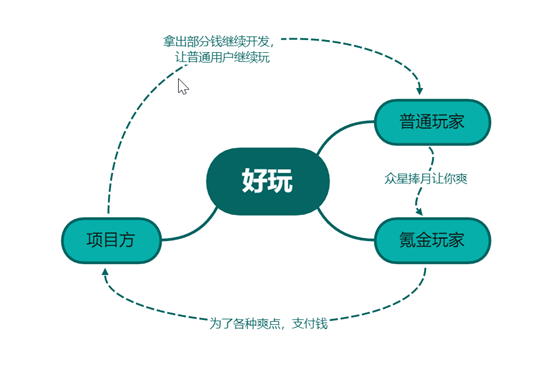
Consider why traditional top-tier games enjoy decade-long lifespans: Pay-to-win players find joy in gameplay, willingly spending on gacha pulls and in-game currency. Project teams retain part of this revenue and reinvest the rest into improving the game. Better games attract more casual players, whose presence further incentivizes spending—creating a self-sustaining cycle.
The entire model operates autonomously—perfect.
Let me cite StepN—recently discussed by everyone. Since launching last August, it now earns over $100 million monthly—an excellent product, though not yet legendary, as it still uses a modified Axie dual-token model destined for a death spiral.
But—it introduced a new thrill: health. Spending thousands of dollars on sneakers motivates running, promoting fitness. Beyond earning, this extra benefit—real or perceived—makes players feel healthier. That’s why StepN succeeded.
(IV) What Happens After Making Games Fun?
Recently, W Labs engaged with traditional game studios, helping them transition existing games into blockchain via internal testing. Unsurprisingly, products refined over 2–3 years far surpass current blockchain games in playability. Assuming a game becomes genuinely fun—delivering multiple thrills—how should it be operated to become a successful project?
Most teams respond: “Blockchain games attract players through earnings. Brother Guan, first design an economic model integrated with our existing game system. Phase one: Let blockchain players earn. Phase two: Use earnings to lure Web2 players—let them play and earn simultaneously.”
Sounds logical—but here’s the catch: Using “earn” as bait turns Web2 players into crypto traders, reverting to the old path. My suggested user-acquisition flow: Step one—design the game to be fun, attracting crypto players. Step two—offer a familiar entry path: download, register, play. Ignore wallets and deposits initially—let Web2 players jump in. Step three—curious why weaker players earn more? Because they bought skins or upgraded characters. Interested? Let me teach you about NFTs and wallets…
Players acquired this way become long-term, genuine blockchain gamers—not mere bounty hunters. Some projects are already trying this approach. Take BigTime, the AAA title promoted since last year. Its standout features:
1. No token issued yet—players earn NFTs;
2. Seamless Web2 onboarding—identical to traditional mobile games: just register. Later, if players wish to monetize, credit card purchases for NFTs are available.
I strongly recommend development teams confident in their game’s fun factor adopt this freemium, non-monetization-first entry path—especially if aiming to convert among the world’s 3 billion Web2 gamers.
Assuming a game now has a core group experiencing genuine thrills—its foundation—treat them well. Because paying whales reside here, they’re the internal drivers of in-game cash flow, enabling self-sustaining cycles. StepN’s success owes partly to internal factors: veteran reinvestment rates far exceed peers. Beyond high returns, the “StepN = Health” thrill genuinely motivates spending. I know many players—especially women—who buy shoes as gifts, encouraging friends and family to run.
The core base is vital. When advising blockchain game teams on modeling, W Labs consistently recommends shifting from “veterans cutting newcomers” to rewarding loyal players—this core base—from revenue earned from paying users. Mechanisms include DAO treasuries distributing rewards to VeToken holders or players with sufficient interaction history.
Once a game delivers fun, protects its base, cultivates payers, and achieves self-circulating cash flow, its lifespan already surpasses pure Play-to-Earn models. But human nature craves novelty—thrills fade over time, new players dwindle, payers stop spending. Then what?
Proactively seek external stimuli to sustain cash flow—something traditional games struggle with, confined behind screens. But Web3 games have the metaverse—imagination unlocked?
Take SNKRZ (see W Labs’ ongoing research series “Move-to-Earn Project Analysis,” Part One: SNKRZ and 5KM)—a StepN clone adding interesting PVE missions for corporate collaboration.
Imagine setting a running route where a sponsor’s billboards dominate visibility—great advertising. Or partnering with Starbucks, designating five stores as checkpoint locations. As runners pass a store, the app plays a voice message: “Congratulations on completing checkpoint two! Keep going! Starbucks cheers you on!” With massive annual marketing budgets, wouldn’t Starbucks gladly pay the project for such exposure? Whether SNKRZ’s team can execute this remains questionable.
Thus, I believe proactive external integration is essential—before internal payer enthusiasm wanes, expand external business development. I suspect StepN’s recent setback stems not just from economic inevitability but insufficient external progress. Its fundamentals are strong—high reinvestment rates internally. Had it accelerated partnerships with athletic brands, could that have offered hope? Hoping StepN achieves rebirth.
In summary: To extend a blockchain game’s lifecycle, prioritize making it fun. When players experience diverse thrills, internal payers willingly spend, and external partners inject cash flow—enabling self-sustaining economies. Key design elements: 1. Seamless Web2 onboarding; 2. Protect the core base, reward loyalty; 3. Proactively integrate external factors.
(V) Nesting Dolls Deep, Iron Rods Become Needles
Last section argued for making games fun—leveraging internal thrills to drive spending and extend lifespans. But how to implement this practically? For individual blockchain projects, create internal loops: stack nesting dolls, extending token circulation cycles. With sufficient fun, many players will happily engage with these layers.
The term “nesting dolls” originated in DeFi—staking 100 TokenA to earn 50 TokenB, then staking 50 TokenB to earn 25 TokenA, looping to maximize original asset utility—common in DeFi’s initial dual-stablecoin farms.
In GameFi, I define two nesting directions: “Upward nesting” manipulates tokens and NFTs; “downward nesting” expands in-game scenes and instances.
Let me use Illuvium—the AAA game selling 20,000 plots on June 2nd—to illustrate.
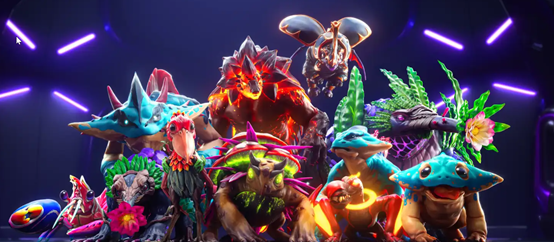
Illuvium launched its ILV token in March last year, riding the GameFi wave from tens to $2,000—despite lacking applications. Solution? Create one: a simple staking-mining scene—stake ILV to earn Silv2. Players encouraged to lock assets (non-withdrawable), receiving Silv2 as interest, with principal intact. Early withdrawal? ILV burned, converted entirely to Silv2.
The key is offering substantial benefits—making Silv2 valuable. Illuvium fulfilled this promise during land sales—buyable with ETH or Silv2—helping 2021’s peak-holders psychologically break even. Side note: Illuvium’s land sale briefly offered ~30% arbitrage—community members profited handsomely—a rare bear-market earning opportunity.
This is the simplest “upward nesting.” Current GameFi models can integrate various DeFi mechanisms—Ve(3,3), Bonding, etc. Recently, K shared an article “Is Token Staking Truly Suitable for GameFi?” summarizing our core insight: Each added layer creates another reservoir, deterring simple farm-and-dump behavior. Ideally paired with gameplay involving strategy—otherwise, it’s merely an extra calculation in the data model. Strategy plus randomness enhances effectiveness.
Now, the more important “downward nesting”: Add game scenes—introduce different genres (SLG, RPG, MOBA) under one theme—vertical nesting; increase instance diversity, expanding narratively—horizontal nesting. Continuing with Illuvium’s “vertical nesting” example, it currently features three scenes:
Scene One: Purchased land enables management games—build structures, deploy miners, farm crops—producing sub-token Fuel. In 2021’s GameFi 1.0, this ends here—either reinvest Fuel to upgrade land or farm-and-dump;
Scene Two: Developers added a layer—a sandbox RPG world where Fuel consumes to battle and capture monsters. This layer could end here—sell monster NFTs on marketplace;
Scene Three: Another layer—an arena where captured monsters form teams competing auto-chess style, earning token rewards upon victory.
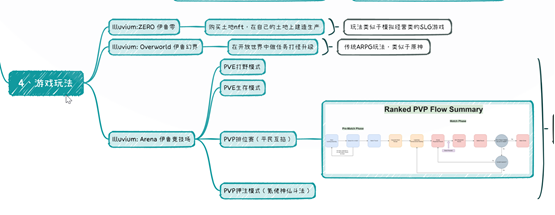
W Labs One-Page Brief
As long as the game is sufficiently fun, “vertical nesting” can theoretically continue infinitely. If layered logically and thrillingly, players may consume tokens across layers, reducing sell pressure. This multi-scene concept isn’t new—remember 3DO’s Heroes of Might and Magic III: The Shadow of Death? An eternal masterpiece seamlessly combining open-world RPG resource gathering with turn-based SLG combat. Blockchain games simply interconnect these scenes via tokens.
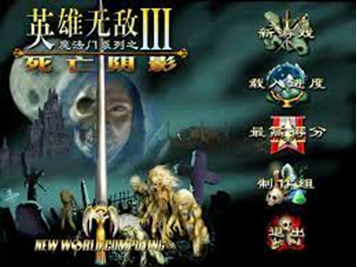
Heroes of Might and Magic—carrying memories for decades
“Horizontal nesting” works too. Imagine my fictional “Condor Heroes” game: After conquering the “Quanzhen Sect” instance, solo-defeating the Seven Masters, you earn a Condor token. A prompt appears: “Congratulations! You ranked top 10% this week. Spend 10 Condor tokens to obtain the ‘Yang Guo’ NFT and access the secret ‘Ancient Tomb’ instance!” Completing this unlocks an ultra-rare “Xiaolongnü” NFT!
Such “horizontal nesting” can extend infinitely—provided it stays fun. For example, merging Yang Guo and Xiaolongnü NFTs destroys both, yielding “Heavenly Sword and Dragon Saber” tool NFTs—unlocking the “Demon Lord” instance. Design possibilities multiply endlessly.
Summarizing nesting mechanics—extending a single blockchain game’s token circulation: “Upward nesting” learns from DeFi, slowing token and NFT velocity; “downward nesting” enriches content—vertical adds varied gameplay/scenes attracting diverse player types (maintain thematic consistency—no mixing Guan Yu with Qin Shi Huang); horizontal adds story-driven side quests, appealing to lore-obsessed players—ideal for instance formats.
Nest well, and players’ tokens gradually vanish—truly “nest deep, iron rods become needles.”
(VI) Metaverse Synergy Through Alliance
Previous section showed how internal “nesting” extends game lifespans—the current highest-ROI economic model fix. In my view, nesting remains at the “technique” level. Is there a higher “philosophy” solution? Consider metaverse scenarios and NFT-centric models.
Since Facebook rebranded to Meta in 2021, the metaverse concept captivated imaginations—suggesting a near-future blend of real and virtual worlds. Not a metaverse expert, I won’t dive deep. But analyzing GameFi economics, metaverse scenarios clearly optimize beyond project nesting: They extend internal nesting externally—enabling cross-project alliances, forming symbiotic networks—thus extending individual project lifespans through mutual support.
Recall movie scenes: a caravan traverses icy cliffs, roped together—preventing falls. Even if one slips, the combined strength of ten holds them.
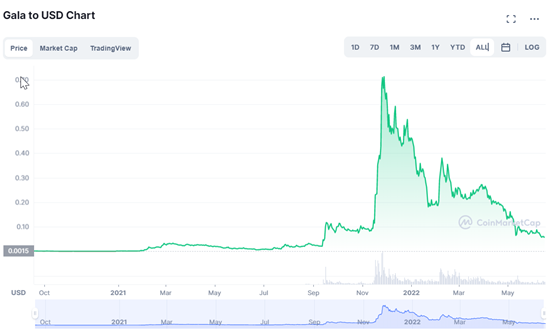
Same in metaverse logic—let’s revisit examples. Gala, hailed as “the Steam of blockchain gaming,” draws confidence from two pillars:
- First, Gala tokens empower all games—e.g., purchasing NFTs;
- Second, all games’ NFTs are interoperable on the platform (though I remain skeptical—how would external partner games accept Gala’s NFTs?)
Thus, we deduce:
- As long as new games join the Gala platform, Gala tokens retain utility;
- As long as the Gala platform exists, individual games’ NFTs maintain permanent value—even if their native tokens perish. NFTs persist across games on the platform, valued by player consensus.
Gala’s design is idealistic. Real-world Gala token performance hasn’t been as resilient as hoped, but it survives—while many standalone games vanished. Town Star and Spider Tank offer decent playability, unfortunately hampered by slow development. Perhaps the founding team already made fortunes during 2021’s GameFi boom—why work hard now? Understandable human nature.
Another example: StepN, during turbulent times, launched a private-server-like initiative—inviting StepN clone developers and entrepreneurs building upstream/downstream services to leverage its 700K DAU. But—your project must use GMT tokens, sharing GMT’s sell pressure. Together, let’s build the metaverse, each gaining needed resources.
Another case: Axie recently announced integrating twelve new games—dubbed “Vietnamese Thirteen Spices, Lobster Chain.” Can these thirteen games mutually support? Yet I remain skeptical—teaming with incompetent partners could backfire (picture Germany and Italy in WWII…)
(VII) Metaverse Game Classification and NFT-Centric Economic Models
Having explained metaverse benefits for GameFi economics, how to implement them? Currently, no fully successful metaverse blockchain game economic model exists. Our lab explores several approaches—one gaining significant traction: Transitioning from “tokenomics-dominated” to “NFT-centric” models, because NFTs possess strong asset stickiness, low liquidity, and high customizability.
Starting with classification—metaverse project NFTs broadly fall into three categories:
- PFP (Profile Picture) NFTs—represent community consensus and avatar identity. In many projects, players use these PFPs as metaverse access passes—a potential issue discussed later;
- Land NFTs—represent players’ in-game home bases, easily establishing consensus on “in-game value preservation”—paralleling urban middle-class wealth concentration in real estate;
- Item NFTs—akin to “clothing, food, transportation”—consumables. Wealthy players buy; others save until able.
Currently, the most prominent NFTs are PFPs—BAYC, Azuki—because metaverse gaming hasn’t taken off, leaving social expansion via avatars as the primary function—you have a monkey, I have a bean—nice to meet you, fellow elite. Maslow’s first need—“recognition”—fully satisfied. Yet regarding metaverse customizability, land NFTs surpass PFPs—enabling infinite enhancements: design, planning, advertising, architecture, functionality—countless creative possibilities. Hence, my metaverse economic model primarily centers on land NFTs.
Further subdividing land NFT projects—developers fall into three types:
Type 1: Masters of Timing (“Heaven’s Timing”)
Examples: Decentraland and Sandbox—early entrants backed by major investors (Grayscale and Animoca), profiting immensely during 2021’s bull market—Sandbox’s land sales went viral.
Masters of timing act like gods arbitrarily marking territory—shouting “It will rise! Buy it!”—followers rush in. An imperfect analogy: Shenzhen during China’s reform era—special policies first, then explosive growth after Deng Xiaoping’s southern tour. From fishing village to metropolis—land value skyrocketing. But post-2022, do Decentraland and Sandbox’s backers still wield “godlike” influence?
Type 2: Masters of Location (“Earth’s Advantage”)
Real estate’s golden rule: “Location, location, location”—Li Ka-shing’s famous quote. Location depends on landmarks—Beijing’s CBD, Shanghai’s Oriental Pearl, NYC’s Central Park—adjacent lands command premium prices.
What defines metaverse landmarks? High-playability, crowd-attracting, thrill-delivering projects. Having one or two such projects grants “location advantage”—players confidently buy virtual land, knowing it’s relatively more valuable than other metaverses.
Blockchain games are prime candidates for metaverse “location advantage”—naturally attracting Web2 gamers. Web3 enables decentralized asset storage. As long as games are fun and easy to join, Web2 migration is inevitable. I predict the first truly successful metaverse project will center on a massively popular game.
No official “location advantage” case yet—BNB Chain’s Ultiverse worth watching. Hope its first game, Endless Loop, becomes the flagship driving Ultiverse’s metaverse.
Type 3: Masters of Harmony (“Human Unity”)
Clear example: Yuga Labs building the Bored Ape metaverse. Leveraging NFT dominance to enter the metaverse race—launched token and sold land months ago, developing Otherside game. Key trait: naturally attracts massive player traffic—comparable to possessing the real-world “Wenzhou property investor group.” Such teams have people and resources—currently holding strongest advantages among land-sale projects.
Thus, “harmony” projects most likely succeed short-term—talent being crypto’s top productivity; “location” projects depend on game quality—fun games attract crowds; “timing” projects face uncertain futures unless continuously nurtured by major players.
Returning to metaverse economic model design—I advocate centering on land NFTs. Beyond land NFTs’ high customizability, PFP NFTs as passcards create dilemmas. Centering models on them causes prices to soar—blocking new players, eventually killing the metaverse. I suspect Yuga Labs, if building a metaverse, won’t use Bored Apes as tickets—too niche an audience.
Join TechFlow official community to stay tuned Telegram:https://t.me/TechFlowDaily X (Twitter):https://x.com/TechFlowPost X (Twitter) EN:https://x.com/BlockFlow_News
 瓜田实验室W Labs






