








UNI Token's Second Wind: What Happens When Uniswap Flips the Fee Switch?
TechFlow Selected TechFlow Selected
UNI Token's Second Wind: What Happens When Uniswap Flips the Fee Switch?
By far, the most mismatched example between a protocol's success and its token performance is Uniswap.
 Navigating Web3 tides with focused insights
Written by: Ben Giove
Translated by: TechFlow
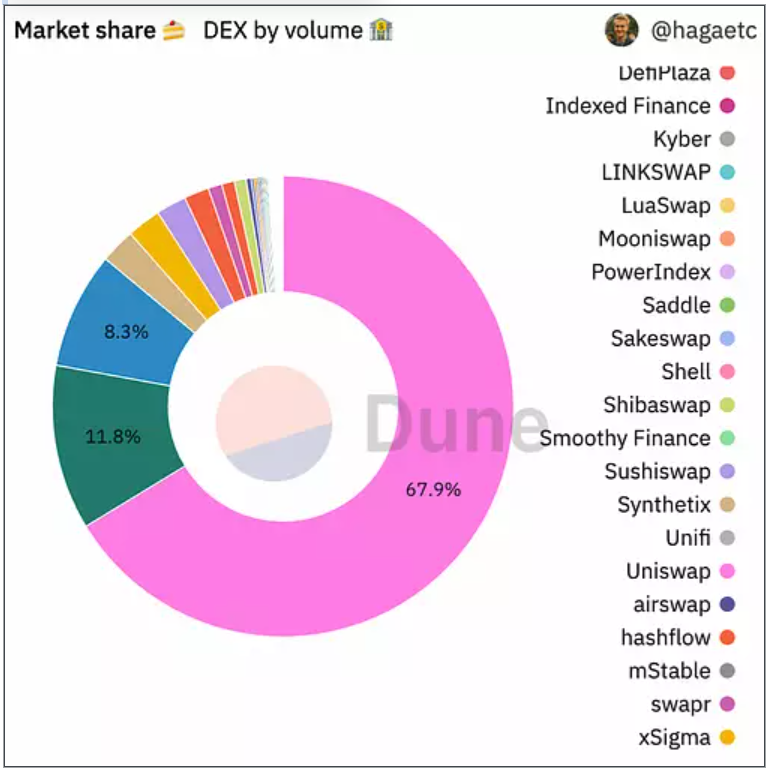
So far, the most mismatched example between a protocol’s success and its token performance is Uniswap. Uniswap is the largest decentralized exchange on Ethereum L1, holding 67.9% market share. The protocol is a cash cow, generating $1.2 billion in revenue for LPs over the past year. On certain days, its daily fee revenue has even exceeded that of Ethereum itself.
Despite this dominance, UNI has performed quite poorly, losing 51% of its value against ETH over the past year. While market volatility certainly plays a role, the prevailing belief is that UNI's underperformance stems from Uniswap’s long-standing decision not to flip the “protocol fee switch.”
By activating the fee switch—only possible through a governance vote by UNI holders—the Uniswap DAO could capture 10–25% of the fees earned by LPs, on a per-pool basis.
This is how the Uniswap protocol itself could be monetized.
Since the launch of Uniswap V3 in May 2021, the fee switch has remained inactive. However, that may soon change, as a proposal by PoolTogether founder Leighton Cusack to activate the fee switch for three pools has passed the first two stages of Uniswap’s governance process.
The implications of this proposal are significant: if it passes, it will signal to the market that Uniswap governance is capable of turning on the fee switch.
Several key questions arise:
- Can Uniswap turn on the fee switch without losing market share?
- How much revenue could the protocol generate from this proposal?
- How much could it earn by activating the fee switch across all pools?
- What might this mean for the UNI token?
Let’s explore.
Proposal Status
Before diving deeper, let’s examine the details of the fee switch proposal itself.
The proposal suggests charging 10% of LP fees from three pools on Uniswap’s Ethereum deployment—the minimum rate possible, as the protocol allows fee collection between 10–25% per pool. The selected pools and their fee tiers are:
- ETH-DAI (0.05%)
- ETH-USDT (0.30%)
- ETH-USDC (1%)
The fee switch would be activated for 120 days (approximately four months), with collected fees going into the Uniswap DAO treasury. After this period, another proposal would be submitted to governance, allowing token holders to vote on whether to disable the fee switch for these three pools.
To date, the proposal has passed the first two stages of Uniswap governance: Temperature and Consensus, both conducted via Snapshot votes.
During the Temperature phase, the initial draft requested activation of the fee switch for ETH/USDC (0.05%) and USDC/USDT (0.01%), with a 10% protocol fee.
That proposal received near-unanimous support, with 3.5 million UNI voting in favor and only 54 UNI opposed.
After community feedback and research, a revised version of the fee switch proposal was submitted for a Consensus check vote. Unlike the first, this iteration proposed activating the fee switch across the three aforementioned pools to test multiple fee tiers over a defined period.
This updated proposal again passed overwhelmingly, with 19 million UNI in favor and only 418 UNI opposed.
Although the proposal must still undergo a final, binding on-chain vote, it appears to have broad community support. While the final vote likely won’t be as lopsided, there’s a strong chance Uniswap will activate the fee switch for these three pools.
Will Uniswap Lose Market Share?
Before analyzing further, let’s consider why Uniswap might activate the fee switch without losing substantial market share.
The argument against flipping the switch is straightforward: if Uniswap turns on the fee switch, it risks losing market share, as LPs—liquidity providers—may migrate away due to compressed profits.
This risk is amplified by the fact that providing liquidity on Uniswap V3 is notoriously difficult, due to concentrated liquidity, which requires more active management from LPs acting as constant product or stablecoin swap AMMs.
Given that profitability is already challenging, cutting LP earnings could trigger a negative feedback loop: reduced liquidity leads to worse trade execution, which lowers trading volume and LP returns, ultimately driving DEX market share to competitors.
This risk is magnified in the highly competitive DEX landscape, where differentiation among rivals is minimal, leading to persistent downward pressure on fees. DEXs are also easily forkable—although notably, Uniswap V3’s code is protected by a business license, which may explain the scarcity of unauthorized forks so far.
While this argument is compelling, Uniswap should still be able to turn on the fee switch for several reasons, the most notable being the concept of “sticky volume and liquidity”, as described in “The Economics of Automated Market Makers.”
This idea rests on the notion that a significant portion of volume and liquidity is fully loyal to Uniswap. Due to its strong brand, many traders may exclusively use Uniswap rather than routing all trades through aggregators to seek optimal execution. The same applies to liquidity providers, who may prefer to continue market-making on Uniswap despite protocol fees, given its proven track record and immutable contract design (aside from the fee switch), rather than migrating to competitors or forks.
Moreover, almost every other major spot or derivatives DEX—including Curve, Balancer, SushiSwap, GMX, dYdX, and Perpetual Protocol—takes a cut of LP fees. Given this precedent, Uniswap appears well-positioned to collect fees without losing a significant portion of market share.
What If the Fee Switch Is Activated for These Three Pools?
Now let’s analyze how much revenue Uniswap could generate if the 10% protocol fee were activated for the three pools outlined in the proposal. To understand revenue potential under varying market conditions, we’ll examine fees accrued over the past 30 days, 120 days (the proposed activation period), and 365 days. We’ll also assess what share of Uniswap’s total volume and LP fees originated from these three pools during these periods.
30 Days

Over the past 30 days, these three pools generated $1.31 billion in trading volume, with LPs earning approximately $2.9 million in fees. If the fee switch had been active, Uniswap would have earned $290,000 in protocol revenue over the past month—annualizing to roughly $3.48 million.

The largest contributor was the wETH-USDT pool, which accounted for 74.4% of protocol revenue. Together, these three pools represented 3.08% of Uniswap’s total trading volume and 5.71% of total LP fees during this period.
120 Days

Over the past 120 days—the proposed duration for fee switch activation—these three pools facilitated approximately $6.41 billion in trading volume, generating $16.04 million in LP fees. With a 10% protocol fee, this would translate to $1.6 million in protocol revenue, or an annualized $4.87 million.

Once again, the wETH-USDT pool contributed the most to protocol revenue, at 81.7%. Collectively, these three pools accounted for 3.32% of Uniswap’s total volume and 6.68% of total LP fees during this period.
365 Days

Over the past year, amid fluctuating levels of on-chain trading activity, these three pools accumulated $40.4 billion in trading volume, with LPs earning $78.19 million in fees.
With a 10% protocol fee, Uniswap would have earned $7.82 million in revenue.

The wETH-USDT pool remained the top contributor, accounting for 80.8% of protocol revenue. Overall, these three pools represented 5.69% of Uniswap’s total trading volume and 6.47% of total LP fees over the past year.
Conclusion
We can see that, across different timeframes, activating the fee switch for these three pools would generate annualized protocol profits ranging from $3.48 million to $7.82 million.
We also observe that the wETH-USDT pool consistently contributes the most, accounting for 74.5%–81.7% of protocol revenue.
Most importantly, these three pools represent only a small fraction of Uniswap’s overall activity, contributing just 3.08%–5.69% of total volume and 5.71%–6.68% of total fees across different periods.
In sum, this suggests the proposal merely scratches the surface of Uniswap’s monetization potential. If the fee switch trial proves successful, it signals substantial room for the DAO to expand and capture additional revenue streams.
What If the Fee Switch Were Activated for Every Pool?
Now that we’ve assessed Uniswap’s revenue potential with the fee switch turned on for just three pools, what about activating it for every single liquidity pool?
By calculating this scenario, we can better understand the upper bounds of Uniswap’s potential profitability.
At first glance, activating the fee switch across all pools may seem unrealistic. However, if the trial succeeds, Uniswap governance may choose to extend the fee switch to more pools. Moreover, recall that DEXs taking a cut from every transaction on their platform is standard industry practice.
In a mature state, the protocol’s overall take rate—the percentage of total trading fees on Uniswap that go to the DAO—is unlikely to be a uniform rate across all pools. Individually scarce liquidity pools might have higher take rates, while others may remain without an active fee switch altogether.
For simplicity, however, we’ll assume a uniform 10% fee across all pools. For comparison, we’ll again measure revenue over the same 30-day, 120-day, and 365-day periods.

With a 10% protocol fee, Uniswap would have earned $5.07 million (annualized ~$61.68 million), $23.99 million (annualized ~$72.96 million), and $120.8 million over the past 30 days, 120 days, and 365 days, respectively.
Notably, this would represent pure protocol “profit,” as Uniswap did not distribute any tokens to liquidity providers during these periods.
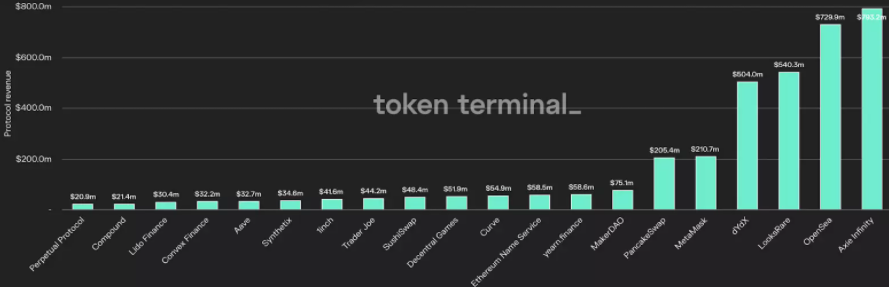
Looking at the 365-day data, according to Token Terminal, Uniswap would rank seventh among all dApps in protocol revenue, behind Axie Infinity, NFT marketplaces like OpenSea and LooksRare, DEXs PancakeSwap and dYdX, and MetaMask’s swap functionality.
Uniswap would rank third in protocol income (protocol income minus emissions), behind only OpenSea and MetaMask—both of which benefit from having no token emissions.
Productive UNI Tokens
Now that we’ve explored how much Uniswap could earn by activating the fee switch, let’s consider how much value this could bring to the UNI token.
While the current fee switch proposal does not require distributing proceeds to token holders, future governance decisions could allow UNI holders to allocate a portion of protocol fees—via buybacks or direct distributions of ETH, stablecoins, etc.
This would be transformative, turning UNI from a purely “valueless governance token” into a productive asset.
For our analysis, let’s assume the Uniswap DAO chooses a mechanism to distribute 50% of all revenue generated from the fee switch to UNI holders, who can stake their tokens to earn USDT income.
Conservatively, we’ll also assume that 75% of all circulating UNI will be staked to earn this yield, as some supply remains on centralized exchanges or is used as liquidity on DEXs.
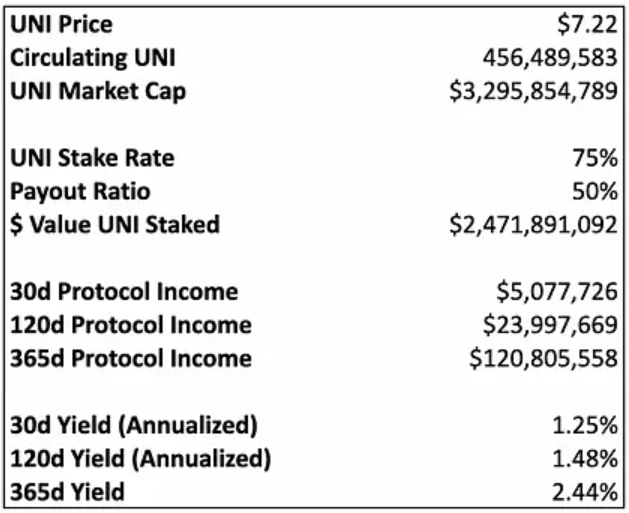
As we can see, if Uniswap activates the fee switch at a 10% rate across all pools, and assuming the same 75% staking rate and 50% payout ratio, UNI holders would earn yields between 1.25% and 2.44%, based on trading activity over the past 30, 120, and 365 days.
While this yield is lower than other DEX tokens like veCRV and GMX—which typically pay 4–8% yields in 3CRV and ETH, respectively—the return may still be highly attractive to investors given Uniswap’s dominant position in the space.
The Bigger Vision
Thus, the impact of flipping Uniswap’s fee switch is profound.
Activating the switch for just three pools barely scratches the surface of its monetization potential. A protocol with such a solid foundation, once it flips the fee switch, instantly becomes one of the most profitable applications in Web3.
Furthermore, if the DAO channels part of the revenue back to token holders, the UNI token becomes a productive asset—offering yields at the lower end among DeFi peers, yet still surpassing many established real-world enterprises.
Of course, these figures are speculative—they rely on historical data and do not account for any potential (and expected) future growth.
Perhaps more importantly, given its status as the most recognized protocol in DeFi, Uniswap successfully flipping the fee switch would send a powerful market signal: “valueless governance tokens” can, in fact, become valuable.
Join TechFlow official community to stay tuned
Telegram:https://t.me/TechFlowDaily
X (Twitter):https://x.com/TechFlowPost
X (Twitter) EN:https://x.com/BlockFlow_News






