SudoSwap: An Overview of the NFT AMM Protocol's Operating Model
TechFlow Selected TechFlow Selected
SudoSwap: An Overview of the NFT AMM Protocol's Operating Model
SudoSwap, an NFT exchange known for peer-to-peer, zero-fee swaps, has recently launched its AMM (Automated Market Maker) for NFTs.
 Navigating Web3 tides with focused insights
Written by: bHeau
Translated by: TechFlow intern
Introduction
SudoSwap is an NFT exchange known for peer-to-peer, zero-fee swaps, and has recently launched its AMM (Automated Market Maker) for NFTs. This has generated significant hype but also considerable confusion, prompting questions like “So why isn’t this just another NFT marketplace?” The goal of this article is to help clarify that confusion.
Before we begin, here are reasons you should care about the SudoSwap AMM model:
-
Instant liquidity for buying/selling;
-
Fully on-chain (no centralized order book);
-
Sometimes cheaper prices;
-
Only 0.5% market fee;
-
No royalties (this point is somewhat controversial);
-
Growing popularity;
-
You may have already heard about it on Twitter;
-
According to Dune data, total trading volume exceeds 5k ETH;
-
Ability to earn trading fees;
-
Capability for automatic DCA into/out of collections;
NFT Exchanges: Order Book vs. AMM
Most NFT marketplaces you're likely familiar with—such as OpenSea and LooksRare—rely on off-chain order books to enable efficient trading. To help you understand what this means, let’s walk through an example:
-
You want to sell a Bored Ape (BAYC) for 100 ETH, so you list it on a marketplace like OpenSea.
-
OpenSea lets you sign a message with your wallet indicating your intent to sell the BAYC at 100 ETH.
-
Your signed order is stored in an off-chain order book hosted by the exchange in a database, displayed on their interface (and publicly accessible via their API) for potential buyers to browse.
-
Your order remains there until it's purchased or you decide to cancel it.
This model has one advantage: users don’t need to pay gas (after initially approving the exchange contract to move their NFT) to list or bid on NFTs—gas is only paid upon execution.
The drawbacks are: a) the exchange hosts the entire order book off-chain, which can make accessing all orders more difficult—developers’ struggles obtaining OpenSea API keys serve as proof; b) all pricing must be "active"; you can't specify rules like "if my first NFT sells for 1 ETH, then try selling the next at 1.3 ETH." On an order book-based exchange, your listings must be manually adjusted (unless you trust the exchange enough to give them your private key so they can cancel/sign new orders on your behalf).
In contrast, SudoSwap takes a completely different approach by using an on-chain AMM model instead of an off-chain order book. Let’s revisit the earlier example—selling a BAYC for 100 ETH—but now using an AMM instead of an order book:
-
You want to sell a BAYC via AMM for 100 ETH, so you go to SudoSwap.
-
SudoSwap allows you to deposit your NFT into a pool managed by a smart contract and set your desired sale price.
-
The contract for your pool can be queried to retrieve the NFT price.
-
Your NFT stays there until it’s bought or you choose to remove it:
-
Purchase: Someone comes to SudoSwap wanting to buy your BAYC. They submit a transaction to purchase it, removing it from the pool and sending you 100 ETH (minus a 0.5% market fee, but no royalty).
-
Cancellation: You withdraw your NFT from the pool.
While the AMM model requires you to pay gas to list your NFT, everything is on-chain and publicly queryable. Overall, these two models seem quite similar so far. However, the AMM-based model enables some interesting capabilities not possible with order books. To understand how, let’s dive into how SudoSwap works.
SudoSwap’s Architecture
If you're familiar with Uniswap V2, SudoSwap’s NFT AMM can roughly be thought of as “Uniswap V2, but with multiple custom liquidity pools per token,” where token = NFT, and custom liquidity pools = optional different pricing curves and spot prices. Given the non-fungibility of NFTs compared to ERC20s, these differences make sense.
If that didn’t click, let me try explaining it more simply, focusing on how a single NFT collection operates on SudoSwap. I’ll use Based Ghouls as an example. When you pull up the "Based Ghouls" page on SudoSwap, you see the following:
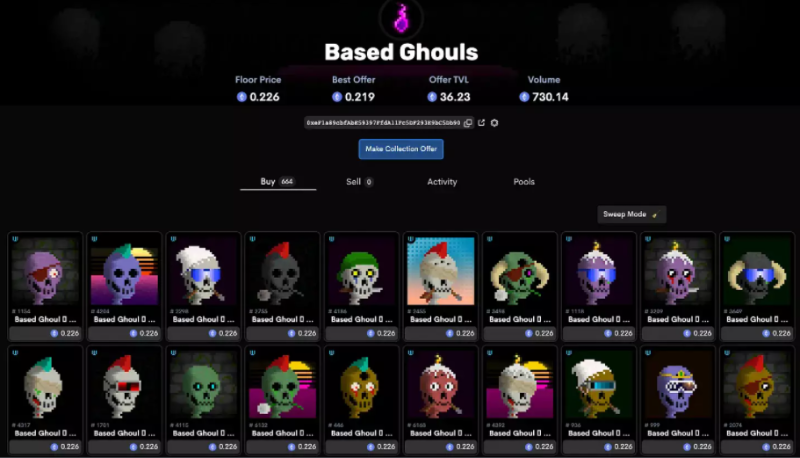
What do the above four metrics mean?
-
"Floor Price" is the cheapest price (0.226 ETH) at which you can buy.
-
"Best Offer" is 0.219, meaning you can immediately sell on SudoSwap for 0.219 ETH.
-
"Offer TVL" means 36.23 ETH worth of liquidity is available in SudoSwap pools for Based Ghouls offers.
-
"Volume" is the total ETH trading volume for Based Ghouls on SudoSwap to date.
Now, when you look at floor-priced NFTs, the difference between this AMM model and the order book model becomes apparent. At the time of writing, 21 Based Ghouls are listed at 0.226 ETH. This contrasts sharply with OpenSea or LooksRare, where typically only 1–3 similar NFTs are listed at floor price.
The reason for this pricing: NFT buys and sells on SudoSwap are executed through liquidity pools. Most of these floor-priced assets likely reside in the same liquidity pool, with prices dynamically adjusting as NFTs are bought (so you currently couldn’t buy all 21 floor-priced NFTs at 0.226 ETH).
But I’m getting ahead of myself. Let’s illustrate the full concept of a "pool" through an example. There are three types of liquidity pools on SudoSwap—"Token," "NFT," and "Trade." Let’s start with the "NFT" pool. This type can be used to sell one or more NFTs from a collection. I don’t own a Based Ghoul, but I do own a Tubby Cat, so when I tried creating an NFT sales pool for my Tubby Cat, I got the following result:
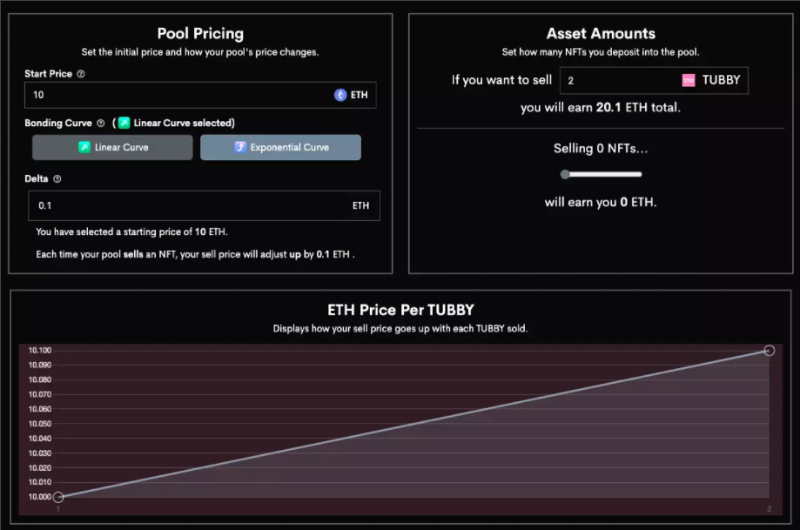
I configured my pool to sell my first NFT at 10 ETH ("Starting Price" = 10 ETH), and each subsequent sale increases the price by 0.1 ETH ("Delta" = 0.1 ETH). This means if someone buys my first Tubby Cat NFT, they pay me 10 ETH. If they want a second, they pay 10.1 ETH—the price updates with each NFT sold, as mentioned earlier. You could also set your Delta to "-0.5" or another value, selling your second NFT at 9.5 ETH, depending on how you structure your pool.
Each NFT collection can (and will) have multiple pools. This makes sense when considering that different users may want different pricing based on their NFT holdings.
Now, you probably have some questions. Here are a few Q&As that should help clarify things:
-
What if I want to sell all my NFTs at the same price? Set your Delta to 0, and they can all be bought at your pool’s starting price.
-
What if I own a rare NFT? How can I ensure I sell it above floor price? Create a separate pool for your rare NFT and set the starting price higher than the floor.
-
How do people know to buy from my pool? That’s an excellent question. SudoSwap’s smart contracts won’t automatically route transactions to your pool as the cheapest option. Instead, people buy from your pool in two ways:
-
They specifically want your NFT, which is only available from your pool, so they must buy from you.
-
They’re “floor sweeping”—buying the 10 cheapest NFTs at once—and your pricing fits within those 10 cheapest. In that case, SudoSwap (or aggregators) will know because they track all pool pricing to offer users the best deals and route part of the transaction to your pool.
-
What if I want to buy NFTs, not just sell? You can create a pool to buy NFTs (called a "Token" pool) funded with ETH. You set the purchase price and the Delta to adjust your bid after each trade. For example, you might offer 5 ETH for your first purchase, and with a Delta of -1, the next would be at 4 ETH—very similar to setting up an NFT selling pool.
-
I thought I could instantly sell NFTs on SudoSwap? Yes, by selling your NFT into the "buy NFT pool" offering the best bid price ("Token" pool). This also explains the role of collection offers; to place a 0.2 ETH offer, simply create a pool with 0.2 ETH and specify “I will buy any NFT from this collection at 0.2 ETH.” Then someone can come and sell their NFT to your pool at 0.2 ETH, giving you the NFT.
-
What about DCA? If you want to do something like DCA, create a pool with your initial buy price and move the Delta in your desired DCA direction. It’s arguably not true DCA since you're not buying/selling at fixed time intervals, but at least you're doing so at defined price points. If there’s demand, perhaps future versions could include a "time curve" between buys.
-
What about trading fees? If you create a "Trade" pool—offering both to buy an NFT at one price and sell it slightly lower—you can earn a percentage fee on each trade.
Thoughts on SudoSwap
I like building "mental models" for new products to understand their market positioning and competitive landscape. Honestly, I’m not entirely sure what a mental model really is—I’ve just been hearing the term a lot lately—but it sounds roughly like what I do anyway.
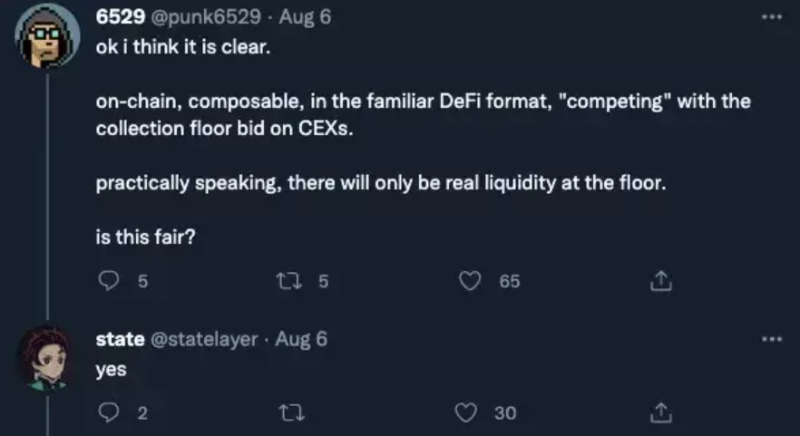
Viewing SudoSwap as an AMM-powered competitor to order book-based NFT marketplaces seems like a generally accurate mental model. SudoSwap makes trade-offs—like “higher gas but fully on-chain” and “more complex for new users but offers instant liquidity”—and users will ultimately decide which exchange type they prefer in different scenarios.
I also fully understand that for many NFT users/traders, AMM/DeFi concepts are things they neither care about nor want to engage with—some even fear them. That said, SudoSwap is still well-positioned to gain more volume through integration with aggregators. SudoSwap’s low fees and abundant liquidity near floor prices mean that routing part or all of a collection’s trades through SudoSwap pools could offer users cheaper execution—even if they never learn about (or know of) SudoSwap itself.
As previously mentioned, SudoSwap transactions do not include royalty payments. This is an interesting development and has sparked debate. I don’t have a strong stance here; it will be fascinating to see whether either side (pro-royalty or anti-royalty) concedes, or whether collections actively try to avoid SudoSwap.
Overall, it’s exciting to see a new protocol design—an NFT AMM—gaining attention and demonstrating real-world differences between NFT AMMs and order books. I look forward to trading on both.
Join TechFlow official community to stay tuned
Telegram:https://t.me/TechFlowDaily
X (Twitter):https://x.com/TechFlowPost
X (Twitter) EN:https://x.com/BlockFlow_News