








How to choose NFT projects in the post-PFP era?
TechFlow Selected TechFlow Selected
How to choose NFT projects in the post-PFP era?
What is the next major opportunity in the future NFT market, and how is this judgment formed?
 Navigating Web3 tides with focused insights
By: autometafi.eth
This topic was originally the title of my speech at inke's Meta Space, but I didn't deliver it well that day. I've always felt the need to organize it into written form so everyone can clearly understand the massive opportunities in the next phase of the NFT market and how this judgment logic is formed.
First, let’s examine the current state of the NFT market. According to today’s OpenSea trading rankings, the 24-hour trading volume of the 15th-ranked project has dropped to nearly 100 ETH.
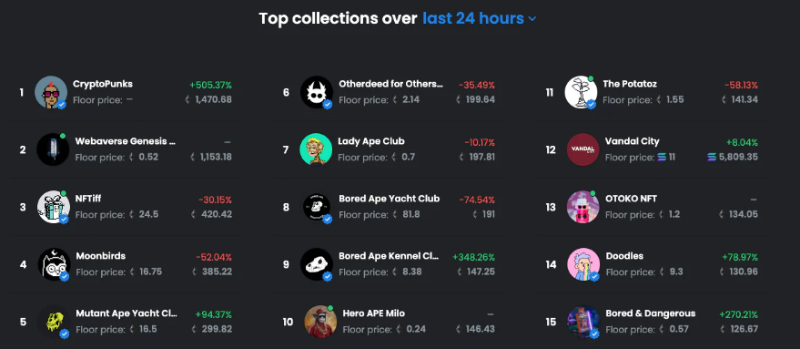
Now, let's compare this with the trading volume data from two months ago on June 8th:
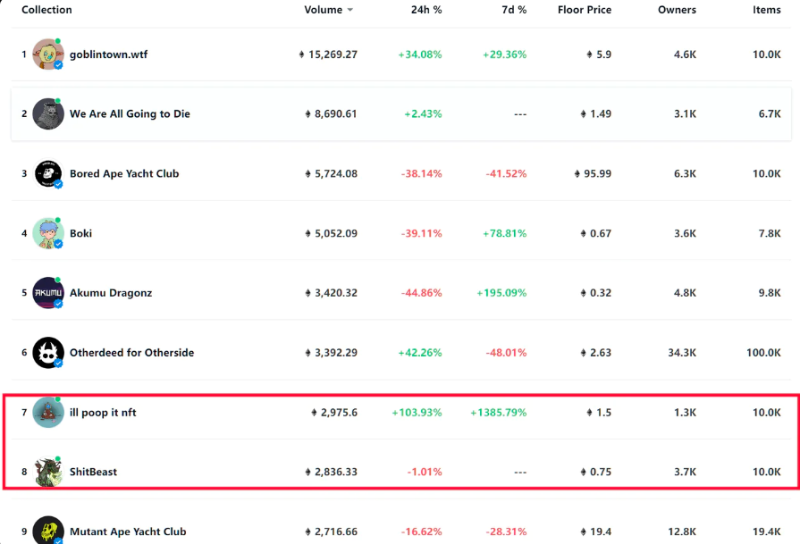
The current market trading volume is now less than 1/20th of what it was just two months ago. What has caused such a dramatic contraction?
First, we must rule out the impact of cryptocurrency prices on NFT trading volumes. On June 8th, ETH was priced around $1,800; today, it’s around $1,700. Therefore, fluctuations in ETH price are not directly correlated with changes in NFT market activity.
So what else could be causing this? And where do solutions and opportunities lie?
1. Unpredictable delivery timelines and quality for core products/services from 99% of NFT projects
Most teams only have a demo during the promotional phase. After minting concludes, very few projects can immediately deliver PFP avatars—many require an extremely long wait just to reveal images.
As for the actual applications promised in roadmaps—such as GameFi, X-to-earn, or Metaverse experiences—that could attract large user bases, delivery typically takes at least three months, often six to nine. During this prolonged waiting period, due to rapidly shifting market sentiment, users lose patience. When a new project emerges, they quickly exit their current holdings, resulting in floor prices crashing within 3–7 days after launch.
Moreover, many long-awaited projects suffer from insufficient early funding or severe internal team conflicts, ultimately failing to deliver high-quality products and services on schedule.
When users repeatedly experience these cycles, they grow skeptical and disillusioned with every new project. As a result, even "diamond hands" turn into flippers.
2. The PFP market is saturated and cannot absorb new projects
The rise of the NFT market cycle cannot be discussed without mentioning Bored Ape Yacht Club (BAYC), which ignited the entire ecosystem. Two key factors drove the emergence of the PFP market:
1) Users’ need for self-expression and group identity. NFT projects inherently foster stronger community cohesion than fungible tokens. People gather around shared appreciation for a project’s design and its underlying cultural ethos, expressing this alignment through profile pictures on social platforms like Twitter, Discord, YouTube, Instagram, Facebook, and WeChat. It also subtly signals one’s social standing within the NFT space.
I’ve noticed that many NFT founders always adopt blue-chip NFTs as their avatars—a signal to the market conveying two things:
-
I entered the space early and understand the market well, increasing the likelihood that influential figures in top communities will support my project;
-
I have sufficient capital, so I won’t act short-sightedly or rush monetization.
This dynamic helps blue-chip NFTs maintain relatively high valuations over time. Meanwhile, profits earned from these top-tier projects get reinvested into earlier-stage ventures, fueling overall market growth.
2) BAYC was the first to grant commercial rights to IP, allowing holders to freely use their NFTs for marketing and product development. Community buy-in ensures these commercial efforts gain traction quickly, prompting countless other NFT projects to follow suit.
However, since BAYC launched last year, there has been an explosion of PFP projects covering virtually every niche demographic. Now, new PFPs no longer confer status or prestige, undermining the foundation of any associated commercial value.
3. Pass cards cannot sustain the broader NFT market
Starting with Moonbirds, various “pass card” projects began gaining attention. With the NFT market booming, teams possessing resources and technical capabilities started issuing pass cards as a revenue model, offering additional benefits to holders.
But pass cards are inherently limited in scalability. Projects with more than 3,000 supply struggle to deliver meaningful excess value to all holders, making them unable to independently drive market momentum.
Furthermore, most pass card issuers lack capabilities beyond sharing NFT alpha. Once the broader NFT market cools down, the utility and value of these passes decline. For example, AAC’s Pass NFT once commanded high secondary-market prices, but when the market cooled, its value plummeted—forcing the community to return a portion of generated revenue to NFT holders and reduce royalty fees to zero.
Similarly, Moonbirds' shift to CC0 licensing led many users to fear Kevin Rose would stop providing exclusive resources, triggering mass exits. This highlights how pass card holders are highly dependent on the continued influence and resource access of project leaders.
Whenever confidence in a pass card’s ability to deliver ongoing value is shaken, users vote with their feet.
4. The gradual disappearance of the Freemint market
The Freemint trend, which began in March, saw several months of intense activity and produced superstars like Goblin, Shit, God Hates NFTees, and The Saudis.
Low entry barriers made participation highly addictive. However, starting mid-July, as ETH prices rebounded, fewer and fewer valuable projects emerged in the Freemint space.
There are roughly three reasons:
-
The longer you participate in Freemint projects, the greater your losses become, because 99% fail to recoup gas costs. Even truly rare gems rarely yield 100x returns needed to offset initial expenses.
-
Freemint projects generate no revenue for creators, leading to extremely high abandonment rates. If early sales don’t happen, NFTs become worthless digital clutter.
-
Widespread scam projects have burned major investors, causing big money to flee the sector.
Freemint projects operate on a Ponzi-like model—early participants profit from later entrants. Once secondary market demand dries up, the primary market collapses.
Conclusion:
1. If a project relies solely on mint revenue (or has no funding in the case of freemints) to fund future product/service development, don’t expect meaningful follow-through. If the project still has visibility and you’re whitelisted, consider short-term flipping if liquidity allows.
2. Avoid long-term holding unless the team can deliver core products/services immediately post-mint. If they haven’t launched successful prior projects or cannot prove financial stability and team continuity, assume delayed or poor-quality delivery.
3. Don’t invest in new PFP-only projects lacking long-term vision or a compelling spiritual/core narrative that fosters genuine user identification—regardless of how visually appealing the artwork may be.
4. For any pass card project, clearly assess what tangible rights it offers. If it merely provides alpha about other NFT drops without added value, proceed with caution.
5. Approach the Freemint market cautiously—only participate if the team delivers usable products immediately or demonstrates proven funding and operational sustainability.
The above explains key reasons behind the NFT market downturn. Yet, underlying demand hasn’t vanished. Projects aiming only for quick profits will fade away. Those capable of solving these structural issues will reignite wealth creation and revitalize the market.
Below are potential trends that could reactivate the market. Keep close watch on projects meeting these criteria—and participate based on your own research. DYOR!
1. Non-PFP-first projects with immediate product/service delivery, engaging gameplay mechanics, and integrated tokenomics
Rich gameplay is central to user engagement. Consider the impact of the NFT project “Shit”—a freemint project that, at its peak, delivered 7 ETH in gains per holder, becoming the hottest topic in the market.
Analyzing Shit reveals several key traits:
-
All development and visual assets were completed before minting. Post-launch, the team released new gameplay updates every 2–3 days, maintaining high visibility across social platforms, continuously attracting new users and amplifying the wealth effect.
-
Gameplay went beyond simple airdrops, burns, and mints—it introduced a “genesis” concept that sparked competition for scarce resources.
-
Token integration lowered the barrier for crypto-native players and whales. Since NFTs alone lack the liquidity and scale of cryptocurrencies, many large investors hesitate to deploy capital into pure NFT plays. But combining gameplay with tokens enabled inflows that boosted token prices, which in turn lifted NFT floor prices.
-
The game design encouraged direct player interaction—gains and losses between users created dynamic feedback loops, keeping participants engaged and the market active.
Later copycats failed to match Shit’s success largely due to simplistic mechanics—just airdrops and merges—lacking interactive dynamics. Without meaningful gameplay, token utility remained low, economic models became unbalanced, and excessive token supply overwhelmed demand, preventing outside capital from entering.
2. Evaluate project potential based on team background and proven capabilities
Before minting, you can filter projects using several indicators:
-
Does the team have strong brand power and influence in Web2?
For instance, publicly listed tech companies launching NFTs tend to perform well. They possess the capability to continuously develop and upgrade offerings, backed by robust marketing budgets. Even if prices dip temporarily, they can attract new users to stabilize value. As long as the future looks promising, short-term volatility becomes irrelevant.
-
Has the team previously launched successful projects or built influence in specific domains?
Such teams usually deliver solid performance on new launches, thanks to past successes and ample capital reserves. When clear market directions emerge, they won’t be hindered by technical or financial constraints.
-
Can you infer strong development and operational skills from the NFT design and initial gameplay mechanics?
In the future, NFTs won’t just be static collectibles—they’ll serve as tickets or membership passes for GameFi, X-to-earn, and Metaverse ecosystems.
If early designs and gameplay demonstrate strong product and technical potential, and the roadmap outlines clear timelines for upcoming deliverables, these projects are ideal for early positioning ahead of the next market surge.
3. Predicting the next market breakout: Metaverse will reignite the NFT space
With the PFP era fading, pass cards losing relevance, and Freemint retreating, where will the next NFT wave emerge?
Metaverse will become the focal point by year-end. While many NFT projects claim their next step is Metaverse, 99% won’t succeed—due to the exceptionally high technical barriers involved.
Let’s define the Metaverse:
An expansive network of digital spaces encompassing augmented, virtual, and mixed reality with immersive 3D experiences. These environments are interconnected and interoperable, enabling seamless movement between them and allowing users to interact and explore with others across different physical locations.
From this definition, two critical components stand out:
● 3D Experience: Most current PFP-based NFT projects face a huge challenge transforming flat images into full 3D avatars. This requires complete digital models compatible with rendering engines to enable true virtual presence. Converting 2D art into realistic 3D is not only extremely costly and time-consuming, but low-effort “pseudo-3D” attempts yield terrible results. This single barrier eliminates 99% of teams claiming Metaverse ambitions.
To test whether your NFT project has real Metaverse potential, simply ask the team: Can my PFP become my digital twin? When can it livestream using my voice, facial expressions, eye movements, gestures, and lip-sync—or at least show a working demo?
Creating expressive avatars is far harder than building 3D land or buildings. If they can’t answer yes, chances are they’ll never deliver a real Metaverse.
● Interaction and exploration among people in different physical spaces: Humans dominate Earth’s biological hierarchy not due to strength or speed, but because communication enables deep cooperation and division of labor, dramatically boosting efficiency.
Readers of *Sapiens* know about Dunbar’s number—the cognitive limit to stable social relationships (~150). In ancient tribes, clan sizes matched this number precisely.
This limitation stemmed largely from physical distance and language barriers. Breakthroughs like telegraph, newspapers, radio, telephone, TV, and the internet shattered spatial constraints, enabling the explosive growth of human civilization over the past 200 years.
Yet, limitations of text and speech persist. Words and sounds convey only ~1/3 of intended meaning. Face-to-face interactions rely heavily on body language, eye contact, and unspoken emotional cues—which carry the remaining 2/3 of communicative effectiveness. No matter how lively our online chats are, they rarely build trust like a real-world meeting.
Metaverse technology will overcome this final frontier.
When our digital twins in the Metaverse can express emotions through eyes, micro-expressions, and gestures, communication efficiency will surpass anything possible on traditional internet platforms. Trust costs will drop, fueling organic growth of economic ecosystems—moving beyond cold, Ponzi-like number games toward revolutionary user experiences.
Thus, the second gatekeeper is: Can your digital avatar authentically convey genuine emotion?
When a virtual character opens her eyes and you see subtle flickers of anxiety and hope—something a generic expressionless 3D model could never replicate—then you know true immersion has arrived.
Additionally, those tracking capital flows will notice institutional players already positioning themselves.
On August 3rd, Binance announced an investment in Lifeform, whose suite includes: 3D avatar creation tools, visual DID protocols, secure contract solutions, decentralized identity-based Web3 avatars, and Metaverse engine SDKs. The virtual human NFT project HALO originates from Lifeform.
Binance’s strategic logic is clear: they anticipate imminent Metaverse product launches and recognize 3D virtual humans as a core technological pillar.
The next big wave has already been backed by capital. You shouldn’t ignore it!
Conclusion:
1. Prioritize investing in NFT projects led by teams with proven 3D virtual human expertise and clear Metaverse roadmaps;
2. Look for projects where users can interact frequently post-mint, enjoy rich gameplay, and benefit from mature token economics;
3. Ensure the roadmap is transparent and backed by prior NFT releases demonstrating design and development competence, with key deliverables nearing completion and under control;
4. Favor teams with strong funding, track records, or significant Web2 influence;
When you find a project matching these criteria, don’t hesitate—join early. Maybe we missed BAYC, Azuki, Moonbirds, CloneX, and Shit because we lacked a clear NFT selection strategy back then. But moving forward, using this framework, we can identify the next NFT gem that delivers 100x returns.
Join TechFlow official community to stay tuned
Telegram:https://t.me/TechFlowDaily
X (Twitter):https://x.com/TechFlowPost
X (Twitter) EN:https://x.com/BlockFlow_News






