








Galois Capital: What happens to Ethereum after the Merge?
TechFlow Selected TechFlow Selected
Galois Capital: What happens to Ethereum after the Merge?
What Will Happen to Miners, Exchanges, USDT & stETH After the Ethereum Merge?
 Navigating Web3 tides with focused insights
Written by: Galois Capital
Translated by: TechFlow intern
This article compiles my responses to yesterday's survey on the ETH merge. Position disclosure: We currently hold ETH spot and are short ETH quarterly futures in roughly equal size.
Which chain will miners support?
It depends on ETC price vs. expected ETH1 price, but I suspect ETH1 will be more valuable. Fundamentally, ETH1 has more infrastructure and contracts than ETC, which is an advantage, but it will also experience chaos in DeFi when it forks—a disadvantage.
After the chaos settles, ETH1 may retain more value than ETC, because ETH1’s steady state is essentially what we see today, except without application development and oracles, and without non-replicable assets such as USDC, WBTC, USDT (possibly), and most NFTs.
Is it highly likely that USDT chooses ETH1 over ETH2?
Yes, it's quite possible. While USDT (followed by USDC and WBTC) is most likely to choose ETH2, there's still a significant chance they pick ETH1. First, Tether/Bitfinex would prefer not to face legal liability or lawsuits.
If PoS has flaws or vulnerabilities undetectable on testnets, this could expose stablecoin issuers to liability—whereas with ETH1, they already have full understanding. Meanwhile, people will definitely try to redeem USDT on ETH1; if problems arise during redemption, they’re very likely to sue the stablecoin issuer. Though legally questionable, it's a low-cost move with potentially high rewards (if successful).
Additionally, Tether/Bitfinex users are mostly Bitcoin maximalists and closely tied to Asia, where Asian miners wield meaningful influence in the space. If there were a way for stablecoin issuers to delay joining ETH2 until after the merge, it would reduce their risk—but this isn't possible; they must decide at the moment of the merge block. I estimate the probability of USDT choosing ETH1 instead of ETH2 to be between 2% and 5%.
How will exchanges handle futures and options?
Most will likely choose ETH2, as it's simpler than creating a basket index. The three major exchanges with margin positions (Kraken, Bitfinex, Poloniex) have each adopted different approaches to handling this event.
Among borrowers, lenders, longs, and shorts, some chose to short, and each exchange picked a different role.
How to create a basket index? Simply treat it as an ETF with two equally weighted components, similar to FTX’s ALT and SHIT indices.
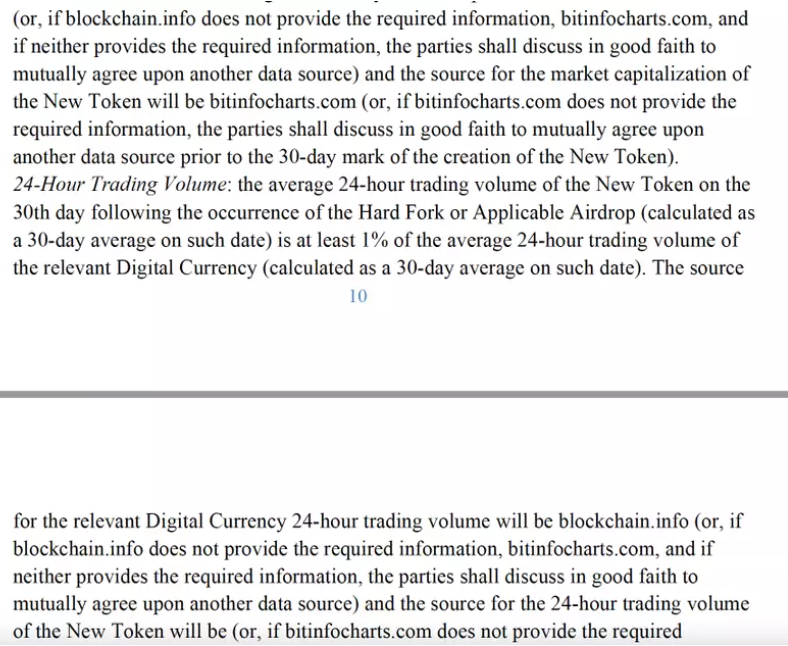
By the way, let's talk about lending. There are usually certain triggers after which forked assets must be repaid. Unfortunately or fortunately, one standard clause explicitly references hash rate.
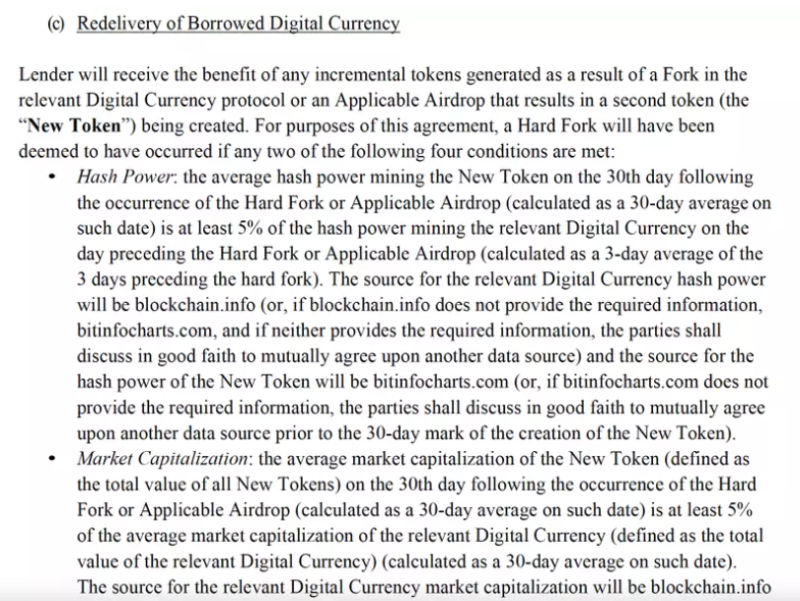
Furthermore, legally speaking, depending on wording, you could argue: ETH1 is the main chain, ETH2 is an airdrop/fork, and therefore both must be returned to lenders.
What happens to stETH?
It goes to zero on ETH1. stETH cannot be redeemed for ETH on ETH1. Therefore, the higher the expected value of ETH1, the greater the discount on stETH. Over the past day, this spread has widened.
There are other factors affecting stETH's discount, but now there's an additional one. Roughly speaking, I think a 2% illiquidity discount offsets yield, and a 4% ETH1 discount seems fair right now. Thus, in my current view, the total discount stands at 6%.
We have many other topics to discuss—historically, whether forks add or destroy value, especially in this case, regarding oracle issues in DeFi, price discovery in CeFi oracles, problems with on-chain lending pools, liquidations across two forks, AMM and MEV on two forks, domains, and ultimately why ETH1 might exist—all of which could eventually benefit ETH2.
Join TechFlow official community to stay tuned
Telegram:https://t.me/TechFlowDaily
X (Twitter):https://x.com/TechFlowPost
X (Twitter) EN:https://x.com/BlockFlow_News
 @Galois_Capital






