








Game Developer: Why NFT Games Are a Nightmare?
TechFlow Selected TechFlow Selected
Game Developer: Why NFT Games Are a Nightmare?
No "Play AND Earn," only "Earn." Because when you place "Earn" within the "Play" experience, you ruin the "Play."
 Navigating Web3 tides with focused insights
Compiled by: Arthur
Editor's note: This is a talk that sparked heated discussion among overseas developers. Compared to the cautious attitude of game developers in China, many overseas developers clearly harbor much wilder fantasies about NFT games. Especially within today’s web 3.0 context, discussions around how NFTs will “rebuild order” and “disrupt everything” have resurfaced.
However, at the recently concluded BIG (Brazilian Independent Games Festival), Brazilian game developer Mark Venturelli changed his presentation slides from the original title “The Future of Game Design” to “Why NFTs Are a Nightmare”. Notably, the 2022 BIG event was sponsored by blockchain companies such as Ripio and Lakea.
Mark Venturelli is the creator of Chroma Squad (a superhero-themed game), and leads Behold Studio, which has developed multiple titles across platforms. His latest project is a space-themed multiplayer cooperative game titled Out of Space.
Mark argues that NFT games offer no innovation in gameplay and are actively undermining fundamental principles of game design. He believes the essence of NFT gaming is speculative economic activity; in NFT games where real-money trading (RMT) is permitted, players lose any meaningful game experience.
In a half-hour speech, Mark elaborated on why blockchain is fundamentally a system built on distrust, while “the future of game design” should instead be based on trust—a foundation he sees as sustainable, humane, and infinitely scalable.
Below is the full transcript of his speech:
I’m Mark Venturelli, a game designer and co-founder of Critical Studio. I designed Chroma Squad with my friends, founded Rogue Snail, and now serve as its CEO.
I’ve been working in Brazil’s game industry for 15 years, witnessing many changes between 2007 and 2022. When we started out wanting to develop games for Steam, some told us “social games are the future,” and called us idiots. Today I’ll discuss new developments—free-to-play, cloud gaming, virtual reality—all these innovations, perhaps similar to what you've heard in other talks today.
Actually, I lied to you all today. I feared that if I told the organizers my real presentation title—“Why NFTs Are a Nightmare” (originally scheduled as “The Future of Game Design”)—they wouldn’t let me speak.
"Why NFTs Are a Nightmare"
Alright, let's skip over weak arguments like “Damn it, I don’t understand blockchain, so that’s why I criticize it.” Blockchain isn’t complicated, right? There are things far more complex—neural networks, physics simulations, rendering pipelines… or connecting a printer to Wi-Fi. These are things even I—and probably most people—don’t fully understand.
But blockchain itself isn't particularly complex. I'm quite familiar with it—I've studied this topic for years. I once found it interesting, but now I’m certain blockchain is a meaningless technology.
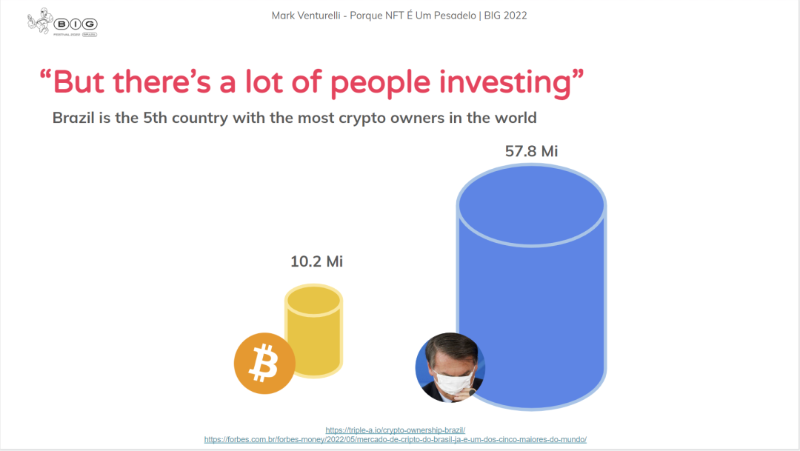
But so many people invest in blockchain—could they all be wrong? In fact, Brazil ranks fifth globally in cryptocurrency ownership, with over 10 million Brazilians holding various digital currencies. Just because many people do something doesn’t mean it’s the right thing to do.
Some say NFTs are the next trend—like free-to-play, mobile games, or social games—and that I’m too old to accept them. But no, they’re not alike at all. This isn’t a shift in business model, technological advancement, new platform, or interface. Play-to-earn transforms games from cultural and entertainment experiences into economic activities.
So how exactly does it work? Okay, buckle up—I’m getting started. We’ll touch economics, philosophy, politics—but I promise it’s relevant to game design!
01 Society
First, what is blockchain? Blockchain is an elegant solution to a very specific problem: maintaining a secure ledger among a group of people who completely distrust each other. A fully decentralized system that trusts neither law, institutions, nor any central authority.
But I believe blockchain is actually an elegant solution… to the wrong problem. What kind of context forces us to solve problems in a system devoid of trust? Why is the level of trust an excellent indicator of human group development? Generally, the higher the mutual trust among individuals, the more efficient the team becomes; the lower the trust, the more energy required to achieve the same goal.
Let me tell a small story: A caveman couldn’t innovate or discover new things about the world because he spent too much energy defending himself from attacks or theft of his cave. So he and other cavemen agreed not to attack one another. They trusted this rule would be respected, allowing their group to focus energy elsewhere and evolve.
This is how society works: we give up a bit of personal freedom—you can’t hit someone in the head—but gain greater freedoms in return. Human groups organized this way tend to succeed more, paving the way for increasingly complex organizations.
Generally speaking, trust index correlates strongly with societal development. More developed countries have higher trust indices, while less developed ones rank lower. By “trust index,” I mean trust in others, in government, in institutions, etc. The higher the per capita GDP, education levels, and the lower social inequality, the higher the trust. The less trust we have, the more effort we must expend to cooperate.
Imagine living with someone I absolutely cannot trust—locking up my belongings would become a nightmare. Installing cameras around the house, hiding valuables, checking constantly whether items remain upon leaving or returning. I’d have to stay vigilant, lock doors, install locks if none exist, and so on.
In short, I’d waste enormous energy coexisting with someone I distrust. Working in a team without trust means staying alert to prevent credit theft, fearing mistakes, stifling innovation. Living in a society without trust requires carrying weapons for self-defense. If I trust no one, it’s almost apocalyptic—like a zombie apocalypse. All my energy goes toward survival, stuck at the base of Maslow’s hierarchy.
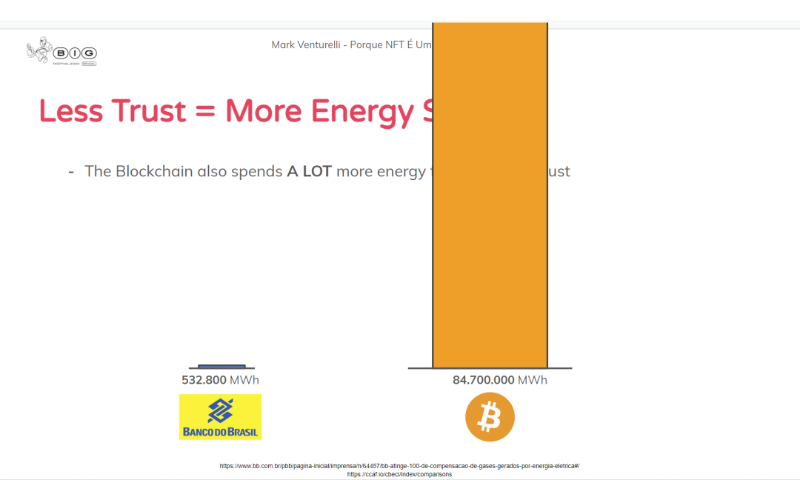
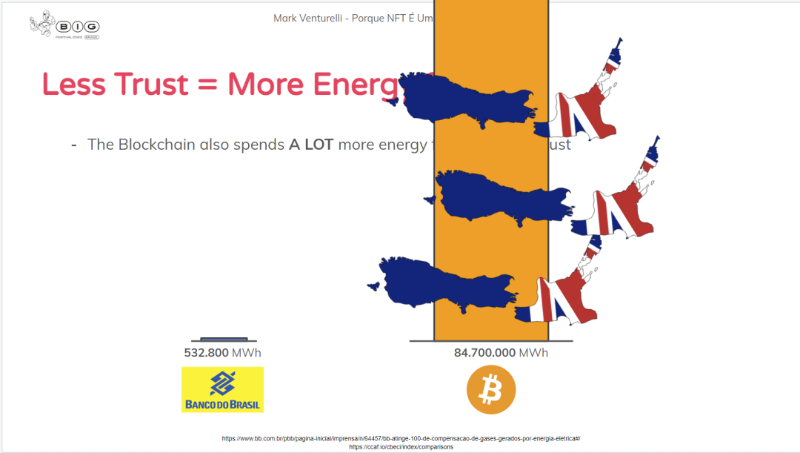
Because blockchain operates on distrust, it also consumes vastly more energy. Let’s compare two similar systems: Banco do Brasil, serving 90 million users, and Bitcoin, with 106 million users—comparable scale. Now consider annual energy consumption: Banco do Brasil uses 532,800 MWh annually; Bitcoin consumes 84,700,000 MWh—three times New Zealand’s entire yearly electricity usage. This is the energy cost imposed by Bitcoin’s lack of trust in participants or central authorities, paid every year.
If blockchain is a tool for a world without trust, then its only real value lies in environments where trust is zero. But shouldn’t we strive for a world where we trust each other more? Then why claim blockchain is the future? Why apply blockchain everywhere? How did we make this mistake?
Because blockchain was invented by anarcho-capitalists from 4chan, who believe governments and economies shouldn’t exist—and that the Earth is flat. Like flat-Earth theory, blockchain demands you unlearn scientific knowledge. Anarcho-capitalism demands you dismantle social organization, believing capitalism could function even without central authority. It requires forgetting humanity’s entire social evolution—essentially saying, “Oh my God! Governments are oppressing me!”
It’s a dystopian worldview that misreads books like *Snow Crash* not as critique or satire, but as an ideal future—a cyberpunk world where everyone wears khaki pants. In its current state, blockchain ends up like a hammer desperately seeking nails. With no proper target, it eventually hits us in the face.
02 Speculation
Cryptocurrency and NFTs are speculative economic activities. Why is speculation bad? Why do we regulate casinos? Why ban pyramid schemes? Because financial speculation is non-productive as an economic activity.
Let me tell another story: Imagine farmers bringing harvests to market to exchange for goods and services. At day’s end, each has created value for society. But suppose they instead bet all produce on arm-wrestling—who wins takes all. No social value is created here. Speculation is a zero-sum game: if someone profits from NFTs, someone else loses. And during this process, we burn through energy equivalent to three New Zealands.
But game development is not speculative—it creates value, fulfilling human needs for culture, entertainment, education, and escapism. Play-to-earn turns gaming into an economic activity, stripping it of intrinsic value. Creation and consumption of games become part of a speculative loop—an activity that forms a “zero-sum” system, or worse, brings no benefit to society. To explain why, we’ll finally turn to game design.
03 Game Design
In the book *Rules of Play*, Zimmerman and Salen introduce concepts like the “magic circle,” which I find fascinating.
These ideas greatly help us understand game experiences. The “magic circle” describes how games赋予 the world new meanings. For example, grabbing flippers becomes a “goal,” or chalk marks on the floor define where you may or may not stand. Games possess this incredible ability to redefine reality, creating safety through artificial boundaries.
For instance, when playing *Among Us*, I can “murder” my friend—but no one actually dies, and I won’t go to jail. These artificial consequences protect us from real-world repercussions. Artificial conflict is essential to the experience. We willingly accept extra constraints because they enable the magic of play.
So if I say, “Hey, let’s race to the edge of town,” but you take a taxi, you break the implied rules of our artificially constructed challenge.
Inside the “magic circle,” I define what actions are allowed and forbidden. That sense of fantasy, consequence-free play, artificiality—is essential to escapism and the magic of games.
But wait—what about professional sports? Aren’t they economic activities? Yes! Professional sports are indeed economic, but they hold social value. Sports aren’t speculative, nor is being an athlete. Athletes and sports bring real value—entertainment, culture—to audiences. And economic elements within games aren’t new inventions of blockchain—they only degrade the gaming experience.
Let’s examine existing aspects of gaming experiences and what blockchain theoretically adds. Interestingly, when I previously asked blockchain game developers this question, none offered fresh answers—because there truly aren’t any.
Let’s start from scratch:
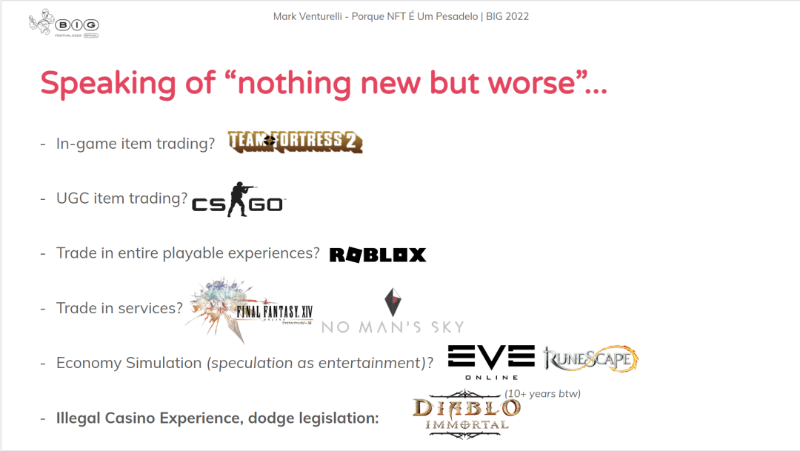
1. Selling in-game items: You can already do this in games like *Team Fortress 2* and others.
2. Selling community-created content or “user-generated content”: If that counts as NFTs, then *CS:GO* invented NFTs ten years ago.
3. Want to earn money from your creations? Platforms like Roblox already exist—no blockchain needed.
4. Want to sell your time or services? In *No Man’s Sky*, players hire designers to create items. In *Final Fantasy XIV*, people pay designers to build their eRP nightclubs—don’t ask how I know.
5. Even economic simulation—if you treat speculation as entertainment. Manipulating markets for profit—can that be fun? Yes, several games already offer this. *Eve Online* and *Runescape*, by the way, both over a decade old.
Why have economic simulations in games like *Eve Online* and *Runescape* lasted over ten years (with ups and downs), while NFT game economies collapse before lasting a single year? Because games like *EVE* have centralized authorities regulating their economies—that’s why.
But wait, don’t NFT games enable a new genre? After all, blockchain excels at enabling illegal and organized crime. Oh wait—that already exists. Isn’t *Diablo: Immortal* basically a casino experience? Essentially, everything Play-to-Earn claims to offer already existed in other games over a decade ago—and done better.
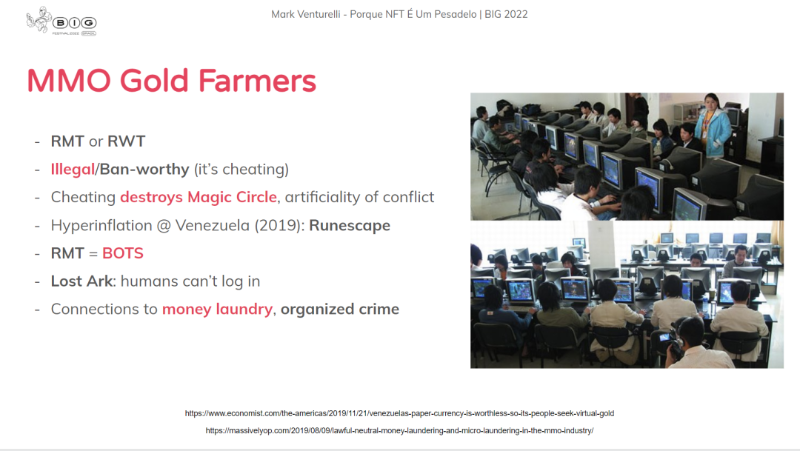
Except one thing—have you heard of MMO gold farmers? Also known as real-money trading (RMT) or real-world trading (RWT). They plague online games and were considered illegal and banned before blockchain. Because it violates rules—it’s cheating. Cheating breaks the magic circle, destroys the artificiality of conflict.
Remember Venezuela’s hyperinflation crisis in 2019? Many earned gold in *Runescape* and sold it, turning in-game currency into real money. But it wasn’t legal, okay? RMT was neither allowed nor endorsed by developer Jagex. Wherever RMT exists, bots follow. If you see many bots in any online game, it’s because of RMT.
Thus, bots run because systems—often organized groups—exist to extract real money via scripts. A prime example is Amazon’s recent release *Lost Ark*, where widespread botting prevented normal users from logging in. Online game gold farming is frequently linked to money laundering and organized crime. Regardless, it’s not a good thing.
Yet, if you’re a blockchain developer, you might look at this and say, “Cool! Let’s go official!” In lifting restrictions on gold farming, promises were made—even suggesting it’s desirable. I even heard someone repeat this promise in a talk today: “You’ll play a cool game and eventually profit from your progress!” As someone from Ubisoft said, “Eventually games will allow players to resell items after finishing or moving on.”
But what value does this hold for those seeking culture, entertainment, and escapism? It’s purely an economic transaction—purely speculative. Like everything on blockchain, it’s also fraudulent. The reality behind this promise is your game experience gets utterly destroyed, as groups focused on profiting operate at ever-diminishing margins—because that’s how capitalism works. You’ll see increasing professionalization, specialization, larger scales, shrinking profits, destroying fair competition for ordinary players who just want to enjoy the game.
There is no “Play AND Earn”—only “Earn.” Because inserting “Earn” into “Play” destroys “Play”. When gaming becomes an economic activity, you destroy the magic circle. You destroy everything we rely on to build game experiences.
Unregulated capitalism always leads to monopolies and oligopolies—you don’t need a PhD in economics to grasp this. While humanity hasn’t seen massive monopolies in real life yet, we’ve seen plenty in games.
"Normal" people—those who simply want to play and have fun—have no chance to compete in such environments. At best, your "progress monetization" might net you a few cents, and the items you sell upon "finishing" the game will be worthless. What you sacrifice is saying goodbye to the fantasy within the game—the possibilities it offered and your ability to shape that world. Because, just like in real life, you’ll greet familiar oppression again, reaccepting control over you within the game world.
Essentially, the game design blockchain aims for draws inspiration from survival games like *Rust*. When you spawn on a server, a PvP gang of 12 kids spends all day camping and killing you instantly. That’s essentially what they want to replicate at the economic level—because anything can be bought with real money.
I’ve heard arguments: “We need to legalize RMT, just like illicit drugs,” “prohibition is never the answer.” Actually, I agree prohibition isn’t the answer. Bans only treat symptoms, but reducing demand at the root is possible. Illicit drugs fulfill needs that other human activities sometimes fail to meet, requiring extensive support systems to eliminate demand. But RMT isn’t a need—it’s an economic flaw, so solutions exist: sound underlying economic design and centralized economic authority.
So I ask you: Is there a popular, enduring, free-to-play online RPG with a trading system and premium currency, yet no botting or RMT issues? Yes—it’s called Warframe. I’d explain how, but that would double my slides, so maybe another day. For now, trust me. Try searching “Warframe bots” on Google—you’ll find almost nothing. The only RMT cases in Warframe involve credit card fraud or coupon scams, nowhere near the scale seen in games like *EVE Online* or *Runescape*.
But wait, wait. Did I forget something? Do “blockchain games” offer any great, wonderful value to our industry? What about the metaverse? What if I want to use an item earned in Game A inside Game B? First, crypto enthusiasts struggle to understand this: decentralization is incompatible with big corporations. What they really want is deregulation.
Therefore, the possibility of companies like Meta building the metaverse you dream of is zero. Ubisoft’s entry into NFTs exemplifies this—those NFTs merely point to links stored on Ubisoft’s servers, fully controlled by Ubisoft. It will never be any different.
Many people watched *Ready Player One* and confused dystopia with utopia. They look at it and think, “F *** YEAH, that’s so cool!” This is literal cultural commodification—turning your favorite characters into symbols, draining their artistic and cultural value, placing them in unrelated contexts. If Spider-Man is just a symbol, his meaning vanishes. He’s no longer Peter Parker. When Spider-Man shoots Naruto in Fortnite, he’s not Peter Parker—he’s just a skinned avatar.
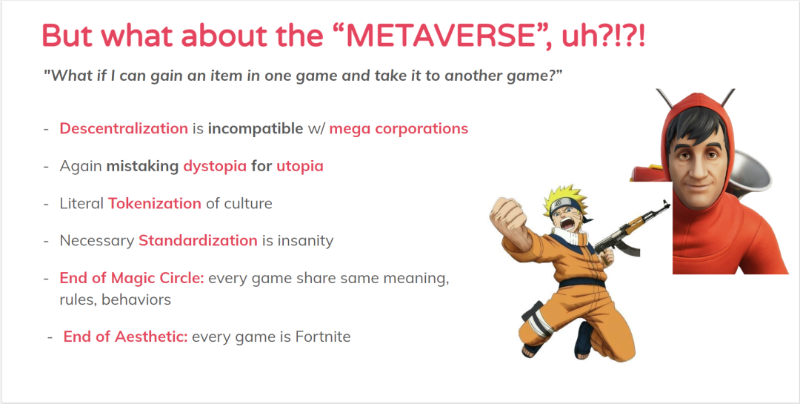
I can imagine developers at Big Festival hearing “use items from one game in another.” First, technically, standardization required would be insane. Anyone who’s used Unreal or Unity Asset Stores knows ensuring asset compatibility would demand unprecedented standardization in the gaming industry.
But when you study game code, all items operate under identical structures. I won’t say it’s impossible—technically, nothing is impossible. It depends on collective will and effort. Still, it remains extremely foolish, like everything related to blockchain. It also implies the death of the “magic circle.” Every game would share identical meanings, rules, behaviors.
When making games in the metaverse, you lose meaning as a game designer—you can’t redefine “my X-Men and his sword.” It’s also the end of aesthetics. Every game becomes Fortnite. Fortnite is certainly a beautiful game, artistically excellent. But if every game features Naruto shooting in Chaplin, Colorado, that becomes problematic.
Let me return to the original title of this talk: “The Future of Game Design.” I’d like to try discussing this—not just focusing on the negatives brought by “blockchain games.”
The future of game design (and to some extent, capitalism and humanity)... depends on creators understanding that “making lots of money” is not the goal. I say this as a creator—it’s entrepreneurial advice for anyone who needs it. If you truly want to make lots of money, understand that economic returns result from delivering immense value to many people.
Making money through financial games is for unimaginative people. I believe that if someone earns tens of billions daily, it requires immense imagination and talent. I trust great entrepreneurs would agree—they understand: “My focus must be on value,” “My focus must be on people,” “What can I do that benefits more people?” That’s how you make real money.
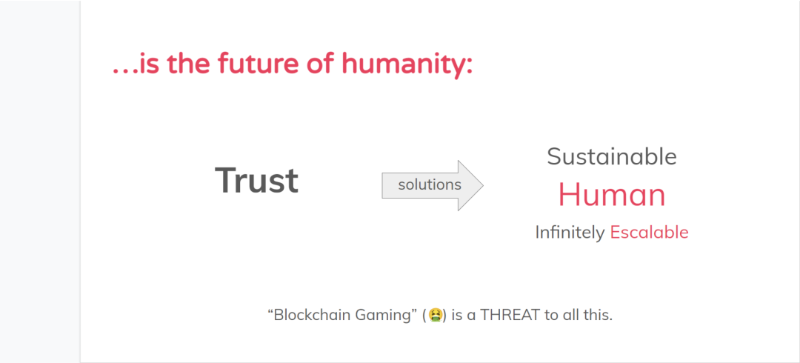
Our pressing challenge today—the solution isn’t blockchain. Problems cannot be solved by systems built on distrust. I believe the future of game design, like the future of humanity, depends on trust. Solutions based on trust are sustainable, humane, and infinitely scalable. These are the kinds of solutions we game designers must pursue. “Blockchain games” aren’t just poor tools that destroy all this—they are a threat to everything we stand for.
I’d like to thank everyone at Rogue. I’m glad, and I hope you all enjoyed it. Thank you!
Join TechFlow official community to stay tuned
Telegram:https://t.me/TechFlowDaily
X (Twitter):https://x.com/TechFlowPost
X (Twitter) EN:https://x.com/BlockFlow_News






