








Bankless: Understanding 5 Popular NFT Drop Models and Their Pros and Cons
TechFlow Selected TechFlow Selected
Bankless: Understanding 5 Popular NFT Drop Models and Their Pros and Cons
Which fundamental NFT drop methods should you pay attention to in the current NFT ecosystem?
 Navigating Web3 tides with focused insights
Author: William M. Peaster, Bankless
Translation: DeFi Dao
Earlier this summer, I wrote an introductory article about NFT smart contract approaches.
When launching an NFT project, choosing a foundational smart contract approach gets you halfway there. The other half comes from deciding which NFT drop method to use.
Of course, NFT contracts and drop methods can be configured in various combinations, and it's entirely possible to mix different drop types in all sorts of ways.
In today’s NFT ecosystem, there are several foundational drop methods you should know.
Popular NFT Drop Methods
01 First-Come, First-Served (FCFS) Minting
An NFT drop method where minting is opened to the public or specific NFT community members on a first-come, first-served basis.
Variants:
Permissionless — Anyone can mint under FCFS terms. Example: Bored Ape Yacht Club.
Token-gated — Only holders of a specified token can mint under FCFS terms. Example: Blitnauts, mintable only by Blitmap holders.
Raffle-based — A raffle system allocates a limited number of whitelist spots for FCFS minting. Example: Boki (final sale).
Price-tiered — Different supply tiers within a collection have different mint prices. For example, NFT IDs 0–999 at 0.1 ETH, 1000–1999 at 0.2 ETH, etc. Example: Hashmasks.
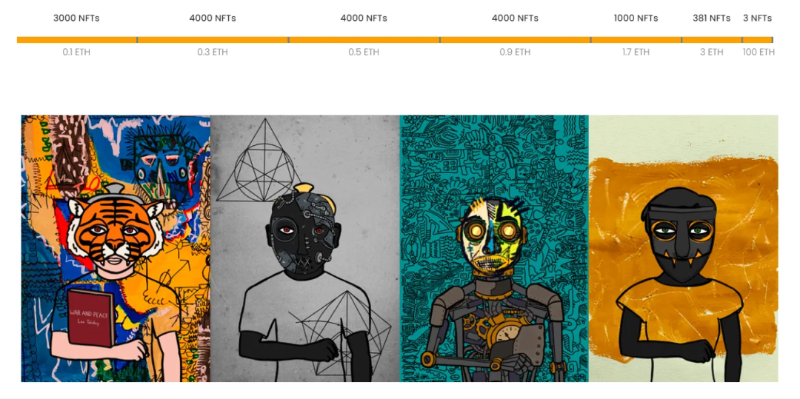
Hashmasks mint tiers, image via thehashmasks.com
Pros:
-
Easy to implement for builders
-
Simple and convenient for minter users
Cons:
-
Low-priced, high-demand FCFS mints may trigger "gas wars," congesting the entire chain (e.g., Ethereum).
-
High chance of transaction failures toward the end of the mint event
-
Susceptible to being flooded by bot mints
-
Time-zone insensitive due to typically rapid FCFS mint speeds
02 Dutch Auctions (DAs)
An NFT drop method where NFTs in a collection start minting at an initial price (e.g., 10 ETH), which decreases by a fixed amount at regular intervals (e.g., dropping 0.25 ETH every 30 minutes), until reaching a set floor price or demand equilibrium, with all NFTs eventually sold out.
Examples:
Art Blocks — To mitigate gas wars and focus on supporting artists over minters, since summer 2021, the generative art platform Art Blocks has allowed artists to launch collections via Dutch auctions.
Azuki — The anime-themed PFP collection launched via Dutch auction in January 2022 but was fully minted within minutes, with its initial 1 ETH mint price never decreasing.
Forgotten Runes Warrior's Guild — The first phase of this expansion series from Forgotten Runes Wizard's Club began with a Dutch auction; the initial mint price started at 2.5 ETH and dropped during minting to the final set price of 0.6 ETH.
Pros:
-
Brings transparency to NFT bidding and price discovery
Cons:
-
Typically favors the wealthiest collectors who can mint at or near the initial auction price.
03 Free Claim / Free Mint
An NFT drop method where NFTs in a collection can be minted free of charge, aside from the gas cost associated with the claim transaction. Recently, projects choosing this model often rely on above-average secondary sales royalties for revenue.
Examples:
CryptoPunks — Hard to believe now, but when the most iconic NFT series ever was released in 2017, all "Punks" NFTs were available to claim for free!
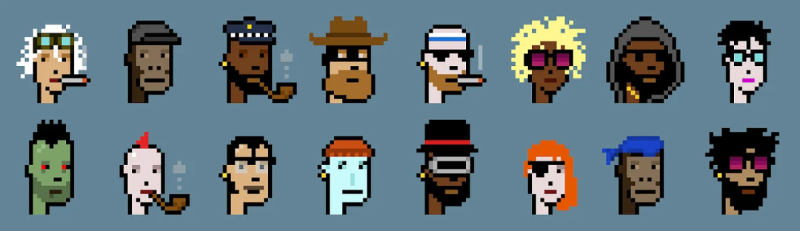
Image via Larva Labs
Loot — Dom Hofman launched Loot, a chain-based adventure gear collection, for free in August 2021. All NFTs in the collection were claimed from the smart contract within hours.
goblintown — The wildly goblin-themed NFT series that swept through the NFT space earlier this year launched with a "1 free + gas per wallet" drop style.
Pros:
-
Low cost makes these NFTs accessible to many users.
-
Incentivizes ongoing project delivery, as sustained progress supports better royalty income over time.
Cons:
-
The rise of low-fee or zero-fee NFT marketplaces could erode future revenue prospects for free-mint projects.
-
Susceptible to being flooded by bot mints.
04 Nounish Auctions
An NFT drop method pioneered by Nouns DAO, requiring a new NFT to be generated and auctioned daily, indefinitely. However, recently we've seen a wave of projects adopt the Nounish issuance model while adjusting their NFT rhythm—such as releasing multiple NFTs per day, among other variations.
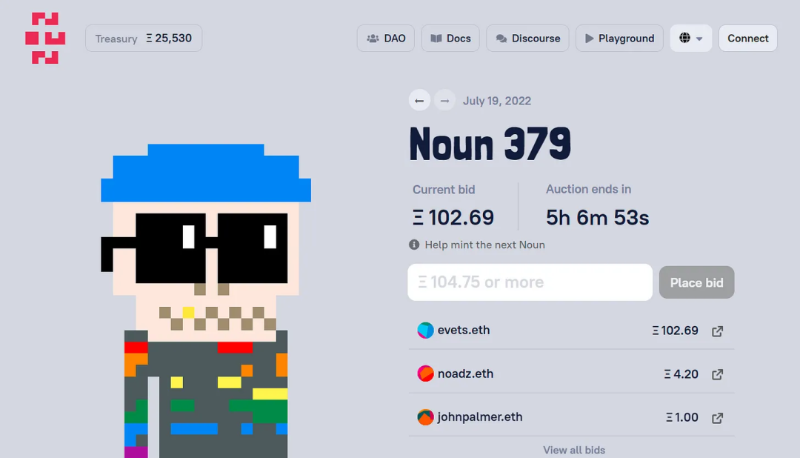
Image via nouns.wtf
Variants:
Nouns DAO — "One noun, every day, forever" is the slogan of the main Nouns project. The underlying protocol generates an avatar from a trait library, auctions it off, and settles the auction once per day.
Lil Nouns DAO — One Lil Noun NFT is auctioned every 15 minutes, forever.
WizardsDAO — Three Wizard NFTs are auctioned daily until the total supply reaches 2000 NFTs.
Pros:
-
This distribution method is a novel on-chain primitive that projects can use to gradually build an NFT community.
-
Rhythm and parameters can be customized in various ways.
Cons:
-
This drop method remains ultimately experimental.
-
High demand may cause auction prices to become unaffordable for many.
-
The Nouns protocol is elegantly designed but quite complex, requiring skilled Solidity developers to fork and build upon it.
05 Open Editions (OEs)
An NFT drop method where creators or projects release NFTs without a hard supply cap.
Variants:
Infinite — Infinite OEs refer to collections with potentially infinite supply and no closure of minting. A recent example is "The Room of Infinite Paintings."
Timed — Timed OEs have no set supply limit but offer open minting only within a finite time window. A recent example is Zora's "State of Mind" project, which ran for three days earlier this month and raised over 123 ETH during that period.
Honorable Mentions: Bonding Curves and MultiRaffle
Over the past year, one NFT drop method seems to have fallen out of favor: bonding curve minting.
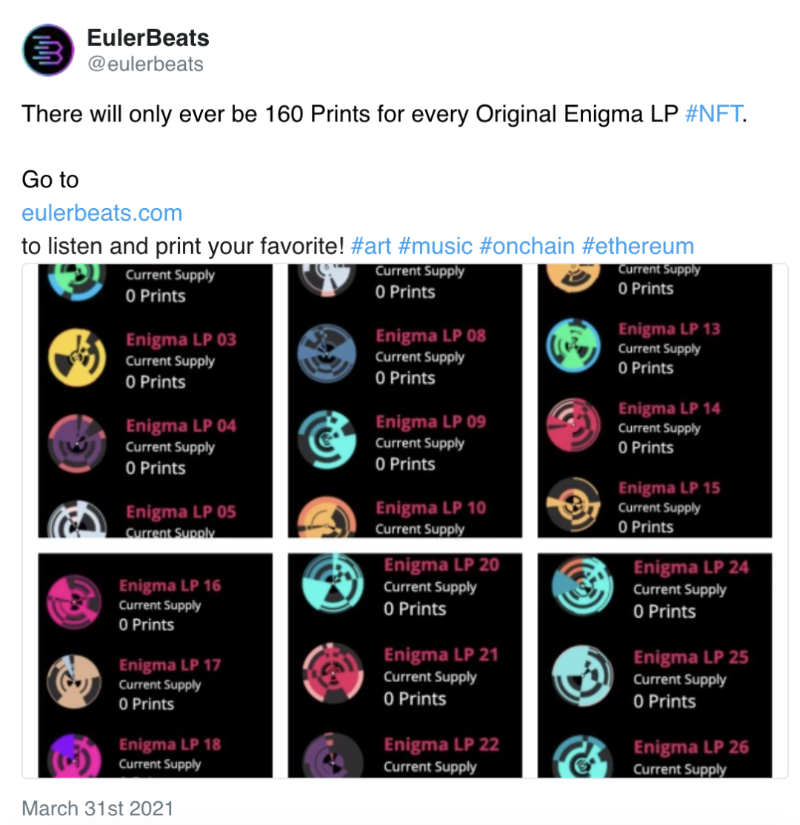
One of the early pioneers of this format in the NFT space was EulerBeats, which sold (and allowed resale of) its NFTs along a price curve determined by a specific mathematical formula. As stated in the EulerBeats documentation:
"Any collector can purchase a print at the price defined by the bonding curve formula. As the number of circulating prints for a given original increases, the price to issue the next print grows exponentially. [...] The bonding curve acts as a liquid market allowing print holders to burn their print tokens, thereby reducing the current print token supply of the related original, in exchange for the burn price received at that moment. Thus, the burning process returns ETH from the reserve to the print token burner."
Finally, another NFT drop method that hasn’t gained much traction but deserves more adoption is MultiRaffle. It is a reference implementation of a raffle mechanism created by Paradigm’s Anish Agnihotri and Hasu.
In short, MultiRaffle represents Agnihotri and Hasu’s research into the fairest and most efficient NFT drop method. In MultiRaffle, they optimize for undevelopable fairness, prevent race conditions, and maximize minting cost efficiency from top to bottom.
I believe some MultiRaffle experiments have been implemented, though personally I haven't seen any since Agnihotri and Hasu published their research post back in October 2021. That’s a shame.
Join TechFlow official community to stay tuned
Telegram:https://t.me/TechFlowDaily
X (Twitter):https://x.com/TechFlowPost
X (Twitter) EN:https://x.com/BlockFlow_News






