








Sui: What Makes This New Public Blockchain—Created by the Father of the Move Programming Language and Led by a16z—Different?
TechFlow Selected TechFlow Selected
Sui: What Makes This New Public Blockchain—Created by the Father of the Move Programming Language and Led by a16z—Different?
Can Sui and Aptos build on Facebook's legacy to usher in a Web3 era? Only time will tell!
 Navigating Web3 tides with focused insights
Author: Zheng Zheng, TechFlow
Like Aptos, Sui is another Web3 blockchain project founded by former Facebook employees. As a well-established Web2 giant, Facebook has recently seen numerous blockchain talents leave to start their own ventures. Will the fall of one whale nourish countless lives? Will these departing teams ignite as a blazing fire together, or scatter like stars across the sky? Today, let's take a closer look at the Sui blockchain project (pronounced like "sweet" without the 't'—sounds sweet already, doesn't it?)
Preface – The Move Twin Stars Born from Facebook
In previous articles, we introduced Aptos, a public blockchain project founded by former members of Meta’s (formerly Facebook) Diem stablecoin team. Today, let’s explore how Sui, also founded by ex-Meta engineers, differs from Aptos. (Read Aptos article here)
Sui is a blockchain project developed by Mysten Labs, which in December 2021 announced a $36 million Series A funding round led by a16z, with participation from Coinbase Ventures, NFX, Slow Ventures, Scribble Ventures, Samsung NEXT, and Lux Capital. The company is currently seeking at least $200 million in Series B funding at a $2 billion valuation, led by FTX Ventures, and has already secured $140 million in this round.
Project Background
● Sui is a Layer-1 blockchain designed for horizontal scalability, enabling rapid transaction speeds and low costs to support a wide range of applications.
● Exceptional founding team: All five co-founders of Sui were top engineers at Facebook across various domains. For example, Kostas Chalkias is a cryptography expert, and Sam Blackshear (Sui’s CTO) is widely regarded as the de facto creator of the Move programming language.
● Joining Web3 to change the world: While working at Meta, the founders felt constrained by the conservatism and regulatory pressures of large Web2 corporations. Their creativity and vision were stifled, prompting them to go all-in on Web3 to realize their ambitions.
Project Features
● Variant of the Move Language: Like Aptos, Sui inherits the legacy of Diem and is built using the Move language, making both projects twin stars of the Move ecosystem. Compared to Ethereum’s Solidity, Move offers stronger security and reliability. Sui has modified Move to be object-centric, supporting object-oriented programming.
● Parallel Processing (System Design Breakthrough): Most transactions on Sui do not compete for the same resources (e.g., two transactions targeting the same NFT). Traditional blockchains like Ethereum require full-node consensus over a globally ordered transaction list, leading to massive computational waste. Sui uses parallel transaction execution to overcome this bottleneck, significantly increasing TPS (transactions per second).
● Scalability (Instant Settlement): Sui’s architecture allows node performance to scale linearly with added computing resources. In a March 19, 2022 test, an unoptimized single Sui node running on an 8-core M1 MacBook Pro executed and committed up to 120,000 transactions per second (TPS), with throughput scaling linearly with core count (25,000 TPS on a single core). This suggests Sui can theoretically scale network throughput infinitely, enabling instant settlement and providing robust infrastructure for Web2-to-Web3 migration.
● Non-Universal Consensus (Bypassing Full Consensus): Under Sui’s design, a transaction only requires confirmation from 67% of nodes instead of 100%, dramatically accelerating transaction processing speed.
● Meta-transactions (Gas Fee Proxy Payments): The Sui team is developing an innovative feature allowing transaction initiators (principals) to delegate gas fee payments to others, avoiding issues caused by insufficient gas balances. These proxy payers can act as agents, earning revenue by showing ads or other content to users. Principals may also reimburse agents off-chain.
Token Economics
● Sui’s native token is called SUI: The total supply cap is 10,000,000,000 (10 billion tokens). A portion of the SUI supply will be circulating upon mainnet launch, while the remainder will be distributed gradually over the coming years as staking rewards or incentives.
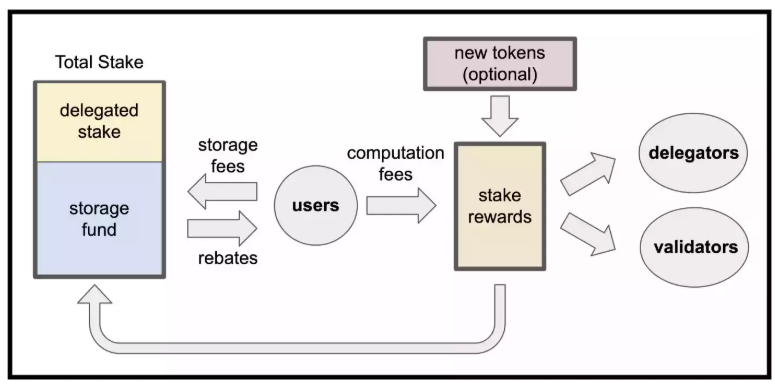
● Four key roles exist within Sui’s economic model:
Users: Interact with the Sui blockchain by conducting transactions, creating and transferring digital assets, or engaging with smart contracts.
SUI Token Holders: Can choose to delegate their tokens to validators and participate in the Proof-of-Stake (PoS) mechanism. SUI holders also have governance rights within the Sui network.
Validators: Responsible for processing and executing transactions on the Sui blockchain.
Storage Fund: Compensates validators for the cost of storing data on-chain.
● Gas Pricing Model:
A unique aspect of Sui’s gas mechanism is that users pay separate fees for computation and storage. Execution gas prices are determined through a three-step process repeated each Sui epoch (each lasting over 24 hours), while storage gas prices are externally set via governance proposals, aiming to reflect real-world USD costs of data storage.
Here’s a brief overview of how execution gas pricing works during each epoch:
At the beginning of each epoch, every validator submits a gas price quote (the minimum gas price they’re willing to accept). Sui sets the reference gas price for the epoch at the 2/3 percentile of all submitted quotes. For instance, if 100 validators submit quotes sorted from lowest to highest, the 67th validator’s quote becomes the reference price.
When users submit transactions, they can use the reference price as a guide. However, due to individual preferences and network fluctuations, actual gas prices may slightly deviate from the reference.
At the end of each epoch, validators are rewarded based on their actual gas usage. Validators who submitted lower quotes (below the reference) or processed transactions above their quoted price receive higher rewards. Conversely, those submitting high quotes (above the reference) or handling transactions below their quoted price face reduced rewards.
This mechanism serves two purposes: it incentivizes validators to lower their gas quotes and provides users with a reliable reference price, ensuring transactions near the reference price are processed promptly.
● Storage Fund:
A key feature of Sui is its ability to handle vast amounts of on-chain data, but this requires substantial storage resources. Therefore, users pay a storage fee with every transaction into the Storage Fund. This fund compensates future validators who bear the cost of storing historical data (since validators must maintain a full ledger). When storage demand is high, validators earn extra rewards; when it's low, rewards decrease accordingly.
Over time, as storage technology improves and SUI token value fluctuates, governance proposals will adjust the storage gas price to reflect updated target values.
Sui’s storage model includes a “delete option,” allowing users to reclaim part of their paid storage fees when deleting previously stored on-chain data (e.g., NFT metadata), since ongoing storage is no longer required.
● PoS Delegation Model:
SUI holders can delegate their tokens to validators for staking and earn proportional rewards at the end of each epoch.
A validator’s share of total staking rewards correlates with their staked amount, which determines their voting power in transaction processing. Each Sui transaction only needs approval from 2/3 of validators weighted by stake. Thus, validators with larger stakes process more transactions and earn greater rewards. Additionally, the Storage Fund allocation means validators earn relatively higher returns compared to delegators.
Before each epoch, SUI holders can freely select which validator to delegate to. Faster, more efficient validators attract more delegators due to higher execution gas rewards, thereby improving overall network quality.
Sui Ecosystem Development
● Target Domains: The Sui team aims to drive adoption in gaming, DeFi, enterprise, and social applications—four areas where Sui’s high throughput and low latency deliver optimal user experiences. Gaming and social apps benefit uniquely on Sui: games can leverage Move’s secure and expressive capabilities for digital avatars, while social platforms can store all data directly on-chain thanks to Sui’s favorable data economics.
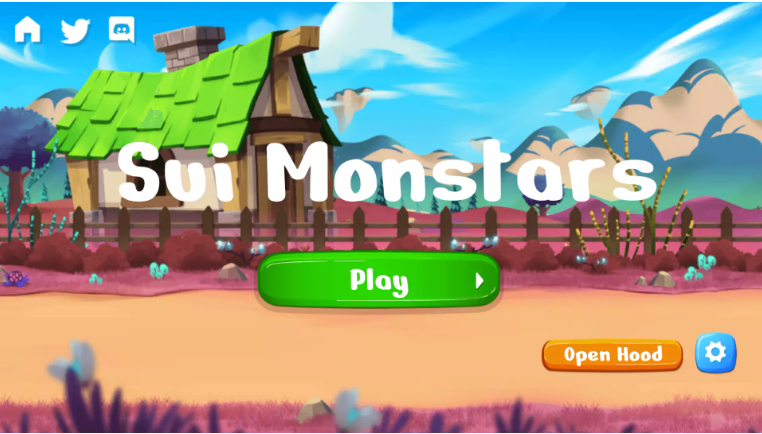
● Sui Monstars: An official mini-game showcasing game development on Sui. In Sui Monstar, users capture cute pets and interact with them by feeding and nurturing. These pets, farms, and accessories are all NFTs on-chain, with attributes like health, friendliness, and accessories updating in real time during gameplay. (Interested fans can try it via this link)
Incentivized Testnet
Sui officially announced the launch of its incentivized testnet in August. The testnet activities are structured into sequential “waves,” each containing two challenges: “sink” (operational challenge) and “swim” (Move-based developer challenge).
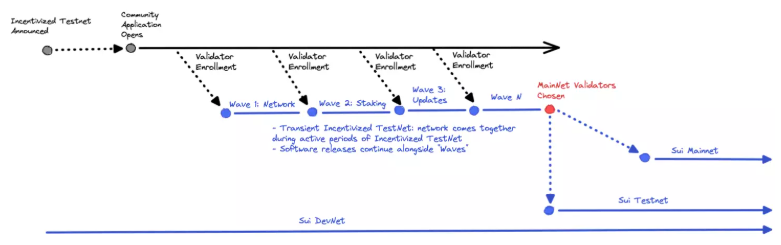
● Wave One – Network
-
Sink: A multi-entity public Sui network will be linked together for the first time, testing distributed genesis, validator configuration, operational coordination, and basic network functions.
-
Swim: Developers get their first chance to deploy apps on the testnet. Sui will soon reveal ambitious plans for this challenge—but for now, just a mysterious hint: Capybaras!
● Wave Two – Staking
-
Sink: The PoS mechanism secures the Sui network through incentive mechanisms involving all stakeholders. Anyone with sufficient SUI can become a validator in Sui’s DPoS system. This wave tests the core economic model’s design and implementation.
-
Swim: A challenge focused on building and deploying financial applications, particularly staking derivatives and DeFi infrastructure.
● Wave Three – Upgrades
-
Sink: Running a stable, secure, high-throughput network is no small feat. This wave tests operators on critical tasks such as validator set changes, software upgrades, and incident response.
-
Swim: Sui will announce upcoming Move hackathon challenges during Blockchain Science Week
Facebook – The Modern-Day Fairchild Semiconductor?
● Fairchild Semiconductor – The Origin of Silicon Valley: In 1956, William Shockley won the Nobel Prize in Physics for inventing the transistor, making Shockley Semiconductor famous. However, his obsession with control and distrust toward subordinates led eight brilliant young engineers—the so-called “Traitorous Eight”—to resign. With backing from a camera equipment entrepreneur, they founded Fairchild Semiconductor. As Fairchild thrived, profits were siphoned off to support the parent company, causing discontent among key members. Many left to found legendary companies like Intel and AMD, laying the foundation for Silicon Valley’s golden age.
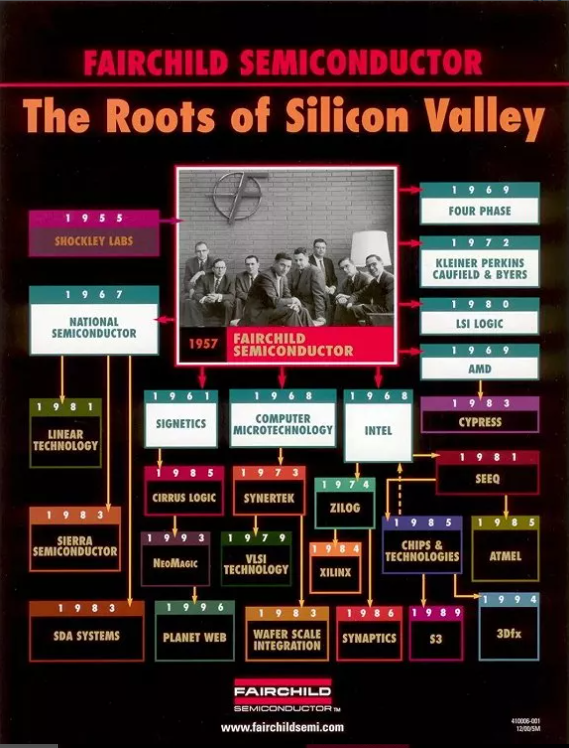
● Facebook – Metaverse Struggles: From Libra’s (Facebook’s planned stablecoin) explosive debut in 2019, to its downsizing and rebranding as Diem, and finally the dissolution of the Diem team early this year, Facebook’s metaverse journey has been fraught with setbacks. Recently, Zuckerberg issued a “layoff warning” to employees. Seeing a global Web2 giant reach such a point evokes deep reflection.
● Facebook – The Contemporary Fairchild: Progress cannot be halted by any single person or company. While Facebook’s fate remains uncertain, emerging Web3 projects like Sui and Aptos born from its talent pool may offer clues. Perhaps the era already favors Web3. Could Facebook become today’s Fairchild Semiconductor? Can Sui and Aptos stand on Facebook’s shoulders to usher in a new Web3 era? Only time will tell.
Hidden Risks
Whoever controls two-thirds of the network’s total staked SUI could gain control over the entire network. If a validator—similar to large Web2 firms—offers subsidies by redistributing not only their own but also users’ execution and storage gas fees to delegators, they could attract massive staking to their node. This would grant them majority control and malicious capabilities, potentially harming the interests of other network participants.
Conclusion
Like Aptos, Sui was founded by former Facebook engineers and has attracted strong investment from top-tier VCs including a16z and FTX. As blockchain talent increasingly departs Facebook to launch new ventures, could Facebook become the modern-day Fairchild Semiconductor? Only time will tell. As spiritual successors of the Diem project and fellow builders of the Move language ecosystem, can Sui and Aptos foster a thriving Move-based environment and create a public blockchain ecosystem benefiting users worldwide? We wait with anticipation.
However, Sui’s mainnet has yet to launch. Whether its performance meets expectations, whether its ecosystem flourishes, and whether malicious actors might exploit mechanisms to seize control—all remain open questions. The unfolding story may yet surprise us.
Join TechFlow official community to stay tuned
Telegram:https://t.me/TechFlowDaily
X (Twitter):https://x.com/TechFlowPost
X (Twitter) EN:https://x.com/BlockFlow_News






