Understanding the Web3 Fintech Landscape: From Payments to Financial Management, Which Projects Are Worth Watching?
TechFlow Selected TechFlow Selected
Understanding the Web3 Fintech Landscape: From Payments to Financial Management, Which Projects Are Worth Watching?
Over the past decade, fintech has been a major driver of innovation in the way traditional financial services companies operate.
 Navigating Web3 tides with focused insights
Written by: Bisolaa
Translated by: TechFlow intern
Over the past decade, financial technology—FinTech—has been the primary driver of innovation in how traditional financial service companies operate. It has disrupted everything from payment processing to forecasting and budgeting, giving rise to some of today’s fintech startup giants such as Stripe, Deel, and Brex.
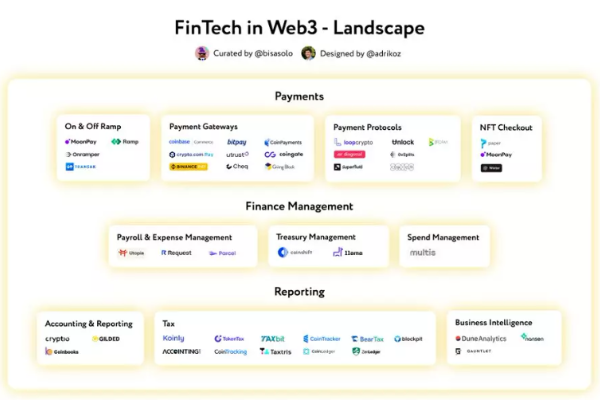
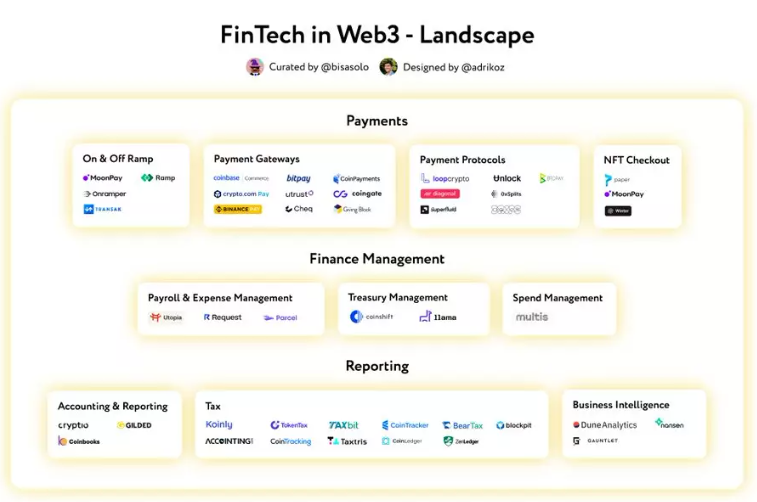
Inspired by @qwqiao's Web3 startup ideas, I dove into researching fintech startups within Web3. The landscape below covers nearly 50 startups offering fintech solutions—ones that investors and founders should pay attention to.
Web3, as a new primitive, marks a fundamental paradigm shift, meaning we can’t simply copy and paste traditional FinTech tools from Web2. Replacing fiat with crypto, bank accounts with wallets, and LLCs with DAOs gives rise to a new class of financial applications built to support innovation at this stage.
As a result, history is repeating itself—FinTech continues to drive greater value in the Web3 space. In this article, I’ll map out the landscape of Web3 financial tools and highlight why it’s rapidly becoming the next exciting frontier for investors and entrepreneurs.
On-Ramps & Off-Ramps
As Web3 reimagines a new financial world, fiat on-ramps and off-ramps serve as essential bridges connecting the virtual and real economies.
They provide a convenient way to convert fiat currency from bank accounts directly into tokens in a wallet, helping users explore and interact with decentralized network applications.
On- and off-ramps are foundational infrastructure and have quickly become the first fintech tool many people use when entering Web3.
Examples: @moonpay, @RampNetwork, @GetOnramper, @transak_
Payment Gateways
As cryptocurrencies have established themselves as a form of digital money, payment gateways serve as portals for users to spend crypto.
They enable merchants to accept cryptocurrency as a form of payment, allowing customers to obtain goods or services.
Payment gateways are a key component in transitioning commerce from fiat to crypto, providing a seamless transaction experience for both buyers and sellers.
Examples: @CommerceCB, @BitPay, @CoinPaymentsNET, @cryptocom, @UTRUST, @CoinGatecom, @binance, @cheq_xyz, @TheGivingBlock
Payment Protocols
By removing centralized entities and replacing them with smart contracts, payment protocols represent the purest form of crypto-native payment gateways.
They enable truly permissionless commerce between merchants and their customers.
Payment protocols offer a decentralized alternative to centralized gateways, accelerating the shift of commerce from fiat to crypto.
Examples: @loopcrypto_xyz, @Superfluid_HQ, @UnlockProtocol, @DiagonalFinance, @BtcpayServer, @dripsnetwork, @0xSplits
NFT Checkout
Given their inherent scarcity and artistic value, NFTs have become essential assets for any participant in the digital economy to assert ownership.
Dedicated NFT checkout provides a frictionless way for buyers to purchase NFTs using credit or debit cards.
NFTs can represent anything from certificates to community membership. Given their significance, NFT checkout offers users an easier way to acquire them.
Examples: @papercheckout, @moonpay, @winter_NFTs
Payroll & Expense Management
As Web3 continues to grow and mature as an industry, payroll and expense management have become critical components of on-chain workforce operations.
They help on-chain organizations streamline financial operations, enabling them to pay contributors and contractors and manage expenses denominated in cryptocurrency.
Web3 is transforming the nature of work, and a crypto-native payroll and expense management solution is key to helping organizations operate in this new world.
Examples: @utopialabs_, @RequestFinance, @parcelHQ
Treasury Management
As online communities with shared bank accounts take root in the form of DAOs, treasury management aims to solve how to manage these collective accounts.
Using treasury management tools, organizations can diversify and otherwise manage their on-chain assets effectively. Online communities are defined by shared asset ownership, and treasury management is a prerequisite for their long-term sustainability.
Examples: @0xCoinshift, @llamacommunity_
Spend Management
As more companies undergo digital transformation, fiat is no longer the default currency, and spend management must support new multi-currency forms.
These tools help on-chain organizations operating across the Web2 and Web3 divide manage their expenditures in both fiat and crypto.
Given that an organization may hold multiple cryptocurrencies simultaneously, spend management is playing an increasingly vital role.
Examples: @multisHQ
Accounting & Reporting
An organization’s financial activities must be reconciled with the real world to some extent, making Web3-native accounting and reporting the preferred tools.
On-chain organizations can use them to track all on-chain transactions—from token swaps to NFT minting—across multiple blockchains to ensure compliance.
Even in a new digital world, participants’ transactions must be tracked and accounted for—making accounting and reporting essential.
Examples: @cryptio_co, @Coinbooks_, @GildedFinance
Tax
As one of life’s two certainties (death and taxes), it’s no surprise that tax remains unavoidable—even in the digital world.
Web3-native tax applications are used by consumers and businesses alike to track crypto portfolios and transactions, from which capital gains, income tax, and more can be calculated.
With thousands of cryptocurrencies and unique mechanisms like staking, on-chain tax applications offer solutions to this complex challenge.
Examples: @koinly, @TokenTax, @TaxBit, @CoinTracker, @bear_tax, @blockpit_io, @accointing, @Coin_Tracking, @tax_tris, @CoinLedger, @ZenLedgerIO
Business Intelligence
Due to the shift toward a new computing paradigm, on-chain organizations have created demand for on-chain business intelligence.
Intelligence platforms process blockchain data for use by Web3-native organizations to enable high-quality decision-making.
As companies move on-chain, the need for actionable insights grows—making business intelligence a necessary tool for surfacing those insights.
Examples: @DuneAnalytics, @nansen_ai, @gauntletnetwork
As existing applications become increasingly insufficient for their needs, I predict more innovation in Web3 fintech will emerge. Some solutions I’d love to see include:
● KYC—As “Know Your Customer” (KYC) evolves into “Know Your Wallet” (KYW), EU regulations are placing burdens on centralized exchanges to collect information about non-custodial wallets or block transfers to them. I predict this will extend to decentralized applications—if certain wallets are known malicious actors, they will be blocked from interacting with dApps. We’ve already seen this happen: Tornado Cash uses Chainalysis’ oracle contract to block OFAC-sanctioned addresses. As dApps face higher regulatory standards, a KYC API service will become necessary for developers to integrate into their apps to handle the full regulatory burden, freeing them to focus on their core product.
● Subscription Management & Billing—As crypto becomes an increasingly popular commercial tool for consumers, current billing models are limited to one-time payments, with no alternatives yet available for quantity-based or recurring business models. Crypto-native subscription management and billing tools will emerge as solutions for merchants, enabling not only the migration of existing Web2 business models to Web3 but also helping manage and reconcile subscription data differences arising from dual currency systems.
● Procurement—Permissionless participation in decentralized organizations is a superpower, but it creates coordination challenges—especially around procurement tools. DAO procurement often happens in non-standard ways, with no clear accountability among stakeholders. Given the expected growth of DAO-specific tools—as distinct from services and investments—procurement management applications will become essential for sufficiently large DAOs, ensuring they acquire the best tools suited to their purpose.
As financial activity continues shifting on-chain, fintech in Web3 will become increasingly important. This landscape serves as a starting point for entrepreneurs and VCs to begin thinking about this emerging category.
Join TechFlow official community to stay tuned
Telegram:https://t.me/TechFlowDaily
X (Twitter):https://x.com/TechFlowPost
X (Twitter) EN:https://x.com/BlockFlow_News