
Global Web3 Ecosystem Innovation Insights Report
TechFlow Selected TechFlow Selected
Global Web3 Ecosystem Innovation Insights Report
The history of blockchain is almost synonymous with the history of public blockchains.
 Navigating Web3 tides with focused insights
Source: DeFi Dao & SUSS NiFT
Preface
This is the first comprehensive industry report globally that observes the sector from a complete Web3 perspective. As long-term practitioners, we clearly see how blockchain technology has matured, driving rapid growth in computing power, crypto markets, metaverse, and Web3—expanding the boundaries of this industry step by step.
Our report undoubtedly represents a new vantage point standing on the shoulders of giants: Messari’s Crypto Theses for 2022, a16z’s State of Crypto 2022, McKinsey’s “Value Creation in the Metaverse,” among others—all describe different facets of this industry's past or present. Our report, while also grounded in the full Web3 perspective, like theirs, can only be accountable to the current moment in history.
We begin our report with the ideas behind Web3, tracing back to early internet-era intellectual roots. Then we examine technological infrastructure and mainstream applications today, followed by the hottest areas in Web3 such as DeFi, NFTs, GameFi, and DAOs—covering roughly the period from Bitcoin’s genesis block to the moment this report was published. Next comes the metaverse world within our current field of vision. Finally, we discuss investment and regulation co-evolving with the industry. We have been fortunate to witness the birth of this industry, and now hope this report will accompany its growth.
Chapter One: Web3 – A Renaissance in Cyberspace
Starting in late 2021, search volume for the term "Web3" surged across the internet. People began enthusiastically discussing Web3, as if its ideals could become reality tomorrow. But Web3 is not some sudden invention—it is a continuation of the cyberpunk and cypherpunk spirit from the 1980s and 1990s. The current Web3 revolution resembles more of a cultural renaissance, injecting native economic vitality into cyberspace.
Section 1: Declaration of the Independence of Cyberspace
On February 8, 1996, John Perry Barlow, founder of the Electronic Frontier Foundation, issued the "Declaration of the Independence of Cyberspace," proclaiming the digital world as an independent mental homeland beyond the jurisdiction of any traditional authority.
The declaration primarily expressed three core principles:
One, Non-Physical: Our world is omnipresent yet intangible—it does not exist in physical form.
Two, Borderless: Anyone may join without privileges or biases based on race, economic strength, military power, or place of birth.
Three, Non-Discriminatory: Any person, anywhere, can express their beliefs without fear of being forced into silence or compliance, no matter how unconventional those beliefs might be.
Barlow’s declaration quickly gained fame and spread widely online. Within nine months of publication, it had been republished on approximately 40,000 websites.
We will create a civilization of the Mind in Cyberspace.
——John Perry Barlow
However, as the internet evolved, increasing numbers began questioning his vision. By 2002, the number of sites republishing the declaration had dropped to around 20,000. Even Barlow himself, in a 2004 interview, reflected on his work in the 1990s, particularly his earlier optimism. He said: "We've all grown older and wiser." Clearly, the envisioned utopia hadn't materialized—but this did not deter idealists from continuing their pursuit.
Section 2: Early Attempts at Sovereign Currency in Cyberspace
If money is the essential lifeblood enabling efficient operation in modern economies, then an independent cyberspace should possess its own native monetary system to conduct economic activities.
Around the same time as the "Declaration of the Independence of Cyberspace," the cypherpunk movement was flourishing. In 1993, Eric Hughes published the "Cypherpunk Manifesto," outlining the mission and goals of the cypherpunks—to build anonymous systems using cryptography to defend privacy. The manifesto also stated: "Software cannot be destroyed; thoroughly distributed systems never go down."
We the Cypherpunks are dedicated to building anonymous systems. We are defending our privacy with cryptography, with anonymous mail forwarding systems, with digital signatures, and with electronic money.
——Eric Hughes
In 1983, David Chaum proposed an anonymous electronic cash system based on blind signature technology—the precursor to later eCash. However, it never gained popularity, and DigiCash, the company behind it, went bankrupt in 1998. There were many reasons for DigiCash’s failure, but fundamentally, its centralized architecture likely played a key role—if the central company or server failed, the entire system collapsed. It's hard to imagine relying on a single corporation's product as the universal currency standard for the internet.
In the same year DigiCash collapsed, another cypherpunk, Wei Dai, introduced b-money—an anonymous, decentralized digital cash system. B-money essentially contained all the basic characteristics of modern cryptographic currency systems, but due to various technical limitations, it was never formally launched.
By 2005, Nick Szabo designed a decentralized digital currency mechanism called bit gold. Since all data in cyberspace can be easily copied and pasted, designing digital currencies must solve the "double-spending problem." Most digital currencies rely on a centralized authority to record account balances to prevent double spending, but Szabo rejected this approach: "I want to mimic the security and trustworthiness of gold in cyberspace as much as possible—especially without relying on a trusted central authority." Bit gold is considered a direct predecessor to Bitcoin, though unfortunately, it too was never implemented.
From eCash to b-money to bit gold, early cypherpunks made numerous attempts to create a native sovereign currency for cyberspace, yet none achieved practical real-world application.
Section 3: Software Is Eating the World
Meanwhile, the internet transitioned from the Web 1.0 era to Web 2.0, but encountered development bottlenecks that existing architectures couldn't resolve.
Web 1.0 is a retroactive term referring to the first phase of the World Wide Web, roughly from 1991 to 2004. During this stage, content creators were rare, and most users were passive consumers—"use-and-go."
In the Web 2.0 era, ordinary users could exchange information and collaborate at very low cost across platforms. The core philosophy of internet products became interaction, sharing, and connectivity. It was in 2011 during this period that Marc Andreessen, partner at a16z, famously declared, "Software is eating the world." He wrote: "We believe many prominent emerging internet companies are building real, high-growth, high-profit, and high-moat business models."
Indeed, we later witnessed the rapid rise of tech giants like Meta (formerly Facebook), Amazon, Alphabet (Google’s parent), and Tencent. Despite differing business models, they shared one common trait: extracting state from users. In computer systems, "state" refers to the condition of something at a given moment. A "stateful" system produces outputs that vary depending on the current state—even with identical inputs. For example, every click a user makes on Google Search helps refine future search results for other users.
In the Web 2.0 era, users weren’t just service consumers—they became part of the product itself. Internet services grow compoundingly in value as users trust platforms with their data in exchange for better experiences, allowing platforms to command higher valuations.
But after the honeymoon ends and platform growth hits a ceiling, they often betray user trust, turning positive-sum relationships into zero-sum games. Platforms extract user data—including privacy—to sustain growth, transforming former partners into competitors. Meanwhile, years of accumulated user state create massive moats that new entrants struggle to overcome, stifling competition and innovation.
Software is eating the world—and the layer above software is increasingly consuming participants’ interests. The internet urgently needs a paradigm shift.
Section 4: The Genesis of Blockchain
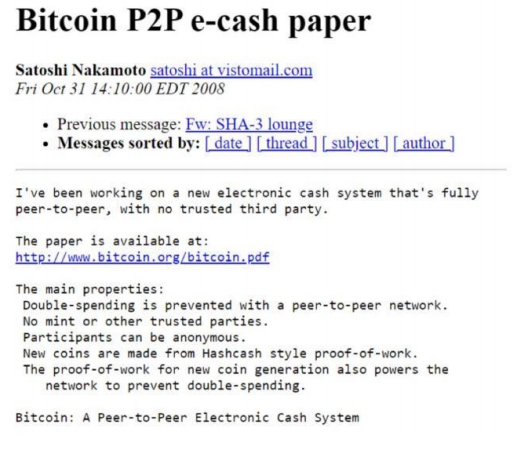
On October 31, 2008, Eastern US Time, Satoshi Nakamoto released the Bitcoin white paper on a cypherpunk mailing list. Two months later, on January 3, 2009, he mined Bitcoin’s genesis block. This marked the emergence of a trustless, internet-native currency—long sought by cypherpunks—for which cyberspace finally obtained the blood of economic activity.
On January 24, 2014, Vitalik Buterin officially announced the Ethereum project at the Miami Bitcoin Conference. Building on Bitcoin, Ethereum offered developers greater flexibility by introducing a Turing-complete virtual machine onto the blockchain, effectively turning the entire network into a globally shared general-purpose virtual computer. The emergence of DeFi protocols like Uniswap and Compound enabled increasingly complex financial activities—trading, lending—in cyberspace. Later, innovations like NFTs, GameFi, and DAOs provided even more spaces for digital natives to engage.
In April 2014, Gavin Wood, Ethereum co-founder and then CTO, first systematically articulated the concept of Web3. Wood argued that in the post-Snowden era, internet users could no longer blindly trust corporations, which manage and use personal data solely for profit. Instead, we need minimally-trusted internet infrastructure and applications. He believed, "Web 3.0 is a set of inclusive protocols providing foundational modules for app developers to build applications in entirely new ways. These technologies allow users to verify the authenticity of received and sent messages, ensuring reliable payments and receipts during transactions. Web 3.0 can be seen as an executable Magna Carta for the internet—a cornerstone of individual freedom against authority."
Thus, the renaissance of cyberspace began to take shape—a decentralized network system characterized by:
1. Open and verifiable, where participants control the state and ownership;
2. Inclusive and non-discriminatory, allowing equal access to network services;
3. No single point of failure, with highly robust network structure;
4. Decentralized governance, requiring participant authorization for changes;
5. Native, trustless economic systems within cyberspace.
Thriving communities like DAOs and Web3 applications already demonstrate the power generated when strangers gather in cyberspace around shared values and missions. With continued infrastructure evolution, countless possibilities remain to be discovered.
Conclusion
Finally, I’d like to close this chapter with a quote from Kyle Samani, co-founder of Multicoin Capital:
Trust is the foundation of all economic relationships. The greatest investment opportunity of our lifetime is betting that it doesn’t have to be this way.
Chapter Two: Infrastructure (Public Blockchains)
The Web3 revolution may have started long ago, but the historical epoch of blockchain begins only with Bitcoin’s creation in 2009. In this revolution symbolized by blockchain, public blockchains are unquestionably the most critical foundation. From Bitcoin’s PoW to ETH 1.0 with smart contracts, and onward to PoS-based L1 networks—public blockchains have undergone three major iterations over these 13 years. Today’s Web3 is a hybrid system where all three models coexist and thrive.
Section 1: The Rashomon of Bitcoin
This marks Bitcoin’s (BTC) fourth halving cycle. As blocks continue piling up, it becomes increasingly difficult to define what Bitcoin truly is. So many meanings have been projected onto this 2009-born "coin" that we can only observe its "Rashomon effect" through shifting perspectives.
1.1 BTC vs Fiat
Bitcoin enthusiasts still believe BTC will replace fiat as a global payment tool—as described in the Bitcoin white paper: a peer-to-peer payment system. El Salvador’s decision in September 2021 to adopt Bitcoin as legal tender greatly encouraged this camp.
But top-down promotion faced bottom-up resistance. Anti-Bitcoin protests emerged, many people downloaded wallets just to claim $30 once and never used them again, and merchant adoption remained low.
El Salvador’s planned $1 billion "volcano bond" issuance in March this year hasn’t launched yet. While other countries consider adopting Bitcoin as legal tender, only the Central African Republic has officially done so. Will Bitcoin ever replace fiat? Can it dethrone the dollar as the world’s reserve currency? According to the Bank for International Settlements’ special report *The Future Monetary System* released June 12, 2022, the answer is no. Governments and regulators worldwide agree it’s impossible.
Perhaps so. But the payment system and wallet infrastructure brought by BTC may offer financial inclusion to the unbanked. Indeed, even if El Salvador ultimately fails to popularize Bitcoin, its promotion of the Lightning Network wallet has already enabled locals to receive USD remittances from overseas relatives. At least they now have another option.
1.2 BTC vs Assets (Gold & Stock)
Bitcoin has always been about "mining." Yet the era of individual prospectors has passed—regardless of why, institutions now dominate mining.
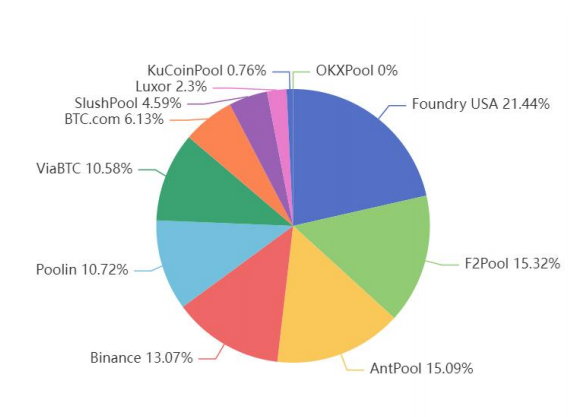
Source: Global Hashrate Distribution
Energy controversies in 2021 led some countries to ban mining (Bitcoin’s PoW mechanism requires energy-intensive probabilistic "puzzles" to generate blocks); others banned cryptocurrency trading; the market turned bearish; Ethereum shifted toward PoS… Mining power migrated and fluctuated, yet never disappeared—just as it has throughout the past decade.
Over the last decade, Bitcoin has steadily eaten into gold’s market share. Regardless of external conditions, holding Bitcoin has become a hedge against risk. Ray Dalio and many investors now include small allocations of Bitcoin in their portfolios.
Yet recently, gold appears to be regaining momentum.
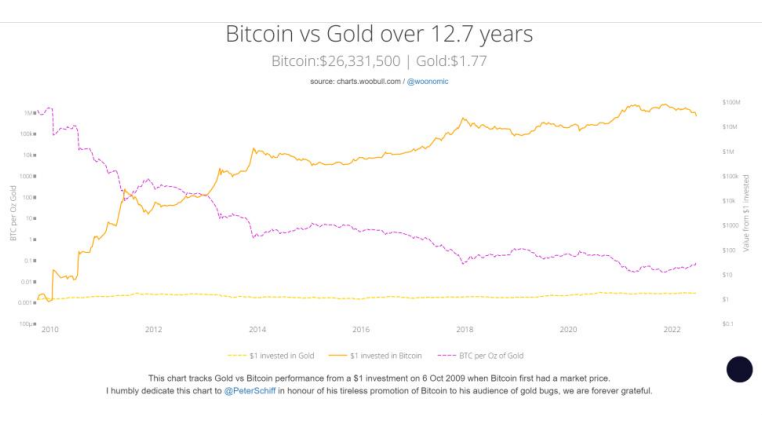
Source: Woobull Charts
Moreover, BTC—which long maintained low correlation with U.S. equities—has increasingly moved in tandem with Nasdaq, especially large-cap tech stocks. This suggests BTC’s asset profile is evolving: its "mining" nature is weakening while its tech-stock characteristics strengthen.
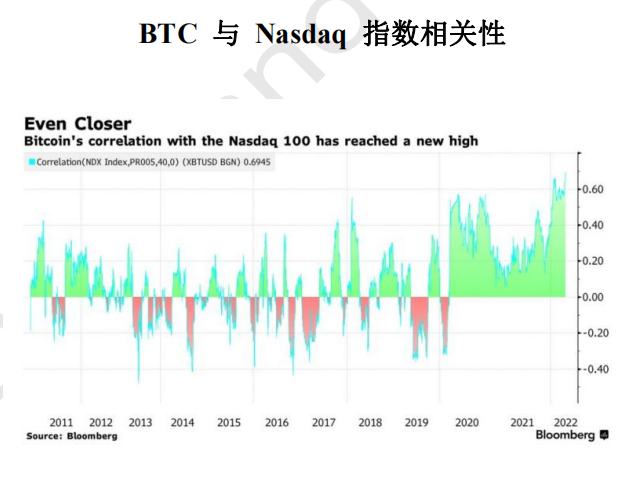
Source: Bloomberg
1.3 BTC vs Crypto
From a blockchain perspective, BTC more broadly represents core values. In terms of market cap, BTC consistently holds over 40% of the total market. During bull runs, capital flows to other tokens; during bear markets, BTC’s share grows—reinforcing its status as the ultimate collateral. Hence the argument: PoS works because PoW worked.
PoW network architecture and validation mechanisms are no longer mainstream in new blockchain development. However, after multiple hard forks, Bitcoin’s main chain has clarified its positioning and values: extreme security and value storage. Payment functions are delegated to Layer 2 solutions like the Lightning Network. Smart contracts mostly run on Ethereum and other L1 chains, with cross-chain bridges (or centralized exchanges) facilitating value transfer with BTC.
The Taproot upgrade arrived late in November 2021, bringing improved security, privacy, and scalability to BTC. We haven’t seen mainstream applications emerge yet, but the BTC ecosystem has become more imaginative.
1.4 BTC vs DAO
Beyond providing the most trustworthy native asset in the crypto world, BTC’s significance to Web3 may lie in offering a new organizational model—at least proving that large-scale global coordination can operate entirely without trust.
Humans and machines—or humans via code—achieved a successful collaboration case.
1.5 BTC vs World
In earlier narratives, BTC was called the bedrock of the blockchain world. Over the years, the blockchain world built atop this foundation has grown richer. Now, this bedrock connects more deeply with the physical world, impacting Wall Street institutions, national regulators, third-world citizens, and tech players. Their involvement reshapes BTC into new forms. Thus, BTC becomes a bridge—one connecting the virtual and the real. Somehow, WAGMI.
Section 2: Ethereum – The Smart Contract Platform
Ethereum is a public blockchain platform with smart contract functionality, allowing anyone to build decentralized applications (DApps). Since Bitcoin ushered in the blockchain era in 2009, the most representative technological innovation has been Ethereum’s introduction of smart contracts—providing the foundational bedrock for the explosion of DApps, DeFi, and NFTs.
2.1 Smart Contracts
Smart contracts are programmable agreements—self-executing code snippets. They derive value under one crucial precondition: an immutable storage and execution layer resistant to physical tampering.
Blockchain’s immutability naturally aligns with smart contracts, freeing blockchain technology from mere cryptocurrency payments. With Turing completeness, blockchain transcends Bitcoin’s simple ledger limitations, enabling complex value transfers. Meanwhile, diverse applications demand higher performance, indirectly catalyzing high-performance L1 chains and Layer 2 projects.
Currently, Ethereum is the largest smart contract platform. Its programming language, Solidity, is the most widely used and popular. Applications built with Solidity hold 85% of the total value locked (TVL) across the DeFi ecosystem.
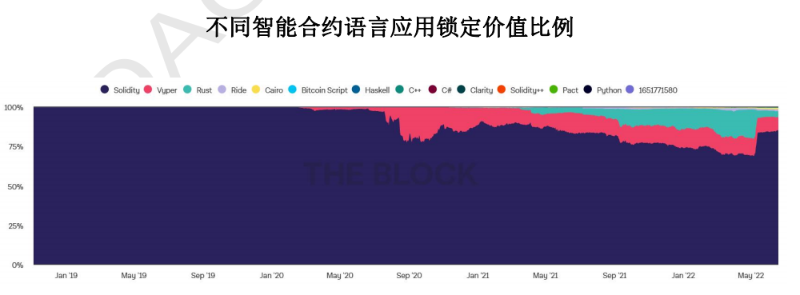
Source: The Block
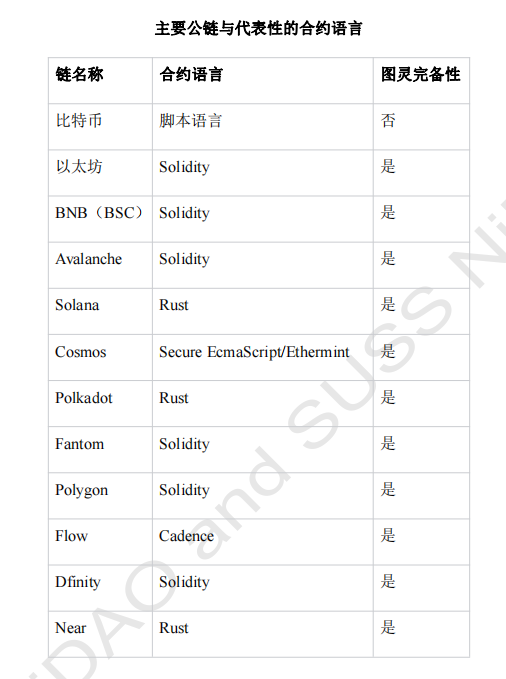
Ethereum’s ecosystem concentrates in DeFi, including: DEXs (Uniswap), lending (Aave, Compound), derivatives (dYdX), stablecoins (MakerDAO, Frax). Other applications focus on NFTs and GameFi.
Currently, Ethereum’s TVL stands at $47 billion—comparable to MediaTek and Kuaishou’s market caps. The top three apps—MakerDAO, Lido, and Uniswap—account for 16.7%, 10.3%, and 9.9% of Ethereum’s TVL, respectively.
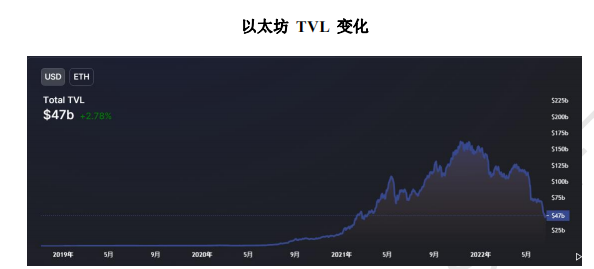
Source: DefiLlama
2.2 Ethereum and EVM-Compatible Chains
Compatibility with the Ethereum Virtual Machine (EVM) is now a necessary choice for many public chains and Layer 2 solutions. As the largest ecosystem with the most developers, Ethereum holds immense influence. Currently, hundreds of active public chains and EVM-compatible chains exist, but few have built sustainable moats. Most chains have shifted from pure TPS competition to dual drivers: ecosystem development and capital incentives.
Ethereum’s ecosystem continues to lead by a wide margin. With progress toward The Merge and eventual sharding, Ethereum’s irreplaceability strengthens further. Public chains actively pursue EVM compatibility to ease DApp migration and deployment. This has created a vast EVM-compatible ecosystem, simplifying multi-chain deployments. Examples include:
BNB Chain (BSC)
Launched on September 1, 2020, Binance Smart Chain was the first EVM-compatible public chain launched by an exchange during the DeFi summer. BSC captured most traffic from Binance’s platform, securing its position among public chains. Using a DPoS mechanism similar to EOS, BSC achieves 30–70x Ethereum’s TPS, but with only 21 effective nodes—far less decentralized than Ethereum.
Avalanche-C
Avalanche is an interoperable, highly scalable decentralized network. It consists of three chains: X-Chain (DAG-structured, fastest for transfers), C-Chain (EVM-compatible smart contract chain), and P-Chain (for staking, similar to Polkadot’s relay chain).
Fantom
Fantom is a high-performance EVM-compatible public chain leveraging DAG technology. Backed by Andre Cronje, Fantom’s ecosystem exploded in growth over the past year. But after Cronje exited in early 2022, Fantom hit rock bottom—its TVL plummeted from $11.81 billion to $980 million, a 91.7% drop.
Additionally, previously non-EVM chains have launched EVM-compatible Layer 2 solutions: Near launched Aurora, Polkadot introduced Moonbeam, Cosmos added Evmos, Solana rolled out Neon. Most major public chains now support EVM, further amplifying Ethereum’s influence in crypto.
2.3 The Ethereum Merge: From PoW to PoS
Consensus mechanisms are a core component of blockchain infrastructure—they maintain network state consistency and determine how block rewards are allocated. While many variants exist today, two dominant models prevail: PoW and PoS. Bitcoin represents PoW; BSC, Fantom, and post-merge Ethereum represent PoS. Under PoS, validators no longer compete via massive computational power. Instead, they earn rewards by creating/subbing blocks when randomly selected, or verifying others’ blocks otherwise.
The Ethereum Merge refers to combining the Ethereum mainnet with the Beacon Chain—what the Ethereum Foundation calls merging the consensus layer (Beacon Chain) with the execution layer (current Ethereum interaction tier). The Merge is a pivotal step toward Ethereum’s sharding era. Afterward, Ethereum will abandon PoW in favor of full PoS. Network validation will shift to stakers; PoW miners and mining rigs will exit the stage.
Ethereum’s low scalability, high energy consumption, and expensive gas fees severely constrain ecosystem growth. Sharding is seen as the optimal solution, making its rollout central to Ethereum’s future. The Merge lays the groundwork for sharding.
Transitioning from PoW to PoS has long been part of Ethereum’s roadmap. The "difficulty bomb"—a special mechanism designed to force consensus change—aims to push PoW miners toward PoS. This algorithm increases chain difficulty exponentially with block height, eventually making mining unprofitable and prompting a shift to PoS. Due to repeated delays, the bomb has been postponed several times. The Grey Glacier hard fork in June 2022 signaled the Merge would occur no earlier than September.
Post-Merge changes fall into three main categories:
First, significantly reduced ETH issuance. Under PoW, ~12,000 ETH were minted daily. Under PoS, daily issuance drops to 1,280—a 89.3% reduction. Combined with EIP-1559’s burn mechanism, Ethereum may enter deflationary territory.
Second, lower validator barriers promote further decentralization. PoW required specialized hardware, limiting participation. PoS eliminates the arms race in computing power, drastically lowering hardware requirements. Anyone meeting staking thresholds can run a node. With staking providers, becoming a validator becomes accessible to more users.
Third, massive energy savings, moving Ethereum closer to carbon neutrality. PoS eliminates constant demand for high-powered mining rigs, slashing electricity consumption. Currently, Ethereum consumes ~51.32 TWh annually—equivalent to Portugal—and emits ~28.63 million tons of CO₂ yearly. According to Ethereum Foundation estimates, post-Merge energy use will drop by 99.95%, with each node consuming roughly the same power as a household computer per day.
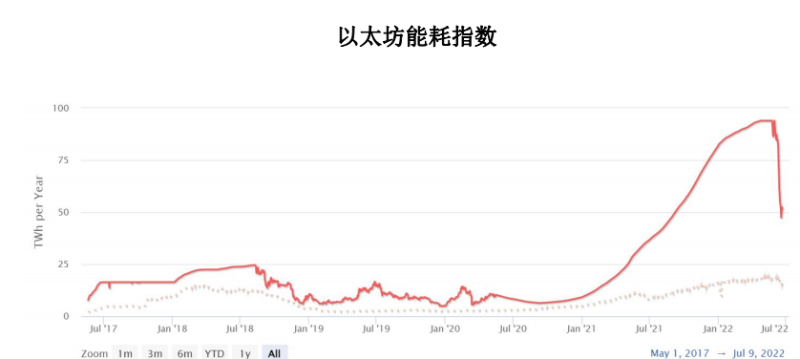
Source: Digiconomist
Importantly, the Merge alone won’t improve scalability or reduce gas fees. Significant UX improvements await subsequent sharding rollouts.
Section 3: Ethereum Layer 2
To scale Ethereum’s performance, various solutions have emerged, broadly categorized by protocol layer: Layer 1 and Layer 2. Layer 1 scaling ("on-chain") improves performance via larger blocks or modified data structures—Ethereum’s sharding falls under this. Sharding includes transaction sharding (partitioning computation across shard nodes) and state sharding (storing data separately by shard attributes), both enabling parallel processing for higher throughput.
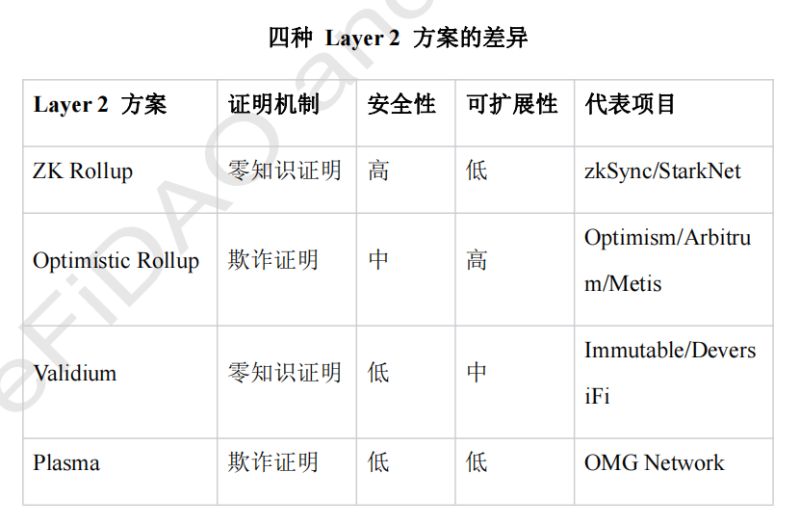
Layer 2 ("off-chain") moves computation and transactions off the main chain to reduce load, improving speed and lowering costs. Ensuring off-chain data availability and security gave rise to different Layer 2 approaches: ZK Rollup, Optimistic Rollup, Validium, Plasma. Until sharding arrives, Layer 2 remains Ethereum’s best scaling option. Currently, Ethereum L2 is dominated by two Rollup types: ZK Rollups and Optimistic Rollups.
Rollup means bundling transactions—multiple transactions are aggregated and submitted to the main chain at once, reducing interaction frequency and easing congestion. Rollups ensure original transaction data resides on Ethereum, eliminating reliance on specific validators, making them the most secure Layer 2 option.
3.1 ZK Rollup
ZK Rollup, first proposed in 2018, relies on zero-knowledge cryptography to safeguard funds (proving ownership without revealing information—"zero knowledge" externally). It uses Ethereum as storage and finality layer, inheriting its security.
While ZK Rollups protect against fund seizure and censorship, immature technology and difficulty building general-purpose networks limit adoption. Creating a generic EVM environment is far harder for ZK Rollups than Optimistic Rollups. Key examples: zkSync and StarkNet.
zkSync
Developed by Matter Labs, zkSync’s fully EVM-compatible 2.0 testnet is live. zkSync 2.0 splits L2 state into zkRollup (on-chain data availability) and zkPorter (off-chain), similar to StarkWare’s StarkNet/StarkEx. Over 100 ecosystem projects are listed, mainly in infrastructure, bridges, and DeFi. On zkSync, gas can be paid in tokens other than ETH.
StarkNet
Led by StarkWare, StarkNet is a general-purpose L2 scaling platform. Though both ZK Rollups, differences exist: StarkNet uses zk-STARKs, offering superior security, while zkSync uses zk-SNARKs, requiring less on-chain storage and gas.
In May, StarkNet raised $100 million at an $8 billion valuation—the highest among all L2 projects. StarkWare is actively testing the L1-L2 bridge starkgate, with StarkNet expected to launch soon. Over 70 ecosystem projects are listed, mostly in DeFi.
3.2 Optimistic Rollup
Optimistic Rollup doesn’t use zero-knowledge proofs but fraud proofs—borrowing from early Plasma techniques. Security relies on game theory between validators and challengers. When L2 transaction states are submitted to L1, a ~7-day challenge window begins. Funds are locked during this period. If fraudulent data is detected, challengers submit fraud proofs and claim the validator’s stake.
Compared to ZK Rollup, Optimistic Rollup’s key advantage is compatibility with complex smart contracts. This explains why most deployed, sizable L2 projects belong to this category:
Optimism
Optimism pioneered EVM-compatible Optimistic Rollup. It ensures Layer 1 data validity via single-round interactive fraud proofs—its main difference from Arbitrum. It was also the first of the four major L2s to issue a token.
Arbitrum
Built by OffChainLabs, born at Princeton University, Arbitrum currently leads all L2 projects in ecosystem maturity and TVL. It uses multi-round interactive fraud proofs: upon dispute, it narrows the contested range through multiple rounds on L2 before simulating on L1—reducing on-chain dispute resolution costs, a key distinction from Optimism.
3.3 Validium and Plasma
Validium (StarkEx)
Validium, developed by StarkWare, is a hybrid scaling solution similar to ZK Rollup. A critical difference: transaction data isn’t stored on-chain like in ZK Rollup. While validity proofs are published on-chain, data resides off-chain—making it less secure. For instance, StarkEx Validium operators can freeze user funds.
It also has limited support for general computation and smart contracts. Generating zero-knowledge proofs demands high computational power, making it uneconomical for low-throughput apps. Its advantages include no withdrawal delays and extremely high throughput (~10k TPS). Notable projects: Immutable, DeversiFi.
Plasma
Plasma was once the dominant Ethereum scaling solution in 2017—a pioneer. But as Rollup matured, Plasma, being less secure, faded from view.
Plasma borrows from Bitcoin’s Lightning Network, featuring a standalone blockchain anchored to Ethereum, using fraud proofs to resolve disputes. Advantages: high throughput, low per-transaction cost. Drawbacks: poor support for general computation, limited to basic token transfers, swaps, etc. Users must regularly monitor or delegate monitoring to ensure fund safety. The most notable Plasma implementation: OMG Network.
Reviewing these L2 solutions reveals they represent different trade-offs between security, performance, and decentralization—giving rise to distinct architectures.
Section 4: Avalanche – Avalanche Consensus, EVM, Subnets
Avalanche emphasizes high performance and scalability—performance via its unique Avalanche consensus, scalability via customizable subnets. It also offers strong EVM compatibility to attract established Ethereum protocols and simplify native protocol development.
4.1 Avalanche Consensus
According to Team Rocket (2018), the Avalanche consensus process lives up to its name: starting with random collapses (statistical sampling), culminating in a large-scale avalanche (consensus formation). Its core idea: repeatedly sample nodes in the network and collect responses to a proposal until all honest nodes converge on the same outcome.
Advantages: high performance, low latency, Byzantine resistance, double-spend protection, miner-user interest alignment, relative fairness.
Potential issues:
-
Random sampling yields probabilistic (non-deterministic) consensus.
-
No protection against conflicting transactions.
-
Requires substantial participation.
(See: ipfs.io/ipfs/QmUy4jh5mGNZvLkjies1RWM4YuvJh5o2FYopNPVYwrRVGV)
4.2 Avalanche Architecture and Native Bridge
Source: Avalanche Official Website
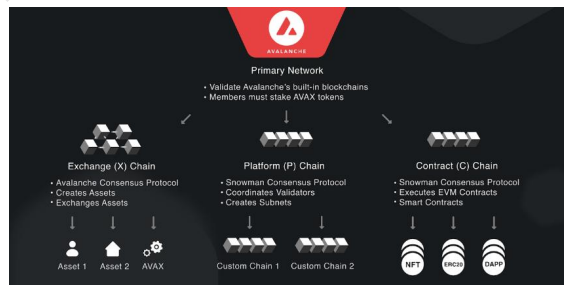
Avalanche’s mainnet comprises three chains:
1. X-Chain (Exchange Chain): for creating assets and transactions;
2. P-Chain (Platform Chain): stores on-chain data, coordinates nodes, manages subnets;
3. C-Chain (Contract Chain): executes smart contracts, EVM-compatible.
The native Avalanche Bridge enables asset transfers from Ethereum to Avalanche. Recently added native BTC bridging allows BTC assets to participate in Avalanche’s DeFi ecosystem.
4.3 Ecosystem
Avalanche’s high EVM compatibility and foundation-led incentives attracted many Ethereum-native projects and fostered native protocols. Users can access the ecosystem by simply adding the Avalanche-C chain to MetaMask.
Avalanche currently has $2.8 billion in TVL. Top five DApps:
-
Aave (Ethereum-native lending protocol deployed on Avalanche)
-
Trader Joe (native Avalanche DEX)
-
Wonderland (native Avalanche DeFi 2.0 protocol, OlympusDAO fork)
-
Benqi (native Avalanche lending protocol)
-
Platypus Finance (native Avalanche stablecoin exchange)
Other notable native protocols:
-
Avalaunch (largest launchpad on Avalanche)
-
Crabada (once most active GameFi protocol on Avalanche)
-
Yeti Finance (leveraged lending on Avalanche)
-
Yield Yak (yield aggregator on Avalanche)
-
Step.app (M2E project on Avalanche)
-
Ascenders (RPG-style GameFi on Avalanche)
4.4 Subnets
Avalanche allows developers to deploy DApps to subnets—creating their own multi-chain application networks. Subnets are easy to deploy, EVM-compatible, and use a subset of Avalanche’s validator pool for security (partial shared security). Subnets cannot directly communicate—best suited for self-contained, low-composability DApps. The first subnet deployment was by DeFi Kingdoms. Others like Crabada, Step.app, and Ascenders plan to follow.
Section 5: BNB Chain – Binance, EVM, BAS
BNB Chain is closely tied to Binance, the world’s largest centralized exchange. It adopts an EVM-compatible architecture and develops BAS sidechains.
5.1 Architecture
Source: Binance Blog
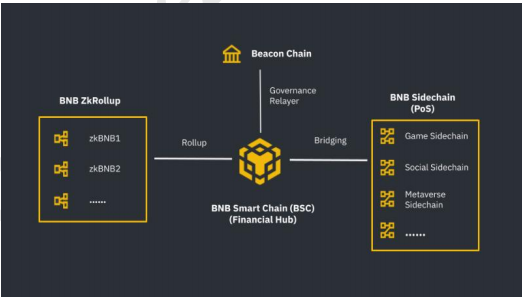
BNB Beacon Chain: governs BNB Chain (staking, voting)
BNB Smart Chain (BSC): EVM-compatible, consensus layer, hub connecting multiple chains
BNB Sidechain: PoS solution for custom blockchains and DApps using existing BSC features
BNB ZkRollup (coming soon): ZkRollup solution to scale BSC into ultra-high-performance blockchain
BSC Partition Chain (BPC): akin to Ethereum L2, handles some computations from BNB Beacon Chain
5.2 BNB
Unlike most public chain tokens, BNB serves both as BSC’s primary token and Binance exchange’s utility token. Its value depends not only on BSC’s activity but also on Binance’s business operations and revenue.
Last November, BNB passed BEP-95’s burn proposal. While beneficial long-term, burning may raise entry barriers for complex GameFi smart contracts. Combined with BSC’s BAS development, BSC may shift high-frequency interactions to sidechains.
5.3 Ecosystem
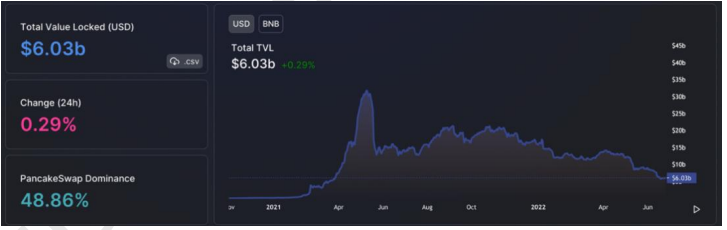
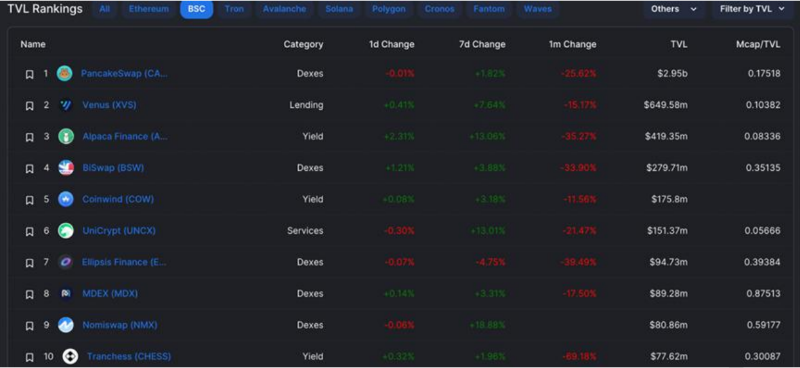
According to DefiLlama, BSC’s TVL is ~$6 billion, accounting for 7.8% of total cross-chain TVL.
Source: DefiLlama
Within the ecosystem, PancakeSwap dominates with 48.86% of TVL. Among the top ten TVL projects, nearly all are BSC-native, and seven are listed on Binance Exchange.
Source: DefiLlama
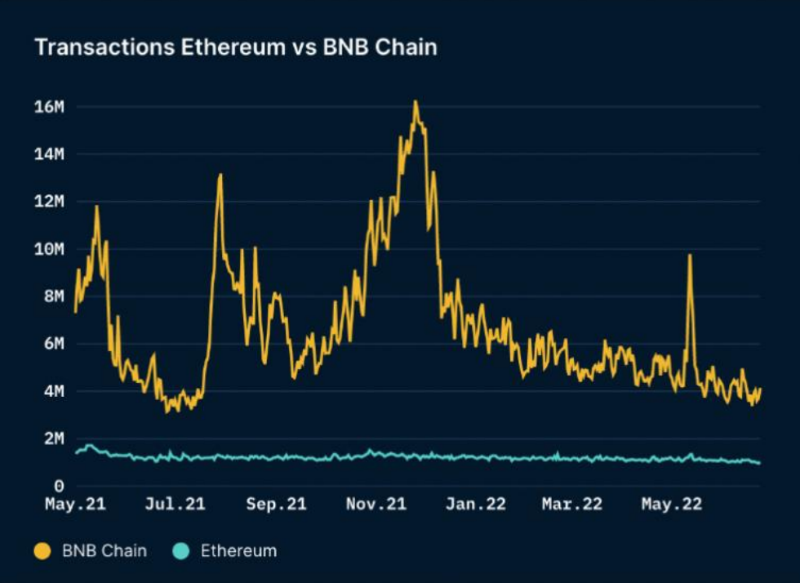
Due to relatively low development costs, BSC hosts abundant active projects—daily transaction hashes peaked at 16 million in November 2021.
Source: defiprime.com
BSC hosts many active DeFi (e.g., Tranchess), GameFi (e.g., Binary X), and metaverse (e.g., SecondLive) projects—only lacking a mature NFT marketplace.
BSC offers generous ecosystem support, regularly running MVB programs to select and fund outstanding projects, plus a $1 billion BSC ecosystem incentive launched in October 2021.
5.4 BAS Sidechain
Per Mehta (2022), each BAS chain will have 3–7 validators, expected to run a super-majority (2/3) PoS consensus. Each BAS chain operates with its own staking and utility tokens. Each sidechain’s state and transitions are fully independent.
Third-party bridges will enable inter-sidechain communication. BSC will leverage Celer’s third-party bridge using a "lock + mint" model to connect to each BAS, and vice versa. (See Shanav K Mehta, Jump Crypto: Flavors of Standalone Multichain Architecture)
Confirmed BAS participants include Meta Apes (native BSC battle GameFi), Project Galaxy (multi-chain identity credential platform), and Cube (native BSC gaming platform).
Section 6: Cosmos – Open Architecture, Modularity, and Airdrops
Instead of running a smart contract on a single public chain, competing with thousands for gas—why not run your own blockchain on Cosmos, secured by shared validators?
——Cosmos Official Website
As the pioneer of multi-chain architecture, if one word could capture Cosmos’ philosophy and ecosystem, it would be: open.
6.1 Open Architecture: Shared Security and Interchain Accounts
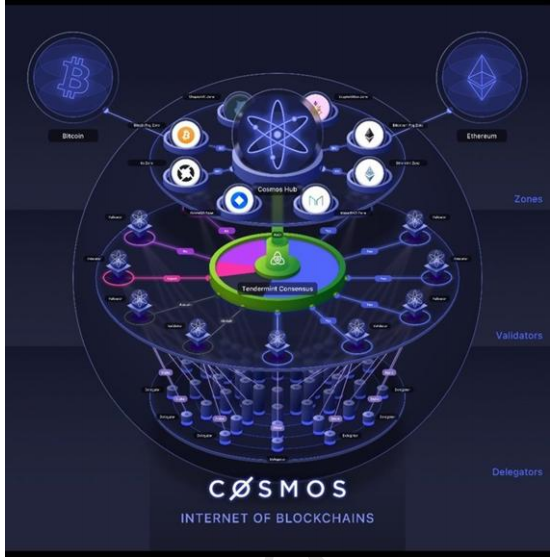
Cosmos Architecture Diagram
Source: X Consulting
At the heart of the Cosmos architecture is the Tendermint consensus engine. This encapsulated consensus module can theoretically be invoked by any application chain via ABCI (Application Blockchain Interface). (Note: ABCI is the green bar connecting Tendermint and the upper Cosmos Hub.)
Upper-layer chains fall into two types: Hub chains (acting as "routers" or relays) and Zone chains (focused on applications). Communication occurs via IBC (Inter-Blockchain Communication) protocol. Later upgraded to Interchain Accounts, enabling seamless operations across chains.
Theoretically, each Zone can independently connect to Tendermint via ABCI. But independence implies autonomy. Without sufficient stakers, chain security is vulnerable. Thus, after launching Cosmos Hub—the first Hub—many Zones chose to connect directly to it, sharing the robust security provided by ATOM stakers, while also indirectly linking to all other Zones via Cosmos Hub. Hence, Cosmos operates as a shared-security collective.
6.2 Modular Cosmos SDK Development Tools
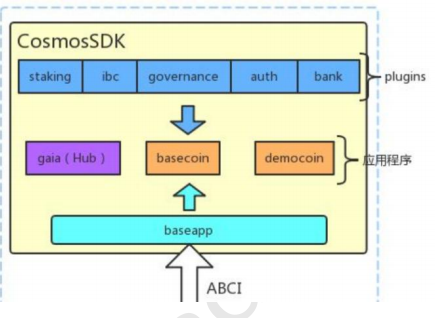
The modular Cosmos SDK toolkit is arguably the most developer-friendly tool for blockchain application builders. By calling pre-built modules, developers rapidly assemble common components and focus on custom logic. SDK also standardizes frequently used modules, preventing redundant development.
Source: cloud.tencent.com/developer/article/1446970
6.3 Airdrops
Due to shared security, validation for new chains is largely handled by existing ones. To reward contributors, new projects typically a
Join TechFlow official community to stay tuned
Telegram:https://t.me/TechFlowDaily
X (Twitter):https://x.com/TechFlowPost
X (Twitter) EN:https://x.com/BlockFlow_News