








MEV 2.0: MPSV Breaks the Oligopoly of the MEV Market, Enabling Passive User Yields
TechFlow Selected TechFlow Selected
MEV 2.0: MPSV Breaks the Oligopoly of the MEV Market, Enabling Passive User Yields
User choice breaks the MEV market oligopoly!
 Navigating Web3 tides with focused insights
Author: Ali Sheikh
Translation: DeFi之道
Since 2017, Maximum Extractable Value (MEV) has undergone several major innovations. These advancements have centered around two participants: miners and MEV searchers. One of the biggest leaps in the MEV space was the creation of Flashbots, aimed at democratizing MEV for these two actors. However, despite today's widespread acceptance of this model under Ethereum’s Proof-of-Work (“PoW”) consensus mechanism, a critical participant remains overlooked: users. With the transition to Proof-of-Stake (“PoS”), there is now an opportunity to redefine MEV to potentially include users. While most current MEV solutions focus on miners, MEV searchers, or even block builders, we believe users can and should be included in this ecosystem.
This article introduces the concept of MPSV (MEV Profit-Sharing Validators), a novel idea that enables users to become beneficiaries of MEV, ultimately completing its full democratization. By “full democratization,” I mean that users could eventually passively earn a share of MEV profits simply by choosing where they stake their assets. But before diving into MPSV, we first need to understand:
(1) The key players in today’s advanced MEV landscape,
(2) The economic market structure of MEV,
(3) The general mechanics of Proof-of-Stake (PoS) systems and the role of validators,
(4) Some game theory.
MEV Participants
Maximum Extractable Value (MEV) remains one of the few areas in the crypto market where participants can extract profits regardless of bull or bear markets. MEV refers to extracting value from users by reordering, inserting, or censoring transactions within blocks.
MEV can be profitable in both bear and bull markets due to the vast, largely unexplored design space for trading strategies. Given current market dynamics, participants are incentivized to continue developing new and innovative long-tail strategies to capture value. According to Flashbots, $20 million worth of MEV has already been extracted on Ethereum alone over the past 30 days. Even as the Terra ecosystem collapsed and the broader crypto market declined, we saw one of the highest daily gross MEV profits of 2022 occur on May 12, 2022:
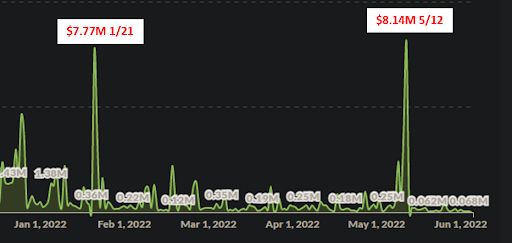
* Gross profit = Daily extracted value from successful MEV transactions without deducting miner payments
Source: explore.flashbots.net
Today, there are two types of winners in MEV: miners and searchers. In this world, searchers are the primary recipients of MEV rewards:
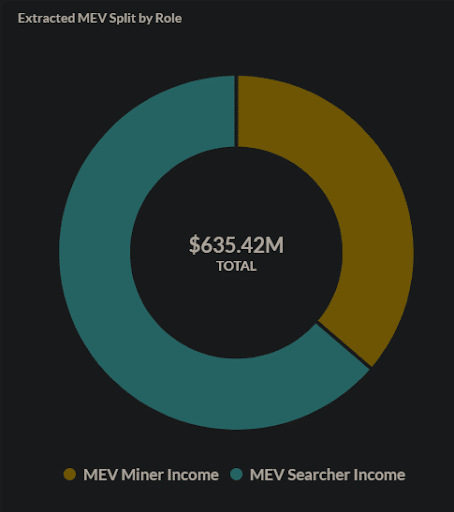
Source: explore.flashbots.net
Economic Market Structure and MEV
Before analyzing market dynamics, it's essential to clearly define its structure. Let's first examine the overall structure of the MEV market, followed by sub-markets involving MEV searchers and miners.
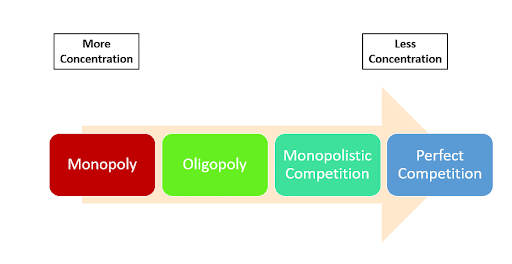
The MEV Market
What makes the MEV market unique is that miners and MEV searchers work together to extract value. When viewed holistically, the entire MEV market resembles an oligopolistic structure.
An oligopoly is a market dominated by a small number of large sellers or producers—in this case, block space is the product being produced and monetized via MEV. Let’s see how this translates to today’s MEV market:
1. High barriers to entry:
-
Miners: High upfront costs related to equipment, technical expertise, and capital make individual entry extremely difficult
-
MEV Searchers: While not necessarily capital-intensive, the high barrier lies in the technical skills, specialization, and deep understanding of DeFi, ETH, and other blockchains required to run MEV strategies.
2. Imperfect competition / pricing power:
Typically, MEV searchers and miners collaborate to maximize total extractable value, even at the expense of users. Additionally, miners hold an advantage because they can choose to accept bids from any searcher offering the highest reward—making them price setters.
3. Interdependence among firms:
Due to their scale and limited competition, how one miner constructs MEV impacts the actions of others.
Moreover, MEV searchers and miners are interdependent: searchers identify MEV opportunities and submit them to miners, who then decide whether to reorder, insert, and/or censor transactions within blocks.
4. Non-price competition:
Generally, competition between MEV searchers and miners isn’t about profit distribution but rather other factors such as specialized hardware, custody, service level, and brand reputation.
5. Potential for collusion:
Given miner centralization, they could theoretically collude. For example, miners might agree to only accept deals where they share 95% of MEV profits with searchers. However, Flashbots mitigates this issue in the current MEV landscape.
Similarly, if MEV searchers unite, they may demand a higher profit split from miners.
The MEV Searcher Market
Now that we’ve defined the overall MEV market, let’s look at its sub-market—the MEV searcher market.
MEV searchers act like blockchain "plumbers." They dive deep into block transactions to uncover MEV. It's a community of skilled, often anonymous specialists with valuable technical knowledge in value extraction. This dynamic exhibits characteristics of monopolistic competition.
Monopolistic competition (not to be confused with monopoly) is a form of imperfect competition where many producers compete, but sell differentiated services rather than perfect substitutes.
Let’s map these features onto the MEV searcher market:
1. Slightly differentiated services:
While all MEV searchers aim to find extractable value on-chain, their approaches differ. For instance, some may focus on arbitrage, liquidations, sandwich attacks, or niche long-tail strategies.
2. Many searchers:
-
Self-explanatory
3. Profit maximization:
MEV searchers seek to maximize profits by extracting as much MEV as possible from blocks. Like pure monopoly games, each searcher tries to extract maximum MEV without typically facing penalties from users.
4. Imperfect information:
MEV searchers possess informational advantages over users, who often unknowingly surrender value.
5. Outcome:
Searchers operate under the assumption that their behavior does not significantly affect others’ actions.
The Miner Market in MEV
A core reason why the MEV market resembles an oligopoly is that the miner market itself is oligopolistic. Since MEV searchers collaborate with miners, the combined system behaves more like an oligopoly interacting with monopolistic competition. In this section, instead of revisiting oligopoly traits, we’ll calculate the Herfindahl-Hirschman Index (HHI) to assess the degree of centralization in the miner market.
The HHI measures firm size relative to its industry and indicates competitive intensity. It is calculated as follows:
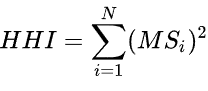
In this equation, MSi is the market share of company i, and N is the total number of companies. We sum the squares of market shares to gauge concentration. Squaring weights gives greater influence to larger participants.
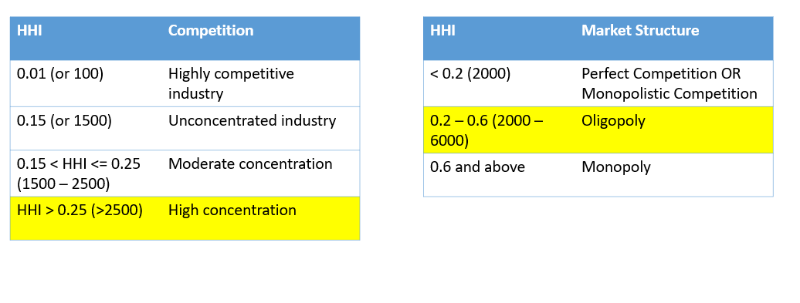
We can use MiningPoolStats to obtain each miner’s hash rate—a proxy for market share (approximately 81 miners listed). Using the following steps:
-
Convert each miner’s hash rate to TH/s
-
Total network hash rate in TH/s
-
Divide each miner’s hash rate by total network hash rate
-
Square each result from step #3
-
Sum all values from step #4
Calculating the HHI for these miners yields approximately 545 (or 0.545), indicating a highly centralized, oligopolistic market structure.
Toward an Ideal Fully Competitive MEV Market
Perfect competition is an idealized market structure where all producers and consumers have complete, symmetric information and zero transaction costs.
Characteristics of a perfectly competitive market include:
-
Large number of buyers and sellers
-
Homogeneous products
-
Free entry and exit for firms
-
Perfect market knowledge
-
Sellers earn normal profits (as opposed to supernormal profits)
In such a market, supply equals demand, achieving Pareto efficiency—where no individual can improve their position without worsening another’s.
One of the greatest innovations in MEV was the creation of Flashbots, designed to democratize access to MEV.
“Mitigating the negative externalities of current Maximum Extractable Value (MEV) extraction techniques and avoiding existential risks MEV may pose to state-rich blockchains like Ethereum.”
Flashbots' Three Goals:
-
Democratize access to MEV revenue
-
Bring transparency to MEV activities
-
Redistribute MEV revenue
Flashbots helps create a fair playing field for MEV searchers by preventing collusion and democratizing MEV access. Although Flashbots democratizes MEV opportunities for searchers, users remain excluded. One might argue anyone can participate in MEV—including users—but we know this is unrealistic since most DeFi users lack access to MEV tools.
Thus, while MEV searchers and miners benefit under the PoW system through Flashbot’s MEV framework, users either gain nothing or become targets of extractable value. The current MEV dynamics among searchers and miners are insufficient to fully democratize MEV or push it toward a perfectly competitive market. However, Proof-of-Stake may change this—and ultimately bring us closer to theoretical perfect competition.
New Paradigm: Enter Proof-of-Stake
It is well known that Ethereum is transitioning to a Proof-of-Stake (PoS) system. In PoS, instead of miners competing to validate blocks, “validators” are randomly selected based on a leader schedule to confirm transactions.
Proof-of-Stake (PoS) is a cryptocurrency consensus mechanism requiring participants to lock up coins to be randomly chosen as validators.
What fundamentally disrupts oligopolistic dynamics in PoS is that users can decide which validators to stake with—potentially influencing leader selection or stake weight (explained below).
We might draw lessons from Solana to understand how users could potentially benefit from MEV profits and share in “extractable value.” The game-changer for users in PoS is their ability to choose where to stake tokens—opening the door for MEV innovation. The greater a validator’s stake weight, the higher the chance of being selected as a leader.
Before exploring further, let’s review some basics about Solana validators.
Solana Consensus and Validators
Solana uses Proof-of-History, its own novel variant of Proof-of-Stake consensus. Solana’s network infrastructure consists of validators and RPC nodes. Validators are the backbone of the Solana network, responsible for processing transactions and participating in consensus. They serve as the network’s “consensus nodes,” validating transactions, voting on blocks, and advancing the consensus mechanism. Running a validator (or RPC node) requires dedicated bare-metal servers with high-end specifications.
From Solana’s documentation on the leader schedule generation algorithm (note #3):
Leader Schedule Generation Algorithm
The leader schedule is generated using a predefined seed. The process is as follows:
-
Periodically, the PoH tick height (a monotonically increasing counter) seeds a stable pseudo-random algorithm.
-
At that height, sample all staking accounts with leader identities that voted within the cluster-configured number of ticks. This sample is called the active set.
-
Sort the active set by stake weight.
-
Use the random seed to select nodes proportionally by stake weight, creating a weighted ordering.
-
This ordering takes effect after the cluster-configured number of ticks.

Validator rewards today fall into three categories:
-
Protocol-based rewards: Issued according to the global inflation rate defined by the protocol—paid on top of earned transaction fees.
-
Staking: Stakers are rewarded for helping validate the ledger. Users benefit from staking by delegating their stake to validator nodes. Validators replay the ledger and send votes to each node’s voting account; stakers can delegate their stake to this account. During forks, the rest of the cluster uses these weighted votes to select a block.
-
Staking pools—these are liquid staking solutions promoting censorship resistance and decentralization, such as Marinade Finance and Lido.
Current staking yields depend on the prevailing inflation rate, total staked SOL, and individual validator uptime and commission rates. A validator’s commission is the percentage fee paid from network inflation to the validator. Validator uptime is determined by voting performance.
In other words, staking returns come from Solana’s inflation program. Validators offer staking rewards to users but may charge fees/commissions. What if we could increase rewards beyond standard inflation in a way that benefits everyone?
Users can stake with their preferred validator and switch if desired—though on Solana this takes 2–4 days. Moreover, with solutions like Marinade’s liquid mSOL, users can instantly unstake SOL in real time. This creates interesting competitive dynamics among validators. Users will favor validators offering the highest rewards and lowest fees/commissions.
All else equal, users will choose the validator with the highest return and lowest fee.
Here’s where it gets very interesting! The more SOL a validator can pool and stake, the higher its stake weight. The greater the stake weight, the higher the chance of becoming a Leader. Think of it like a lottery system—the more stake a validator holds, the better its odds of being selected.
Current MEV on Solana
Today, most MEV extracted on Solana goes to MEV searchers. Much of Solana’s MEV comes from bots spamming the blockchain, constantly hunting for arbitrage opportunities or front-running NFT launches. Due to Solana’s low transaction costs, running bots is a simple strategy for capturing MEV.
Future MEV on Solana
One way to break this spam-bot cycle is to implement a sealed-bid state auction, making contested resources more expensive to lock. On Solana, Jito Labs is building a sealed, silent bid auction allowing searchers to bid for block space. Benefits include enabling MEV transactions to run off-chain in a shared mempool (Solana currently lacks one). Transactions sent via Jito will be prioritized, with rewards shared between searchers and validators—similar to Flashbots. Advantages include:
-
Eliminate spam bots—they can no longer find meaningful MEV since their transactions aren’t prioritized
-
Improved user experience
-
Help clear congestion and improve network efficiency
So, how do we fully democratize MEV and move toward a perfectly competitive market?
User choice!
Enter MPSV: The Future of an Efficient MEV Market
When MEV searchers collaborate with validators to extract value, interesting game-theoretic dynamics emerge. An optimal outcome is that users could passively receive a portion of MEV rewards—but how?
MPSV = MEV Profit-Sharing Validator

Let’s explore two game theory exercises. Game 1 is trivial, but let’s go through it. Should the validator and MEV searcher share rewards? For simplicity, assume: one searcher and one validator.

-
As noted, this case is trivial—if either party refuses to share any reward and insists on keeping 100% of extracted MEV, cooperation fails. The optimal solution shown above is profit-sharing between searcher and validator. Though 50% is arbitrary, mutual cooperation serves both parties best. Whether 60/40, 90/10, etc., matters less—the key is collaboration.
-
Clearly, there’s interdependence between MEV searchers and validators in the MEV market. Neither can exist without the other.
-
Long-term, we may see validators internalize MEV searchers or run strategies themselves—leaving only exotic forms of MEV for external searchers.
The next case is more intriguing. We’ve established that some profit-sharing exists between searcher and validator. Now ask: should validators themselves choose to share any MEV profits with users staking on their platform?
Assume the following:
-
Interdependence between MEV searcher and validator established per Game 1.
-
Two validators: Validator A and Validator B
-
Both start with equal stake weight (same amount staked)
-
Users are economically rational—they will stake with the validator offering the highest reward
-
Validators A and B independently decide how much MEV profit to share with their users
-
If a validator loses all users, it can no longer become a Leader (assuming all tokens moved to another validator)
-
If a validator loses users, it receives no MEV transactions from searchers, which instead route to other validators
-
Assume uniform, constant MEV generation—each validator generates $100 in MEV. Numbers outside boxes represent retained profit per validator.
-
We consider the long-term equilibrium, not short-term outcomes.
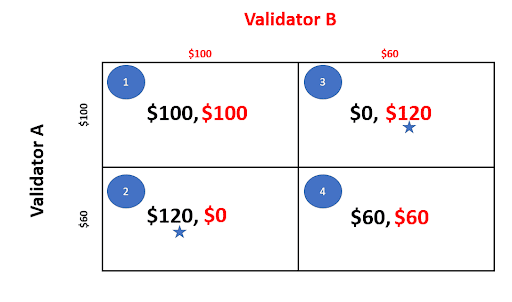
Now examine each scenario:
1. A = B.
Validator A sets MEV profit at $100 (User A profit = $0).
Validator B sets MEV profit at $100 (User B profit = $0).
Total user profit = $0.
Each validator earns $100; users get nothing.
2. A < B.
Validator A sets MEV profit at $60 (user profit = $40).
Validator B sets profit at $100 (user profit = $0).
Users earn $40 per MEV transaction ($80 total).
Long-term, Validator B’s users leave, driving its profit to $0.
Meanwhile, Validator A gains additional MEV traffic, earning extra $60 (total: $60 + $60 = $120). Logic:
-
Long-run dynamics
-
Users are rational—Validator A offers higher staking APY, so funds shift from B to A over time.
-
As all stake moves to A, B loses Leader eligibility and stops receiving MEV transactions.
-
MEV meant for B flows to A—generating same-level profit: $60 + $60 = $120.
-
Eventually drives B’s MEV profit to $0.
3. A > B.
Same logic as #2 applies.
4. A = B.
Validator A sets MEV profit at $60 (User A profit = $40)
Validator B sets profit at $60 (User B profit = $40)
Users earn $40 per MEV transaction ($80 total).
In this case, users stay with both validators—neither is abandoned.
MPSV Nash Equilibrium
Nash Equilibrium is a game theory decision theorem stating that players achieve optimal outcomes when no one benefits from deviating from their initial strategy. In Nash Equilibrium, each player’s strategy is optimal given others’ choices.
From the matrix above, if both Validator A and B set equal profit shares, they’re better off than setting higher levels (box 4 > box 1). But will box 1 actually occur? To solve this, let’s determine best responses for A and B:
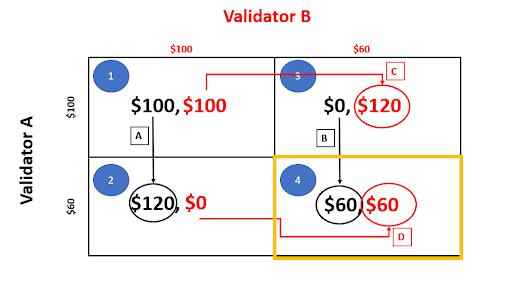
Similar to above, walk through each response starting with Validator A:
-
A. If Validator B sets profit at $100, Validator A has two options (box 1 vs. box 2):
Set profit at $100 → earn $100
Set profit at $60 → earn $120
Being economically rational, Validator A chooses $60, yielding $120.
-
B. If Validator B sets profit at $60, Validator A has two options (box 3 vs. box 4):
Set profit at $100 → earn $0
Set profit at $60 → earn $60
Rational Validator A chooses $60, earning $60.
Note: Setting profit at $60 is always the dominant strategy for Validator A. Setting $100 is never optimal.
Validator B:
-
C. Box 1 vs. Box 3:
Rational Validator B chooses $60 → earns $120
-
D. Box 2 vs. Box 4:
Rational Validator B chooses $60 → earns $60
Nash Equilibrium: Only one outcome exists where both validators play optimally—when both set profit at $60 (yellow box above). This is the sole Nash Equilibrium, each earning $60.
Therefore, we’ve shown that if users can freely move stakes between validators, Nash Equilibrium occurs when validators offer the most attractive profit-sharing terms—mirroring how perfectly competitive markets function:
This gives rise to MPSV = MEV Profit-Sharing Validator.
MPSV Flywheel
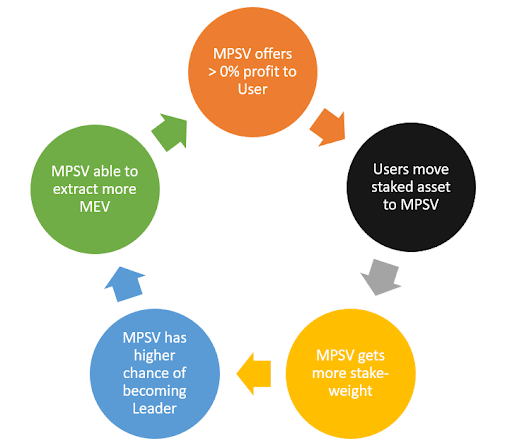
Proof-of-Stake (PoS) empowers users to choose where to stake assets. All else equal, higher staking weight increases a validator’s chance of becoming a Leader in the PoS model. For rational economic agents, staking decisions depend on maximizing APY at the lowest fee/commission.
Using MEV earnings, smaller MPSVs could return a portion of MEV profits to users, boosting yields above standard inflation. Furthermore, if smaller MPSVs pool their MEV profits, they gain more room to offer enhanced staking returns. Over time, new users migrate to the MPSV model (i.e., validators sharing MEV profits), enabling that validator to accumulate additional stake from others. This increases the frequency with which the MPSV is selected as Leader.
Conclusion
To summarize, we can envision a Proof-of-Stake MEV scenario where everyone ends up better off—including users. In Proof-of-Work systems, miners act independently of users when confirming blocks. In Proof-of-Stake, there is interdependence between validators and users.
This is what I mean by “fully democratizing MEV.” We’ve demonstrated above that the Nash Equilibrium for MPSV occurs when validators competitively share the most attractive profit splits with users. Long-term, even a single validator offering superior MEV profit-sharing can drive market-wide change.
We believe MPSV can achieve the following:
-
Create a new paradigm where users passively benefit from MEV
-
Enable smaller MPSVs to compete against top validators by sharing more profits—or even collaborate with other small MPSVs to pool and share MEV gains
-
In a fiercely competitive environment where all validators pass 100% of MEV profits to users, users ultimately benefit the most. [Note: Validators still earn income via transaction and priority fees.]
-
In this world, everyone wins—MEV searchers, validators, and users alike.
Breaking the MEV oligopoly is user choice!
Perhaps, just perhaps, we can transform the MEV market into a perfectly competitive structure.
If you're building in the MEV space or want to discuss MEV with us, please reach out.
Join TechFlow official community to stay tuned
Telegram:https://t.me/TechFlowDaily
X (Twitter):https://x.com/TechFlowPost
X (Twitter) EN:https://x.com/BlockFlow_News






