








Chainlink Staking Mechanism: Long-Term Objectives, Development Roadmap, and Initial Implementation Plan
TechFlow Selected TechFlow Selected
Chainlink Staking Mechanism: Long-Term Objectives, Development Roadmap, and Initial Implementation Plan
Chainlink staking mechanism's long-term objectives, initial implementation plan for the second half of 2022, and subsequent expansion roadmap.
 Navigating Web3 tides with focused insights
Chainlink provides the foundational infrastructure for the smart contract economy, establishing nearly 1,000 decentralized oracle networks that secure tens of billions of dollars in value across hundreds of projects. As Chainlink continues integrating with new blockchains and launches more oracle services, the total value secured by its ecosystem keeps rising. Therefore, enhancing the security of the Chainlink network has become increasingly critical. Chainlink will introduce an economic model 2.0, marking a new phase focused on sustainable development and network security—with staking as the starting point.
The core mechanism of staking aims to create a new cryptoeconomic security layer for Chainlink by introducing incentive mechanisms that further encourage orderly network operations. The Chainlink staking mechanism allows participants—including node operators and community members—to stake LINK tokens to support oracle services, thereby improving service security and user protection. Node operators who stake LINK tokens can also access higher-value oracle tasks within the Chainlink network and earn increased service fees.
This article outlines the long-term goals, initial implementation plan for the second half of 2022, and future expansion plans for the Chainlink staking mechanism.
Long-Term Goals of the Chainlink Staking Mechanism
The Chainlink staking mechanism is built around four long-term objectives. These goals serve as guiding principles for the development of the staking system and will lay the foundation for continuous optimization and iterative improvements.
1) Enhance Cryptoeconomic Security and User Protection for Chainlink Oracle Services
The primary goal of the Chainlink staking mechanism is to strengthen the cryptoeconomic security and user protection of Chainlink oracle services. This is achieved by locking up LINK tokens as collateral to back oracle performance. If an oracle network fails to meet its on-chain Service Level Agreement (SLA), a portion of its staked LINK tokens will be slashed and redistributed. Additionally, we are exploring loss mitigation mechanisms that use part of the slashed tokens to compensate users for financial losses caused by oracle failures.
Staking establishes effective incentives and penalties for Chainlink nodes, encouraging them to generate accurate oracle reports and deliver data promptly to the correct destinations. Staking is part of Chainlink’s defense-in-depth security strategy, which includes decentralization, cryptography, implicit incentives, Future Fee Opportunities (FFO), and modular configurations.
Given Chainlink’s deep integration into leading smart contract applications, further enhancing oracle security and user protection through staking will play a pivotal role in advancing the multi-chain smart contract economy—and ultimately extend into traditional industries, securing markets worth trillions of dollars.
2) Empower Community Participation in the Chainlink Network
Another key objective of staking is to enable broader community involvement by allowing members to directly participate in the Chainlink network through staking LINK tokens and supporting oracle networks. Notably, stakers who detect that an oracle service fails to meet predefined performance standards can submit alerts. Those who issue timely and valid alerts may receive rewards. Community monitoring and alerting mechanisms will play a crucial role in further decentralizing the Chainlink network and building a robust reputation and penalty system.
Ecosystem participants—including both community members and node operators—can stake their LINK tokens in pools according to different quotas. Furthermore, node operators may create or utilize delegation mechanisms to offer additional staking opportunities for community members.
3) Long-Term Engagement with Ongoing Rewards
The third goal of staking is to generate and distribute staking rewards to participants. We anticipate multiple reward distribution channels emerging over time. As network usage grows and service fees accumulate, non-native issuance sources will account for an increasing share of staking rewards.
● Initially, native issuance of LINK tokens will fund staking rewards, but this source will gradually diminish as other reward streams grow.
● Subsequently, a portion of user fees paid for Chainlink oracle services will be allocated to stakers. The higher the fees generated by Chainlink services, the greater the rewards distributed to those who have staked LINK tokens to secure those services.
Another channel for distributing staking rewards is the "Partner Growth Program" (PGP). In this program, protocols and DAOs integrated with Chainlink provide various incentives to accelerate their growth and foster cross-ecosystem participation. As Chainlink’s enhanced security benefits many projects, these projects may choose to join the Partner Growth Program.
Additionally, we are researching loss prevention mechanisms designed to protect users from financial losses due to oracle network defaults, which could further increase user fees. The higher the value protected, the greater the demand for loss prevention—and the higher the potential staking rewards available to participants.
4) Enable Node Operators to Access Higher-Value Oracle Tasks via Staking
The final goal of the Chainlink staking mechanism is to establish a robust reputation framework that helps users select oracle nodes and assemble Decentralized Oracle Networks (DONs). As differences in reliability and infrastructure security among Chainlink nodes narrow (as reflected in metrics such as response time and accuracy), the primary criterion for selecting DON nodes will shift toward how much LINK each node is willing to stake to back its oracle services. Going forward, staking will become a critical factor enabling node operators to win higher-value oracle tasks and greater revenue opportunities within the Chainlink network.
Notably, using both reputation and staking as selection criteria will enhance cryptoeconomic security for end-users relying on Chainlink oracle services. A more comprehensive reputation system for node operators will also allow users to better understand node performance and incentive alignment.
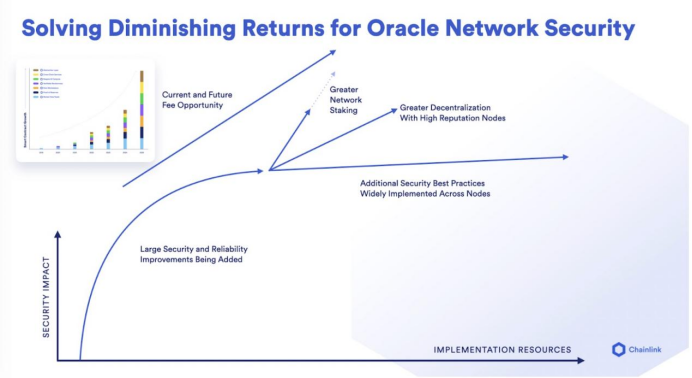
Note: The Chainlink staking mechanism optimizes the security-efficiency curve of oracle networks.
ALT: Chainlink's security-efficiency curve
Initial Implementation Plan for the Chainlink Staking Mechanism
Before diving into design concepts and initial parameters, it is important to emphasize that as more oracle networks and services are deployed, Chainlink’s fee revenue will continue growing—and the staking mechanism will evolve accordingly. The initial implementation focuses on building a simple, secure foundation and progressively expanding functionality based on user feedback.
The development roadmap for the staking mechanism mirrors the evolution of Chainlink Price Feeds. Initially, we launched a single ETH/USD Price Feed on Ethereum operated by three oracle nodes; today, nearly 1,000 Price Feeds are run by over 50 leading node operators across 12 blockchains and Layer 2 networks. This pragmatic approach allowed us to identify risks and opportunities early, enabling stable scaling to meet growing user demand.
Likewise, the Chainlink staking mechanism will follow a similar incremental rollout strategy, with the first v0.1 version expected in the second half of this year. The initial version will focus on launching a reputation framework and a staker alert system. These components will undergo thorough validation based on real-world usage and community feedback before progressing to v1, which will introduce new features such as token slashing to enhance cryptoeconomic security and incorporate user fees into staking rewards. Later, in v2, we plan to explore loss prevention mechanisms to protect users from financial losses due to SLA violations by oracle networks.
The following roadmap details the planned release of core functionalities across different versions of the Chainlink staking mechanism. Specific details may be adjusted based on user feedback and actual usage to better meet user needs. Additionally, to manage risk and simplify deployment, individual features within each version may be released at different times.
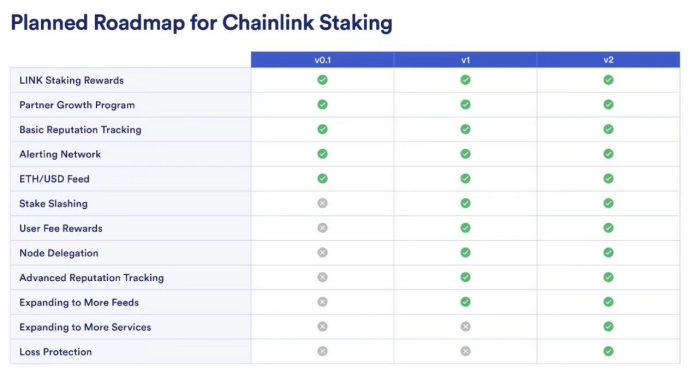
Note: Overview of the Chainlink staking mechanism development roadmap.
ALT: Chainlink staking mechanism development roadmap.
Reputation Framework and Alerting Mechanism
Version v0.1 will prioritize the introduction of a reputation framework and alerting mechanism, laying the groundwork for future features like slashing. To ensure operational stability, these systems will initially monitor the ETH/USD Price Feed on Ethereum.
Stakers will have the opportunity to monitor price feeds and submit alerts. If they detect that the ETH/USD feed fails to meet SLA requirements in a timely manner, they can earn rewards. In v0.1, the primary trigger for alerts will be feed uptime, with additional parameters added in later versions.
When an alert is submitted, an arbitration smart contract will automatically verify whether the SLA was violated and determine the validity of the alert. Upon confirmation, the staker who issued the alert will receive a reward. If the alert is validated, the result will be recorded in the reputation system, updating the relevant node operator’s reputation score. In v1, the reputation system will include additional key performance indicators. As the Chainlink network scales, the reputation system will play an increasingly vital role.
The core of the v0.1 Chainlink staking mechanism—the reputation framework and alert system—will continuously iterate toward linear security guarantees and eventually expand into the “superlinear security” model described in the Chainlink 2.0 Whitepaper.
Participating in Staking
The v0.1 staking pool will have a size cap, with separate allocation quotas for node operators, community members, and oracle network coordinators. The initial pool size will be 25 million LINK tokens, with plans to scale up to 75 million LINK tokens a few months after launch based on demand. The pool will continue expanding in subsequent phases to support more Data Feeds and oracle services.
We will distribute alerting rights fairly across the community to encourage broad participation. Priority will be given to long-term LINK holders most committed to participating in the alerting mechanism. Active node operators contributing to Chainlink Data Feeds will also receive designated slots. We are currently exploring third-party node delegation mechanisms, with plans to introduce this feature in v1.
Participants in v0.1 must lock their staked LINK tokens until the v1 release. Starting in v1, stakers will be able to choose their own lock-up durations.
Staking Rewards
In v0.1, staking rewards will be issued through native token minting, targeting a baseline annual staking yield of 5%. After the v1 release, the annual staking yield will vary based on user fees and chosen lock-up duration. Stakers who commit to longer lock-up periods will receive higher rewards.
Additionally, v0.1 stakers will be eligible for extra rewards through the Partner Growth Program (PGP). The PGP will launch alongside the staking mechanism, offering incentives from Chainlink-integrated projects to accelerate their growth and economically reward the Chainlink community. This encourages stakers to actively engage with project ecosystems and drives faster adoption. The PGP will initially target v0.1 and be refined for v1. More details will be shared in the future.
As the staking mechanism evolves from v0.1 to v1, we plan to allocate a portion of user fees as staking rewards and introduce a LINK token slashing mechanism to strengthen cryptoeconomic security. Furthermore, we are researching a loss prevention mechanism for v2, where associated costs might be funded using native LINK issuance, user fees, and PGP rewards—all potentially redistributed as staking rewards. Detailed specifications for each version will be published in due course.
Conclusion
Launching the staking mechanism marks a key milestone for Chainlink, signaling the transition to an economic model 2.0 centered on long-term security and network sustainability. The initial implementation prioritizes minimizing participant risk while laying a solid foundation for future growth. Ultimately, our vision is for Chainlink to become a global standard—an ever-growing, self-sustaining ecosystem that offers greater earning opportunities for stakers and significantly enhances overall cryptoeconomic security and user protection.
To learn more, visit chain.link, subscribe to Chainlink News, and follow Chainlink on Twitter, YouTube, and Reddit.
For deeper technical insights, refer to the original Chainlink Whitepaper, the Chainlink 2.0 Whitepaper, and the developer documentation.
Disclaimer:
This article discusses future development plans for Chainlink, including product features, roadmaps, and tentative timelines for feature releases. These statements are not guarantees and involve risks, uncertainties, and assumptions. Successful testing and development in the next stages depend on community participation and successful execution at every step. Readers should independently decide whether to participate in the initial implementation and bear their own risks. The content is based on reasonable assumptions, but we cannot guarantee that actual outcomes will align with the vision described herein. Due to unforeseeable user feedback and changing circumstances, actual developments may differ from what is presented, and we may not update this document accordingly.
Join TechFlow official community to stay tuned
Telegram:https://t.me/TechFlowDaily
X (Twitter):https://x.com/TechFlowPost
X (Twitter) EN:https://x.com/BlockFlow_News






