








"Ultra-Stable" USDD — A New Order in the Crypto World
TechFlow Selected TechFlow Selected
"Ultra-Stable" USDD — A New Order in the Crypto World
This time, Sun Brother? A smile—perhaps just the beginning of a larger game.
 Navigating Web3 tides with focused insights
By Professor Zhou
On the first day of June, Sun Yuchen wrote on his personal website: "We hope to make USDD the new settlement currency in the crypto spaceBut at a time when stablecoins have collapsed, algorithmic stability narratives have shattered, and fear, uncertainty, and doubt (FUD) about stablecoins dominate the market, choosing this moment to speak out—beyond marketing or opportunism—suggests that TRON may have敏锐ly spotted an opportunity within the crisis:
The chance to reshape the competitive landscape of stablecoins and strengthen the TRON ecosystem through its own stablecoin.
When faced with such an opportunity, the best way to convince the market is to “bring something powerful to the table.”
And on June 5, USDD underwent a major upgrade. The highlight? USDD introduced the concept of “ultra-stable (over-collateralized stablecoin),” distinguishing itself from most other stablecoins by emphasizing decentralization, transparency, and over-collateralization.
At the same time, data shows that thanks to USDD’s emergence, TRON’s total value locked (TVL) has now surpassed $6 billion,ranking third among all public blockchains.
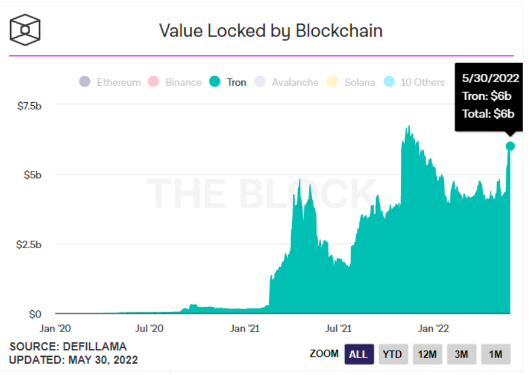
When rapid TVL growth coincides with these new features, regardless of your prior view on TRON or USDD, one thing is clear: the “ultra-stable” narrative for stablecoins has begun.
And this time, will the story be different?
Review: Opaque Collateral Ratios – The Achilles’ Heel of Stablecoins
Before diving into USDD’s “ultra-stability,” it’s worth revisiting history for context.
Looking back, pioneers have designed stablecoins in various ways because the market always needs stable assets to hedge against the volatility of cryptocurrencies.
When discussing “ultra-stability” (over-collateralized stablecoins), we naturally think of MakerDAO’s DAI, launched in 2017. For example, users must lock up $1.50 worth of ETH or other assets to mint $1 of DAI.
The benefit of over-collateralization is that when collateral value drops and reaches liquidation thresholds, sufficient assets can be sold to redeem DAI, minimizing de-pegging risks.
Historically, DAI has mostly maintained a price close to $1.
But this comes at a cost: Due to over-collateralization and the CDP (Collateralized Debt Position) model, DAI suffers from low capital efficiency, difficult arbitrage, and a liquidation system highly dependent on Ethereum’s performance. This limits its adoption and scale compared to other stablecoins.
Later, fiat-backed USDT/USDC and under-collateralized but algorithmically stabilized UST became more popular in the stablecoin space.
However, the opacity and centralization of USDT raise concerns—whether there are actually equivalent USD reserves remains a black box. As for UST, well, we all know what happened: Relying solely on algorithms without sufficient reserve backing came at a far greater cost than mere de-pegging.
With over-collateralization not yet widely adopted, and both popular fiat-backed and purely algorithmic models unable to prove they hold sufficient reserves to withstand shocks, stablecoins have left a fatal Achilles’ heel: opacity often leads to instability.
Innovation: USDD Chooses Over-Collateralization + Active Disclosure of Collateral Ratio
Clearly, to rebuild market trust in stablecoins, at least two things are required:
● A transparent and honest query mechanism that allows everyone to see that issuing $100 worth of stablecoins isn’t backed by thin air, but real collateral assets;
● The underlying collateral assets must have real value, significantly exceeding the total market cap of the issued stablecoin. For instance, if $100 of stablecoins are issued, there should be $150 of assets behind them to intervene during de-peg events.
This kind of open-book design is so honest that even dominant players like USDT haven’t directly disclosed their full reserve holdings.
Let’s return to USDD.
On June 5, USDD underwent a major upgrade, defining itself as a “decentralized over-collateralized stablecoin.” At first, the author thought this was just marketing spin—after all, TRON’s talent for generating buzz is well known.
But after deeper research, we were surprised to find that post-upgrade, USDD has actively chosen transparency:
It openly allows anyone to check the status of its underlying collateral, and the value of these assets significantly exceeds USDD’s circulating supply.
This is unprecedented among currently popular decentralized stablecoins. While you worry whether USDT truly holds enough dollars, or suspect UST couldn’t mobilize enough BTC during the crash…
Now USDD lays all its cards on the table: Whether there are reserves, how much there are, and whether they’re over-collateralized—all fully visible. This truly qualifies as “bringing something powerful to the table.”
Let’s examine the details.
Transparent and Verifiable Collateral Status
First, visit the USDD collateral inquiry website https://usdd.io, or the Reserve Bank of TRON (TDR) official site tdr.org. In the reserve disclosure section, you’ll see that USDD currently uses highly liquid crypto assets like BTC, USDT, and TRX as collateral reserves.
That means, for every $1 of USDD issued, more than $1 in crypto assets is locked as collateral, proving USDD’s full backing.
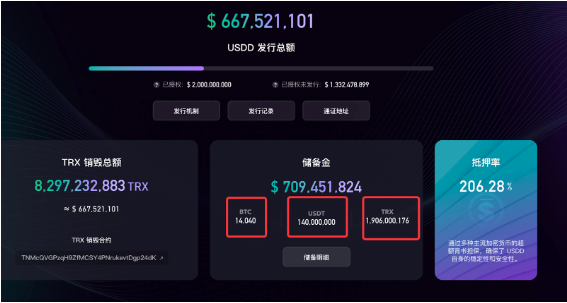
Public interface for checking USDD’s collateral status
These collateral assets are stored in designated on-chain wallets. Using blockchain explorers, anyone can quickly verify the exact status of these assets.
For example, the page shows 14,040 BTC currently held as collateral. You can view the transaction count, timestamps, and amounts of BTC transferred in and out. This also means this address is operationally linked to USDD’s BTC reserves, and any future BTC transactions here are fully visible to the public.
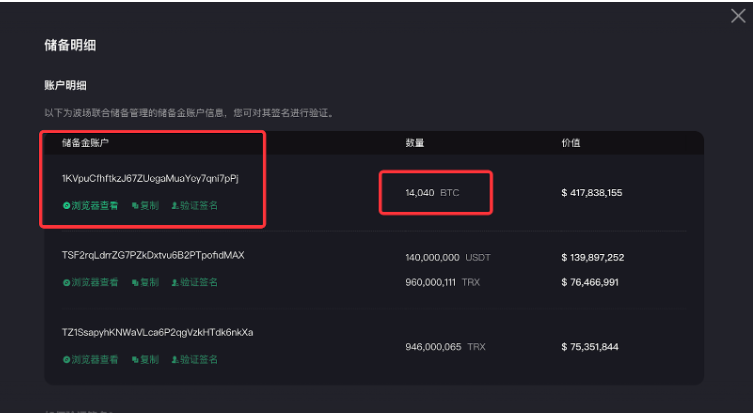
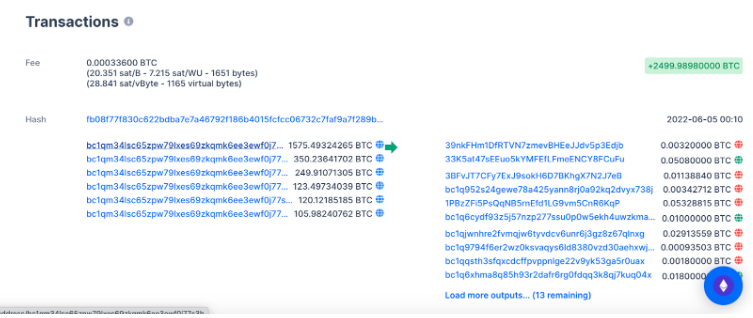
Querying fund flows of USDD’s collateral assets
In extreme market conditions, you won’t need to guess whether USDD used its BTC reserves to stabilize the peg—just check the wallet activity.
Moreover, since the website and wallet addresses are unique (excluding rare outages), users can monitor collateral status 24/7, meaning USDD voluntarily subjects itself to public oversight.
This is indeed a surprising “open-book” strategy.
Compare this to stablecoins like USDT, which argue that full transparency is “unnecessary”: Tether periodically releases reserve reports but sees no need to publicly prove it holds the claimed dollar reserves.
But consider MakerDAO’s DAI—here, transparency feels “only natural”: If it’s over-collateralized, then the collateral status should be self-evident on-chain and in smart contracts.
Clearly, USDD is aligning with the latter approach.
130% Minimum Over-Collateralization Ratio
According to disclosures on the USDD website, the minimum over-collateralization ratio is 130%. But actual reserves exceed this threshold significantly.
Currently, the Reserve Bank of TRON holds 14,040 BTC, 1.9 billion TRX, and $140 million USDT in reserves. Combined with 8.29 billion TRX in the burn contract, total reserves amount to $1.34 billion, backing $667 million of USDD in circulation—meaning USDD’s current total collateral ratio exceeds 200%.
This high over-collateralization ratio is key to USDD’s safety and stability. It ensures ample reserves to respond during crises, so users don’t have to fear their USDD might be backed by nothing. This design draws from MakerDAO’s model to create a risk-free stablecoin.
To quantify this further, DAI—one of the earliest over-collateralized stablecoins—has a minimum collateral ratio of just 120%. The chart below clearly illustrates how USDD compares with other stablecoins in terms of collateral ratio and transparency.
Theoretically, once use cases expand, considering only transparency and capital efficiency, USDD may emerge as the better choice—with over-collateralized reserves, users can feel more secure using it.
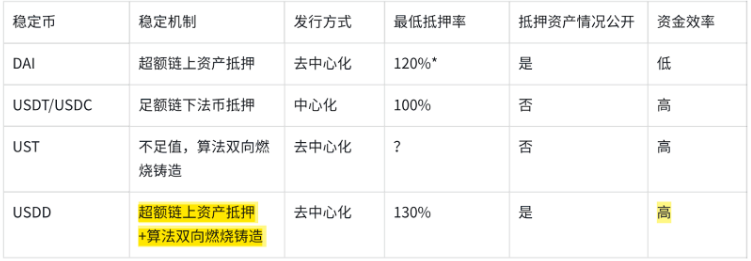
Note: DAI in its over-collateralization mechanism supports multi-asset collateral, with varying ratios per asset, the lowest being 120%.
Gradually Opening Minting Rights to Maintain Stability
Publicly disclosing collateral ratios and implementing over-collateralization is good news for users—but could this burden TRON itself?
If USDD is rapidly and continuously minted, TRON must raise even more funds to maintain over-collateralization—and many eyes are watching whether the over-collateral wallet truly holds enough assets.
Previously, UST allowed unlimited minting rights to users, combined with Anchor Protocol’s tempting 20% APY, leading to explosive UST issuance in the primary market—planting the seeds for its eventual collapse.
Clearly, USDD has learned from this lesson.
In USDD’s overall design, stablecoin supply is phased. During Phase 1 (“Space Age”), USDD minting operates under a whitelist mechanism—only designated institutions within the “Reserve Bank of TRON” can mint and issue USDD. That is, in early stages, minting rights are not fully open.

Additionally, in Phase 1, there’s a $2 billion cap on total USDD minting, keeping supply controllable within a given timeframe. Meanwhile, based on the set over-collateralization ratio (e.g., 130%), the theoretical maximum reserve requirement would be at least $2.6 billion in assets.
When stablecoin circulation is manageable, the required reserve size can be estimated in advance. This is a clever design: Limited minting rights in the early phase prevent supply from spiraling out of control and reduce pressure on raising reserve funds.
After all, in stablecoins, safety and stability always come first. Waiting until USDD reaches a certain transaction volume before fully returning minting rights to the market seems the wiser path.
Cautious Consideration: Applaud USDD’s Transparency, But Don’t Ignore Risks
USDD’s open-book design is undoubtedly pushing stablecoin competition to a new level.
While we applaud transparency and honesty, we must remember there is still no foolproof solution for stablecoins. USDD builds on MakerDAO’s over-collateralization model but still faces challenges:
● Part of the over-collateral includes USDT. Whether USDT truly holds equivalent dollar reserves remains uncertain. If USDT collapses, USDD’s reliance on it creates a “nested risk,” potentially turning part of its reserves into non-performing or worthless assets.
● Macroeconomic risks remain hard to eliminate. Fed rate hikes, regional conflicts, and pandemics continue to impact markets, transmitting sharply to crypto and causing wild swings in asset values. By using on-chain assets as collateral, USDD remains exposed to systemic depreciation risks when macro conditions hit crypto.
● Moral hazard within the “Reserve Bank of TRON”. Currently, TRON has brought together eight top industry institutions to form the “Reserve Bank,” which collectively controls USDD minting via multi-sig. Could this power lead to insider abuse? Fortresses fall from within. Ensuring mutual checks among members and reducing collusion risk must be prioritized.
Action: Welcome Stablecoin Competition—Solid Execution Matters Most
As relatively safe and stable settlement assets, stablecoins are vital to the crypto world. From DAI to USDT, UST, and now USDD, the space never lacks contenders.
As free-market economist Hayek wrote in *The Denationalisation of Money*, if multiple currencies compete in the market, survival of the fittest will determine the winner.
Projects compete with product strength; users vote with their feet. The stablecoin race is undecided, and the market now has a new option: USDD.
Yet social media sentiment and some analyses suggest lingering bias due to Sun Yuchen’s persona and TRON’s marketing-heavy history. There remains skepticism about whether USDD can truly succeed.
But success or failure has never depended on individual preferences or biases.
One undeniable detail: USDT, the most widely used stablecoin today, is predominantly issued on the TRON network.
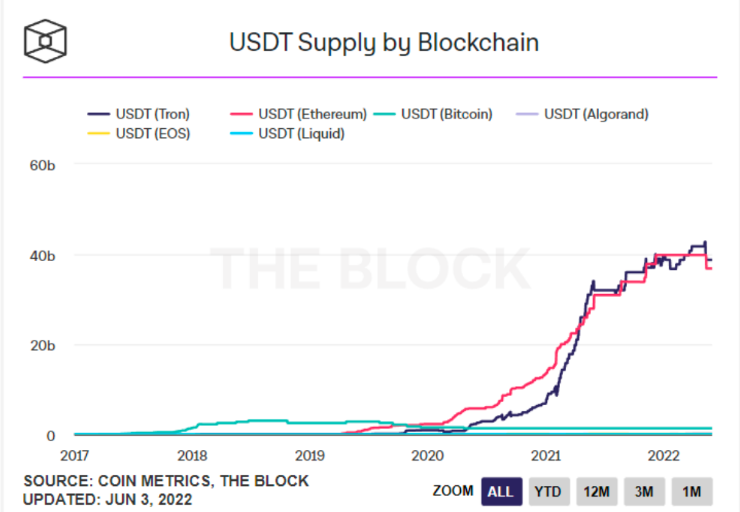
USDD has accurately targeted the pain points of insufficient collateral and opaque ratios in existing stablecoins. Pursuing this direction gives it a competitive edge—a strong start indeed.
What remains is execution and consistency.
As USDD confronts the shattered narrative of algorithmic stability and chooses transparency and over-collateralization to demonstrate authenticity, we hope it stays grounded in its issuance, governance of the Reserve Bank, and crisis response.
If all goes well, USDD could become a key driver for TRON, potentially triggering an explosion of applications and use cases within its ecosystem.
Sun Yuchen’s smile this time might just be the opening move of a much bigger game.
Join TechFlow official community to stay tuned
Telegram:https://t.me/TechFlowDaily
X (Twitter):https://x.com/TechFlowPost
X (Twitter) EN:https://x.com/BlockFlow_News






