








DeSci — A New Web3 Movement, Revolutionizing Research and Funding
TechFlow Selected TechFlow Selected
DeSci — A New Web3 Movement, Revolutionizing Research and Funding
Decentralized science is a relatively "young" trend that is experimenting with new technological tools to revolutionize science.
 Navigating Web3 tides with focused insights
Author: Sergey Baloyan
Translation: TechFlow Intern
DeSci — Science in Web3
According to a market research report on the future of blockchain, the Web3 market is currently valued at over $6.3 billion and is projected to grow at a compound annual growth rate (CAGR) of 44.6% from 2023 to 2030. Not only are numerous industries and institutions leveraging the emergence of Web3 to drive innovation, but scientists are also exploring its applications.
Not long ago, I discussed on Twitter how blockchain and crypto are impacting the tech and scientific communities, and how science can be integrated into the new Web3 trend.
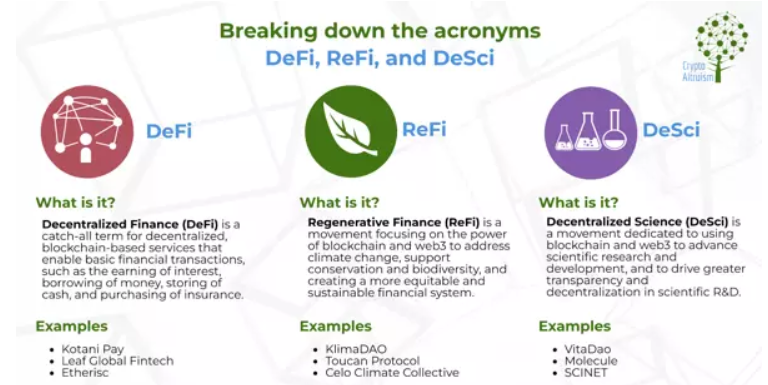
Today, many scientists have already deployed blockchain tools such as smart contracts and decentralization to revolutionize the world of science. This movement that leverages blockchain and Web3 applications is known as Decentralized Science (DeSci). Although still in its infancy, DeSci represents the intersection of two major movements:
-
The scientific community's pursuit of alternative methods to fund their work and freely share information and data without restrictions.
-
A crypto-based movement aiming to eliminate profit-driven intermediaries from value exchange or transactions.
A Brief History
For years, significant efforts have been made to make research findings and data more accessible to the public.
Open science has played a crucial role in this regard. Its major contribution was supporting the National Institutes of Health (NIH) mandate, which allows all scientific discoveries to be published without restrictions. However, journals responded by requiring scientists to pay fees before publishing their work. This barrier necessitated a more revolutionary approach, giving rise to the decentralized science revolution.
What Is Decentralized Science?
Decentralized Science (DeSci) is one of the latest potentially revolutionary Web3 movements aiming to leverage technologies like blockchain and Web3 to address some of the major challenges in scientific research. These pain points include barriers to accessing research results and other bottlenecks within the research process.
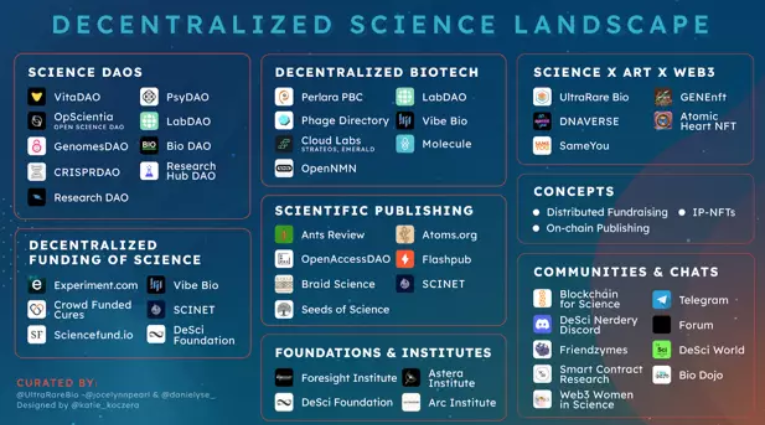
DeSci Landscape
As DeSci gains widespread acceptance across the global scientific community, research funding will undergo a dramatic transformation, and knowledge will no longer be hoarded in silos. DeSci aims to take power away from profit-seeking intermediaries such as publishing groups and strengthen collaboration among the global scientific community.
Many scientists struggle to secure research funding, with some spending nearly 50% of their time writing grant proposals—without any guarantee of success.
Restricted access to scientific discoveries and data is another major pain point plaguing today’s scientific community. Despite science being hailed as life-saving, gaining licensed access to scientific data remains difficult. A primary goal of DeSci is to ensure unrestricted public access to this scientific data.
Blockchain-based science initiatives began gaining global recognition in 2021, driven by the emergence and proliferation of new projects.
Examples include the Open Science NFT project sold for 13 ETH, and the explosive growth of DAOs built to support and advance decentralized scientific research.
Additionally, DeSci panel discussions were held at LisCon, a blockchain event, during the final quarter of 2021.
The current decentralized science ecosystem consists of interconnected networks of various DAOs. Each of these DAOs is built to serve specific research outcomes. However, some DAOs are designed to focus on particular research fields, such as biotechnology. Biotech-focused DAOs like Molecule, LabDAO, VitaDAO, and BioDAO are leading the way.
The current decentralized science ecosystem is the result of interconnections among different DAOs. Each of these DAOs serves a specific niche in research outcomes, such as funding, peer review, and unrestricted access. Some DAOs are also designed to serve specific research domains, such as biotechnology. Biotech DAOs are at the forefront, with Molecule, LabDAO, VitaDAO, and BioDAO standing out as leaders.
How Will DeSci Leverage Blockchain and Web3?
Smart Contract-Powered Peer Review
Although scientists conduct peer reviews without compensation, intermediary publishers profit significantly from the process. By integrating smart contracts, DeSci can eliminate intermediaries in peer review, enabling direct interaction between authors and reviewers.
Over the years, evidence has shown that governments have intervened in and censored scientific research and discoveries. A report published by RW Newman on Council Science Editors noted that the politicization of science has become so prominent that it even appears in mainstream newspaper cartoons.
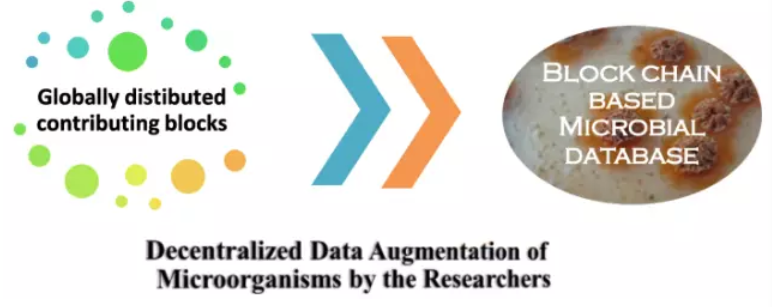
DeSci leverages the decentralized nature of blockchain technology for data storage, making it accessible globally. This helps mitigate government censorship and gatekeeping of scientific data.
Blockchain-Powered Research Funding
By leveraging the features of decentralized autonomous organizations (DAOs), scientists can launch funds to finance their research.
In the future, platforms specifically built for scientific purposes may emerge. Scientists could also adapt DeFi systems to create sustainable and efficient funding models for scientific research.
Additionally, value-generating assets such as NFT sales can generate funds to support research, thereby enhancing the sustainability of the scientific community.
Ownership Without a Single Controlling Entity
One major drawback of open science is the risk that an exclusive commercial platform holds control over scientific ownership. However, the emergence of DeSci ensures that unique, specialized communities can govern specific areas of scientific research.
In addition to reducing the dominance of single entities in science, DeSci also protects the scientific community from rapidly evolving technologies and other emerging threats.
With DeSci, scientific knowledge belongs to the people—not corporations or governments. Imagine communities setting vaccine prices, with most profits reinvested into funding further research. This would undoubtedly improve health outcomes for everyone.
Verifiable Reputation
Today, a scientist’s “authority” and ability to secure funding depend largely on the number of publications they have.
With DeSci, scientists can earn NFTs by performing value-adding functions for research purposes. Scientists can train and mentor young experts in their field, participate in peer review, and share data openly.
NFTs can serve as verifiable proof that a scientist has made significant contributions to science.
Conclusion
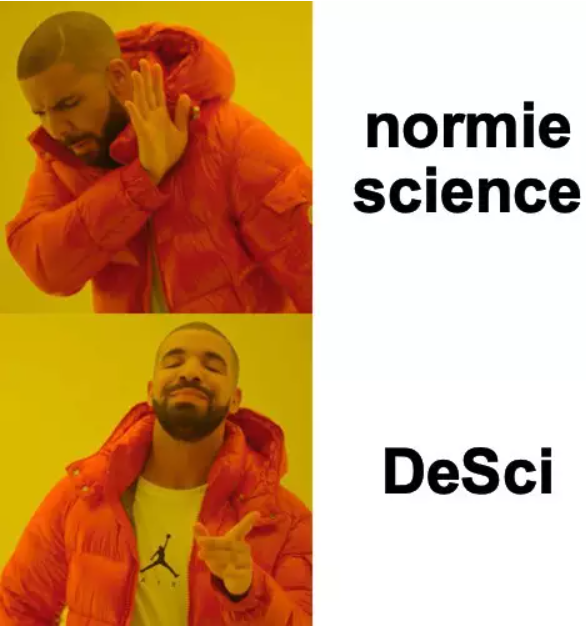
Decentralized science is a relatively "young" trend experimenting with new technological tools to revolutionize science. Before DeSci achieves widespread success, its tools must become mainstream and integrated into scientists’ daily workflows.
DeSci must prioritize providing scientists with all necessary tools—those that are genuinely useful and enhance their efficiency—while everything else remains secondary.
Join TechFlow official community to stay tuned
Telegram:https://t.me/TechFlowDaily
X (Twitter):https://x.com/TechFlowPost
X (Twitter) EN:https://x.com/BlockFlow_News






