








How to design a more sustainable game economy model?
TechFlow Selected TechFlow Selected
How to design a more sustainable game economy model?
Some more sustainable design elements, and their significance to each game economy.
 Navigating Web3 tides with focused insights
Author: lyceum.gg
Translation: TechFlow Intern
Introduction
This article focuses on some of the more sustainable design elements used in existing NFT games and their significance for each game's economy. The games discussed, such as Splinterlands and Gods Unchained, are among the longest-running NFT games. These titles demonstrate the significant impact that thoughtful design can have on sustainability. The design elements covered here are not the only sustainable options currently available—more creative approaches are rapidly emerging.
1) NFTs > Tokens
Overall, games that generate revenue or distribute rewards (through earnings and trading) via NFTs rather than tokens tend to be more sustainable.
These games emphasize "game-driven" engagement over "profit-driven" participation. Profit-driven models rely on a one-dimensional cycle of dumping and rewarding. In contrast, using various NFTs—like trading cards—allows value to circulate more effectively. For example, unlike Axies, diverse NFT types enable more efficient distribution of value within the ecosystem.
Splinterlands and Gods Unchained exemplify sustainable, NFT-driven trading card games (TCGs). Although both games issue tokens, the primary economic driver is reinvestment into NFTs—selling NFTs to buy (or rent) other needed cards for gameplay and trading. Compared to Axie Infinity, which requires only three NFTs to play, TCGs encourage ownership of a wide variety of NFTs across different rarities and levels, enhancing collectibility. Game mechanics often incentivize players to engage with diverse content and reward them accordingly.
Such games avoid unlimited breeding systems that mint infinite NFTs and lead to oversupply. Reward cards are limited in quantity and low in value, intended primarily for gameplay rather than trading. Other cards are randomly generated from purchased “booster packs.” Once booster packs are exhausted, no further cards from that set are minted—each card set has a fixed supply. This creates scarcity and increases demand. Limiting the number of booster packs per set restricts the availability of free NFT cards and increases the value of functional cards as their market supply diminishes.
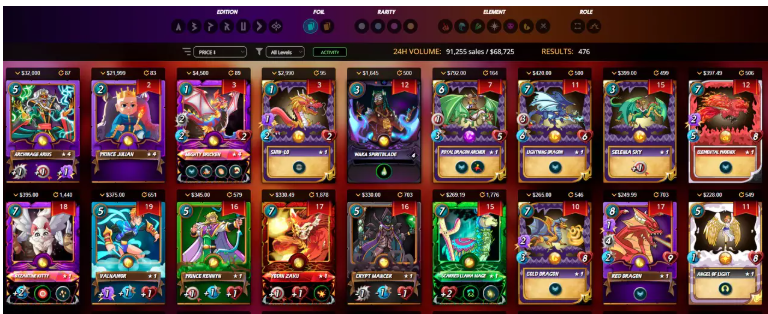
Splinterlands NFT Marketplace

Variable rule systems encouraging NFT diversity
2) Reward Pool Systems
Many games like Axie Infinity offer fixed rewards to players or winners, but this does not mitigate supply inflation as player numbers grow. In contrast, an increasing number of games now implement flexible systems such as reward pools, which provide semi-fixed daily payouts. These systems allow developers to better control the amount of reward tokens minted or distributed, offering greater adaptability. Several methods have emerged to manage pool size and allocation.
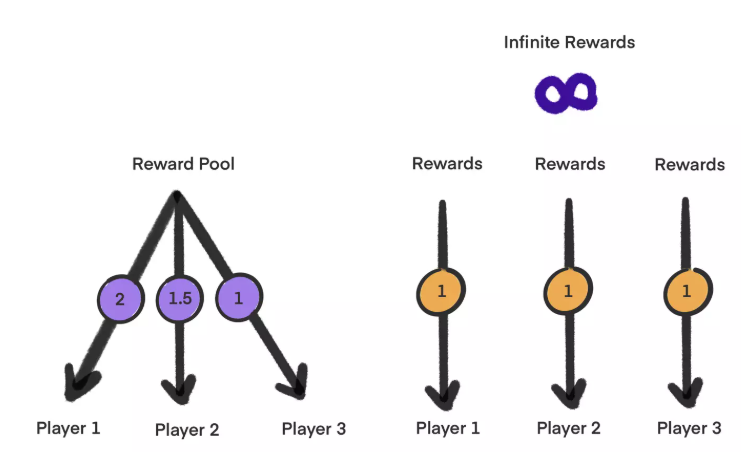
Splinterlands defaults to 1 million tokens available in its daily pool, but adjusts the pool size based on whether the token price stays above or below a soft peg of $0.001. This enables dynamic expansion through effective supply management. While the system doesn’t directly combat inflation through token burning, it has maintained price stability for over six months. Additionally, multiple variables determine individual earnings—from the number of battles in the past 24 hours to diminishing personal returns over time and consumption-based bonuses.
Gods Unchained uses a scaled reward pool system in its weekly “Weekend Ranked” event. Players accumulate points throughout the weekend instead of receiving immediate post-match rewards. At the end of the weekend, players receive a share of the prize pool proportional to their points. The pool scales up or down based on the number of participants from the previous week. Upper and lower limits prevent excessive distortion of rewards when players join or leave en masse.
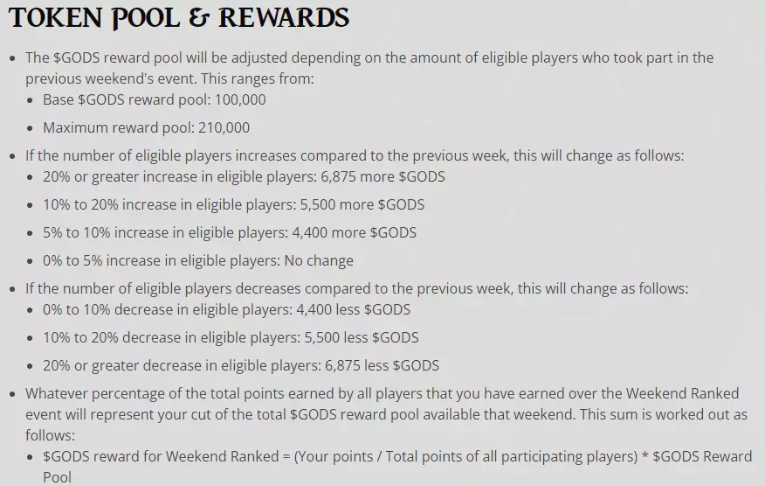
Gods Unchained Weekend Ranked Reward Pool
ICE Poker does not use a pool system but scales daily token rewards based on active player counts. A user’s daily token reward consists of two parts:
1. Base reward amount, earned by completing daily challenges of varying difficulty (and other factors);
2. A multiplier (ranging from 0.05x to 2x) determined by the user’s daily ranking in net profit.
The multiplier depends on the user’s position on the daily leaderboard, comparing their total poker chips earned against others. Without a fixed reward cap or pool, the game scales token distribution according to the total number of players, balancing daily earnings disparities. That said, ICE Poker’s reward token is currently at an all-time low, largely because the base reward scales linearly with player count.
In the long run, a sustainable economy cannot pay players more in rewards than the value brought in by players and external parties. Reward pool systems help limit the value developers distribute, but if the game fails to extract meaningful value from users, even the best-designed system will fail.
3) NFT Durability Systems
Many games treat NFT purchases or mints as inflows of value into the game economy, justifying corresponding outflows. However, these inflows are often unlimited over time. Eventually, NFT buyers may surpass break-even thresholds, leading to inflation when NFTs are excessively acquired.
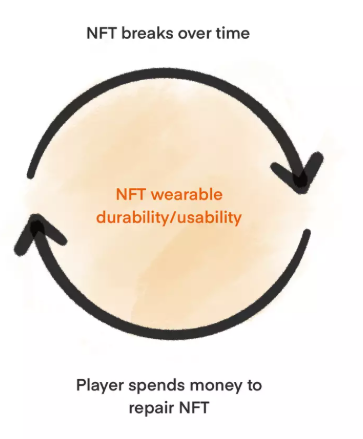
Some games impose limits and taxation on NFT-generated income through "durability" systems that simulate wear-and-tear or diminishing returns.
Typically, these NFTs function as consumable cosmetics. Even after their earning durability is depleted, players can still use and enjoy them. Unfortunately, "repair" costs are sometimes indefinitely repeatable or do not scale over time (unlike breeding costs), potentially causing perpetual inflation and acting as a form of revenue tax.
An alternative approach could require increasingly higher repair fees—making repairs feasible only for skilled players who earn enough to afford them—thus alleviating inflationary pressure. However, this remains theoretical, as such mechanisms haven't been implemented in live environments yet.
Netmarble’s upcoming game Golden Bros pre-sold all character cosmetic NFTs during early access. These NFTs incorporate several mechanisms to cap earnings:
1. Players can earn rewards from only a fixed number of matches per day;
2. Repairs require waiting periods, resulting in passive loss of token earnings;
3. There is a maximum number of allowed repairs, limiting total potential earnings.
Earnings also vary based on match outcomes, so daily income rarely reaches the theoretical maximum. During early access, Golden Bros offers unlimited durability to help early adopters reach profitability before public launch.
Still, earnings are governed by an energy system, and the total number of specific NFTs is capped. Thus, maximum supply is known during early access. Golden Bros further limits supply by introducing token sinks for early-access users.
Thetan Arena employs a similar model but without repair costs. Each NFT has a fixed number of daily matches and a finite total number of matches over its lifetime. Earnings vary by performance (making exact returns unpredictable), though the maximum possible reward per held NFT can be estimated. Overall profitability tends toward breakeven—and often results in net losses.
4) Tournaments
Tournaments where total entry costs exceed the prize pool value are effective mechanisms for skill-based supply reduction and reward distribution. Tournament participation functions as investment, with most participants expecting net losses—an anticipated and common outcome. Various tournament designs exist, including "pot systems" that allocate a portion of entry fees to prizes, or distributing rewards in different tokens or NFTs.
Moreover, tournaments need not follow strict PvP formats since pure PvP is already a well-established model—two players pay entry fees, and the winner takes the pot minus fees/taxes. This flexibility allows countless variations in tournament structure and outcomes. Such systems must support players of all skill levels and maintain hope—even for losers—that they might earn sufficiently high rewards.
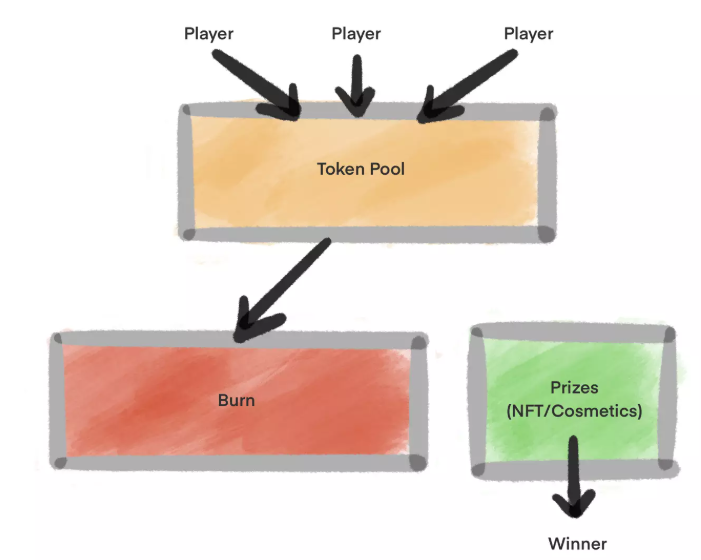
An ideal state is when all tournament entry fees are fully utilized, with sufficient rewards to meet player demand
Splinterlands features a built-in tournament system for both players and developers. Crucially, players can customize entry costs, prize pools, eligibility requirements, and rules—including total participant count and match formats. Interestingly, player-hosted tournaments often serve as promotional events for sponsors or streamers, fostering community engagement.
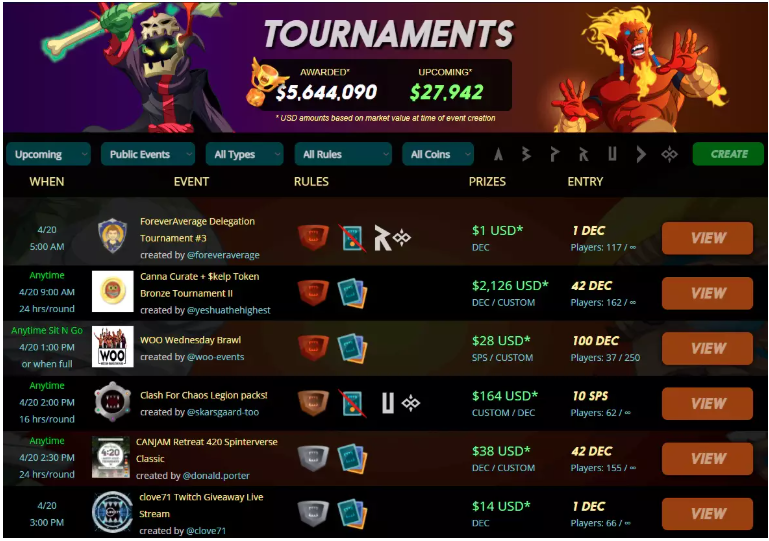
Splinterlands Tournament Interface
Crypto Raiders recently hosted a "Permadeath" tournament with 64 participants, each required to mint a new NFT. Only the top 16 earned rewards—the remaining 48 had their NFTs burned. This exemplifies using NFTs as sunk costs, especially impactful in a game with strict NFT minting controls. Games without breeding caps should consider Permadeath-style events to incentivize NFT burning.
Skyweaver features a "Conquest Mode," where players must achieve a set number of wins to earn rewards. Entry costs are either $1.50 (in USDC) or a silver NFT card. Rewards range from nothing (if the first match is lost) to silver or gold cards, depending on performance. As a PvP mode, some players won’t recoup their entry cost, but the system achieves economic balance by recycling silver cards (tradable NFTs) and generating additional revenue. This is another strong example of using or burning NFTs to control supply, especially since rewards are uncertain (players might receive cards they want to play, trade, or use for future entries).
ICE Poker plans to launch Sit-n-Go tournaments where entry fee tokens are burned, and winners receive various rewards—stakable governance tokens, cosmetics, NFTs, or tickets to future tournaments.
Beyond burning tokens via entry fees, ICE Poker is experimenting with NFT durability in tournaments: if a player ranks too low, their NFT becomes "dirty" and must be cleaned (via token burn) before entering another tournament. If this new gameplay mode successfully acts as a token sink while delivering competitive, high-stakes gameplay and faster paths to ownership, it will mark a new chapter for ICE Poker. Additionally, ICE’s poker format mirrors real-life tournaments, where poor performance leads to disqualification.
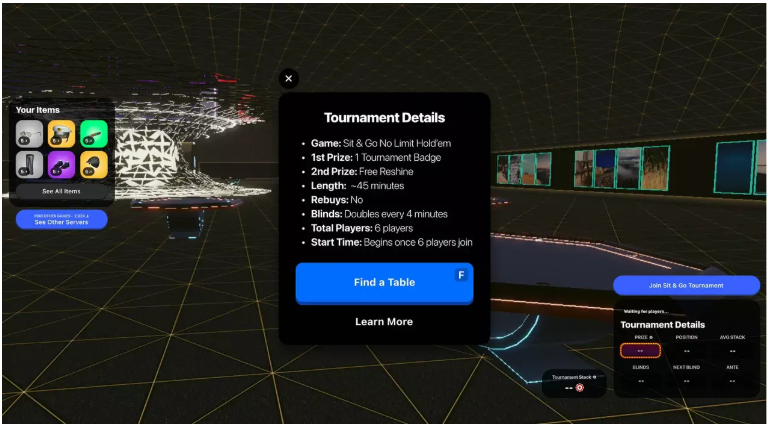
ICE Poker SNG Mode
In Golden Bros, players pay entry fees to join battle royale events, but only the winner receives rewards. Fifty percent of total entry fees are burned, and the winner receives five times the entry cost—providing strong incentives to participate. Notably, players without NFTs can also join, enhancing the mechanism’s effectiveness.
5) Pay-to-Win Mechanics
Secondary pay-to-win elements have successfully boosted revenues in F2P games—especially mobile titles—and are somewhat accepted in genres like TCGs. The key is maintaining minimal or temporary advantages that require growing skill/knowledge to exploit effectively. Monetizing in-game earnings through pay-to-win encourages reinvestment and creates more demand for tokens, helping sustain higher earning levels. With systems allowing profitable investment, players always have pathways to benefit, preserving fairness.
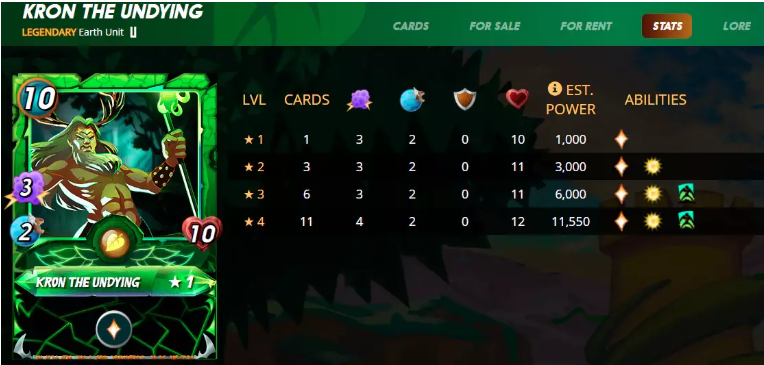
Splinterlands Card Upgrades
Like most TCGs, Splinterlands allows users to buy the strongest cards directly from other players. Several balancing mechanisms minimize dominance—for example, different match rules prevent reliance on powerful cards. The game also includes tournaments and entry-tier requirements that regulate card strength. These balancing features encourage purchasing both powerful and diverse cards.
In Axie Infinity, varying Axie prices combined with dominant "meta" strategies create synergistic pricing dynamics. When paired with Origin’s upgrade mechanics for body parts, runes, and charms, players are incentivized to reinvest more earnings and cash. Developers also introduced elements encouraging diverse Axie development, enhancing collectibility.
In Golden Bros, players spend in-game tokens to purchase chests containing character upgrade points—exclusive sources for stat progression. Additionally, players can boost stats once per season using earned rewards. This creates a pay-to-win dynamic: players can invest fiat to buy chests and boosters for better characters, but spending isn’t mandatory—skilled play can earn or purchase these items organically.
6) F2P Without P2E
Allowing players to enjoy the game for free without earning (or earning very little) is an effective way to increase engagement without destabilizing the economy. Non-earning players expand the opponent pool for paying users. If players can spend money without earning, the game must be compelling enough to attract participation regardless of profitability. This is a crucial step toward overall deflation. The best indicator of a game’s quality is whether players remain willing to spend time and money even without profit potential.
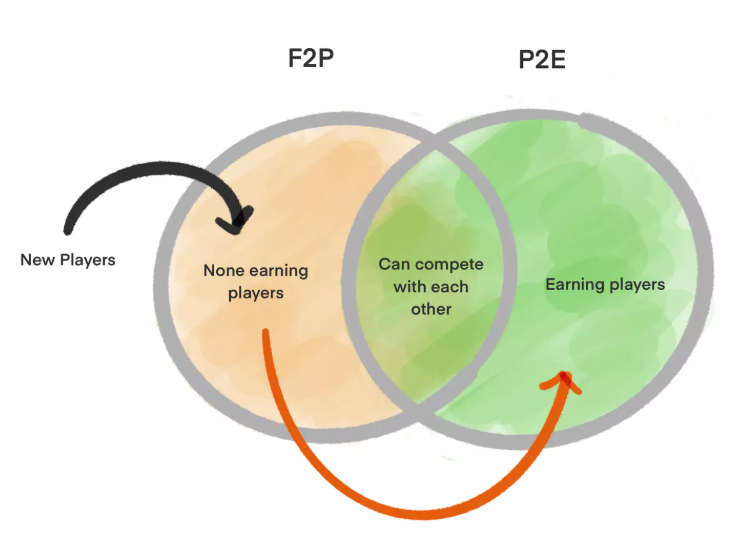
Skyweaver is a fully free-to-earn game designed to help players earn non-tradable cards to expand their collection. It also allows buying/selling cards and earning tradable cards through weekly leaderboards and paid events. The focus is on fun—a more direct appeal than trading NFTs on the marketplace.
Golden Bros is completely free-to-play, available on App Store and Google Play. Players only need to purchase NFTs if they aim for maximum earnings. This paves the way for traditional studios to enter GameFi, enabling integration of such features into existing games.
Gods Unchained supports low-income free-to-earn play, where most rewards are unrelated to NFT cards—primary income is concentrated in weekend ranked events. For the rest of the week, players play for fun and earn “soulbound” cards. Allowing non-tradable cards motivates effort for better cards. Alternatively, players can craft NFT replicas by spending tokens—acting as a token sink—even if resale profits are minimal or negative.
Splinterlands is free to play, but earning requires an initial $10 investment. Earnings decline over time with continued play, yet rankings remain achievable. This balances play-for-fun and earn-for-profit, sustaining enjoyment and economic stability.
Axie Infinity Origins is launching F2P with beginner Axies, letting players enjoy the game without earning. It’s unclear which non-profit elements will be included, but any option to play without energy or SLP farming would be a positive step forward.
7) Game Skins
Allowing players to enhance cosmetic skins without affecting earnings incentivizes ongoing spending. However, unless a game already has strong brand recognition or a highly engaged player base, skins alone won’t drive major revenue. Only dedicated fans and high-spending whales typically spend heavily on cosmetics, so deep and immersive integration is essential to grow skin-related income.
Metaverses and metaverse-integrated games like ICE Poker (Decentraland), upcoming Rumble Kong League (Sandbox), and Otherside offer fertile ground for skin monetization. When players represent themselves in virtual worlds, character cosmetics become tools for personal expression. The fusion of social identity and luxury fashion remains popular. At the individual level, users can mint skins tied to their identity. In metaverse games, skins can also serve as optional rewards, with developers controlling their availability.
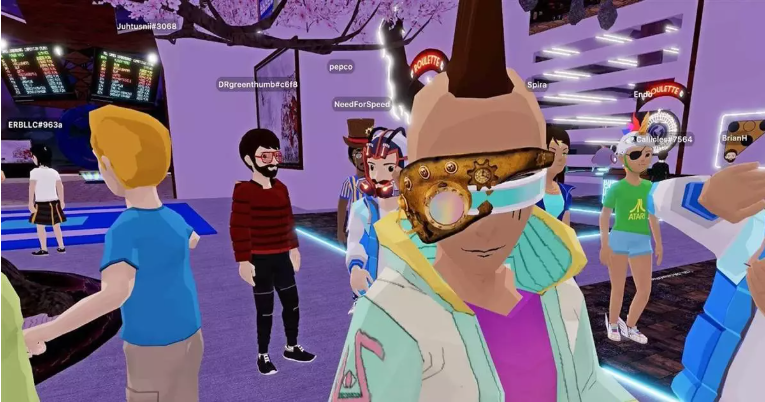
Decentraland citizens showing off their skins
Splinterlands has also launched card skins for bragging rights. The game introduced gold-foil cards, which slightly increase in-game earnings when used—adding both utility and aesthetic appeal. Upgrading skins could significantly boost player spending.
Conclusion
Innovations in sustainable NFT game design have made significant progress and continue evolving weekly. However, incorporating one or more of these elements does not automatically guarantee economic stability, as many other factors influence sustainability. There is no definitive blueprint for a sustainable economy yet, and many games have yet to enter the NFT space—promising even more innovative gameplay ahead. Once the initial excitement around Web3 gaming fades, what will keep players engaged and spending is ultimately the addictive gameplay loop.
That said, we remain optimistic about NFT games and believe the best ones are still ahead. With upcoming titles and the influx of players from the global base of three billion gamers, identifying teams taking the right steps will be increasingly challenging.
Join TechFlow official community to stay tuned
Telegram:https://t.me/TechFlowDaily
X (Twitter):https://x.com/TechFlowPost
X (Twitter) EN:https://x.com/BlockFlow_News






