








Messari: Orca, making DEX more human-friendly
TechFlow Selected TechFlow Selected
Messari: Orca, making DEX more human-friendly
Orca makes accessing decentralized finance more accessible and improves financial experiences through human-centered design, customizable liquidity settings, and an easy-to-use SDK.
 Navigating Web3 tides with focused insights
Written by: Messari
Translated by: TechFlow
Summary
-
Orca is a Solana-based automated market maker (AMM) decentralized exchange (DEX).
-
Orca's core focus is on user interface, enhancing usability and accessibility through human-centered design.
-
As the largest and most pure AMM on Solana, Orca emphasizes composability and simplicity of AMMs, positioning itself as the "DeFi Lego" (middleware) of the ecosystem.
-
Orca recently launched Whirlpools, similar to Uniswap V3’s concentrated liquidity pools, to improve capital efficiency for liquidity providers and enhance trade execution for traders.
-
With the recent launch of governance v0 and the community Whirlpool listing initiative, Orca is advancing toward decentralized decision-making.
To humans, orcas are friendly and approachable ocean ambassadors—but in marine ecosystems, they are apex predators. As a DEX on Solana, Orca aims to live up to its name by emphasizing exceptional user experience (UX), capital efficiency, and composability.
On a small scale, DEXs are central to the decentralized finance (DeFi) ecosystem. In 2021, DEX trading volume grew over 800%, exceeding $1 trillion. The most popular type of DEX is the AMM, which relies on mathematical formulas rather than order books to price assets.
In this vast market, Orca stands out through its focus on human-centered design and simplicity. Its AMM implements simplified features that improve trading and liquidity provision. Orca also distinguishes itself as Solana’s first major AMM to introduce concentrated liquidity, improving capital efficiency and trade execution speed over standard constant product market makers (CPMM). Finally, Orca provides a software development kit (SDK) to further increase adoption. Projects on Solana can use the SDK to integrate with the exchange. Looking ahead, an easy-to-use SDK gives Orca the opportunity to become the preferred AMM middleware within the Solana ecosystem.
Background
Founders Grace Kwan and Yutaro Mori’s broad technical backgrounds and complementary skills enabled them to develop dApps suitable for mainstream users.
In the summer of 2020, the two began developing a beginner-friendly interface for Aave’s Ethereum-based lending market but quickly became discouraged by high gas fees. To enable smaller crypto holders to access and benefit from their protocol, lower fees were essential. Thus, the team was drawn to the nascent Solana network. By the end of summer, they received one of the earliest grants from the Solana Foundation to build the ecosystem’s first purely AMM-based DEX.
Overview
Trading
Orca’s primary function is enabling spot trading for supported tokens. Currently, the Orca team oversees which trading pairs are listed.
After connecting a supported wallet, users can view their assets in Orca’s novel token balance panel. While the DEX is non-custodial, this feature allows users to see real-time balances without opening their browser extension.
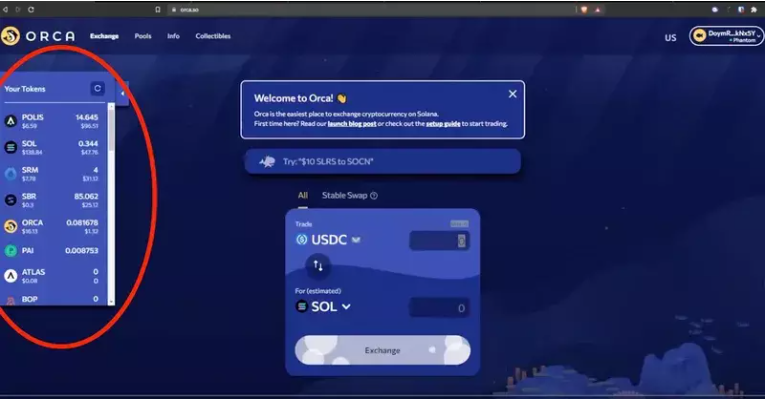
Token balance panel. Source: Orca.so, YouTube
Another unique feature of Orca is the Fair Price Indicator. When users trade, the Fair Price Indicator informs them:
1) The token price differs from CoinGecko’s price by less than 1%.
2) Price impact—the effect of the trade on market price—is less than 1%.
If either condition isn’t met, Orca displays a “price warning” for the first condition and a “price impact warning” for the second. Although users can still proceed, this feature enables more confident decisions without extra steps (e.g., checking a price tracker or another exchange).
Once a trade is completed, balances are updated in the token balance panel, and fees are deducted.
Fees
Solana transaction fees are under $0.01, denominated in SOL. Orca charges 0.3% of trade value as fees for each constant product liquidity pool involved. For Whirlpools, the protocol charges 0.26% of trade value per involved Whirlpool.
Of these 0.3% trading fees, 0.25% goes to liquidity providers (LPs), 0.04% to the Orca treasury, and 0.01% to the Orca Development Fund. However, Whirlpools currently do not charge the Orca treasury fee (0.04%).
For stablecoins, trading fees are 0.07% of trade value, with 0.06% going to LPs, 0.008% to the Orca treasury, and 0.002% to the Orca Development Fund.
The Orca Development Fund regularly donates accumulated fees to nonprofit organizations working on ocean conservation and climate change.
Liquidity
Each Orca liquidity pool is a smart contract holding reserves of two tokens in a trading pair (e.g., SOL/USDC).
Every two weeks, Orca announces its token emissions rewards. In this incentive program, LPs can earn additional ORCA rewards in select pools. The amount of ORCA distributed is set by the Orca team, prioritizing pools with high trading volume relative to liquidity. Some pairs also have “double-dip” pools where users stake their LP tokens to earn both ORCA and partner project tokens.
Currently, Orca has introduced Whirlpools as a second mode for providing liquidity. Whirlpools employ a concentrated liquidity model available for specific pools, allowing LPs to market-make within any price range. Since LPs no longer need to allocate liquidity across the entire price spectrum (from zero to infinity), this method increases capital efficiency and the probability of earning fees.
While Whirlpools require manual setup by LPs, Orca simplifies the process by offering preset price range suggestions with varying risk-return profiles. After depositing liquidity, LPs receive a Whirlpool NFT representing their position.
Pricing Curves
Most token pools on Orca still determine prices using the Constant Product Market Maker algorithm (CPMM). For stablecoins, Orca uses a pricing curve similar to Curve.
Currently, some trades utilize the Whirlpools model. Aggregating different LP positions into a single pool creates a unique composite curve for trading. Because this liquidity is concentrated near the current market price (to earn higher fees), traders experience less slippage.
User Interface Design
The aesthetic design of the product seems deeply appealing to users. This includes larger fonts, proper spacing, comfortable readability, visually pleasing numerals and typography, uniquely crafted graphics, and a cool color palette.
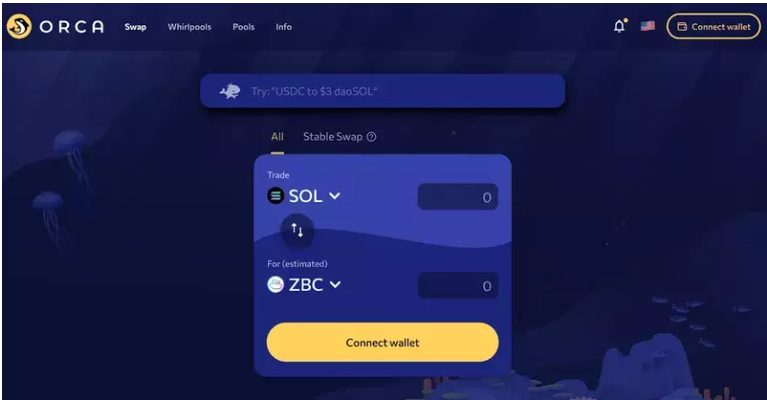
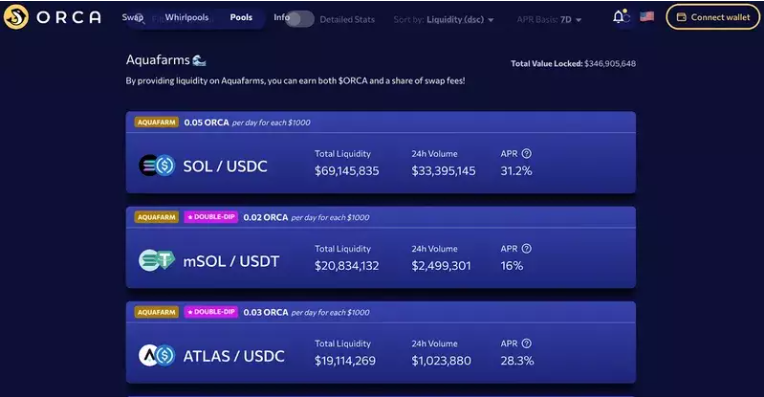
Orca user interface. Source: Orca.so
Most projects either neglect frontend design or use generic cyberpunk templates. Orca bucks the trend by fostering community building through its human-friendly appearance and playful language.
Orcanauts
In late November 2021, Orca launched Orcanauts, a collection of 10,000 whale-themed NFTs. Orcanaut holders are builders of the Orcanautical community, enjoying privileges such as early access to products (e.g., Whirlpools beta), exclusive communication channels, AMAs with the Orca team, and NFT-based partnerships.
Of the mint proceeds ($1.2 million), 75% funded Aflatoun International, a nonprofit developing a cryptocurrency and DeFi education curriculum for youth, while 25% went to artists.
Composability
One of the core advantages of AMMs is their composability. To serve as “DeFi Legos,” Orca offers an open-source TypeScript SDK mirroring all application functions. Consistent with the Orca brand, the API is designed to be simple and easy to use, enabling developers to integrate, embed, or build upon exchange functionalities (e.g., trading, liquidity provision, quoting). Orca recently updated its SDK to include support for the Whirlpools model.
Examples of current integrations include the aggregator Jupiter, portfolio visualization platform Sonar Watch, and yield aggregator Tulip.
ORCA Token
ORCA is Orca’s SPL governance token based on Solana.
Orca launched its token in August 2021, nearly six months after the protocol went live. The initial supply accounted for 5.25% of the total supply and was airdropped to early traders and liquidity providers. 20% of the total supply was allocated to the team, subject to a 1-year lockup and 3-year vesting period. Since the airdrop, ORCA has primarily been used for liquidity incentives (e.g., Aquafarms) and fundraising.
Over a month after the token launch (September 2021), Orca announced an $18 million Series A round led by Three Arrows Capital, Polychain Capital, and Placeholder. Other investors included Jump Capital, Sino Global Capital, Solana Capital, Coinbase Ventures, and DeFiance Capital. These investors received 9.6% of the total ORCA supply, also subject to a 1-year lockup and 3-year vesting.
4.3% of the total supply is allocated to builders and advisors, including developers through the Builders Program and experts who contributed to protocol growth (e.g., e^{i} Ventures and Reverie).
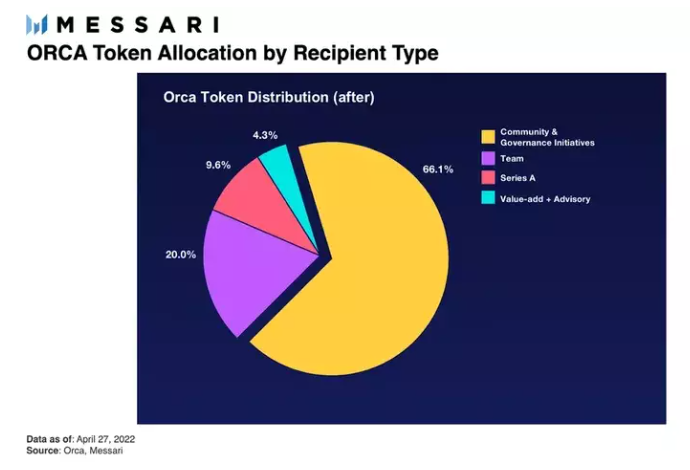
In April 2022, Orca launched its first governance iteration (v0), expanding ORCA’s utility. Until April, Orca had only one governance vote. Now, v0 establishes a formal community governance process. After discussion on the Orca governance forum, anyone holding 100,000 ORCA can formally submit an on-chain proposal to modify the protocol. Over a 7-day period, all (unlocked) token holders can vote (one ORCA, one vote). Proposals receiving over 500,000 votes pass and are executed by the Orca team.
Traffic Trends
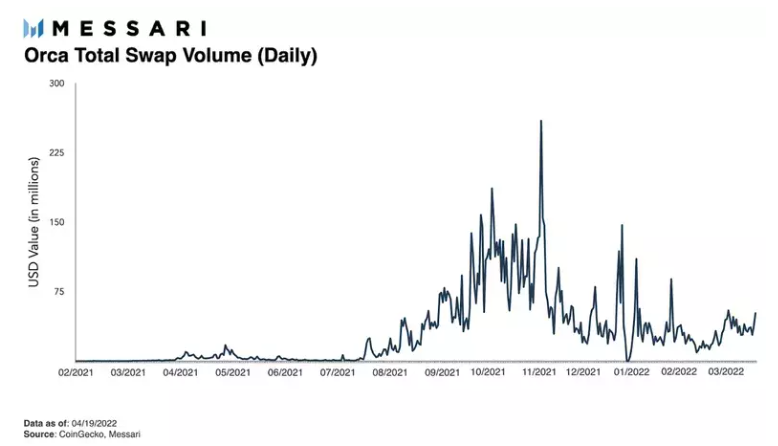
After launching in February 2021, Orca took about six months to gain traction. Since then, trading volume has appeared to correlate with the price of Solana (SOL). Over the past six months, average daily trading volume has exceeded $50 million.
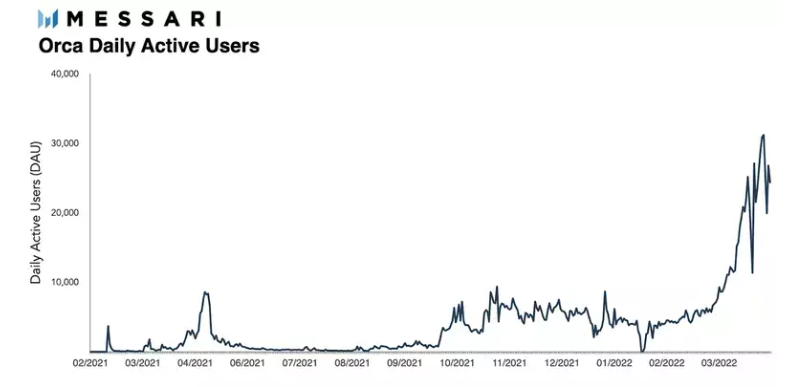
Until recently, daily active users (DAU), measured by unique addresses, fluctuated with trading volume. However, starting mid-March, DAU rose from around 5,000 to a range of 20,000–30,000 and began stabilizing. This trend is likely driven by STEPN, a lifestyle/fitness dApp that recently gained significant attention in the crypto space.
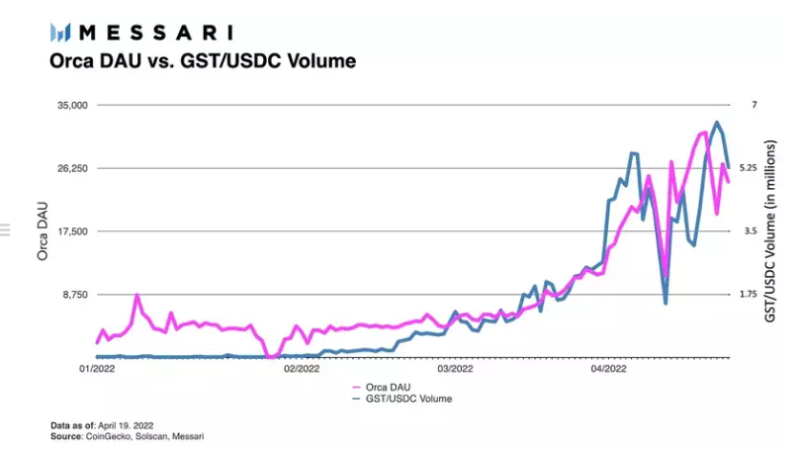
In terms of historical trading volume, the top two pairs are SOL-USDC and SOL-USDT. Two Ethereum pairs (ETH-USDC and ETH-SOL), a staked Solana pair (mSOL-SOL), and the stablecoin swap USDC-USDT also rank in the top 10.
Outlook
Migrating to Whirlpools
Orca’s most notable roadmap item is the transition to the Whirlpools model. Initially, Whirlpools will run parallel to existing constant product pools. However, ongoing liquidity mining rewards (Aquafarms and Double-Dips) will gradually phase out and shift to Whirlpools. Additionally, since Whirlpools do not charge treasury fees, this will further boost LP returns and reduce trader fees.
Orca also aims to establish a framework for custom, community-driven Whirlpool listings and fee tiers to help LPs reduce impermanent loss.
Governance
Orca plans to experiment further with customization in future governance versions. This includes building a new custom governance platform, as v0 was simply deployed on Realms (Solana’s official open-source UI framework). The team also intends to test parameters such as discussion duration and voting thresholds. Future iterations may allow approved proposals to include self-executing code.
Solana’s DeFi Lego
The Orca team will continue announcing new partnerships as it strives to become Solana’s foundational AMM infrastructure—or middleware.
Competitors
Orca faces two main sets of competitors: pure AMM-based DEXs (like Uniswap, Curve Finance, and Trader Joe) and Solana-based DEXs (like Raydium and Serum).
Pure AMMs
In terms of AMMs, Orca has few direct competitors on Solana. However, cross-chain competition is intense. Much of this competition hinges on native chain liquidity. Some AMMs dominate single chains—Uniswap on Ethereum, SpookySwap on Fantom, and Trader Joe on Avalanche—while others operate across multiple chains, such as Curve Finance and SushiSwap.
The chain a project chooses is crucial, as it determines its total addressable market (TAM). While it’s difficult to pinpoint the exact value of liquidity on a given chain, a proxy metric is Total Value Locked (TVL).
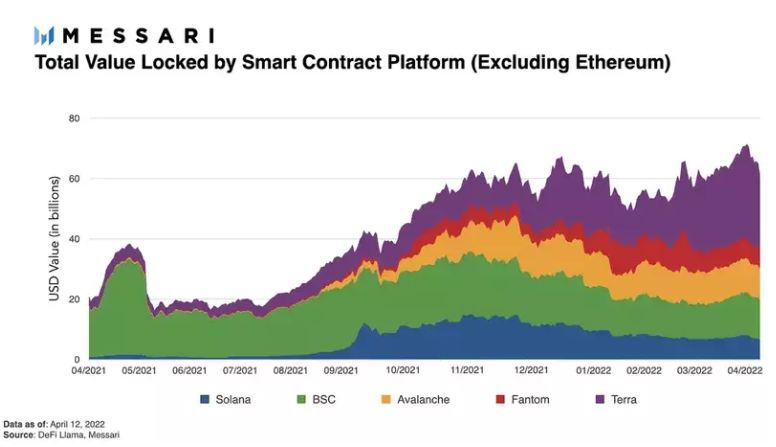
For much of the second half of 2021, Solana ranked third in TVL, later falling to fifth. If Orca aims to catch up with leading protocols like Uniswap and Curve Finance, it must either expand cross-chain or rely on Solana attracting more on-chain activity.
However, Orca’s key advantage with its new concentrated liquidity pools lies in Solana’s low fees and fast transaction speeds. This enables users to trade, set up, and rebalance liquidity quickly and cheaply.
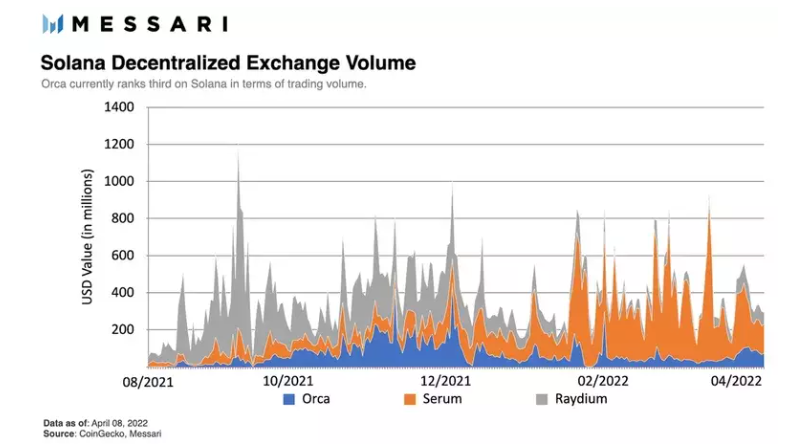
On Solana, Orca’s two main competitors are Serum and Raydium. Though all are DEXs, they differ significantly from Orca.
Serum and Raydium
Serum is the highest-volume DEX on Solana. It uses an on-chain centralized limit order book (CLOB) and does not have its own front-end. In this sense, Serum is not truly an exchange. Rather, it functions more like open-source order book middleware, allowing protocols to embed its liquidity network.
Raydium is currently the largest AMM on Solana. It integrates Serum’s open-source CLOB and provides liquidity to it. As a result, Raydium LPs and traders gain access to Serum’s cross-protocol order flow and liquidity. Another key difference between Orca and Raydium lies in functionality: Orca offers concentrated liquidity pools, while Raydium offers two distinct features—an initial decentralized exchange offering (IDO) platform and permissionless liquidity pool creation.
Raydium’s model offers LPs two options: passively providing liquidity across the entire price curve or actively managing orders on Serum. Orca’s concentrated liquidity pools combine the benefits of both approaches while mitigating their drawbacks. Concentrated liquidity gives LPs better capital efficiency and flexibility to choose price ranges based on their willingness to actively manage risk and capital, thereby reducing potential impermanent loss. For traders, the model reduces slippage compared to standard AMMs (CPMM). By not integrating Serum, Orca maintains autonomy at the protocol level while preserving platform usability.
Conclusion
From both ethical and market perspectives, DeFi’s two main goals are democratizing access and improving financial experiences. Orca embodies this ethos through human-centered design, customizable liquidity settings, and an easy-to-use SDK.
Join TechFlow official community to stay tuned
Telegram:https://t.me/TechFlowDaily
X (Twitter):https://x.com/TechFlowPost
X (Twitter) EN:https://x.com/BlockFlow_News
 Messari


