Hangout Metaverse: The Web3 cross-chain social platform that truly recreates "Free Guy"
TechFlow Selected TechFlow Selected
Hangout Metaverse: The Web3 cross-chain social platform that truly recreates "Free Guy"
HANGOUT aims to empower everyday business and social interactions among players/users, between users and project teams, and among project teams, enabling them to build businesses and create value.
 Navigating Web3 tides with focused insights
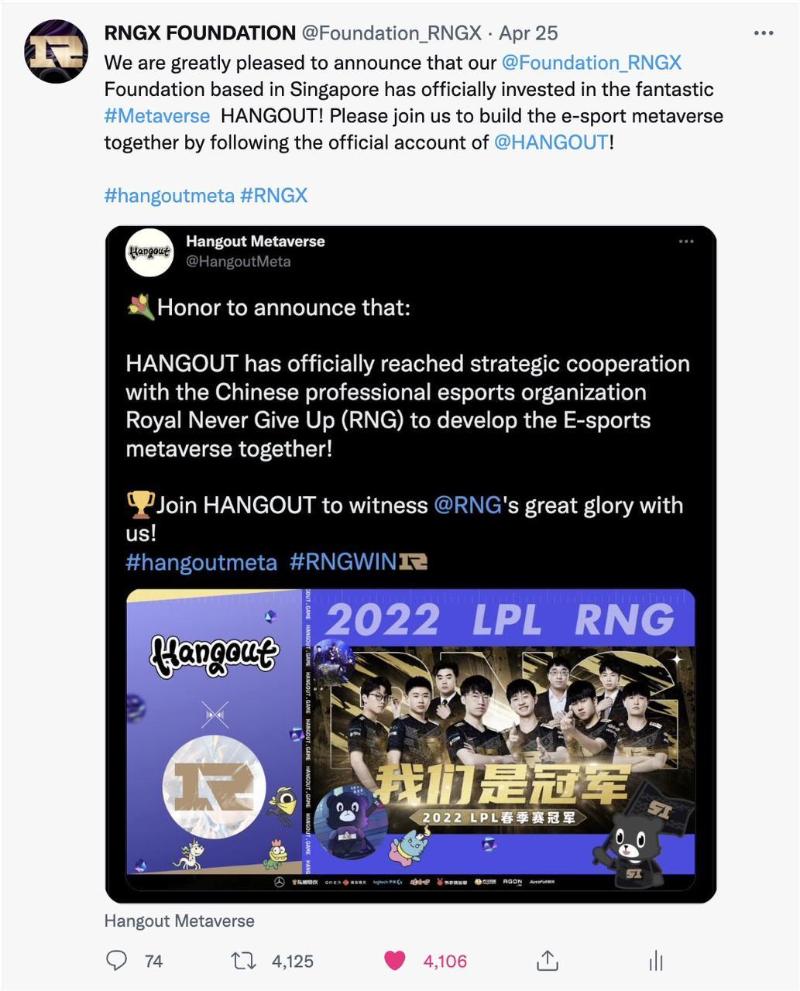
On April 25, RNG Foundation, based in Singapore and under the Royal Never Give Up esports club, announced its investment in the metaverse game Hangout, bringing Hangout into the public spotlight.
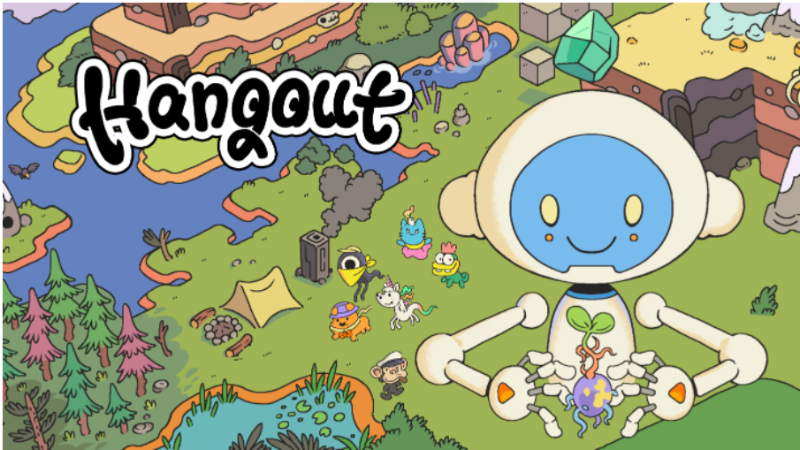
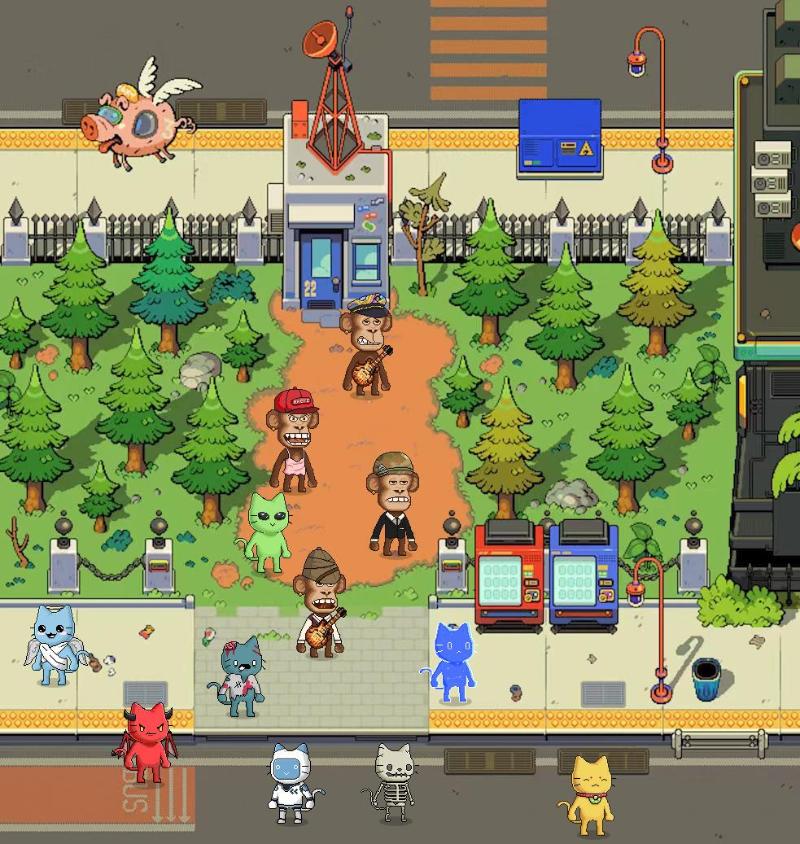
At first glance, Hangout is a 2D pixel-style metaverse world notable for its exquisite art design. It aims to build a multi-chain-powered metaverse ecosystem that connects project teams and players.
Basic Information
Game Overview
HANGOUT is a 2D pixel-art, highly open-ended Web3 social game.
HANGOUT aims to integrate and empower various blockchain projects—including NFTs, DeFi, GameFi, and DAOs—through a multi-chain architecture, ultimately presenting a complete crypto cultural universe in metaverse form. The platform fulfills players' needs to establish friendly social connections and communities within the game, engage in digital asset and goods trading, participate in diverse gameplay and world-building activities for enjoyment and rewards. HANGOUT empowers daily commercial and social interactions among players, between users and project teams, and among project teams themselves, enabling them to build businesses, create value, and share outcomes with ecosystem participants. This vision positions HANGOUT as a super traffic gateway for Web3 where users and projects can meet, work, and live.
Official Links
Website: https://hangout.game
Twitter: https://twitter.com/HangoutMeta
Discord: https://discord.gg/hangoutmetaverse
Whitepaper: https://docsend.com/view/26m6nehkxy8ynrsq
Game Background
HANGOUT features two types of spaces: Layer1 and Layer2. Layer1 consists of three interconnected concepts—"continents," "scenes," and "plots." Players can access Layer2 via portals from Layer1 or through a Layer2 teleportation list. This structure resembles Pokémon: exploring outdoors corresponds to Layer1, while entering buildings for gym battles corresponds to Layer2. However, unlike Pokémon, Layer2 spaces can exist independently without requiring entry from Layer1.
Layer1
Continents
HANGOUT's universe, named MOJITO, is divided into nine distinct continental zones, each associated with specific geographical, cultural, and native ecological characteristics tied to corresponding blockchains. The project plans to deploy digital assets such as land across multiple chains including Ethereum, BSC, and Polygon.
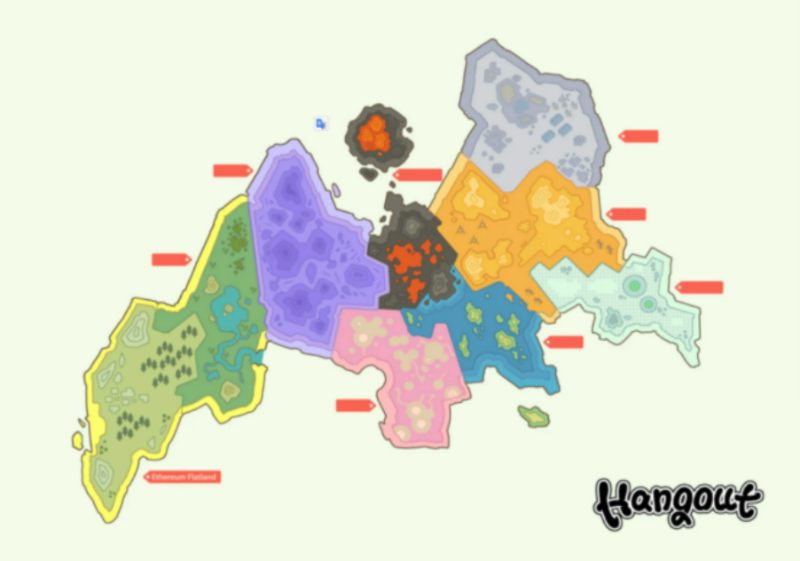
Scenes and Plots
Each zone comprises different scene maps, with every scene consisting of 16 plots categorized into extra-large, large, and standard sizes, each bearing a unique identifier. Scenes are classified as either "platform-reserved" or "public-sale" scenes. Platform-reserved scenes are exclusively used by HANGOUT for public infrastructure or partner collaborations and are not available for sale. Public-sale scenes can be freely purchased and customized by players, who gain full rights to modify their appearance and functionality upon purchase.
Layer2
Layer2 refers to independent mini-spaces coexisting alongside Layer1, essentially representing interior spaces of individual buildings. Players can enter these Layer2 spaces via entrances on Layer1 buildings or directly through the teleportation list. HANGOUT constructs publicly accessible buildings within common areas, while players may build private residences or commercial structures on their own land.
Getting Started
HANGOUT allows any player with a cryptocurrency wallet address to log in and explore the MOJITO world. Owning personal scenes or plots enables participation in building the HANGOUT universe.
Ethereum Zone
The Ethereum Plain is the first explored and developed zone on the MOJITO continent. Players seeking to begin their creation journey in MOJITO can join by purchasing scenes or plots. Purchasing an entire scene (16 plots) grants full customization and management rights, offering higher creative freedom and exploration possibilities.
Total number of scenes in the Ethereum zone: 369 (each scene has 16 plots – totaling 5,904 plots)
-
Platform-reserved scenes: 72 (1,152 plots)
-
Public-sale scenes: 297 (4,752 plots)
-
Initial land sale includes 47 scenes (752 plots)
According to official updates, Hangout will open minting for the first batch of land at 8:00 PM on May 6 (Singapore time).
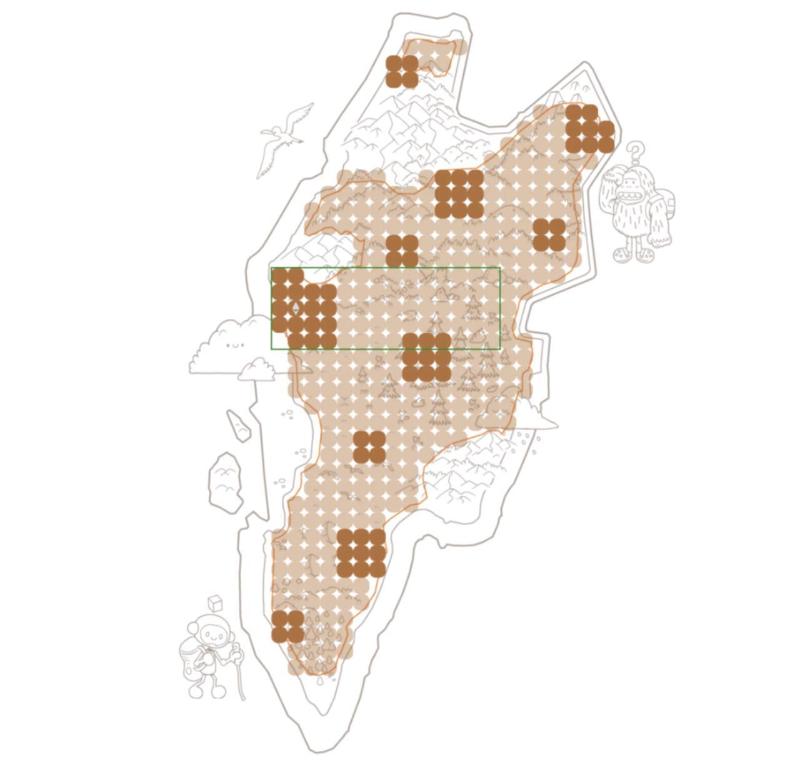
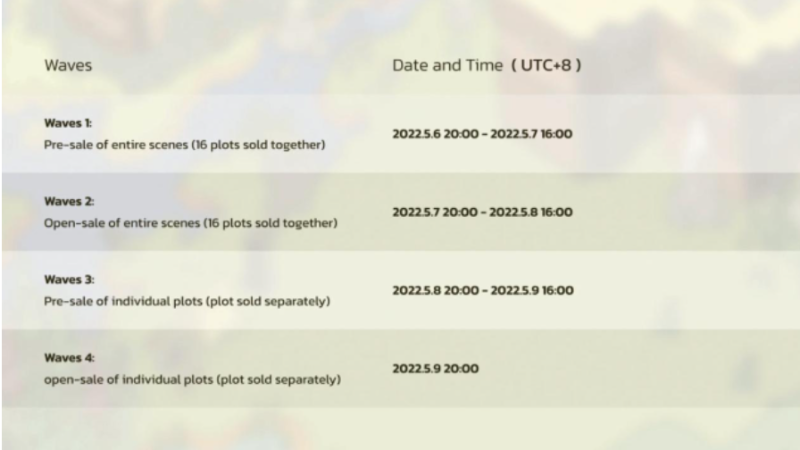
The 47 scenes in the initial Ethereum Plain sale will be released in four phases. Sale dates are listed below:
-
During Wave 1 & 2, purchases are limited to full scenes only (16 plots together). Each wallet address may buy a maximum of one scene (16 plots).
-
During Wave 3 & 4, individual plots become available for purchase. Players may buy one plot per wallet address.
How to Buy Land?
-
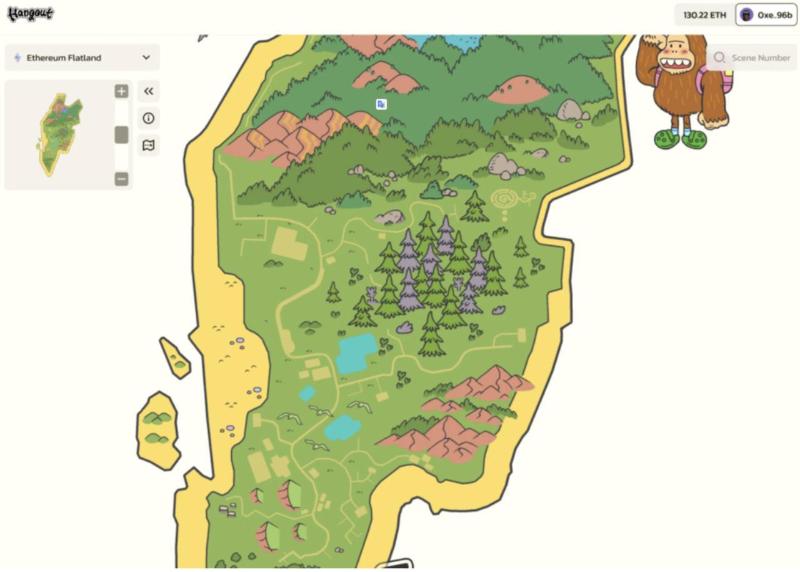
Visit the HANGOUT official website (hangout.game), select the Ethereum network in your MetaMask browser wallet, and connect your wallet.
-
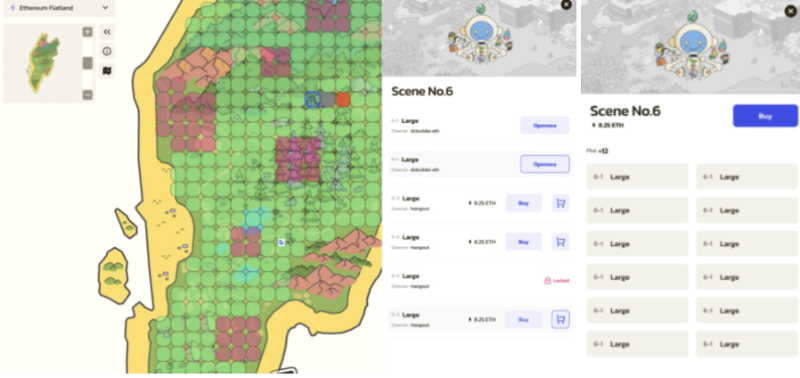
Open the map on the website and locate green-colored scenes. Click on a green scene to view purchasable assets. Purchase methods vary by wave: during Waves 1 & 2, land must be bought as full scenes; during Waves 3 & 4, individual plots can be purchased separately.
Plot Size and Pricing
-
Extra-Large Plot: 0.25 ETH
-
Large Plot: 0.13 ETH
-
Standard Plot: 0.09 ETH
-
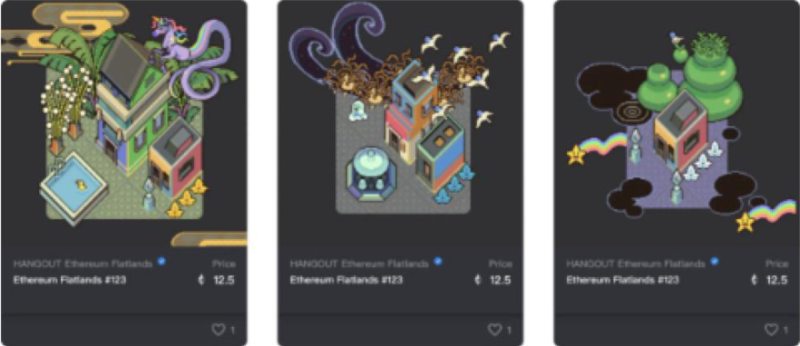
After completing the transaction, players can view their assets on OpenSea. HANGOUT land assets are standard ERC-721 tokens, fully tradable at the owner’s discretion. Each land NFT possesses dozens of metadata attributes, ensuring every buyer receives a uniquely combined asset. Purchased NFTs initially appear as mystery boxes; official metadata revealing exact attributes will be disclosed days later.
Gameplay Introduction
Once owning a personal scene or plot, players can customize the appearance and functions of these assets in this open sandbox world. These private spaces serve as ideal venues for gatherings, mini-games, showcasing and trading private NFT collections, etc. Gameplay is categorized into four major types.
-
Social Community
HANGOUT retrieves user identity and asset information using decentralized IDs. The platform provides dedicated Layer2 spaces for each partnered project or collaborator. Players holding NFT assets from a specific project or community can access the corresponding Layer2 space via designated Layer1 entrances or the teleportation list.
For example, players can view their NFT assets usable in-game. By selecting their Cool Cat NFT as their in-game avatar, their character appearance dynamically changes—a standout feature. Additionally, music-themed NFTs can even be played or publicly shared within the game.
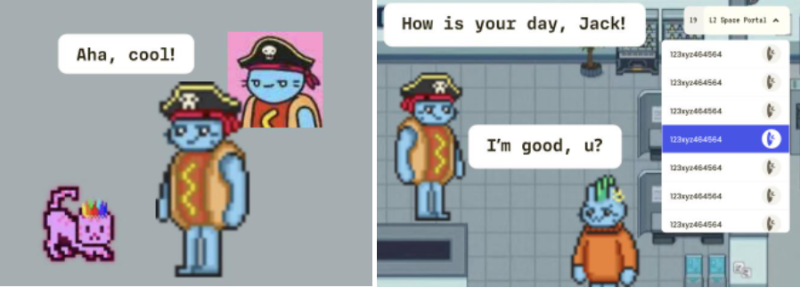
Using the game’s asset display function, players can identify others’ identities—such as high-net-worth individuals, creators, gamers, etc.—facilitating new social relationship chains based on themes and interests within HANGOUT.
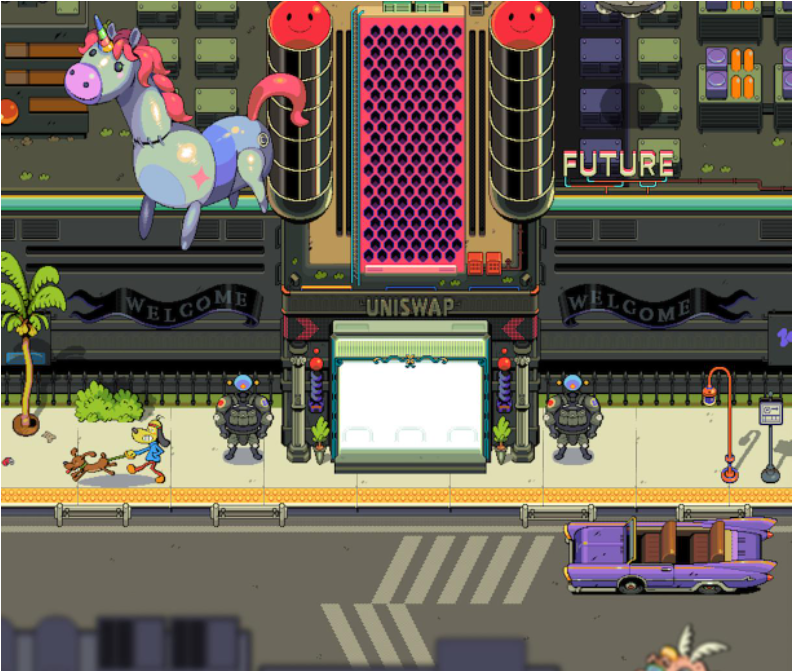
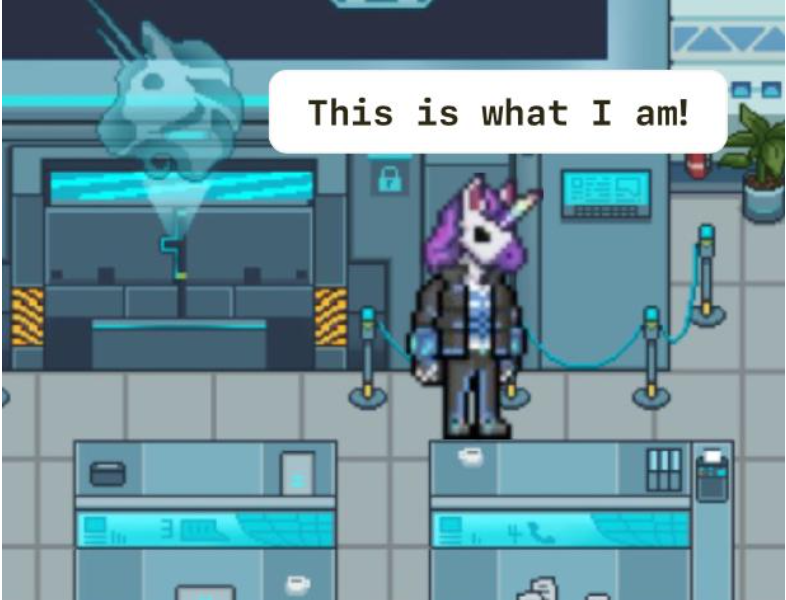
Integrating DeFi projects into the HANGOUT world adds gamified experiences to purely functional products. HANGOUT also explores co-branded asset issuance with DeFi projects. For instance, the collaboration with UNISWAP features a unicorn-headed character (demo visual concept).
-
Commercial Finance
HANGOUT offers modular smart contract integration, allowing players to easily incorporate and use DeFi protocols via drag-and-drop tools and parameter configuration. With these capabilities, players can develop virtual banks or other financial assets—such as trading and lending systems. For protocols not directly configurable in-game, HANGOUT provides SDKs and development guidelines, expanding integration options for technically capable players or organizations.
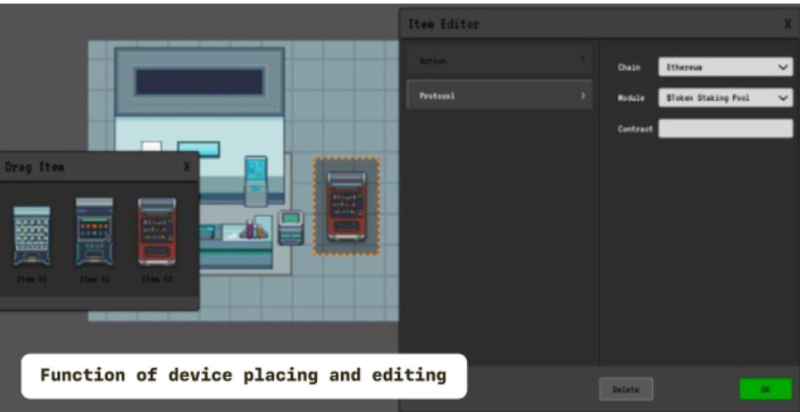
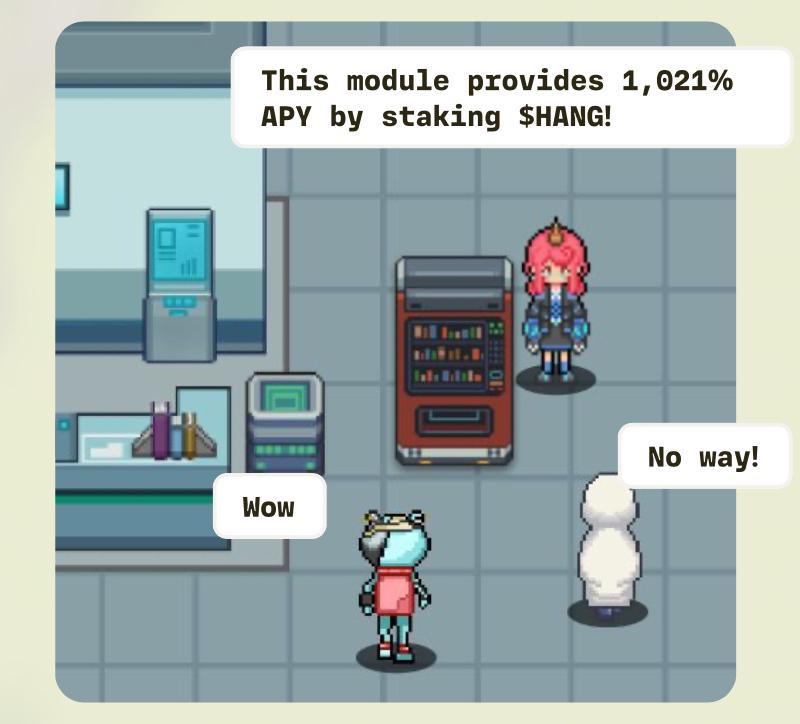
Players can embed financial functionalities into their custom Layer2 spaces, games, or quest objectives using the in-game editor, enabling monetization of self-created content.
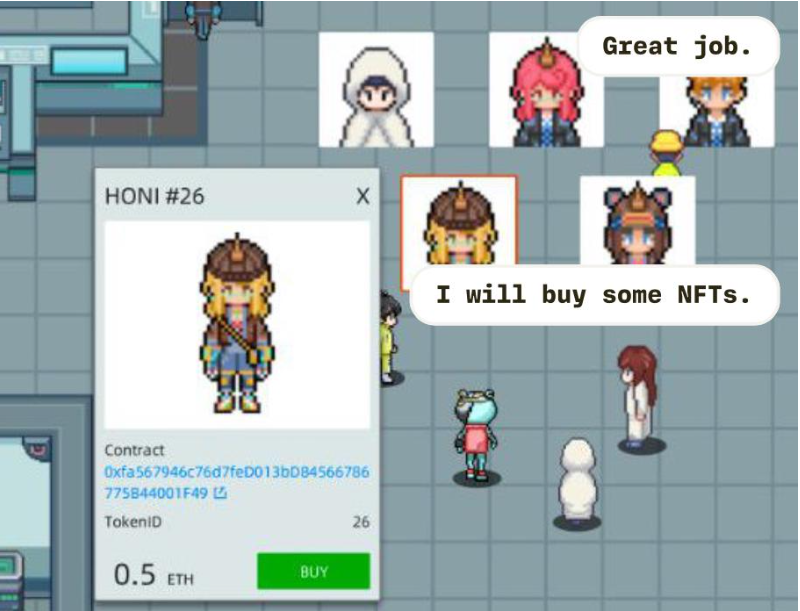
NFT projects, artists, and others needing exhibition and sales opportunities can host NFT exhibitions and sales events within their Layer2 spaces. Any player inside these spaces can view displayed NFT information and purchase available assets.
-
Space and Content Creation
Owning land assets grants full customization rights. Players can freely place items—including equipment, decorations, NPCs, and NFTs—within their Layer2 spaces. Access permissions for private spaces can be set as public, pay-to-enter, or passcard-restricted.
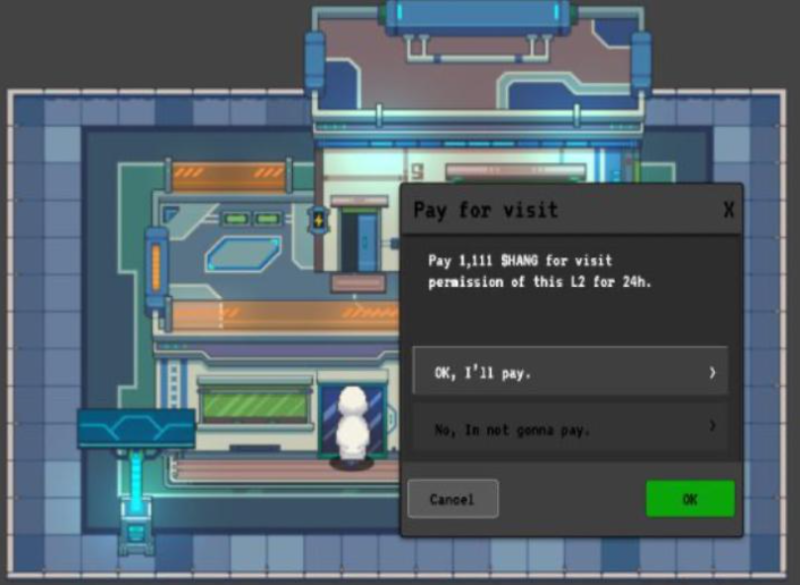
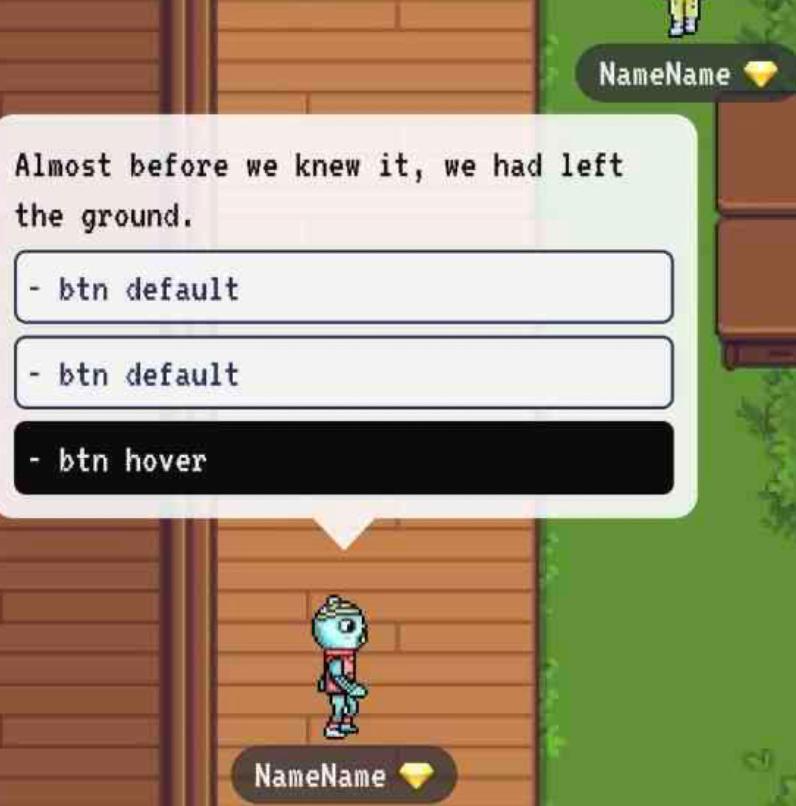
Most public NPCs in HANGOUT are played by local residents called "HOMIs." Their main role is guiding players into the metaverse and assisting with quests. Players can also purchase customizable NPCs to place in their Layer2 spaces, serving roles like greeters, announcers, or POAP distributors.
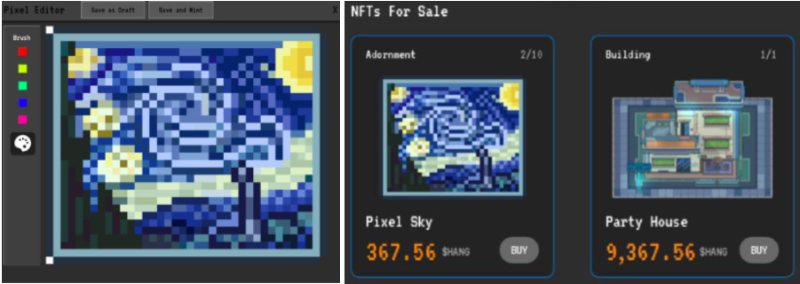
Creative players skilled in 2D pixel art can use PixelMaker—an external pixel graphic editor provided by the project—to create pixel artworks. These creations can be minted as standard NFTs and sold as decorative items in HANGOUT’s official marketplace. Items sold in the marketplace are standard ERC-721 assets, tradable via OpenSea and other mainstream platforms. To encourage creativity, HANGOUT will not charge commission fees on asset transactions during the early stages.
In addition to PixelMaker for visual editing, the project also offers MetaController, a logic editor for creating complex quests and functional items.
HANGOUT will also establish a foundation dedicated to funding innovative creators and organizations, supporting the creation of high-quality content to promote ecosystem growth.
-
Entertainment & Games
HANGOUT combines the construction capabilities of a sandbox metaverse platform with built-in gameplay experiences such as main storyline quests. These integrated game mechanics merge with player-created content to deliver diverse and complex entertainment experiences.
Additionally, HANGOUT proposes a "gaming platformization" direction, aiming to incorporate standalone mini-games like battle royales and NFT duels within the world.
Project Highlights
-
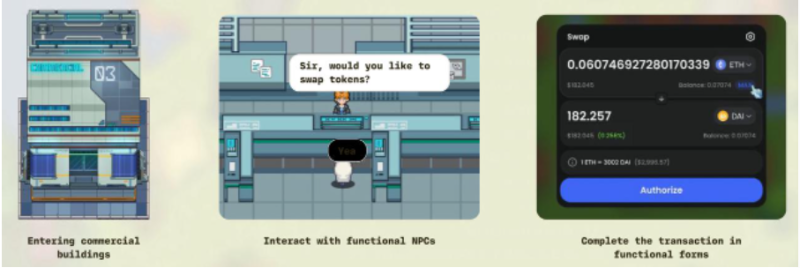
While providing entertainment and social interaction, HANGOUT also aims to help newcomers unfamiliar with crypto or blockchain gradually learn how to use DeFi features. Through gamification, HANGOUT offers a low-barrier, highly flexible magical world where players can experience various applications such as NFTs, DeFi, and GameFi. Even beginners can try out DeFi functionalities like token swaps on DEXs (shown below), cross-chain transfers, staking in yield aggregators, and automated arbitrage strategies.
-
In typical RPG exploration games, NPCs merely guide players. In HANGOUT, everything is customizable—NPC appearances and dialogue flows can be tailored to personal preference. Beyond basic settings, NPCs can integrate with services like Amazon AWS or Alibaba Cloud Alimebot, giving them conversational abilities. Much like the movie *Free Guy*, NPCs could potentially reach a certain level of artificial intelligence—a major innovation in HANGOUT.
-
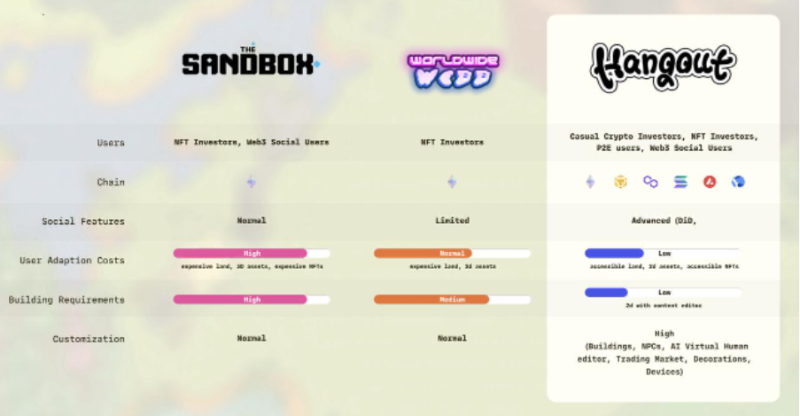
Compared to well-known counterparts like The Sandbox, HANGOUT’s biggest advantage lies in its extremely low entry barrier. Land prices are typically very high elsewhere, but HANGOUT significantly lowers the cost. Furthermore, its 2D art style greatly reduces the threshold for creative modifications—2D editors are far lighter and easier to use than 3D ones. HANGOUT targets a broad audience, attracting not only NFT enthusiasts and Web3 social gamers but also traditional gamers. Its multi-chain support gives players more flexibility. In this highly open magical world, we believe HANGOUT can achieve extraordinary things.
Current Operations
Community Management
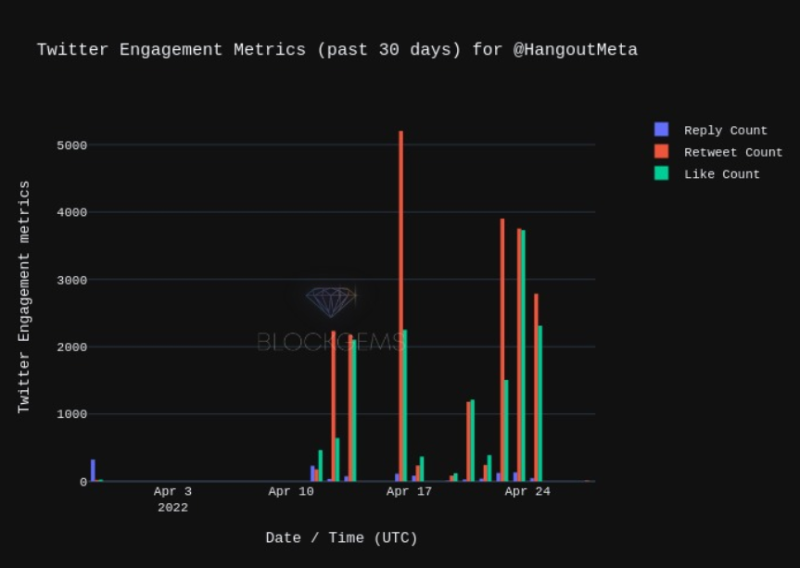
Analyzing Hangout’s Twitter data over the past 30 days (via Blockgem), user engagement is strong, with an average of 2,500 interactions per post—indicating high project热度.
Business Partnerships
As early as 2021, RNG established a blockchain gaming foundation and has now officially invested in HANGOUT—an innovative selling point among current metaverse projects, injecting significant traffic into the traditional blockchain ecosystem. As such, fans can find an esports-themed scene built specifically for RNG supporters within HANGOUT, allowing them to interact and celebrate RNG’s glory together. Reports suggest HANGOUT is actively pursuing partnerships with more top-tier IPs, and we look forward to seeing how these collaborations enhance the product with added utility and gameplay.
Multi-Chain Expansion
HANGOUT aims to build a multi-chain metaverse composed of nine continents, each linked to a specific blockchain. Currently, the game plans to support integration and asset mapping across Ethereum, BSC, Polygon, Solana, Terra, and Avalanche.
Economic Mechanism
Token Utility
$HANG is HANGOUT’s primary utility token, used to purchase in-game assets, toolkits, or unlock features. Additionally, $HANG serves as a governance token, allowing holders to vote on platform decisions via a decentralized autonomous organization (DAO).
In-Game Economy
Token Distribution
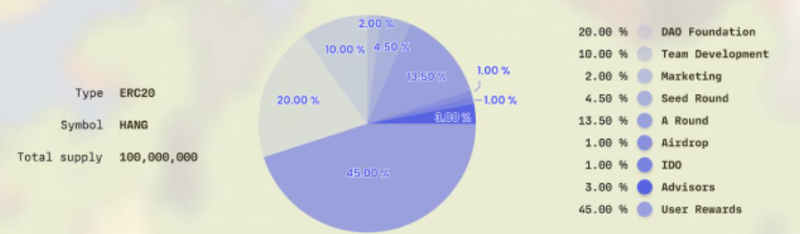
Founding Team: 10%
Investors: 25%
DAO Governance: 20%
Player Game Rewards: 45%
As shown below, the team holds a relatively small share. The official allocation dedicates 45% of tokens to players as incentives for participation, while strongly supporting DAO development.
Token Revenue Streams
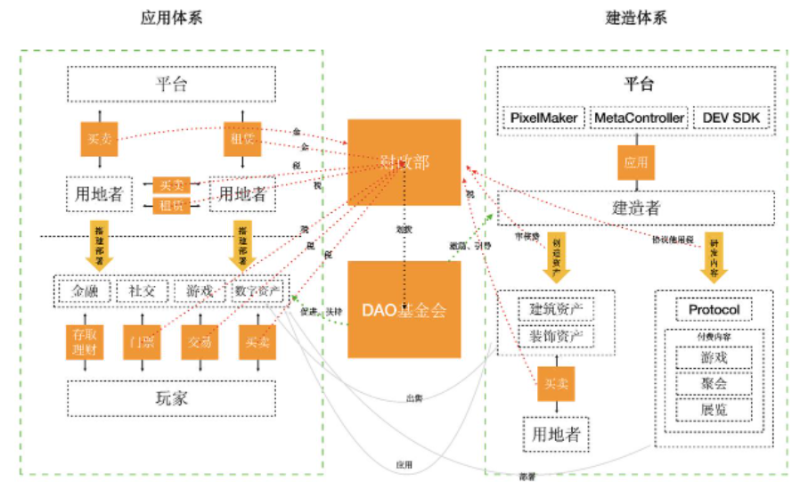
-
Staking
-
Renting out land resources
-
Selling tickets to access Layer2 spaces
-
Earning through creation
Token Expenditure Channels
-
Room decoration
-
Renting others' land resources
-
Market purchase of land resources
-
Purchasing tickets to enter Layer2 spaces
-
Purchasing Layer2 space usage rights
-
Quest consumption
-
In-game spending
Team & Collaboration
According to official information, HANGOUT is an international team with members in North America, Australia, China, Singapore, and other countries. The team consists of 20 full-time and 12 part-time employees.
CEO
Alex Camacho, a creative leader and co-founder, is proficient in GameFi and the metaverse. According to LinkedIn, Alex began focusing full-time on Web3 development in October 2021, serving as a consultant and market researcher across multiple projects. Leveraging exceptional learning and communication skills, he accumulated extensive experience in consulting, operations, and management. For the promising Hangout Metaverse project, Alex leverages his CEO strengths in strategic planning and market expansion. He oversees global team operations and international cooperation.
Art Team
The art team is an independent game studio based in Shanghai, whose 2D pixel games have been rated by Steam as “among the best pixel art designs ever.”
Art director Halsey brings rich experience in character illustration, design, and creative composition for Vtubers. With solid artistic fundamentals and 12 years of drawing experience, she excels in form design and imagination. Her designed games enjoy an 86% positive rating on Steam, strong sales records, and numerous international awards.
Art director Halsey brings rich experience in character illustration, design, and creative composition for Vtubers. With solid artistic fundamentals and 12 years of drawing experience, she excels in form design and imagination. Her designed games enjoy an 86% positive rating on Steam, strong sales records, and numerous international awards.
Technical Team
TechyDAO is a six-member alliance of cryptocurrency technical experts from Australia, Singapore, South Korea, Canada, and other regions. Members possess deep expertise in front-end, back-end, and smart contract development on ETH and BSC.
Lead technologist GAO has over 20 years of R&D and project management experience, having worked on over 100 mobile games, web games, and H5 projects. His experience spans MMORPGs, sandbox, idle, board, and card games—offering broad vision and deep expertise. He previously held CTO and technical director roles at several companies. Before joining HANGOUT, he served as CTO at Tencent’s Penguin Fairy Tale Technology.
Marketing Team
HTR Group, founded in 2017, is a professional investment and management team dedicated to incubating next-generation crypto projects. HTR Group connects over 300 communities and 500,000+ members, supports 450+ blockchain projects, and has backed 50+ projects listed on Binance. Key projects include Avalanche, Huobi Primepool and Primelist, and Jswap.Finance. Some partnerships have lasted over three years. With backgrounds in trading and investing, HTR Group has the capability to accelerate crypto project growth.
Dao, founder of HTR, formerly served as Country Manager at OKEx and Southeast Asia Community Manager. He is also co-founder of Titans Ventures, one of Vietnam’s largest blockchain incubators with a successful track record. With five years of marketing experience, he has consistently helped IT enterprises enhance brand visibility and clarify market positioning to drive financial growth, possessing rich project experience in social media, globalization, and diversified collaborations.
Project Progress
Roadmap
The project is currently in Phase One. Since its founding in February 2022, Hangout’s overall development has largely followed the roadmap.
-
Phase One (until May 2022)
-
First land sale
-
First open-world partners ✅
-
Official website launch ✅
-
Demo version featuring MMO and core NFT asset functionalities ✅
-
-
Phase Two (until July 2022)
-
Launch of $HANG utility token
-
Completion of full game art upgrade
-
Full rollout of L2 spaces with customizability and light social entertainment features
-
Development initiation of PixelMaker and MetaController professional editing tools
-
Expansion of PVE gameplay
-
Initiation of Hangout Asset Marketplace development
-
-
Phase Three (until November 2022)
-
Release of HO SDK integration standards
-
Alpha testing of PixelMaker and MetaController
-
Deepening community collaboration and promotion of L2 community features
-
Alpha testing of Hangout Asset Marketplace
-
-
Phase Four (starting December 2022)
-
Incubation of in-HANGOUT game projects and Web3 communities
-
Potential Risks
The project demonstrates strong Twitter operational capabilities, but Discord appears to need greater exposure, as current user activity there remains relatively low.
Could whitelist acquisition methods be more diversified?
The multi-chain development plan lacks clarity.
While the multi-chain approach is innovative, it risks uneven user distribution between earlier and later developed chain segments, with no apparent solution yet proposed.
Currently, HANGOUT emphasizes social interaction and creative creation, but its core gameplay depth requires improvement. Players joining primarily for gaming may find the experience different from expectations.
Given the low entry barrier and high game freedom, can the project team effectively detect, monitor, and govern potential negative in-game behaviors?
Join TechFlow official community to stay tuned
Telegram:https://t.me/TechFlowDaily
X (Twitter):https://x.com/TechFlowPost
X (Twitter) EN:https://x.com/BlockFlow_News