Podcast Notes | Sam Altman: Jensen Huang Is My Hero, AI Chip Demand Is Overhyped, OpenAI Will Eventually Go Public
Compiled & Translated by: TechFlow
TechFlow Guide: At the “Silicon Valley & The World” summit hosted by Semafor, OpenAI CEO Sam Altman engaged in an in-depth dialogue with Reed Albergotti, Semafor’s San Francisco Bureau Chief. This marks the first public remarks from a top AI leader since Jensen Huang’s departure shook the tech world. Altman directly addressed his complex feelings and heroic assessment of Huang’s exit, confronted the public backlash over voter-approved referendums opposing data centers across the U.S., and criticized Silicon Valley for a public relations disaster that paints humanity as becoming “emotionally passive Labradors.”
The entire conversation delved into the “computing power double-counting” bubble in the chip supply chain, the sustainability of tens of billions in data center debt, OpenAI’s considerations regarding a public listing versus safety trade-offs, and how AI is evolving from chat and coding agents into the foundational scientific engine for next-generation physics and mathematics.
Guest: Sam Altman (CEO of OpenAI)
Host: Reed Albergotti (San Francisco Bureau Chief, Semafor)
Source: Semafor (https://www.youtube.com/watch?v=oi-E6xB4wSU)
Original Title: Sam Altman: ‘It’s Hard To Imagine the AI Revolution Without Jensen’ | Silicon Valley & The World
Air Date: November 16, 2026
Key Takeaways
· Deep empathy for Huang’s departure and the hero narrative: Sam Altman called Jensen Huang a long-time hero but noted “every hero has flaws.” He deeply sympathizes with being ousted by a board and holds profound gratitude for Nvidia’s early mutual investments. Though he declined to weigh in on whether Huang should return, he stresses that Huang’s immense ambition remains an irreplaceable core engine of the AI revolution.
· Nvidia’s backing and industry resilience: Regarding Nvidia’s $105 billion guarantee for OpenAI’s Ohio data center project, Altman believes Nvidia’s sheer scale still inspires trust. Despite Huang’s deep ties to the company, true downstream demand and revenue growth for AI are exceptionally strong, and the overall industry will not stall.
· Criticism of the “Labrador pet-style” AI PR disaster: With anti-data center referendums passing across numerous U.S. states, Altman bluntly pointed out Silicon Valley’s severe missteps in messaging. If the narrative sold to the public is “trading away human agency for cures for cancer and cheap goods, leaving humans alive like pets served by machines,” it inevitably triggers reasonable global fear and instinctual pushback.
· Exposing the “double-counting” vapor trail in the chip supply chain: Historically, there was only one major chip supplier, aligning wafer capacity closely with real demand. Now, multiple new players are entering the market and simultaneously booking capacity with foundries, each blindly assuming they will secure most of OpenAI’s or Anthropic’s orders, leading to obvious false overlap in upstream silicon supply statistics.
· OpenAI’s listing considerations and safety trade-offs: Altman revealed that OpenAI will eventually go public to meet the participation needs of everyday global investors. However, he acknowledged that in today’s highly volatile industry where safety decisions are intensely controversial, remaining private offers unparalleled advantages in decision-making freedom and security control compared to a listed company.
· Trillions in computing debt and foundational science breakthroughs: Data center infrastructure debts currently backed by high leverage have not strayed from rationality. Future generations of large models will completely surpass chatbots and coding agents, unleashing unprecedented exponential productivity in solving mathematical problems, deducing new laws of physics, automating chip design, and cutting-edge biotechnology.
Key Quotes
· “Jensen Huang has long been my hero, but every hero has flaws. On a personal level, I deeply empathize with this situation, and I still vividly recall what it feels like to be ousted by a board of directors. But it’s hard to imagine an AI revolution without Jensen Huang. He bet heavily on us in the very early days, and we bet heavily on him in return, for which I am profoundly grateful.”
· “If the industry pitches to the public that we will provide you with cures for cancer and cheap goods, but at the cost of you completely losing all agency, control, and voice in the future—living like a Labrador pet dog gently fed by machines—that is simply the worst sales pitch imaginable. Most normal people absolutely do not want that kind of world.”
· “What people are truly resisting isn’t just the physical noise or energy consumption of massive data centers, but a deep-seated public anxiety: Are the Silicon Valley elites currently building AI genuinely on the side of ‘humanity’?”
· “For a long time, the industry basically had only one main chip supplier, making it easy for foundries to verify the actual appetite of end customers. Now, multiple emerging chipmakers are making commitments to the silicon supply chain, convinced they will devour all our and Anthropic’s purchasing volume. There is indeed serious double-counting happening in the industry.”
· “We will inevitably go public at some stage, but as a private institution bearing extremely significant safety ethics decisions and extremely high social concern, a non-listed company undoubtedly enjoys much greater strategic composure when upholding technological baselines.”
· “If it’s just building chatbots, hundreds of billions in debt would indeed be unbearable. But when we see AI beginning to break through human cognitive boundaries in mathematics, physics, and materials chemistry—achieving in one year what took a century before—the long-term value of computing power will fundamentally reconstruct the entire world.”
Full Transcript
On Jensen Huang’s Departure and the Nvidia Shift: Heroes Have Weak Spots, But It’s Hard to Imagine an AI Revolution Without Him
Reed Albergotti: Great to have you here, Sam, thank you for joining. Did you catch the latest sketch from Saturday Night Live over the weekend?
Sam Altman: I actually did watch it, thought it was pretty funny. I’ve always liked that show.
Reed Albergotti: The sketch satirized exactly the Jensen Huang departure shakeup that is rocking Silicon Valley right now. Roughly three years ago, around this same time, you experienced your own turbulent moment of sudden ouster by the board. Recently, an open letter calling for Jensen Huang to return to Nvidia circulated in the industry, its wording almost entirely copied from the joint letter written by your supporters back then. I want to ask you directly: Do you think Jensen Huang should come back to take over Nvidia?
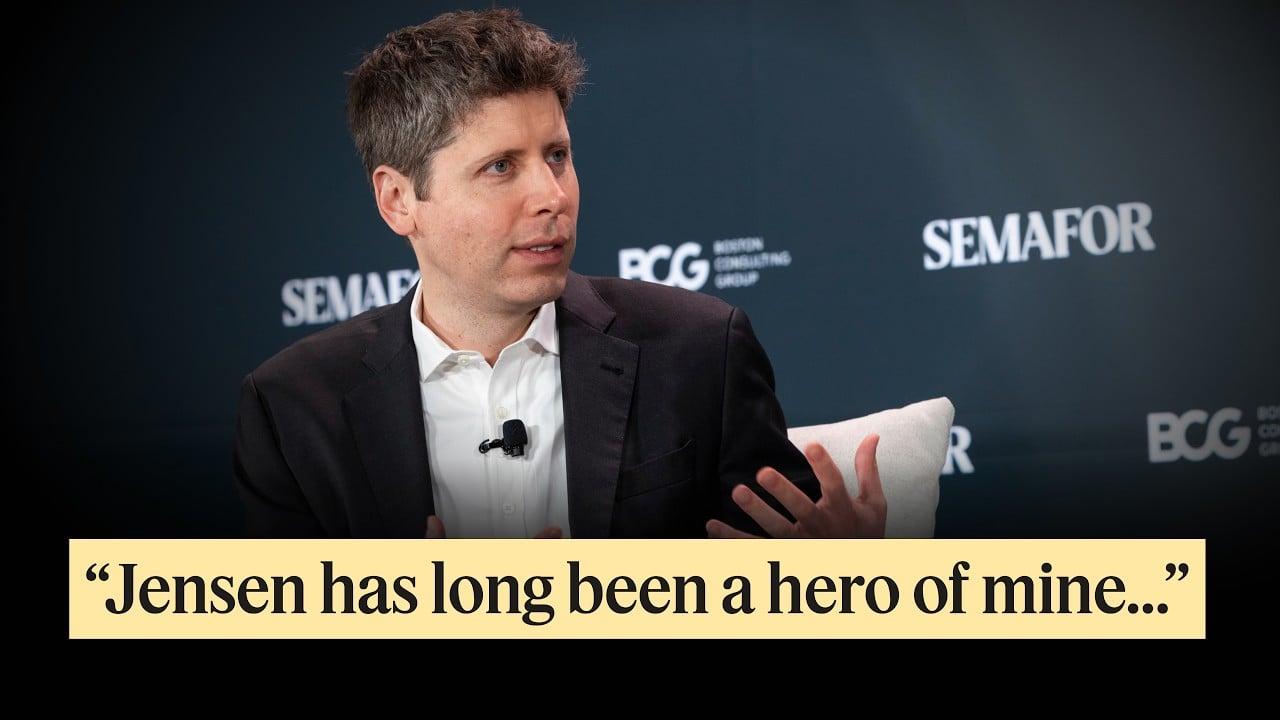
Sam Altman: I don’t believe I possess enough inside information to pass judgment. Jensen Huang has long been my hero, but heroes also have flaws. I am deeply grateful for the company he built. Personally, I feel tremendous empathy for the situation he is going through; I still vividly remember what it felt like to be in the eye of the storm, even though looking back now it seems almost like a lifetime ago.
That said, it’s hard for anyone to imagine an AI revolution without Jensen Huang. The Nvidia he built firmly bet on us when we were incredibly small in our early stages, and we equally went all-in on him early on. I hold immense respect and gratitude for this relationship of mutual success.
Reed Albergotti: According to insiders, Nvidia previously even provided roughly $105 billion in guarantees for your Ohio data center project. They are essentially using their balance sheet to backstop the entire industry. Do you think that after Jensen Huang steps down, this hundred-billion-dollar guarantee still carries the same weight today as it did just a few weeks ago?
Sam Altman: Nvidia has grown into a business giant of staggering scale, and markets and financial institutions still place great trust in their ability to fulfill financial obligations. But it cannot be denied that Nvidia without Jensen Huang will operate under a completely different context; Jensen Huang and the Nvidia brand have long been deeply intertwined. His grand ambition and aggressive expansion scale injected into the entire semiconductor industry hold extraordinary milestone significance in history.
Reed Albergotti: Does that mean this entire shakeup could trigger sector-wide ripple effects?
Sam Altman: From a current fundamental perspective, the market’s genuine demand for high-end computing power is too robust. The practical value of AI technology is beyond doubt; commercial clients’ willingness to purchase and revenue growth curves are exceptionally healthy, so the core foundation of the entire AI industry is fully capable of moving forward smoothly. But I must reiterate: Jensen Huang drove the industry’s explosive progress with his visionary courage, playing an irreplaceable and precious role in history.
Capital Markets and Listing Considerations: Anthropic’s IPO Push and OpenAI’s Long-Term Choice
Reed Albergotti: Meanwhile, Anthropic is reportedly advancing its initial public offering process this week, while secondary market investors’ scrutiny of AI narratives is significantly diverging. If it were entirely up to you personally, would OpenAI prefer to completely avoid the public capital markets?
Sam Altman: I’ve noticed that strong skepticism currently comes mainly from media reporters, while core investment firms who understand the industry’s pulse remain highly bullish on AI’s mid-to-long-term trends. Every wave of frontier technology inevitably experiences valuation fluctuations and cyclical swings; infrastructure will certainly see alternating phases of overbuilding and supply shortages. But the macro consensus is undeniable: massive real value is being created.
As for whether OpenAI itself desires to go public? We will ultimately reach the public market at some point in the future. Frankly, becoming a public company comes with undeniable institutional costs and outside interference. We are in a wildly oscillating, high-stakes frontier track where major decisions regarding system safety boundaries and social integration norms require immense strategic focus; these explorations are clearly easier to advance under a private structure. However, everyday people globally deserve access to share in this technological dividend, and that is a social responsibility we must balance.
Reed Albergotti: Industry chatter recently suggests concern that if both leaders go public one after another, the liquidity of public markets might not be sufficient to simultaneously support such massively overvalued giants. Are you concerned about this?
Sam Altman: That is completely outside my realm of concern. I know the media needs to continuously manufacture competitive conflict and win-loss drama, but looking at actual capital flows over the past few years, the market has consistently faced insufficient supply of quality assets rather than a lack of investment desire. We have full confidence that, together with the entire industry, we will carve out unimaginably vast value spaces.
Questioning the Supply Chain’s False Prosperity: Deconstructing Chip “Double-Counting” and Wafer Allocation Shadow Games
Reed Albergotti: Foreign media previously reported that in closed-door meetings, you warned supply chain executives at companies like Samsung about severe “double-counting” in the semiconductor industry. Can you elaborate on this concern for the public?
Sam Altman: For quite a long period, the AI computing field was almost entirely monopolized by a single core supplier. When foundries planned advanced-node wafer quotas, they could precisely map out downstream effective computing demand simply by cross-referencing our actual procurement plans with just a handful of top model research organizations.
However, the current market landscape has evolved into a multiplayer scenario. Numerous emerging chip startups and in-house teams are placing aggressive order forecasts with silicon foundries, and nearly every company assumes in its own business plan that it can monopolize the majority of OpenAI’s or Anthropic’s procurement budgets. In reality, even if our data center construction schedules with global partners are fully delivered as planned, our aggregate demand has strict limits. It is impossible to simultaneously absorb the capacity projections drawn by every independent chip fab—that is typical double-counting.
Reed Albergotti: Does this mean the chip market currently breeds irrational valuation bubbles?
Sam Altman: Cyclical expectation corrections are inevitable. The global long-term hunger for hyper-scale intelligent computing and underlying value realization is unbreakable, but short-term volatility triggered by quarterly supply chain surpluses and bottlenecks is entirely understandable. Our supply chain complexity is extremely high; we are frequently bottlenecked alternately by high-bandwidth memory packaging, server rack assembly, grid connectivity, or even shortages of basic components. Any surge in capacity along a single dimension cannot escape the coordinated constraints of the entire chain.
Data Centers Face Backlash from Public Opinion: Severely Criticizing the “Labrador Pet-Style” AI Messaging Disaster
Reed Albergotti: In recent local elections across several U.S. states, with very few exceptions, virtually all voter referendum proposals regarding new data center construction suffered crushing defeats. Cross-partisan voter resistance to data centers is reaching unprecedented levels. As an industry leader, what severe narrative mistakes do you think Silicon Valley made in telling the AI story to the outside world?
Sam Altman: The core issue lies in the extremely flawed narrative logic Silicon Valley is currently selling. If the signal tech delivers to society is: “We promise to cure cancer and provide cheap consumer goods for you, but only if you hand over control and agency over the future, living out your life like a Labrador dog cared for by intricate machines,” that is undeniably the most repulsive vision of the future.
The vast majority of humans simply do not want to become pets stripped of self-control. Data centers became targets because, as tangible monoliths, they embody the public’s genuine fear of unemployment pain and personal class marginalization. What everyone truly worries about is this: While tech titans feverishly compete for monopoly rights over supercomputing power, are the very people building AI still on “humanity’s side”?
AI must exist firmly as a powerful tool to expand human agency, not be packaged as a substitute that gradually takes over human destiny. The tech industry must produce an unwavering action plan proving that we keep the power to decide the future firmly in human hands, otherwise facing public backlash is inevitable.
Washington Politics and Transnational Espionage: From White House Banquets to Office Wiretapping Terrors
Reed Albergotti: Last summer, you publicly stated that Democrats are gradually losing their original culture of innovation, even describing yourself as “politically homeless.” Has your political mindset shifted since then?
Sam Altman: As a leader in a tech enterprise, my primary duty is to work closely with any legitimately elected governing team. I firmly believe that a political environment that deeply embraces pioneering spirit and encourages frontier innovation is the cornerstone of maintaining America’s long-term vitality. Whether Democratic or Republican, I welcome more pragmatic shifts toward actively supporting tech infrastructure.
Reed Albergotti: Media previously disclosed that hidden listening devices were discovered in your private office, and you repeatedly reminded internal staff to be wary of social engineering infiltration by foreign intelligence. Given complex cross-border investors like Gulf Capital, has this underlying geopolitical maneuvering changed your external interaction protocols?
Sam Altman: These series of frictions have made us even clearer that frontier intelligent technology has long become the central nervous system of great-power strategic competition. Whether it’s protecting core model weights from theft, securing infrastructure against threats, or conducting compliance reviews of peripheral capital, we have established extremely rigorous physical isolation and sovereign security review standards. We maintain the highest level of professional vigilance against any potential systemic risks globally.
Trillions in Computing Debt and the Scientific Singularity: AI’s Leap from Code Tool to Physics and Math Engine
Reed Albergotti: Many Wall Street economists worry that the leveraged debt currently backing data center construction has reached the trillions of dollars. Will this enormous debt bill become the powder keg that collapses industry prosperity?
Sam Altman: Debt only evolves into a catastrophic crisis if downstream technologies fail to deliver outsized returns on investment. And what we are witnessing today is the fastest-expanding technological revolution in revenue and productivity that I have seen in my career.
Today’s corporate clients no longer treat AI merely as a chat tool. Next-generation reasoning models are displaying astonishing creativity in the apex domains of human intellect, such as cracking mathematical theories, simulating quantum physics, and designing circuits for complex advanced-process chips. We are seeing productivity multiply not just in software engineering, but accelerating exponentially in fundamental scientific research.
If AI can help humanity crack physical laws and molecular biology puzzles that previously took a century to solve within a single year, and rapidly translate them into novel energy sources, controllable nuclear fusion, and age-reversal cellular engineering in the real world, then the computing debt and infrastructure investments made today are not only far from bubbles when measured against civilization’s long-term compound interest—they will prove to be an incredibly worthwhile foundational investment.
Join TechFlow official community to stay tuned
Telegram:https://t.me/TechFlowDaily
X (Twitter):https://x.com/TechFlowPost
X (Twitter) EN:https://x.com/BlockFlow_News
 深潮TechFlow