








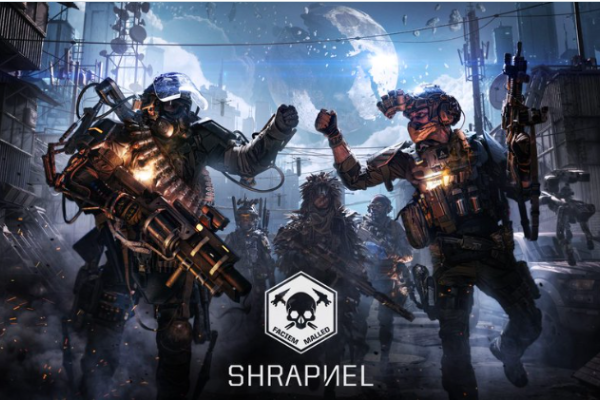
Shrapnel on AVAX, a 3A blockchain game encouraging user-generated content—can it become the next Sandbox?
TechFlow Selected TechFlow Selected
Shrapnel on AVAX, a 3A blockchain game encouraging user-generated content—can it become the next Sandbox?
Shrapnel: A 3A shooter blockchain game + RPG + user-generated content.
 Navigating Web3 tides with focused insights
Viewing blockchain as a microservice that delivers novel gameplay experiences is far more compelling than forcing it into games without considering how it enhances the player experience.
— Marklong, CEO of Shrapnel
Many blockchain games generate significant hype during early promotion, but after launch, their token prices and active user counts gradually decline, eventually spiraling into obscurity.
In contrast, blockchain games like Sandbox and Decentraland, which support user-generated gameplay, have maintained longevity through market cycles. We believe the key differentiator lies in these projects enabling players to create new content, which in turn expands gameplay variety. This increased diversity strengthens token value capture and sustains market demand for both the game and its token.
Therefore, the ability to fully激发 player creativity and engagement may become a critical competitive advantage in blockchain gaming. But can a high-quality, creator-focused AAA title guarantee success?
Today, we introduce Shrapnel—a blockchain-based shooter that serves as an excellent case study.
Built on Avalanche with plans to launch a dedicated subnet, Shrapnel aims for AAA quality and is still in its earliest development phase. It recently released its whitepaper, highlighting a strong emphasis on player-driven creation that transcends typical competitive shooting mechanics—making it worth watching closely.
Token: SHRAP (not yet launched)
Shrapnel: AAA Shooter + RPG + User-Created Content
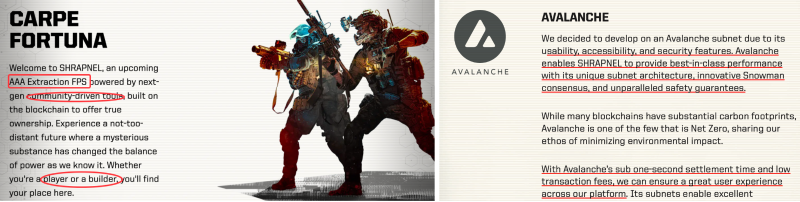
According to its official website, Shrapnel defines itself as a AAA first-person shooter blockchain game. Like other blockchain games, it uses blockchain technology to give players true ownership over in-game gear and assets.
Beyond aiming for AAA production quality, Shrapnel stands out from most current blockchain shooters in three key ways:
Technology Choice: Leveraging Avalanche’s subnet architecture, Shrapnel will operate on its own dedicated subnet (similar to DeFi Kingdoms), enabling lower transaction fees and faster confirmation times. This improves the user experience for all blockchain-related interactions within the game.
Open Creation Tools: Similar to CS:GO or The Sandbox, players can use official tools provided by Shrapnel to create custom content such as maps, skins, and new gameplay rules, going beyond what developers alone provide.
Multiple Playstyles: Thanks to open creation tools, players aren’t limited to just shooting. Those less skilled at combat can participate as “Builders,” creating NFT items and earning revenue through sales.
As the game is still in a very early stage—without playable demos or trailers—we won’t focus on its lore, setting, or gameplay feel. Instead, we’ll analyze its system design and participation mechanics.
As an FPS, Shrapnel centers around shooting, but unlike pure shooters like CS or Mini Royale, it incorporates RPG elements such as customizable gear, tactical choices, and character progression.
Overall gameplay can be divided into two parts: combat and content creation.
Combat Gameplay:
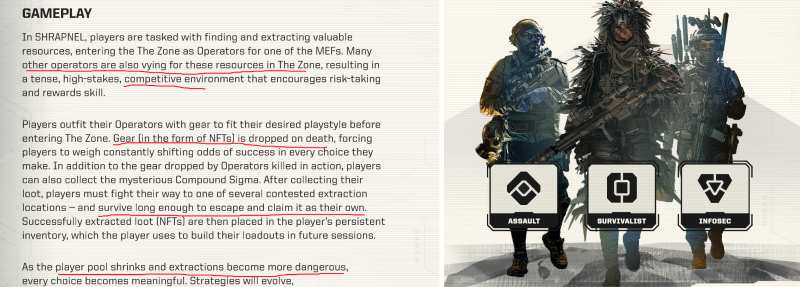
Battle Royale Style: Players enter a zone to gather valuable resources while engaging in combat.
Gear Drop on Death: Upon death, players drop their equipped NFT gear, which others can pick up—but only gain ownership after surviving for a set duration.
Risk vs. Reward Strategy: The gear-drop mechanic encourages strategic decision-making before entering matches.
Role Specialization & Progression: Beyond raw shooting skill, players choose from three roles—Assault, Survival Expert, and Info Specialist—each with unique skills. As they level up, players can customize their abilities to optimize team tactics (similar to titles like Rainbow Six Siege or Escape from Tarkov).
Content Creation System:
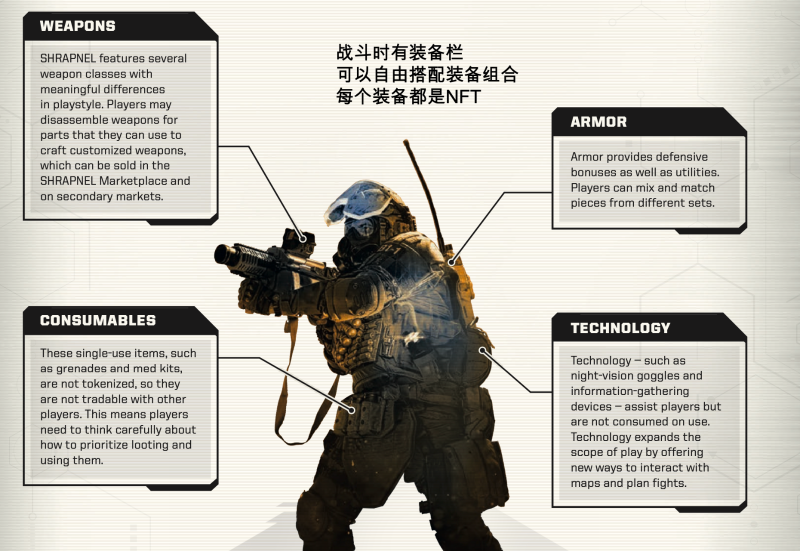
Craft Functional Gear: Each role has equipment slots categorized into weapons, armor, consumables, and tech—each represented as NFTs. Players can craft these using gathered resources, then buy, sell, or equip them based on their role’s strengths.
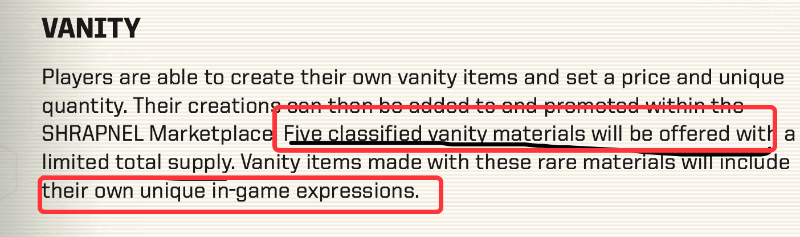
Create Skins (Vanity Items): Players can design vanity items—likely cosmetic weapon skins—for self-expression. Creating a skin requires a base asset plus five types of rare vanity materials. These skins can be priced, traded, or displayed in-game.
Design Maps & Tournaments: This is one of Shrapnel’s innovations: players can use intuitive tools to build high-quality maps, which exist as tradable NFTs. Unlike Sandbox land, these maps are solely for competition. They can be sold or used in public matches.

Additionally, players can host custom tournaments, setting rules and entry conditions. These features expand Shrapnel beyond mere shooting, emphasizing community-driven UGC participation.
In traditional gaming, Forza Horizon offers a similar model—players compete on official tracks but also join community-created events with custom rules for fun and variety.
Finally, complementing the creation system, Shrapnel includes base-building mechanics called “Headquarters.” These serve as hubs for showcasing achievements, gathering resources, and preparing for combat. Owning a HQ allows players to promote their creations, acting as a social platform within the game.
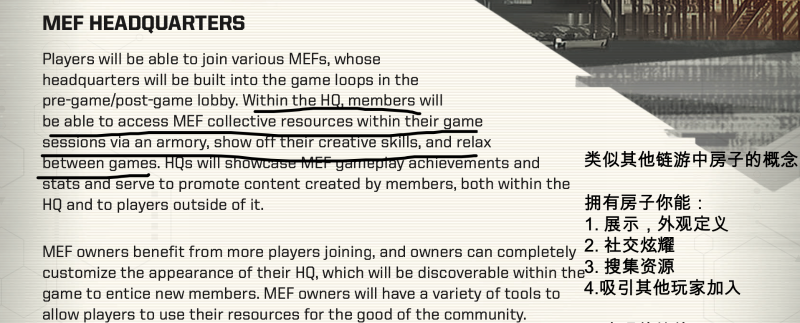
For the above creation mechanics, player-made items and maps are listed on the in-game marketplace.
Given their utility, well-crafted and popular creations naturally attract greater attention.
The team actively encourages secondary creation and provides community spaces for discussion.
Moreover, creators can stake tokens within their NFTs to increase visibility and discovery chances. Creators who receive positive feedback earn additional token rewards.
To govern behavior across these systems, Shrapnel implements a reputation framework:
Combat players are rated via in-game reputation. Frequent quitting or toxic behavior results in penalties or bans; high-reputation players may receive match bonuses.
For creators, higher reputation increases the discoverability of their NFTs. Community reputation reflects overall contributions and friendliness in channels.
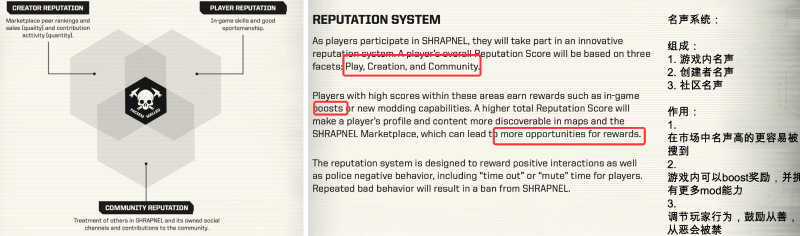
In summary, Shrapnel’s design aims to stimulate creativity and collaboration, fostering a continuous stream of high-quality UGC to extend the game’s lifespan. It shifts from simple “play-to-earn” to a hybrid model of “play + create to earn.”
This enriches gameplay, increases player retention, and boosts emotional value. Higher emotional investment, in turn, strengthens token demand and value capture. We can visualize Shrapnel’s core loop as follows:
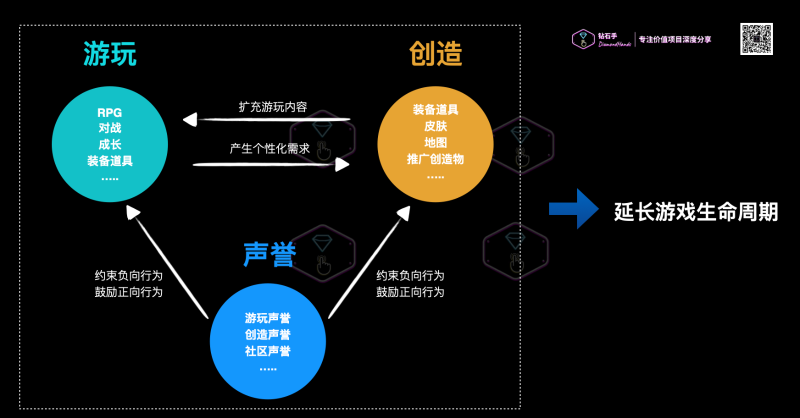
Shrapnel's Economic Model: Single Token, Incentivizing Creation, Competition, and Promotion
SHRAP Token Basics and Release Schedule
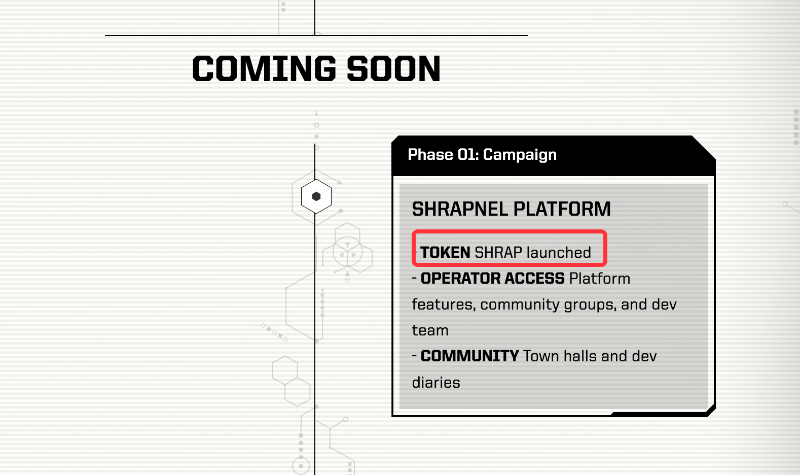
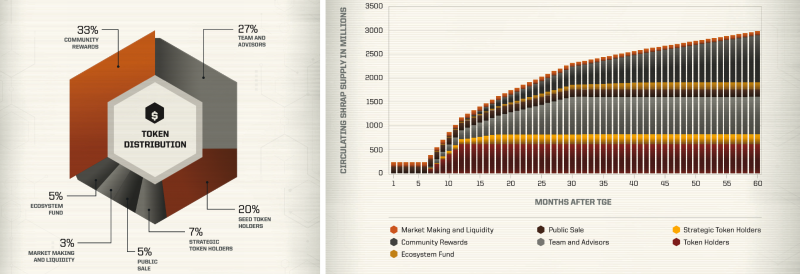
Shrapnel uses a single token, SHRAP, initially issued as an ERC-20 token. No TGE has occurred yet, but deployment on Avalanche is planned. The total supply is capped at 3 billion, with no pre-TGE token minting.
Community rewards receive the largest allocation at 33%. The specific distribution methods tie directly into the game’s economic model, detailed below.
Teams and advisors receive 27%, seed investors get 20%, and only 5% is reserved for public participation—relatively small. The TGE timing and access method remain vague, described as “coming soon” on the website and unclearly on Discord, with no confirmation about whitelist requirements.
Given the project’s early stage and potential for changes, interested users should follow its Twitter and Discord, which currently each have around 10k followers.
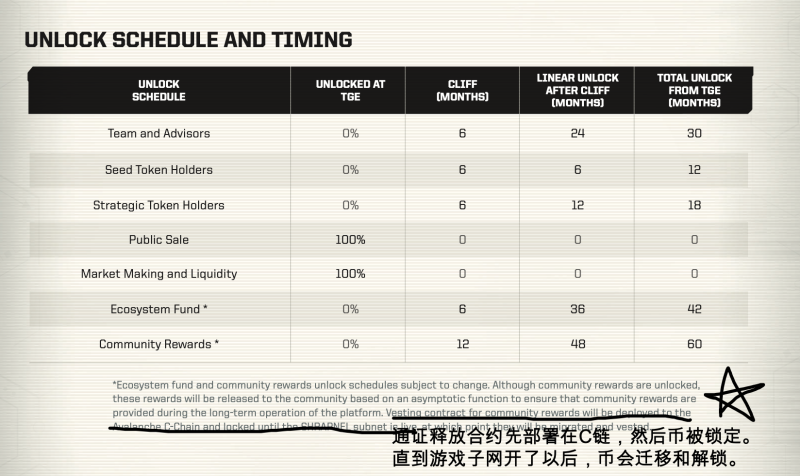
According to the whitepaper, nearly half of the SHRAP held by teams and seed investors unlocks linearly starting six months post-TGE, over periods ranging from 6 to 48 months.
Notably, community reward tokens unlock only 12 months after TGE. This is because the token contract will initially deploy on Avalanche’s C-Chain, with migration and unlocking occurring only after the game’s own subnet is live. Thus, this longer unlock period depends heavily on successful subnet development.
SHRAP Utility: Core Incentive for Creation and Value Discovery
From earlier sections, we’ve seen Shrapnel’s dual focus on combat and creation. To sustain strong player motivation, robust token incentives and demand design are essential.
Shrapnel employs a single-token economy centered on SHRAP, serving two broad functions: supply and demand.
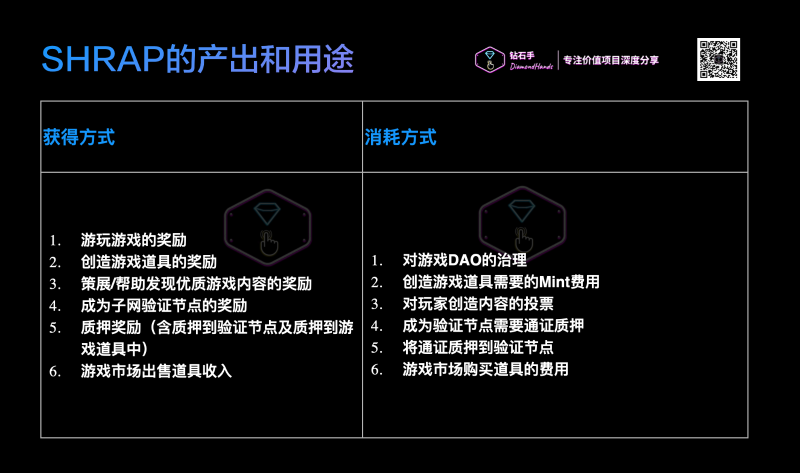
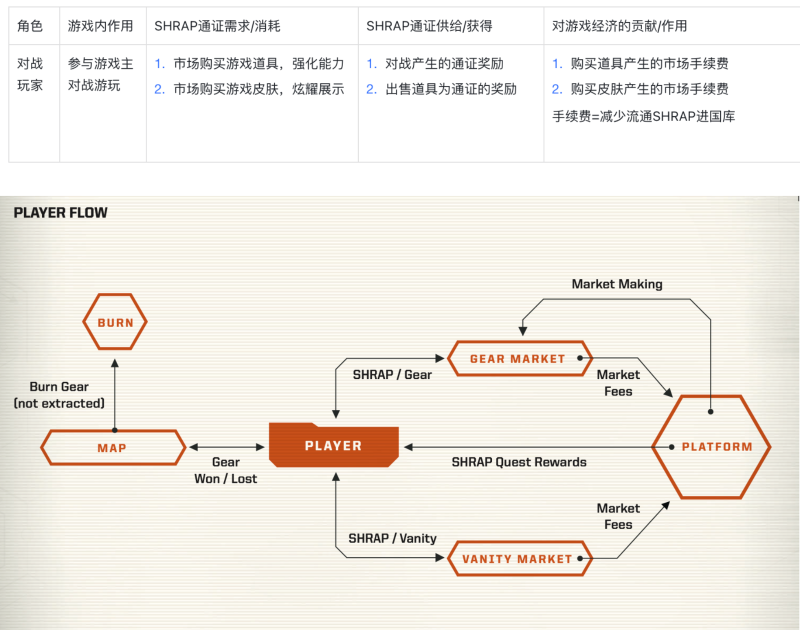
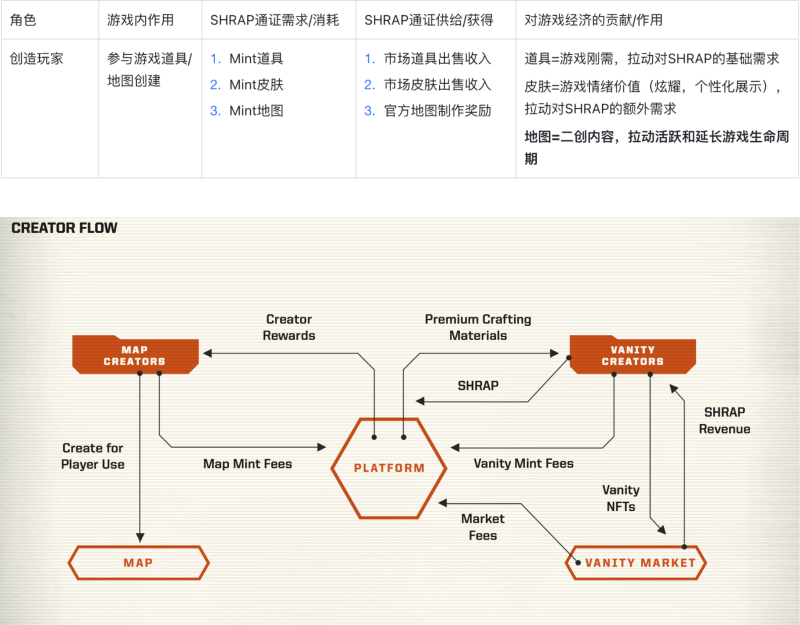
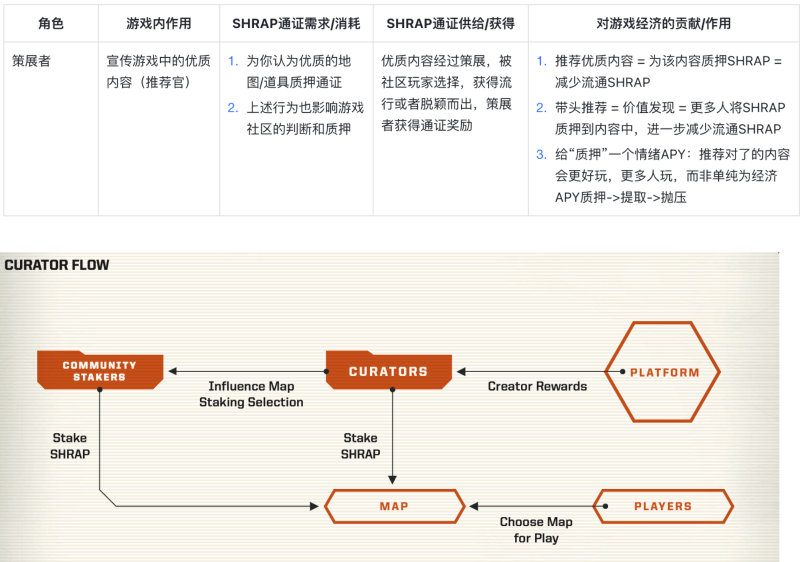
Drilling deeper, four distinct in-game participant roles interact with SHRAP, collectively forming the game’s token economy:
-
Combat Players: Interact with SHRAP primarily through acquiring and consuming in-game items.
-
Creator Players: Sustain the secondary creation economy by crafting items and maps, interacting with SHRAP through monetization and staking.
Curators: Act as amplifiers for high-quality content, discovering and promoting top creations in exchange for SHRAP rewards.
Landowners, provide map display space, though their economic role remains ambiguous
According to the whitepaper, landowners mainly offer visibility for maps, increasing play rates. In return, the system rewards them with SHRAP for hosting maps.
However, this incentive resembles the curator model. Introducing a separate landowner role lacks clear added value. Without it, the core economy involving the first three roles would remain intact. If maps require land to be displayed, it feels like a forced design—land exists simply because land must exist.
With little official clarification and the game still early, the purpose and value of this component await future validation.
Economic Model Summary: Creator Incentives + Gameplay Value Could Break Negative Cycles, But Single-Token Design Remains Vulnerable to Market Volatility
Most blockchain games eventually face economic collapse. We reference a widely shared supply-demand model from Twitter to illustrate:
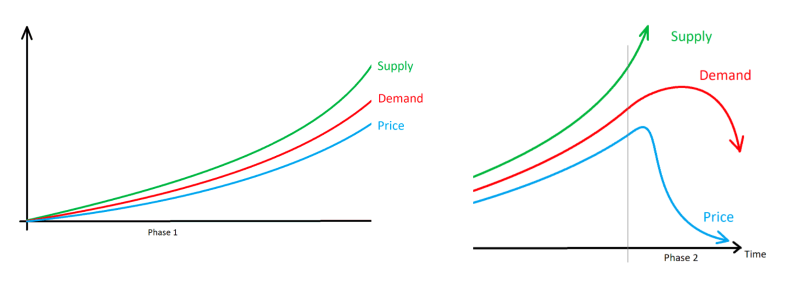
Image credit: @spacepixel
Left: Early growth sees increasing in-game item supply (profitable minting);
Demand keeps pace, so prices remain stable or rise;
At the critical turning point (right): Supply continues growing, but new player inflow stalls;
Oversupply leads to price drops;
Seeing no profit, newcomers leave, triggering a downward spiral where fewer players mean even less demand.
This model reveals classic flaws in most blockchain games:
New users are the sole lifeline for inflation; without them, asset value declines (Ponzi trait);
Asset utility is too narrow, ROI too transparent—“farm, sell, exit” becomes inevitable;
Lack of diverse use cases = no emotional value = existing players eventually leave (no profit).
In short: Fails to attract new users due to price spirals, fails to retain current ones due to shallow content.
Revisiting Shrapnel’s model, SHRAP incentivizes creators and curators to generate and surface valuable content.
These activities are tied to real usage and emotional value, potentially mitigating the issues outlined above.
Furthermore, user-generated content extends the game’s lifespan, giving the team time to refine gameplay, introduce new features, and manage tokenomics responsibly.
However, the single-token structure lacks tiered utility. Should the secondary market experience sharp volatility, the in-game economy could suffer severe disruptions. Whether this proves detrimental remains to be seen.
We can assess Shrapnel’s economic model using the following evaluation matrix:
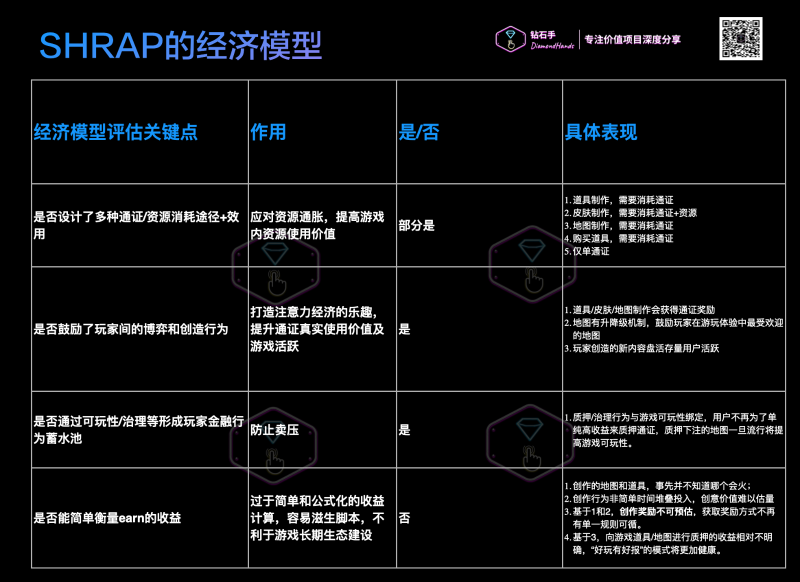
Shrapnel Team & Backers: Top-Tier Western Game Developers + Renowned Investors Like Three Arrows
The professional background in gaming and film is one reason Shrapnel has gained widespread attention online.
Shrapnel is developed by Neon, an independent game studio. While Neon may not be familiar to many, its former parent company HBO is legendary in television—creator of *Game of Thrones*.
Neon was spun off from HBO’s interactive entertainment division, with years of expertise in cross-media storytelling, virtual production, and game-as-a-service models. Their VR game *Westworld* won an Emmy Award—the highest honor in American television, equivalent to the Oscars in film—proving their excellence in immersive visual storytelling, which bodes well for Shrapnel’s presentation.
Key team members include:
CEO Mark Long, former head of Microsoft xCloud;
COO Aaron Nonis, ex-Vice President of HBO Now at WarnerMedia;
Studio Head Don Norbury, lead producer on major Western FPS IPs including *Star Wars*, *BioShock*, *Indiana Jones*, and *Sunset Overdrive*;
Marketing Lead Mark Yeend, ex-R&D Head at HBO Max, with credits on *Halo*, *Harry Potter*, and *The Sims*.
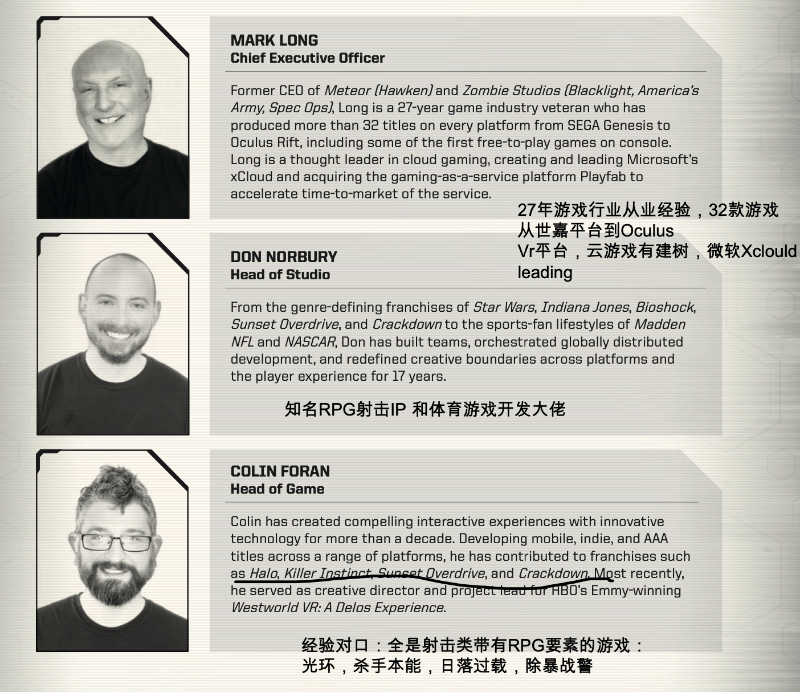
This team composition signals a major influx of top-tier game industry talent into blockchain gaming. From a development standpoint, their capabilities far exceed those of most existing blockchain game studios.
Yet, blockchain games also require deep Web3 knowledge. While the core team lacks native crypto expertise, they’ve brought on advisors including the CTO of Compound, a leading DeFi protocol, and the founder of Genopets, another blockchain game.

On funding, Neon secured $10.5M in seed funding in November last year,
led by Griffin Gaming Partners, Polychain Capital, and Forte.
In April this year, they raised an additional $7M, with participation from Dragonfly, Three Arrows Capital, and even Razer.

With growing funding, the team has expanded from 7 to 30 employees. However, developing a AAA shooter likely requires more manpower, so hiring continues.
Still, we emphasize: elite game development does not guarantee dominance in the blockchain space. SHRAP token release will precede full game launch, and its market performance remains uncertain. Only after more gameplay footage emerges can we reasonably evaluate its true potential.
Shrapnel’s Potential & Risks
Overall, Shrapnel presents the following potential and risks:
Potential:
+ World-Class Western Film & Game Talent Ensures High Production Quality:
For FPS games, visuals are paramount. With HBO’s Emmy-winning pedigree and a team experienced in flagship Western franchises, Shrapnel is poised for strong graphical fidelity and polished design.
+ Player-Created Content Focus Balances Economy & Emotional Value, Extending Lifespan:
Historically, UGC has shown immense staying power—from DOTA maps in Warcraft III to CS in Half-Life, and The Sandbox in blockchain gaming. By empowering players to create maps, skins, and gear, and letting the market decide what succeeds, Shrapnel effectively decentralizes game development. This fosters sustainable ecosystem growth: moving away from extractive, short-term farming toward rewarding genuinely enjoyable content. Though harder to monetize quickly, this path may lead to longer-term survival.
Risks:
-& Mismatch Between Long Dev Cycle and Short Unlock Period:
AAA shooters typically take 2–3 years to develop. Yet, team and investor tokens begin linear unlocking just six months post-TGE. This means significant SHRAP supply could hit the market long before launch, forcing the team to manage tokenomics early—diverting focus from pure game development. Meanwhile, community rewards unlock only after 12 months, risking dilution against earlier sellers. This imbalance could weaken community incentives from the start.
-& Single-Token Model Exposes Game Economy to Market Volatility.
As a single token, SHRAP’s value swings could directly impact creator economics. If early selling drives prices down, making maps or gear unprofitable, creator motivation may dwindle. The team must carefully balance tokenomics and creative incentives—an ongoing challenge requiring exceptional execution.
Overall, the emergence of such a quality-focused, creativity-driven game genre reflects the vision of Griffin Gaming Partners’ partner Pierre Planche:
“Blockchain must deliver exciting, practical pillars for games—innovation beyond competitive modes, rewarding and empowering community players.”
Perhaps “fun gets rewarded” is the healthiest long-term model for blockchain gaming.
Join TechFlow official community to stay tuned
Telegram:https://t.me/TechFlowDaily
X (Twitter):https://x.com/TechFlowPost
X (Twitter) EN:https://x.com/BlockFlow_News






