








Who is Sun Yuchen, who spent 9 million to acquire the digital zodiac animal heads?
TechFlow Selected TechFlow Selected
Who is Sun Yuchen, who spent 9 million to acquire the digital zodiac animal heads?
NFT is the gallery for our generation.
 Navigating Web3 tides with focused insights
By 0x5willows
On March 31, Justin Sun, founder of TRON, sparked widespread discussion after purchasing the "Digital Zodiac Animal Heads" NFT series from Poly Auction's Metapoly XM for nearly ten million yuan. Based on the iconic "Zodiac Animal Heads," this collection was recreated using NFT technology and exists as a single complete set—the first time the twelve zodiac heads have been reunited within the metaverse.

This isn’t the first time Justin Sun has made headlines at auctions. He previously acquired multiple artworks through top-tier art platforms, building a collection spanning both traditional and digital artists—including globally renowned figures such as Picasso, Andy Warhol, Giacometti, Beeple, and Pak. Notably, Beeple and Pak rank first and second respectively among the most valuable digital artists in the world.
What exactly is Justin Sun trying to achieve with his aggressive NFT moves?
Meanwhile, two developments are gaining momentum in the market:
(1) APENFT, an NFT project supported by TRON, will launch its Marketplace beta version;
(2) One of the Zodiac Animal Head NFTs from this set will be auctioned on the APENFT Marketplace.
With Justin Sun and the TRON ecosystem now involved, what impact might this have on the NFT market?
The Reunion of the Twelve Zodiac Animal Heads in the Metaverse
For every descendant of the Chinese nation, the twelve zodiac animal heads strike a deep emotional chord.
Historically, the Chinese zodiac originated from animal worship in ancient China. Starting from Emperor Shun, the twelve animals—rat, ox, tiger, rabbit, dragon, snake, horse, goat, monkey, rooster, dog, and pig—were used as annual markers for tribes and clans. To Chinese people, these animals represent different years in a cyclical calendar.
Among them, the twelve animal head statues from the Old Summer Palace (Yuanmingyuan) are particularly famous worldwide. Crafted from specially formulated bronze alloys under imperial supervision, each statue was meticulously carved by court artisans. Their lifelike depictions of skin, eyelids, ears, noses, and mouths showcase the unique characteristics of the zodiac animals, making them highly valuable for both collection and appreciation. However, since 1860, these statues have been scattered overseas—a lasting national tragedy spanning over a century.
Reuniting the twelve animal heads has long been a shared dream among the Chinese people. Despite continuous efforts, full restoration has remained out of reach—until now. The metaverse offers a new space, and NFTs offer a new opportunity.
“NFTs are the galleries of our generation,” Justin Sun once said.
The “Digital Zodiac Animal Heads” auctioned by MetaPoly, Poly Auction’s digital art brand, leverages blockchain technology to tokenize the original animal head sculptures into NFTs.
Justin Sun’s acquisition of the Digital Zodiac Animal Heads comes as no surprise. On one hand, the collection holds immense collectible value. On the other, MetaPoly and Justin Sun have been longstanding collaborators.
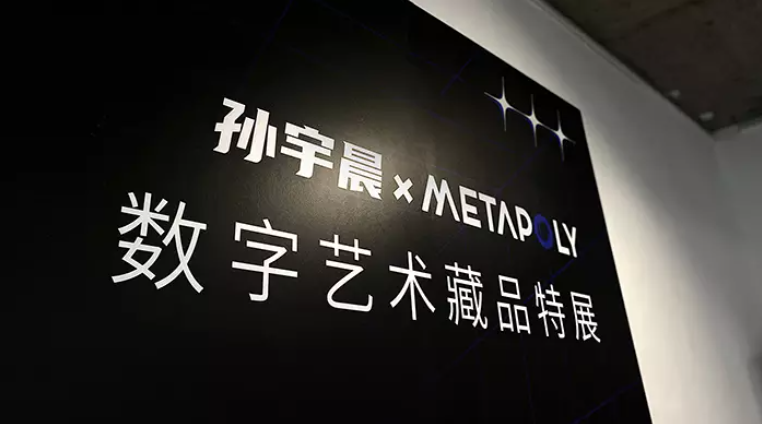
In December 2021, Poly Auction announced via its official Weibo account that the “Justin Sun × METAPOLY Digital Art Pop-up Exhibition” had officially opened in Beijing. Co-produced by TRON founder Justin Sun and the digital art brand METAPOLY, the exhibition featured star-studded crypto art pieces recommended by Sun, including Picasso’s *Reclining Nude with Necklace*, Beeple’s *Ocean Front*, PAK’s *Cube*, as well as Chinese digital artworks supported by METAPOLY.
In the traditional art world, museums and galleries rely on “crown jewel” exhibits to draw visitors—for example, many tourists visiting the Louvre do so primarily to catch a glimpse of the Mona Lisa’s smile.
Beyond the digital zodiac heads, Justin Sun already owns a vast collection of top-tier NFTs—more than enough to form the foundation of a fully-fledged online art museum.
Where will the digital zodiac animal heads find their NFT home?
On April 8, Brother Sun revealed the answer on Weibo—the APENFT Marketplace, launching on April 15.
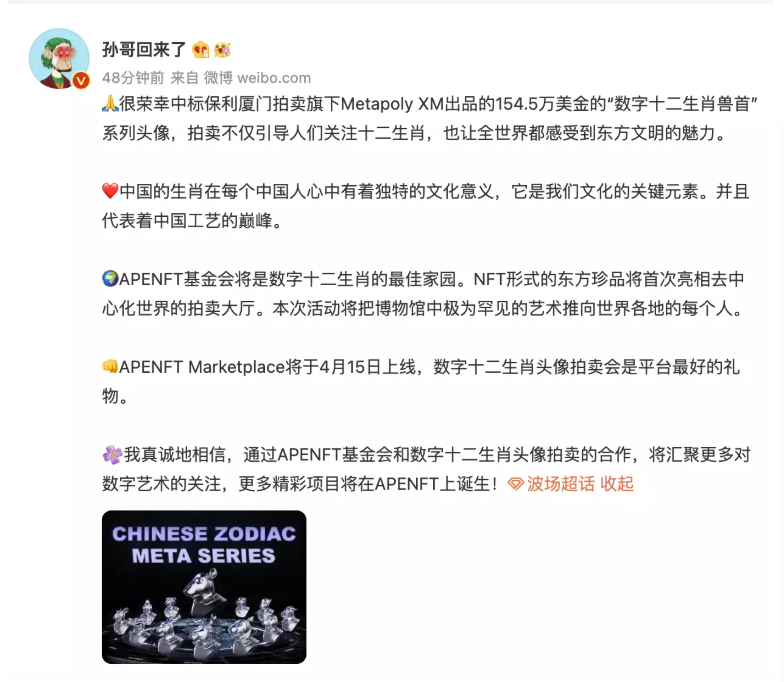
Compared to pure matchmaking platforms like OpenSea, APENFT Marketplace has a unique advantage: it comes pre-loaded with a large inventory of premium NFT artworks. Combined with innovations pushing beyond static images, APENFT Marketplace is poised to become not just a marketplace, but a true digital gallery.
Auctions: Adding Ceremony to On-Chain Transactions
As consensus assets, the value of artworks largely depends on their symbolic meaning—social recognition or standing in art history.
For NFTs, the social proof of the underlying project and the ownership history of the NFT itself serve the same role as meaning in traditional art—they are decisive factors in determining NFT value.
The number of followers an NFT project has on social media platforms like Twitter and Instagram serves as a direct metric of social proof. Hence, countless NFT projects strive to generate buzz and increase visibility. In some ways, hype runs counter to artistic value. Traditional artworks are valued more for their intrinsic artistic merit, and collectors bidding at auctions are often connoisseurs whose participation becomes the strongest form of validation.
Just as artworks bearing seals of famous collectors gain value, the identity of an NFT’s issuer and previous owners significantly impacts its worth. NFTs created by well-known individuals or corporations typically command higher prices. That’s why issuers often partner with high-profile brands or personalities to boost credibility. Similarly, resale of NFTs previously owned by celebrities can fetch a premium.
While on-chain transactions excel at verifying ownership history, they may fall short in generating broader social proof. This is why Vitalik Buterin once warned: “The danger is you end up with these $3 million monkey NFTs becoming another form of gambling.”
Auction formats could serve as a powerful complement. Auction houses bring historical credibility, while auctions themselves provide the ceremonial gravitas essential to art transactions.
The APENFT Foundation has long advocated for its mission to “tokenize 50% of the world’s top artworks.” As legacy auction houses increasingly participate in NFT trading, APENFT—already a whale in the NFT art space based on the quantity and quality of its holdings—is well-positioned to lead the charge.
Now, with its own NFT marketplace about to launch—and its consistent fusion of physical and digital art traditions—APENFT may pioneer a new trend blending on-chain and off-chain transactions, breaking new ground in how meaning is assigned to NFTs.
The NFT Market Needs Fresh Water
While I don’t doubt this auction brought massive attention to Sun’s project—entirely justified for any savvy entrepreneur—I’m less interested in whether it was a PR stunt and more curious about its broader implications. Specifically, can cultural IP-backed NFTs break the monopoly held by digital-native projects like Bored Apes in the NFT market?
Looking back at viral NFT drops, each surge of attention feels like performance art. To outsiders, the idea of spending fortunes on tiny digital images remains baffling.
Setting aside speculation, how many NFTs truly resonate emotionally with a broad audience?
Going back to the origins of native NFTs in 2017, Larva Labs developed a pixelated avatar generator, creating around 10,000 unique characters. Embracing a “punk” ethos, they named the series CryptoPunks. Larva Labs then minted these avatars onto the blockchain, assigning them collectible value. From there, NFTs emerged as a standalone sector in the crypto world, spawning countless avatar-based collections.
If we consider Punk and MAYC as representatives of digital-native NFTs, then IP-backed NFTs represent their “digital twin” counterparts. At least in terms of price, digital-native NFTs currently hold the upper hand.
NFTs risk becoming exclusive playgrounds for the wealthy, alienating the general public.
Here’s a personal view: IP-backed twin NFTs may be undervalued compared to digital-native ones. Their real potential lies in leveraging familiar, widely recognized IPs to help NFTs go mainstream.
Recent trends show more NFT projects incorporating nostalgic IPs—like the Naruto series—that evoke shared memories. Cultural IPs, especially, have deeper roots and broader appeal. For instance, when Alipay and the Dunhuang Academy jointly released two NFT skins—Dunhuang Flying Apsaras and the Nine-Colored Deer—they sold out instantly amid widespread enthusiasm.
The Chinese zodiac dates back to the pre-Qin era, enduring for over 2,500 years as part of the collective memory of the Chinese people.
Whether through donating high-value NFTs and physical artworks to the APENFT Foundation to promote democratized access to art, or acquiring the digital zodiac animal heads to spotlight the fusion of tradition and NFTs, Justin Sun is simultaneously expanding his commercial NFT strategy and advancing the transition of traditional art into the digital realm.
Looking ahead, more traditional art IPs will inevitably join the NFT wave. They’ll need a proper “gallery.” Perhaps, APENFT Marketplace could become one of their ideal homes.
In short, stagnant water turns foul. APENFT represents flowing, fresh water—not only challenging OpenSea’s dominance like many other platforms, but also serving as a bridge helping traditional cultural IPs enter the NFT market.
Join TechFlow official community to stay tuned
Telegram:https://t.me/TechFlowDaily
X (Twitter):https://x.com/TechFlowPost
X (Twitter) EN:https://x.com/BlockFlow_News
 深潮TechFlow






