








Vibe, an indispensable part of Web3
TechFlow Selected TechFlow Selected
Vibe, an indispensable part of Web3
Vibe is more important than tokenization and other financialized mechanisms, as well as all DAO collaboration tools.
 Navigating Web3 tides with focused insights
Authors: Pingfeng & Wu Liuwu
SeeDAO Translation Guild deeply resonates with this article. Through our series of practical experiences, we have profoundly felt that Vibe is far more important than financialized instruments like Tokens or any DAO collaboration tools. It is the soul inherent within a DAO—the soil in which creative seeds grow into flowers—and the very reason members choose to stay and grow alongside the organization.
The world of Web3 needs both technology and warmth. We hope more DAOs and Web3 tools can find their own Vibe!
"Have you heard of Vibe fashion?" If you're part of the streetwear scene, over the past two years you may have heard about it—or even followed it.
Veteran streetwear enthusiasts believe the essence of Vibe lies in its sense of casualness. What you wear depends solely on your personal aesthetic comfort zone. Once you fall into the trap of chasing "oxidized soles," your look becomes forced and stiff—just staged posing. That kind of deliberate styling loses the authentic, effortless Vibe. Trying too hard contradicts the true spirit of "Vibe" itself.
Clearly, keywords such as casual, comfortable, free, and natural form the core of Vibe.
In Web3 and across various DAOs, we also see echoes of Vibe. Through observing multiple different DAOs and reflecting on our own experiences, we've gradually come to recognize the importance of Vibe. In this article, we attempt to understand Vibe through observations of several DAOs—feel free to explore this with us.
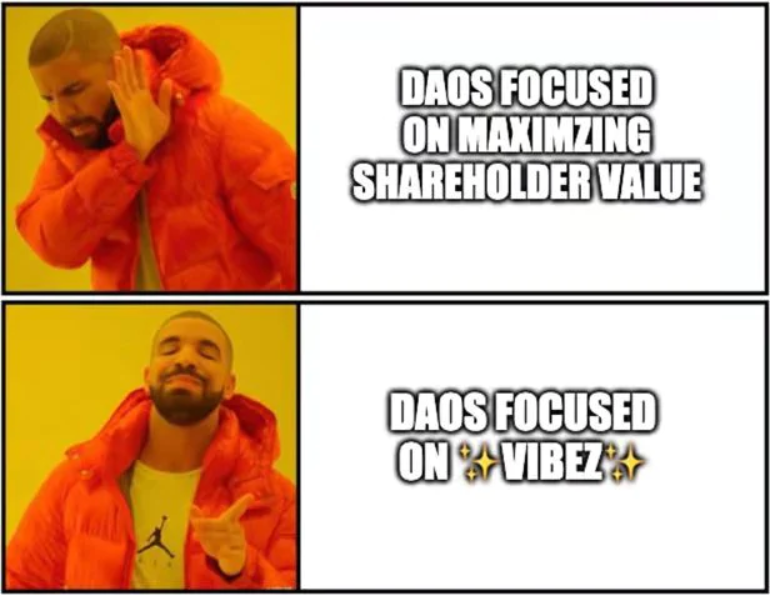
When FWB founder Trevor was interviewed by The New York Times, he said, in FWB, what people get is Vibe—tokens reflect the value of that Vibe. As one of the most iconic DAOs in Web3, FWB clearly embodies "Vibe culture" more thoroughly than any other DAO in the space. But then, what exactly is Vibe?
CONTENTS
[1] What Is Vibe?
[2] Why Is Vibe So Important?
[3] What Does Vibe Mean for DAO/Web3 Communities?
[4] How Is Vibe Created?
[5] What Behaviors Undermine Vibe?
1. What Is Vibe
What is Vibe? It seems like art—we struggle to give it a precise, official definition—but we try to grasp it from multiple angles.
Vibe literally translates to "resonance, atmosphere, vibe"—and in Chinese context, I believe "resonance" best captures this state. Physically, "resonance" refers to objects producing sound due to vibrational harmony; psychologically, it means shared emotional or mental states arising from mutual influence. Both aspects reflect a key quality of Vibe: harmony/alignment—whether between two individuals or large groups, whether fleeting or long-lasting. As long as someone’s emotional state or environmental atmosphere can be conveyed and felt by others, Vibe emerges.
Vibe is neutral. We can't deny that even a group of criminals might generate a Vibe before committing a crime—though it may be evil. In the early 2000s, China's "Kill Me" subculture generated a Vibe among its members—a complex, melancholic one. Vibe can function as both noun and verb. For example, during its development, more and more members were Vibe'd into the Kill Me tribe, leading to coordinated behaviors—even if their sense of beauty eventually faded due to mainstream rejection.
As an emotional atmosphere, Vibe has varying levels of intensity. When particularly strong, it transforms into visible collective euphoria with powerful infectious energy. Memes are classic examples—they often drive people to act irrationally. At lower intensities, Vibe might simply manifest as scattered discussions.
The duration of a Vibe also varies. Memes typically rise and fall quickly—you might remember that Vietnamese guy's NFT. But some Vibes are cherished and carefully maintained, like FWB's.
Regardless of form, Vibe remains an indispensable element of DAOs—and indeed, all of Web3.
2. Why Is Vibe So Important
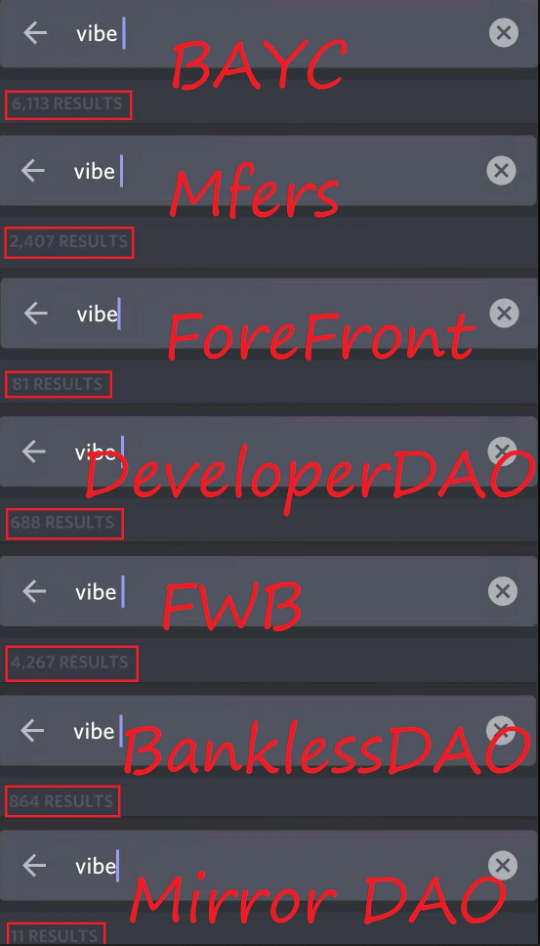
Senior DAO practitioner Wang Chao (Twitter @cwweb3) once searched several popular DAO communities using "Vibe" as a keyword and found the following frequency rankings:
Frequency Ranking
BAYC (6000+) > FWB (4000+) >
Mfers (2000+) > BanklessDAO (800+) >
DeveloperDAO (600+) > MirrorDAO (11+)
These communities share a common trait: they are content- or culture-driven DAOs. Compared to DeFi DAOs, Vibe plays a more critical role here. Interestingly, we’ve noticed that the frequency of "Vibe" mentions appears to correlate positively with a community’s productivity, vitality, and sustainable creativity. Of course, frequent use of the word "Vibe" isn’t a necessary condition for a successful DAO—but the actual presence of Vibe certainly is.
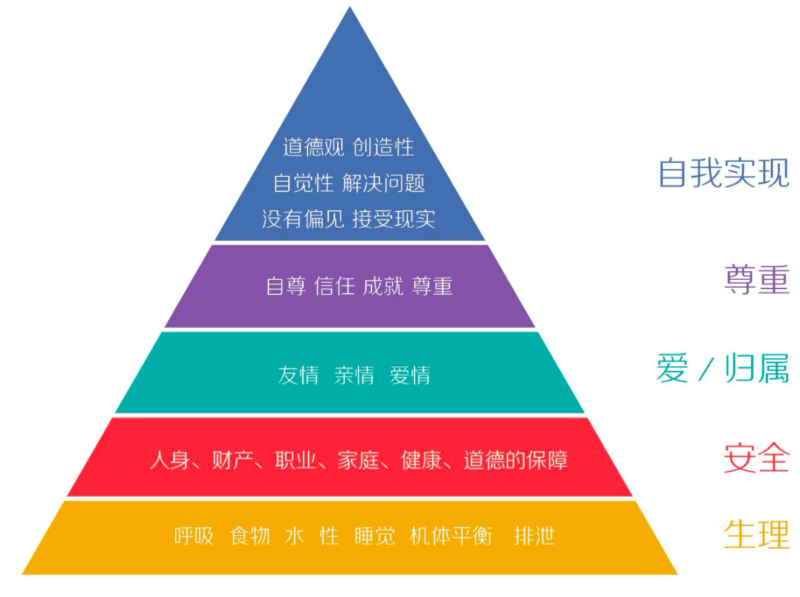
For DAO/Web3 communities, people are the soul of growth. Maslow’s hierarchy tells us that after fulfilling basic physiological and safety needs, humans seek love/belonging, respect, and self-actualization. As social beings, we crave acceptance by society and specific groups—that sense of security many are searching for. A community’s Vibe—its unique, familiar atmosphere—acts as a protective medium, making individuals feel at ease. This medium also functions as the glue connecting people. For a community, what could possibly matter more than human connection?
Maslow’s Hierarchy of Needs
But mere connection isn’t enough. A weak bond can fade over time or be damaged by malice. Yet such connections are prerequisites for value creation within a community.
In modern society, we often need collaboration to achieve goals—and DAOs are no exception. Initially, a community’s Vibe brings like-minded people together. Over time, as membership grows and especially as Vibe concentration increases, impulses to express oneself and create emerge. Much like ancient scholars chatting joyfully until inspired to write poetry—or wealthy people flaunting luxury brands after gaining wealth—it seems we’re never free from human nature. Setting aside intellect and skill, practice proves that mutual admiration and alignment lead to better collaboration.
Of course, the most crucial role of Vibe is expressing a community’s unique spirit—and serving as one indicator of a DAO’s long-term sustainability. Like art, Vibe comes in different grades. We can borrow Danan’s analysis of artworks from *The Philosophy of Art* for comparison.
The purpose of art is to elevate a prominent characteristic above all else. Clearly, characteristics vary—those that are less changeable, profound, intrinsic, innate, and fundamental (belonging to elemental or material traits) are more stable and superior compared to superficial, external, derivative, or overlapping ones (relating to arrangement or configuration).
We can intuitively sense the Vibes different communities project. Successful, content- or culture-driven communities tap into humanity’s deepest spiritual expressions—whether pursuit of beauty, aversion to ugliness, existential confusion, or vanity. Beneath seemingly hollow notions of beauty and ugliness lie shared inner cores that resonate widely, giving these communities strong vitality.
On the other hand, some communities reflect only superficial, derivative traits—the clearest examples being copycat projects. Still, beyond core essence, there are countless expressive forms—just as works celebrating love appear not only as novels and poems but also music. Whether black or white, avatars or songs, they can all serve as vessels amplifying a Vibe-fueled product.
3. What Does Vibe Mean for DAO/Web3 Communities
We can examine Vibe’s significance from conceptual and practical perspectives—roughly analogous to Web2 strategy vs. tactics, except in Web3 things usually emerge bottom-up.
At the conceptual level, as previously mentioned, Vibe, as a community’s spiritual character, provides members with psychological safety while co-evolving with cultural accumulation. But it doesn’t fit within traditional corporate culture frameworks. Corporate culture is top-down, existing to support products and services rather than激发 employee creativity or fulfill self-actualization. Vibe carries a quality corporate culture lacks: respecting individual uniqueness instead of forcing people into predefined molds.
At the operational level, what roles does Vibe play? At least the following:
✓ Anchor Point for Mechanism Design
In fact, I believe Web3 already has its overarching Vibe—the feeling of freedom, fairness, and openness experienced by those in the ecosystem. People are the generators of Web3 Vibe. This points to a vital principle: whether designing macroeconomic systems or micro processes like onboarding or voting, everything should serve the majority’s needs and well-being. Otherwise, members will quickly feel used as tools and alienated, soon leaving the community.
✓ Catalyst for Action
Though memes may seem purely speculative and full of bubbles, their power is undeniable—they often sweep people up involuntarily.
Bubbles are often an inevitable phase for new things.
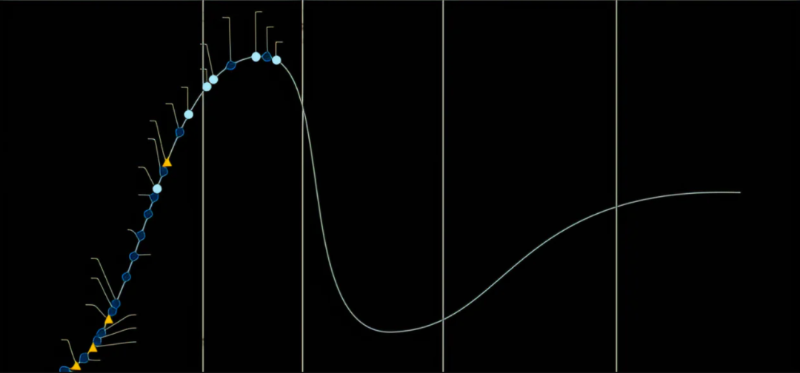
Gartner’s Hype Cycle illustrates this process well. Recalling moments when communities decided to act, we sense that Vibe—the many inspirations born from emotional fermentation—excitement builds, and when Vibe reaches a certain intensity, people jump in enthusiastically, paving the way for real execution.
Gartner Hype Cycle
✓ Lubricant for Friction
Even healthy communities experience high alignment and strong Vibe, yet every individual has unique personality, expertise, and skills—collaboration inevitably causes friction. With no central leader to mediate, resolving conflicts relies on personal initiative—and Vibe plays a major role here.
Like on the Web3 Suibyimen podcast, we often hold differing views, but even when fiercely debating, we trust deeper alignment exists—rooted in shared values, often reinforced in moments of excited agreement: “Ah yes, exactly!”
Finally, a bull market is the best time to feel Vibe, but a bear market best tests whether a Vibe is truly profound.
4. How Is Vibe Generated?
In the first episode of Web3 Suibyimen podcast, we discussed two models for launching a DAO—I think they also aptly explain Vibe formation.
01. Centralized Organization First, Then DAO Formation
Here, methods vary.
For instance, brand-sharing with organizational independence—Bankless and BanklessDAO. They exist separately; BanklessDAO simply leveraged the Bankless brand to launch.
Or, the centralized team becomes part of the DAO—GitcoinDAO is a case in point, where the Gitcoin team became part of GitcoinDAO. Here, initial Vibe originates from the founding team, perhaps emerging silently among just a few people.
02. Goal or Idea First, Then DAO Formation
Here, a specific goal or idea must exist first (with no Vibe yet), and the DAO structure enables achieving what current organizations cannot.
ConstitutionDAO exemplifies this—low entry barrier, clear mission and vision—rapidly attracting massive participation and generating widespread Vibe.
5. What Behaviors Undermine Vibe?
Creating Vibe is difficult, but destroying it is easy. Opaque decision-making, unfair benefit distribution—any of these could collapse a DAO overnight. We offer partial insights as reference for community builders.
✗ Technocracy
Technocracy, or "rule by experts," can be understood through this scenario: nearly all DAOs suffer from technocratic tendencies—even seemingly successful ones, where a small group wields disproportionate influence over proposals and decisions.
Technocracy reflects social/cultural centralization, which hinders Vibe formation and DAO progress. Vibe requires collective resonance. If a community represents only one person’s or a small group’s subjective will without spreading and infecting other members, no real Vibe emerges. A typical example is the "JUST DAO IT" model.
"JUST DAO IT" can rapidly build a DAO facade—community, token, economic model—but often looks good on surface, weak underneath.
Real-world cases overcoming technocracy follow the pattern: build core/inner circle first, then decentralize.
Take Gitcoin and TEC DAO—they share a common approach: spending at least a year preparing to become a DAO. This allows ample time for community members to deeply understand the project, collide on vision/mission/values, and build "cultural resilience," trust, and interpersonal resonance.
Only like-minded people, fortified by time, can form a community’s soul—Vibe. Vibe is organic, a sustainable life force—as if the community has reached its Schelling point.
✗ Capital Shock
Capital shock refers to excessive profit-seeking behavior and influx of outside capital before a strong Vibe or productive capacity has formed—negatively impacting governance or economic models.
DevDAO
In early March, DeveloperDAO prepared to discuss reward allocation for early contributors. With stakes involved, many suddenly showed great enthusiasm—understandable given personal interest. But strikingly, the community had been nearly silent otherwise!
Scrambling for rewards breeds collusion, manipulation, and dark behaviors. When rational discussion is needed, most have already lost patience and faith. On the surface, it damages community image—outsiders see proclaimed ideals as mere covers for money-grabbing.
Juicebox
Juicebox, famous for the People campaign, was overwhelmed by crypto speculators. The Vibe built around People seemed overnight replaced by wealth-chasing vibes—idealism vanished, and hasn’t recovered since. Small communities can’t withstand such shocks.
Mirror
"Mirror’s Chinese channel initially had a great vibe, but later big influencers came pushing coin prices and soliciting votes—the Vibe immediately soured. Only after Mirror explicitly banned炒币 and whitelist articles did things improve," shared an insider.
For typical DeFi protocols, users farm data, projects need metrics, capital chases profits—all parties benefit. But for DAOs, playing this game breaks them.
✗ Malicious Intrusion/Destruction
Have you noticed? On Discord, before entering a community, there’s often a step confirming you won’t engage in actions violating fairness or disrupting order.
Some Refi communities even state: if you don’t believe or are pessimistic about crypto helping climate change, please don’t join. At first, I mocked such rules—aren’t doubts allowed? Later I realized, words are powerful. For a nascent, untested community, even a single skeptical voice can be catastrophic—especially if intentionally provoked by bad actors.
In 2018, our DAOONE community ultimately disbanded partly due to intrusion and sabotage. Constant attacks questioning contributors’ motives/abilities, combined with delayed information disclosure, eroded foundational trust. Doubt, disappointment, and sorrow spread. Promising projects stalled, and eventually the entire community froze.
Community cultures differ greatly—BanklessDAO members work diligently, FWB folks casually chat then quietly build, Gitcoin people chant slogans while building. But no DAO can move forward while doubting itself.
✗ Lack of Positive Feedback Loops
As mentioned in our podcast, though FWB members may seem idle to outsiders, behind the scenes they continuously strengthen bonds through IRL events—opening cafes, forming NFT investment groups, etc.
Self-actualization requires tangible value activities—event planning, content creation, project management, design, investing, etc.
Through executing these activities, Vibe is continuously released, community vitality strengthened, individual value discovered—material and spiritual fulfillment rising spirally as one.
The opposite? Imbalance. Some communities obsess over wealth secrets; others over empty slogans. Humans are extremely complex—we crave novelty, greed, both material and spiritual fulfillment, yet hate risk and seek stability. Can we have a Möbius strip? Something endlessly playable!
Finally, we wish everyone finds their favorite Vibe in Web3 and lives a casual, comfortable, and free Web3 life!
Join TechFlow official community to stay tuned
Telegram:https://t.me/TechFlowDaily
X (Twitter):https://x.com/TechFlowPost
X (Twitter) EN:https://x.com/BlockFlow_News






